this week in lectures, signings, panel discussions, workshops, and Q&As

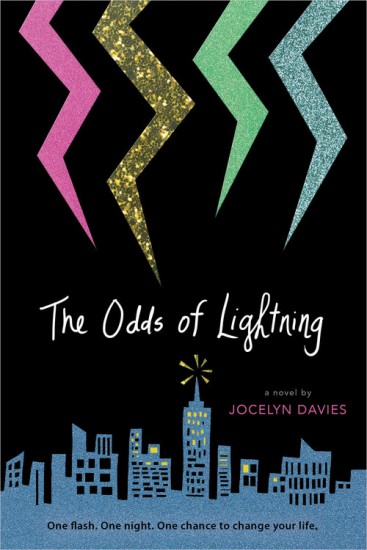
TWI-NY TALK: JOCELYN DAVIES / THE ODDS OF LIGHTNING

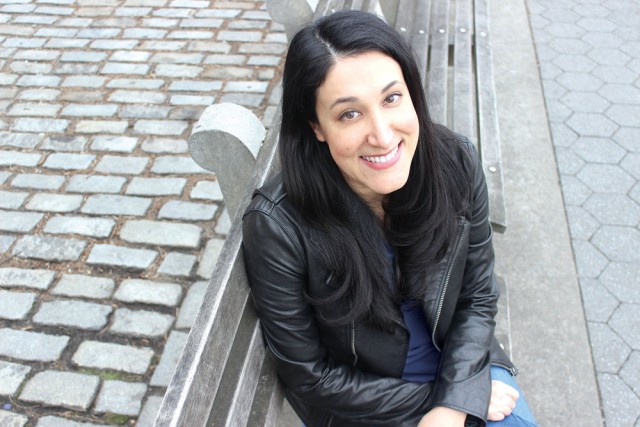
Jocelyn Davies

Jocelyn Davies will be at McNally Jackson on September 20 for launch party of her latest novel, THE ODDS OF LIGHTNING

McNally Jackson
52 Prince St. between Lafayette & Mulberry Sts.
Tuesday, September 20, free, 7:00
212-274-1160
www.mcnallyjackson.com
www.jocelyndavies.com

Children’s book editor and author Jocelyn Davies is one of the most upbeat, happy people you’re ever likely to meet. She’s always quick with a smile and a note of encouragement, sharing her positivity and funny sense of humor with all around her. I’ve had the privilege of being around her for several years now, working with her at HarperCollins Children’s Books, where she edits young adult novels in addition to having written the trilogy A Beautiful Dark, A Fractured Light, and A Radiant Sky. Her latest YA novel, The Odds of Lightning (Simon Pulse, September 20, $17.99), was just listed by BuzzFeed as number 6 on its list of “23 YA Books You Need to Read This Fall.” The story follows four high school friends who develop special powers when the roof they are standing on gets struck by lightning, but this is no mere update of the Fantastic Four; instead, their powers stem from common fears that are deep within them, and us. As she prepared for the September 20 book launch of The Odds of Lightning at McNally Jackson, Jocelyn took the time to answer some questions about writing and editing YA novels, facing one’s fears, and living it up in New York City, where she was born and raised.

twi-ny: You’ve never been struck by lightning yourself. Is it a particular fear of yours? Or maybe you have a special relationship with storms since you experienced a blizzard in Central Park when you were still in utero?

Jocelyn Davies: Ha! Maybe I do! Or maybe I have a special relationship to Central Park, since many scenes in the book take place there!

I’ve never been struck by lightning — but one time, I almost was! When I was a teenager, I was hiking in Colorado when a storm rolled in very suddenly. It was pouring, and there was intense lightning and thunder, and we were up on a mountain, which is not a good place to be during a thunder and lightning storm. The group I was with basically flew down the mountain to base camp as quickly as we could, with lightning flashing all around us. Memory and imagination may have intensified the experience in retrospect, but I remember dodging actual lightning bolts (just like the kids in The Odds of Lightning when they’re riding their Citi Bikes across town).

twi-ny: Yikes!

jd: I guess the appeal of lightning is that it has this sort of mythical, rare quality. It’s beautiful but dangerous, is a pretty regular occurrence in nature, but it’s rarer to be struck. There’s something magical about it, which made it the perfect catalyst to kick-start the adventure in this book. It takes place on a literal “dark and stormy night.”

twi-ny: About seven years ago, I was electrocuted in a thunderstorm at an outdoor concert, and the shock actually led to some psychological benefits, although no superpowers, like the four main characters in the book receive. If you could choose any superpower for yourself, what would it be?

jd: I want to hear more about these psychological benefits! I’ve given this a lot of thought, and right now I would want the ability to teleport anywhere in the blink of an eye. I could visit my friends across the country whenever I wanted, travel to all the places on my international bucket list — even the really far places like Australia and Japan — as easily as walking down the block, avoid the subway rush hour commute, and I’d never be late!
odds-of-lightning

twi-ny: I’m not sure even teleportation could help you avoid a New York City rush hour. The superpowers the protagonists get focus on important problems that most teenagers go through, primarily involving self-identity and trying to find one’s place in the world. Do you relate to any one character more than the others? I’m thinking it might actually be Juliet.

jd: Well, I did study theater in high school and college, like Juliet (and Lu). But on some level I’ve been a bit of all four of the main characters, at various points in my life, and I have this hunch that a lot of readers might feel that way too. I think most people go through phases where they question who they are, hold back from going for what they really want, fear getting hurt, and feel invisible. Tiny, Lu, Nathaniel, and Will’s stories are specific to their unique characters, but they also have a somewhat universal quality.

twi-ny: What was your biggest fear in high school? What is it now?

jd: I remember feeling like everything was always changing, that you couldn’t really trust or rely on anything, that even if things were going great one day, the rug could be pulled out from you the next. In the book, Tiny loves this line from The Great Gatsby about “the unreality of reality,” and the rock of the world being founded securely on a fairy’s wing. And that’s how I felt a lot of the time, that tectonic plates were always shifting beneath me, that nothing would ever stay the way it was — and that was scary. I probably relate to Tiny more now — that feeling of wanting to be heard and understood.

twi-ny: That never does go away, does it. With the stormpocalypse approaching, the high school students decide to have a blowout party, even with the SATs scheduled for the next day. Early on, you ask the question, “If it were the end of the world, would you stay at home?” What would you do if you knew that the end of the world was coming?

jd: I’d definitely spend it with my family and friends! And maybe go skydiving or cliff jumping. I would not stay at home — I’d be having one last adventure.

twi-ny: That might be a bit too adventurous for me. During the day, you’re an editor at HarperCollins Children’s Books, for whom you’ve previously written a YA trilogy. Is it hard to balance the two very different skills, writing and editing?

jd: I’ve learned a lot about the process of crafting a novel from working with so many talented writers and editors over the years. I learn new skills and lessons all the time while editing other writers’ books, and I’ve learned things from my own editors that I pass on to writers I work with. It’s a pretty symbiotic relationship. Writing and editing are two very different parts of the brain — you can’t really use both at the same time. Writing is boundless — you do a lot of experimenting, letting your imagination run wild, trying new things and seeing what works. Editing is about reining in, taking all that raw material and helping shape it into a story with a beginning, middle, and end, consistent characters, satisfying emotional arc, logical world rules. But at the end of the day, they’re both working toward the same end goal.
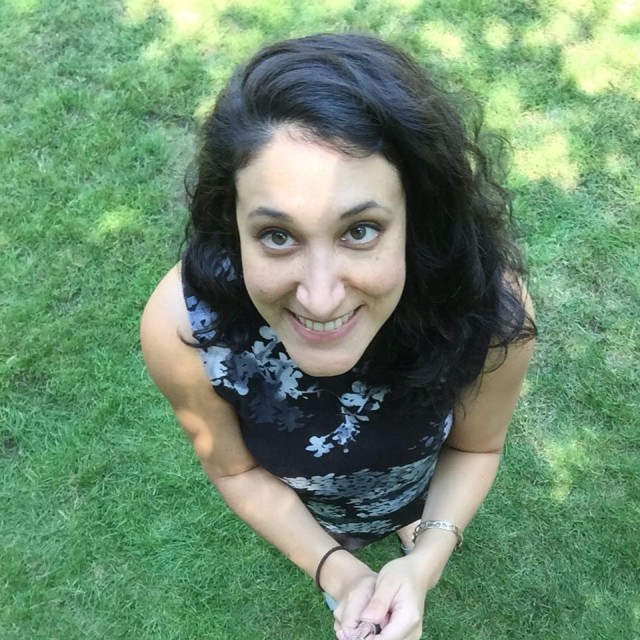
Jocelyn Davies

Things are looking up for YA author Jocelyn Davies with release of THE ODDS OF LIGHTNING

twi-ny: If you ever have free time to read something for yourself, what types of genres do you turn to? Or are you pretty much wrapped up in YA all the time?

jd: Sometimes I feel like I eat, sleep, and breathe YA. At any given time, I’m immersed in the world of what I’m writing, am reading a submission or a work-in-progress manuscript, and am reading a recently released YA novel. When I go on vacation and I’m looking for something to take me out of the YA world for a little bit, I gravitate toward literary fiction, humorous essays, and, lately, a good page-turning literary thriller.

twi-ny: You were born and raised in New York, and you currently live in Brooklyn and work in Manhattan. New York City is like a character unto itself in The Odds of Lightning. What are some of your favorite parts of the city?

jd: A lot of them — like Central Park, and the American Museum of Natural History — are featured in the book. Ice skating at Wollman Rink in the middle of Central Park makes you feel like a character in a New York City romantic comedy. I love the rich historic feel of the Upper West Side, the West Village, brownstone Brooklyn — places where stories were taking place long before I was born. Driving across the Brooklyn Bridge in a taxi with the windows down fills me with love for New York, every time. It always makes me feel like I’m home.

twi-ny: The launch party for The Odds of Lightning is taking place September 20 at McNally Jackson. What’s on the agenda?

jd: I’ll be having a conversation with children’s book buyer Cristin Stickles, reading from The Odds of Lightning, signing books — and maybe there will be some fun surprises!
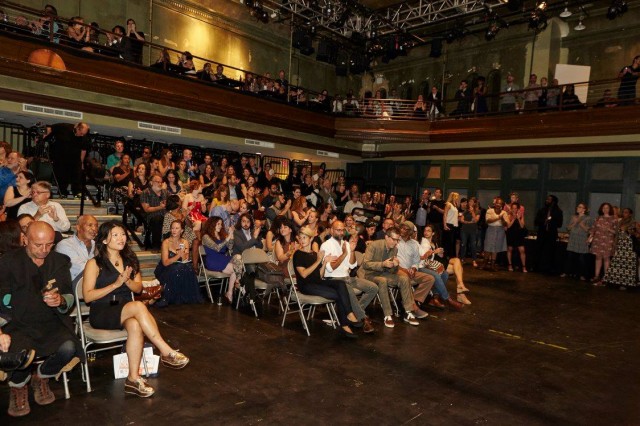
BROOKLYN BOOK FESTIVAL 2016

Literature lovers will gather in Brooklyn on September 18 for eleventh annual Brooklyn Book Festival

Literature lovers will gather in Brooklyn on September 18 for eleventh annual Brooklyn Book Festival

Multiple locations in Brooklyn
Sunday, September 18, free, 10:00 am – 6:00 pm
www.brooklynbookfestival.org

The eleventh annual Brooklyn Book Festival celebrates literature and the best borough in the world with a fab lineup of more than three hundred writers participating in more than one hundred events at Brooklyn Borough Hall, the Brooklyn Historical Society, Brooklyn Law School, Columbus Park, Cadman Plaza, and other venues. Below are our suggestions for what do to each hour. In addition, there will be more than three hundred booths, from indies and major publishers to other literary organizations.

Powerful by Design: Chip Kidd and Kyle Baker, moderated by Joan Hilty, Brooklyn Historical Society, 128 Pierrepont St., 10:00 am

Best of Brooklyn: Jacqueline Woodson, moderated by A. O. Scott, St. Francis College Auditorium, 180 Remsen St., 11:00 am

A Conversation with Margaret Atwood, moderated by Calvin Reid and introduced by Meg Lemke, St. Francis College Auditorium, 180 Remsen St., 12 noon

Bewitched, Bothered, and Bewildered, with Alexis De Veaux, Joyce Carol Oates, and Andre Dubus III, moderated by Gregory Cowles, St. Francis College Auditorium, 180 Remsen St., 1:00

Short But Sweet, with Ben Katchor, Emily Flake, and Glen Baxter, moderated by Connie Sun, Brooklyn Historical Society, 128 Pierrepont St., 2:00

Wanderlust and the Search for Meaning, with Russell Banks, Sarah Glidden, and Pico Iyer, moderated by Timothy J. Houlihan, Congregation Mt. Sinai, 250 Cadman Plaza West, 2:30

Who Tells Your Story? Identity and Representation on the Contemporary American Stage, with Madeline George, Stephen Adly Guirgis, Alvin McCraney, Lucy Thurber, and Carl Hancock Rux, Main Stage, Columbus Park, 3:00

Darkly Comic, with Rick Moody, Geoff Dyer, and A. M. Homes, moderated by Ian S. Maloney, Borough Hall Courtroom, 209 Joralemon St., 4:00

Source Texts, with Salman Rushdie, Elizabeth Nunez, and Michael Seidlinger, moderated by Baz Dreisinger, St. Francis College Auditorium, 180 Remsen St., 5:00

MOVIE IN MY HEAD: BRUCE CONNER AND BEYOND

Bruce Conners A MOVIE is centerpiece of film exhibition at MoMA

Bruce Conner’s A MOVIE is centerpiece of revelatory film exhibition and retrospective at MoMA

MoMA Film, Museum of Modern Art
11 West 53rd St. between Fifth & Sixth Aves.
September 16-30
Tickets: $12, may be applied to museum admission within thirty days
212-708-9400
www.moma.org

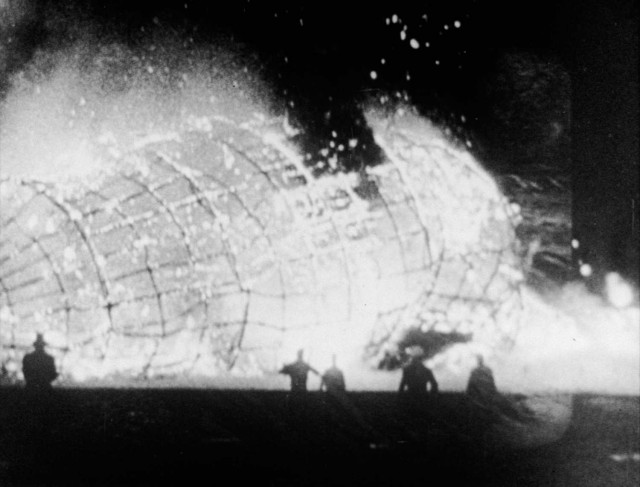
I first saw Bruce Conner’s seminal film A Movie in college, when I was studying with Amos Vogel, the Austrian-born founder of Cinema 16 and cofounder of the New York Film Festival. Conner’s 1958 twelve-minute marvel consists solely of found black-and-white footage edited into a fascinating tale of life on Earth in the post-WWII era, with an epic, boisterous soundtrack. “One of the most original works of the international film avant-garde, this is a pessimistic comedy of the human condition, consisting of executions, catastrophes, mishaps, accidents, and stubborn feats of ridiculous daring, magically compiled from jungle movies, calendar art, Academy leaders, cowboy films, cartoons, documentaries, and newsreels,” Vogel wrote in his 1974 book, Film as a Subversive Art, placing the film in his section about death. “Amidst initial amusement and seeming confusion, an increasingly dark social statement emerges which profoundly disturbs us on a subconscious level. . . . The entire film is a hymn to creative montage.” Watching A Movie can be a transformative experience; it was for me, showing me a whole new purpose behind filmmaking and leading me to further study cinema at NYU. So it’s fitting that A Movie is the first thing you see upon entering the MoMA exhibition “Bruce Conner: It’s All True,” a revelatory survey of Conner’s fifty-year career as a visual artist, including drawing, sculpture, photography, collage, photograms, performance, and, of course, film, continuing through October 2. It’s a stunning retrospective that ranges from his early “Ratbastard” hanging constructions to his obsession with the mushroom cloud and the atomic bomb, from his creepy “Child” sculpture to his punk-rock photographs for the music magazine Search and Destroy, from collages using found print materials to spectacularly detailed inkblot drawings, from his ghostly photograms using his own body to buttons declaring, “I Am Not Bruce Conner.” But at the center of it all are Conner’s films, scattered throughout the exhibition but also screening in the exciting film program “Movie in My Head: Bruce Conner and Beyond,” which runs September 16-30 and consists of nearly all of Conner’s cinematic output seen alongside work by many of his contemporaries.

Toni Basil in BREAKAWAY

Toni Basil gets all groovy in Bruce Conner’s dazzling short film, BREAKAWAY, a precursor to the MTV video

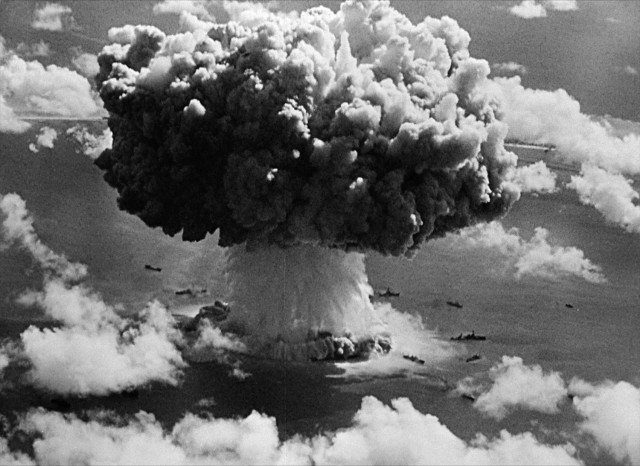
A leading counterculture figure, Conner was born and raised in Kansas and spent most of his life in San Francisco, where he met up with the Beats, hippies, and punks; he died in 2008 at the age of seventy-five, leaving behind a legacy of cutting-edge short films that offer a unique look at America and its values, commenting on consumerism, war, religion, pop culture, and film itself — the mechanics of the medium, including the countdown leader and the physical filmstrips themselves, were often visible and part of the subject matter — in precisely edited works embedded with subliminal messages and featuring surprising soundtracks to match. “In my opinion, Bruce Conner is the most important artist of the twentieth century,” his friend, collaborator, and fellow native Kansan Dennis Hopper said. Hopper was on the set of Conner’s Breakaway with actor Dean Stockwell; Conner honored Hopper with the three-volume work “The Dennis Hopper One Man Show,” twenty-six collage etchings actually made by Conner. The MoMA exhibition includes that as well as Hopper’s photograph “Bruce Conner’s Physical Services” and Conner’s 1993 collage “Bruce Conner Disguised as Dennis Hopper Disguised as Bruce Conner at the Dennis Hopper One Man Show.” That’s all part of Conner’s modus operandi, where the art is more important than the artist, even though his hand is so evident in his works (although his name is often not). Breakaway is a frenetic short in which Antonia Basilotta, aka Toni Basil (later of “Mickey” fame), dances wildly in various black-and-white costumes (and naked) as Conner’s handheld camera keeps pace. Conner, considered by some (but not him) to be the father of MTV because of his editing style, also made videos for Devo (“Mongoloid”) and Brian Eno and David Byrne (“Mea Culpa,” “America Is Waiting”) in addition to Cosmic Ray, set to Ray Charles’s “What’d I Say.” Conner made two versions of Looking for Mushrooms, about his time in Mexico (and his search for psychedelic fungi), one silent, a later edit boasting the Beatles’ “Tomorrow Never Knows.” Two of his most political works are Report, which incorporates the Zapruder footage of the assassination of President John F. Kennedy with clips from advertising and industry films, and Crossroads, in which he repurposes the military’s Operation Crossroads film about the atomic bomb test at Bikini Atoll. And in 2008’s Easter Morning, Conner’s last completed major film, he reworks his 1966 Easter Morning Raga, creating a hypnotic compilation of abstract Kodachrome shots of nature set to Terry Riley’s “In C.”

CROSSROADS

CROSSROADS explores the Bikini Atoll atomic bomb tests, which fascinated Bruce Conner

“Movie in My Head: Bruce Conner and Beyond” begins with “Opening Night,” featuring A Movie and Conner’s Marilyn Times Five, which combines Marilyn Monroe’s performance of “I’m Through with Love” from Some Like It Hot with existing porn shots of a Marilyn look-alike, and Crossroads, introduced by chief curator Stuart Comer. Each program starts off with Conner’s Ten Second Film, a commissioned trailer for the 1965 New York Film Festival, under the leadership of Vogel, that was ultimately rejected for being too experimental. The series is arranged into eleven programs that encompass nearly all of Conner’s films along with works by Fernand Léger, Joseph Cornell, Carolee Schneeman, Christian Barclay, Stan Vanderbeek, William S. Burroughs, Robert Frank, Wallace Berman, Ron Rice, Cauleen Smith, Bruce Baillie, and others. On September 28, “Dreamland: An Evening with Peggy Ahwesh and Julie Murray,” the two filmmakers will show their own works along with Conner’s Take the 5:10 to Dreamland and Valse Triste, and on September 30, Michelle Silva of the Conner Family Trust will present “Revisitations,” consisting of rare and unfinished Conner films, shorts by George Kuchar and Ben Van Meter, and a talk with Brooklyn-based artist and archivist Andrew Lampert. The title of the MoMA series is taken from a 2003 interview in which artist Doug Aitken sat down with Conner for the nonprofit group Creative Time: “One of the reasons I made A Movie was because it’s what I wanted to see happen in film. Ever since I was fifteen years old, I’d been watching movies and thinking of ways to play with their storylines. For instance, I would imagine taking a backlit shot of Marlene Dietrich in Blonde Venus walking through a doorway and overlaying it with something like the final words from King Kong: ‘Beauty killed the beast.’ Then I’d imagine the next shot being something else entirely using different sound. Basically for years, I’d been playing with bits and pieces of different films in my head, and I kept assembling and reassembling this immense movie using pictures and sounds and music from all sorts of things. I’d been waiting for someone to come up with a movie like this. And nobody did.” So Conner did, as this MoMA exhibition and film series so effectively display.

TARYN SIMON: AN OCCUPATION OF LOSS

(photo © Naho Kubota)

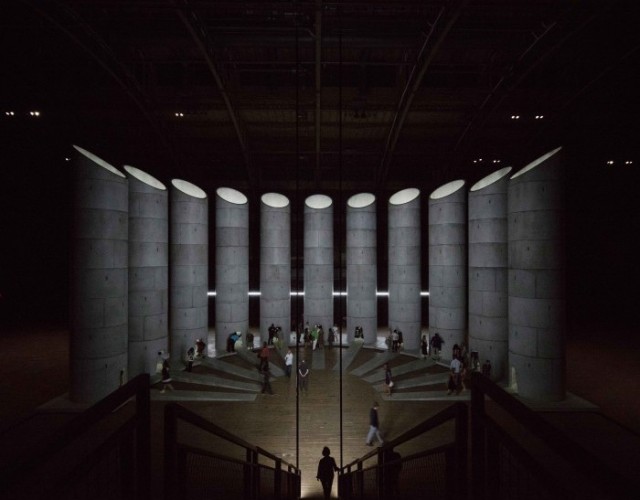
Taryn Simon’s Park Ave. Armory installation resembles both a memorial pipe organ and a semicircle of crematorium chimneys (photo © Naho Kubota)

Park Ave. Armory
643 Park Ave. between 66th & 67th Sts.
September 13-25, daytime installation: Tuesday – Sunday, $10, 12 noon – 4:00
September 13-25, evening performances: Tuesday – Sunday, $45, 6:20, 7:10, 8:00, 8:50, 9:40, 10:30, 11:20
212-933-5812
www.armoryonpark.org
tarynsimon.com

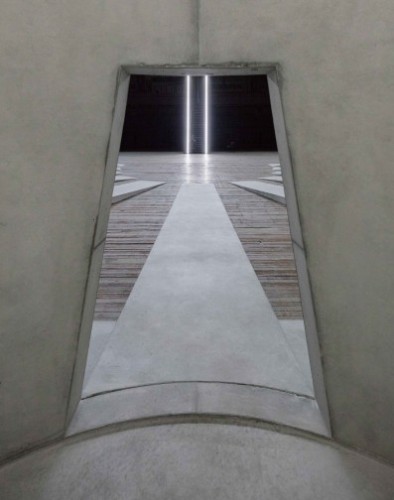
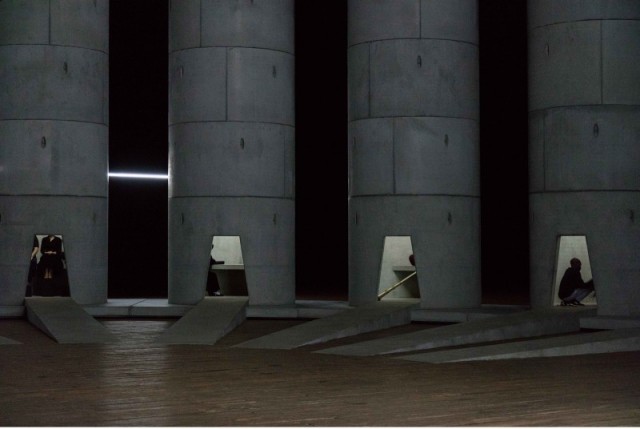
New York–based conceptual artist Taryn Simon has primarily used text and image and exhaustive research to document, collect, catalog, categorize, and classify multiple aspects of the human condition, examining such issues as politics, justice, governance, immigration, economics, and religion in such previous works as “A Living Man Dead and Other Chapters I-XVIII,” “Contraband,” “Paperwork and the Will of Capital,” and “An American Index of the Hidden and Unfamiliar.” In her latest piece, “An Occupation of Loss,” Simon takes on all that and more in a compelling and deeply involving interactive performance installation continuing its world premiere at the Park Ave. Armory through September 25. Co-commissioned by the armory and London’s Artangel, “An Occupation of Loss” is an intimate exploration of the ritual of grief and the marginalization of professional mourners. Each evening, there are seven thirty-five-minute performances that begin with a group of fifty ticket holders waiting outside the armory on Sixty-Seventh St. At the designated start time, they are led up the stairs and into the massive Wade Thompson Drill Hall, where they line up on the balcony, overlooking eleven forty-eight-foot concrete wells (composed of eight six-foot rings apiece), arranged in a semicircle, each with a walkway leading to a small entrance. Slowly and quietly, up to three professional mourners enter each structure (designed by OMA / Shohei Shigematsu for maximum acoustical effect), which evoke Zoroastrian Towers of Silence as well as crematorium chimneys and a pipe organ. The audience is then led downstairs onto the floor of the 55,000-square-foot drill hall, through two long, narrow vertical white lights that echo the “Tribute in Light” homage to the Twin Towers (the lighting is by Urs Schönebaum), and are then permitted to enter the small, tight-fitting spaces where the mourners perform their laments. Wearing traditional clothing (except for a trio of Greeks who are in contemporary dress), the men and women sing, chant, cry, wail, and play instruments as they would at a funeral in their native country; however, in this case, since they are not mourning for any specific person, it is as if they are mourning for us all. “I was looking at the space that grief and loss generate and how it is performed and that line between something that is scripted and authentic,” Simon explains in an armory video, “and how we process that when the object of loss is not present — when there’s no body at the center. Is there a space where one actually has individual emotion, and where are our emotions governed and part of a program, and when are they liberated and something of our own? And questioning if that space even exists.” In addition to the evening performances ($45), the installation will be open Tuesday through Sunday from noon to four o’clock ($10), when visitors can walk around the wells and lament in their own way without the professional mourners, who only appear at night. The piece challenges viewers to consider such dualities as life and death, absence and presence, sound and silence, day and night, bona fide and staged, the private and the public, and light and dark.

Visitors can enter small spaces where professional mourners perform their laments (photo © Naho Kubota)

Taryn Simon’s “An Occupation of Loss” offers a fascinating look at how several cultures deal with grief in a public setting (photo © Naho Kubota)

As detailed in a booklet that visitors receive on their way out, the mourners come from Burkina Faso, India, Azerbaijan, Greece, France, Cambodia, Ghana, Ecuador, China, Romania, Russia, Malaysia, and Venezuela. The extensive information Simon had to provide in order to get the performers nonimmigrant visas forms a fascinating overview of their historic and cultural context. For example, Dr. Boureima T. Diamitani writes, in support of Burkina Faso mourners known as masks, “For many years, performers of mourning rituals are taught sacred practices to protect them from malefic powers of external enemies.” Dr. Sarah Laursen notes, “It is also customary throughout China to hire professional mourners to inspire attendance at funeral ceremonies, as it is believed that the number of attendees at a funeral is reflective of the importance of the deceased in the community.” And Juan Mullo Sandoval points out, “Along with its poetic structure and morphological system, the telluric, sentimental, and lamentation aspects of yaravíes represent the affliction that has characterized marginal sectors of the Ecuadorian population since the colonial times: problems of exclusion, economic deprivation, and exploitation.” “An Occupation of Loss” is particularly poignant in the wake of last weekend’s fifteenth anniversary of the 9/11 attacks, but there’s a timeless quality to it as well, given the many military actions going on around the globe right now, the frightening number of mass shootings in America, the fierce battle over immigration, and the national controversy over the killings of unarmed black men, women, and children by white police officers. Also, Simon was very careful to omit the graceful ambience of the armory, with its decorated period rooms, portraits, and plaques honoring veterans and military dead, from visitors’ experience. Thus, no one exits or enters through the main lobby; instead, a side and back door are used, allowing the installation to stand on its own. “An Occupation of Loss” might be about death and grief, but it is also a celebration of unique and different cultures at a moment when fear of the other is so prevalent in America’s psyche, and Simon doesn’t want anything else to get in the way of that.

Taryn Simon’s “An Occupation of Loss” offers a fascinating look at how many cultures deal with grief in a public setting (photo © Naho Kubota)

Visitors can enter small spaces where professional mourners perform their laments (photo © Naho Kubota)

The thirty-five minutes pass by very fast, so be sure to save some time to relax near the center of the semicircle, where all of the sounds of mourning come together to form an entrancing cacophony of lament. You will then be led out through a surprise exit that will delight those who attended the armory’s previous exhibition, Martin Creed’s “The Back Door.” And the booklet itself is also extremely worthwhile, identifying each of the professional mourners and sharing engrossing information on their specific forms of lamentation and how they relate to social, political, and economic issues in their country; over the years, many of the mourners have risked their own lives in order to help honor those that have already lost theirs, adding yet more power to this wholly original experience. [Note: Simon will be at the armory on September 24 for an artist talk moderated by scholar Homi K. Bhabha ($15, 6:00).]

REMBRANDT’S FIRST MASTERPIECE / HANS MEMLING: PORTRAITURE, PIETY, AND A REUNITED ALTARPIECE

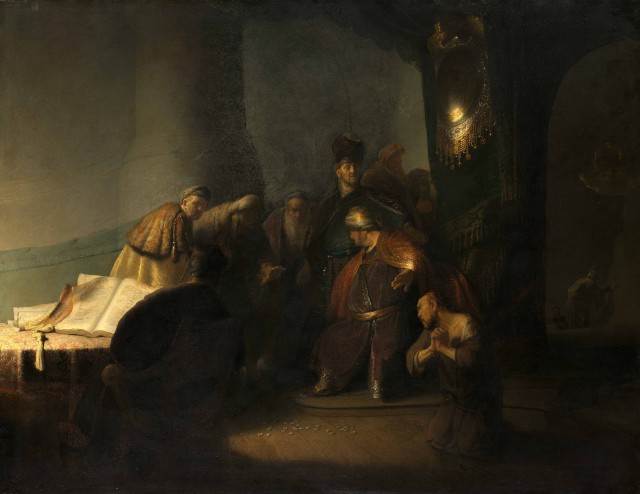
Rembrandt van Rijn, Judas Returning the Thirty Pieces of Silver, oil on panel, 1629.  (© Private Collection, photo courtesy of the National Gallery, London, 2016)

Rembrandt van Rijn, “Judas Returning the Thirty Pieces of Silver,” oil on panel, 1629 (© Private Collection, photo courtesy of the National Gallery, London, 2016)

Morgan Library
225 Madison Ave. at 36th St.
“Rembrandt’s First Masterpiece” through September 18
“Hans Memling: Portraiture, Piety, and a Reunited Altarpiece” through January 8
Tuesday – Sunday, $13-$20 (free Friday nights from 7:00 to 9:00)
212-685-0008
www.themorgan.org

Like the Morgan Library’s spring 2013 exhibition “Degas, Miss La La, and the Cirque Fernando,” an expansive look at Edgar Degas’s thrilling 1879 painting “Miss La La at the Cirque Fernando,” a pair of splendidly curated current shows take viewers deep inside two other remarkable works by two very different artists. Closing on September 18, “Rembrandt’s First Masterpiece” is a thorough examination of Rembrandt van Rijn’s powerful 1629 oil painting “Judas Returning the Thirty Pieces of Silver,” which has never previously been shown in the United States. The canvas depicts the biblical event in which a remorseful Judas Iscariot gives back to the Sanhedrin the reward he received for betraying Jesus. Rembrandt, only twenty-three when he finished the work, displays a masterful use of light and color in relating the narrative, the darkness on the right side and the glowing anachronistic open book on the left flanking a shadowy central section where Judas, hands clasped, begs for forgiveness from suspicious elders. “All this I compare with all the beauty that has been produced throughout the ages. All honor to thee, Rembrandt!” ambassador and diplomat Constantijn Huygens wrote of the work at the time; Huygens’s original manuscript is on view along with other related etchings, drypoints, and ephemera, including rare preparatory drawings for “Judas Returning the Thirty Pieces of Silver,” which have never been seen publicly together with the painting. Also in the show are Rembrandt’s stunning, tiny etching and drypoint “Self-Portrait in Cap, Wide-Eyed and Open-Mouthed,” the etching “Self-Portrait with Curly Hair and White Collar: Bust,” multiple renditions of such biblical scenes as the circumcision of Christ, the presentation in the temple, the crucifixion, and the descent from the cross, and two studies after Leonardo da Vinci’s “The Last Supper,” a theme that Rembrandt never painted, as well as Jan Lievens’s “Portrait of Constantijn Huygens.” It all makes for a fascinating exploration of what is considered Rembrandt’s first mature work.

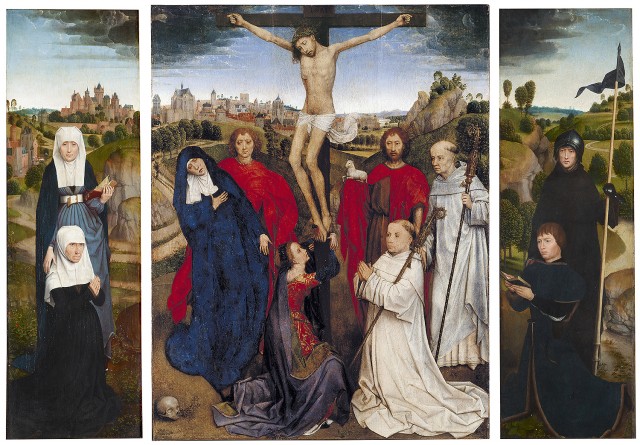
Hans Memling, “The Triptych of Jan Crabbe,” oil on panel, ca. 1467–70 (Center panel: Image courtesy of Pinacoteca Civica di Palazzo Chiericati, Vicenza. Left and right panels: © The Morgan Library & Museum, photo by Graham S. Haber)panel: Image courtesy of Pinacoteca Civica di Palazzo Chiericati, Vicenza. Left and right panels: © The Morgan Library & Museum, photo by Graham S. Haber)

Hans Memling, “The Triptych of Jan Crabbe,” oil on panel, ca. 1467–70 (center panel: image courtesy of Pinacoteca Civica di Palazzo Chiericati, Vicenza. Left and right panels: © the Morgan Library & Museum, photo by Graham S. Haber)

About 160 years earlier, Flanders-based German painter Hans Memling created “The Triptych of Jan Crabbe,” a dazzling altarpiece that is being seen in full for the first time in more than two centuries. Running through January 8, “Hans Memling: Portraiture, Piety, and a Reunited Altarpiece” packs a whole lot of information into the small Thaw Gallery, comprising the complete triptych, which was commissioned by Cistercian abbot Jan Crabbe around 1470, when Memling was forty, along with other works by Memling and his contemporaries. The inner wings of the altarpiece — one depicting Crabbe’s mother, Anna Willemzoon, with St. Anne, the other pairing his half-brother, Willem de Winter, with St. William — were acquired by J. Pierpont Morgan in 1907 and have been consistently on view in his study ever since. They are now joined by the central panel, in which Crabbe kneels beneath the cross, his hands together, St. John the Baptist and St. Bernard of Clairvaux behind him, the Virgin Mary, St. John the Evangelist, and St. Mary Magdalene on the other side of Jesus on the cross, a foreboding skull in the lower corner. The outer wings, known as the Annunciation Panels, show the Angel Gabriel and Mary. Infrared and X-radiography reveal some of Memling’s working process through images of his underdrawing and various changes he made while painting. The exhibit is supplemented by such other works by Memling as the Frick’s extraordinary “Portrait of a Man” and the Morgan’s “Portrait of a Man with a Pink,” examples of Book of Hours illuminated manuscripts that both influenced and were influenced by Memling, oil paintings and drawings by the Master of the St. Ursula Legend and artists from the Netherlandish school, and an exquisite metalpoint by Gerard David. Perhaps what is most impressive in both the Rembrandt and Memling exhibits are the precise, masterful techniques they utilized in order to bring such striking humanity and emotional depth to the works as a whole as well as to the individual characters, who seem to be alive with breath as they contemplate their fate in the wake of the crucifixion of Jesus. There will be a gallery talk led by Morgan assistant curator Ilona van Tuinen on September 16 (free with museum admission, 6:00), Met curator Maryan Ainsworth will deliver the lecture “A Closer Look at Hans Memling’s Working Methods” on October 4 ($15, 6:30), and the Morgan will host the concert “Flanders Remembers: Music and Words from WWI” on November 17 ($35 including gallery visit, 7:00).

TASTE WILLIAMSBURG GREENPOINT

taste

East River State Park
Sunday, September 18, $35-$100, 1:00 – 5:00
www.tastewg.com

North Brooklyn will be strutting its culinary stuff on September 18 at the seventh annual Taste Williamsburg Greenpoint, where you can sample food and drink from more than fifty purveyors of edibles and potent potables from the neighborhood. Among those establishments that will be dishing out delights in East River State Park are Amami, Anella, Black Flamingo, Brooklyn Cupcake, the Brooklyn Star, Cheeseboat LLC, Delaware and Hudson, Delaney BBQ, El Born, Hail Mary, Harvey, Le Fond, Lighthouse, Lilia, Maison Premiere, MatchaBar, the Meatball Shop, Midnights, Nitehawk Cinema, Randolph, St. Mazie, Rosamunde Sausage Grill, Sugar Couture, and Zona Rosa. There are three ticket levels (twenty-one and over only, no pets): The Tastes Firehouse package ($35) gets you four tastes and two drinks, the Firehouse Plus ($60) eight tastes and four drinks, and the Firehouse VIP ($100) twelve tastes and six drinks. There will also be live music, cooking demonstrations, and a beer garden, and first-time Lyft users can get twenty bucks off their ride by using the code TASTENYC now. All proceeds benefit the Firehouse North Brooklyn Community Center on Wythe Ave., which seeks to “renovate and operate the former Engine Co. 212 Firehouse for community activity [to] provide a permanent home to neighborhood social justice organizations for continued advocacy and direct services to Williamsburg and Greenpoint [and to foster] civic and cultural engagement with original arts programming and community gatherings.”

CELEBRATING RED HOOK 2016

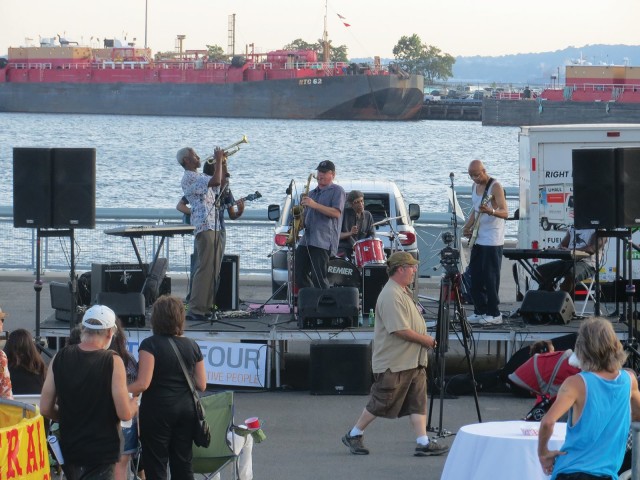
BERST will return for the third annual Celebrating Red Hook festival in Erie Basin Park

BERST will return for the third annual Celebrating Red Hook festival in Erie Basin Park (photo courtesy Red Hook Star-Revue)

Erie Basin Park behind IKEA, 1 Beard St.
Saturday, September 17, free, 12 noon – 9:00 pm
redhookstar.com

The third annual Celebrating Red Hook festival takes place September 17 from 12 noon to 9:00 in Erie Basin Park behind the IKEA. Hosted by the Red Hook Star-Revue, the all-ages event features live entertainment, face painting, henna tattoos, a local marketplace, a Tiki bar, fireworks, and more. “Celebrating Red Hook is a day when we bring so many pieces of Red Hook into a single place in order to display all of the culture that makes our community special,” Red Hook Star-Revue publisher Kimberly G. Price said in a statement. The music lineup consists of Stan Kosakowski (1:00), HAPPS (1:35), the Eephus Band (2:00), William Robertson (3:00), Berst (4:00), the Sanghatones (5:00), Sean Kershaw and the New Jack Ramblers (6:00), Andi Rae Healy and the Back River Bullies (7:00), and Union (8:00). Among the more than fifty participants with booths are Red Hook Winery, Sixpoint Brewery, Cora Dance, the Red Hook Art Project, the Red Hook Justice Center, Giant Jenga, Tarot Cards with Serena, the Brooklyn Bridge Rotary Club, Friends of the Red Hook Library, Addabbo Health Center, Dolce Brooklyn, Brooklyn Whatever, and the Red Hook Conservancy.