In the hybrid documentary Holding Back the Tide, director and cowriter Emily Packer delves into the long history of New York City and oysters, visiting such spots as the Gowanus Canal, Grand Central Terminal, Governors Island, the Battery Park SeaGlass Carousel, the Brooklyn Children’s Museum, the Staten Island Ferry, the Union Square Greenmarket, Jamaica Bay, and Violet Cove to trace their relation to the delicious mollusks. At each stop, Packer shares details about how oysters are raised, served, and preserved, topics that have taken on new importance during the major expansions of the waterfront that have thrived since the Bloomberg administration.
Packer also highlights oysters’ ability to switch gender — the mollusks are born male, and most become female within a year or two — to honor the LGBTQIA+ community, interspersing numerous scripted scenes into the film, which is “dedicated to the queer future.”
“All things living transform. We build, break, morph, become, and become ourselves again. The tides rise and fall, a rock turns to sand, an island is named, renamed, and made a city,” Aphrodite (Robin LaVerne Wilson aka Dragonfly) says early on, walking barefoot along the rocks. “No river is endless. All oceans meet the shore. And in the end, in the best case, we return to the beginning.”
Exploring harbor restoration, coastal protection, commercialization, and more, Packer meets with a wide-ranging group of environmentalists and entrepreneurs who are never identified, including Mothershuckers founder Ben “Moody” Harney, former WNBA star and current oyster farmer Sue Wicks, commercial fishermen Wade Karlin and Phil Karlin of PE & DD Seafood, Cornell Cooperative Extension shellfish hatchery manager Joshua Perry, CCE SPAT director Kim Tetrault, resilience planner Pippa Brashear, Gowanus Dredgers founder Owen Foote, and Tanasia Swift, Agata Poniatowski, and John Ribaudo of Billion Oyster Project. The nonfiction scenes are fun and informative, filmed on location as the people go about their daily business.
The fiction scenes, featuring actors Aasia Taylor-Patterson, TL Thompson, Hannah Rego, Thomas Annunziata, Meghan Dolbey, Katharine Antonia Nedder, Avery Nusbaum, Hilary Asare, and Marlena Ospina, have a New Age-y atmosphere, like mini-fantasies with poetry, lilting music, and underwater choreography, making it often feel like you’re watching two different films. A nonbinary couple slurp oysters at an otherwise empty Grand Central Oyster Bar, then go to the whisper gallery, hearing the sound of the ocean. A server shucks oysters in front of Delmonico’s in the Financial District. A pair of performers pose like Wisdom and Felicity, two of the figures in the Bailey Fountain at Grand Army Plaza in Brooklyn.
“Holding Back the Tide was made with intersectional queer values, queer practices, and LGBTQIA+ collaborators. As a nonbinary queer filmmaker working with a subject that regularly changes its sex as part of its reproductive process, it was important for me to create a vision of the oysters’ cultural economy that celebrated the environmental heroism of the oyster through a queer perspective,” Packer explains in their director’s statement. “Not only are most of the characters and actors queer people, but they also come to see that their gender evolution and self-actualization are reflected in nature. . . . Our creative choices are deeply rooted in our research and incorporate our subjects’ Black Indigenous immigrant and working class histories. We subvert the oyster’s ‘classic’ connotations of wealth and heterosexual aphrodisia reframing old tropes through an intersectional and anti-capitalist lens.”
Holding Back the Tide is running September 6-12 at DCTV Firehouse Cinema, with Q&As September 6 at 7:00 with Packer and Pete Malinowski of Billion Oyster Project, moderated by DCTV’s Dara Messinger; September 7 at 6:30 with comedian Esther Fallick and friends; September 8 at 5:00 with Packer and journalist Bedatri Choudhury; September 10 at 7:00 with Packer and filmmaker Lynne Sachs; and September 11 at 7:00 with Harney, aka the Real Mothershucker.
During the Olympics, I was surprised to see Puerto Rico taking on the United States in men’s basketball, since Puerto Rico is a US territory and all Puerto Ricans are American citizens. For some reason, I hadn’t realized that Puerto Rico has been competing as its own entity in the Summer Olympics since 1948 and in the Winter Olympics since 1984. Unfortunately, when I think of Puerto Rico, one of the things that first comes to mind is Donald Trump throwing rolls of paper towels at Puerto Ricans in the aftermath of the destruction wrought by Hurricane Maria in 2017.
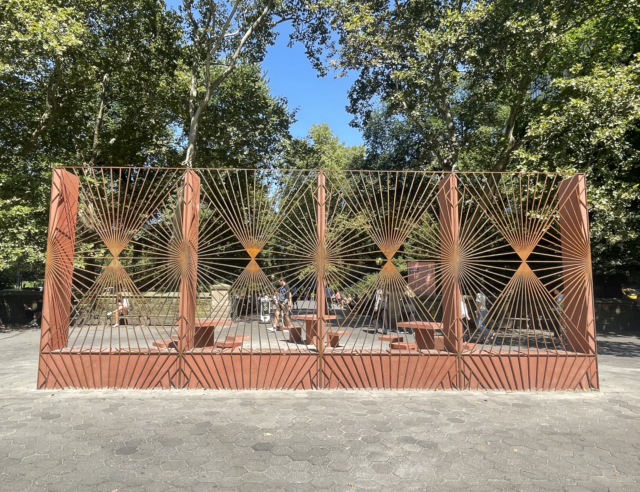
That separation between Puerto Rico and the United States is forefront in Edra Soto’s new Public Art Fund commission, Graft, a red terrazzo concrete and corten steel barrier at the Scholars Gate entrance to Central Park. Soto, who was born and raised in Puerto Rico and has lived and worked in Chicago since 1998, has placed architectural interventions at several previous indoor and outdoor locations. This latest iteration, situated on Doris C. Freedman Plaza, looks like a wrought-iron fence that can let people in — and keep them out, referencing immigration, fear of crime, and the prison system.
On the park side of the physical boundary, there are three sets of tables and chairs where people can grab a seat but have no privacy, as they can be seen through the grating, which features an intricate design inspired by rejas, fences that are incorporated into middle-class Puerto Rican houses, based on Caribbean palm leaves and Yoruba symbols from West Africa.
“The rejas make perfect sense to me, as an expression of self. They exist and are understood as a formality in art, but they can live in invisibility because they are not meant to be contemplative,” Soto said in a statement. “As decorative patterns from a common house, they are meant simply to be pleasant enough to be a part of living spaces.”
Graft feels right at home in New York City, with its proud past of rampant corruption and large Puerto Rican communities; the sculpture resides among tall buildings and large, lovely trees, where people from all around the world will pass by, while nearby is Augustus Saint-Gaudens’s golden statue of Civil War general William Tecumseh Sherman astride his horse, Ontario, led by Victory. “Fear is the beginning of wisdom,” Sherman, who was born in Ohio and died in New York City, once said.
Fear is often the reason why walls are built. The inclusion of floral motifs also may be referencing botanical grafts, the process of cutting a branch of one plant and joining it to the stem of another so that they grow together, generating a more robust and beautiful tree or shrub.
“Graft at Central Park invites viewers to contemplate the resilience of cultural identity and the diasporic experiences which have infused New York City’s history and present day,” Public Art Fund senior curator Melanie Kress explained in a statement. “Soto’s installation will encourage connection in a communal space where people can reflect on their shared histories and celebrate their diverse cultural heritage.”
The opening celebration takes place September 4 at 6:00 and is open to everyone; future programs will include dominoes tournaments held in conjunction with the Clemente Soto Velez Cultural and Educational Center, and the Public Art Fund usually hosts an artist talk about its commissions. No paper towels necessary.
[Mark Rifkin is a Brooklyn-born, Manhattan-based writer and editor; you can follow him on Substack here.]
R.O.S.E. premiered last year at the Manchester International Festival (photo by Johan Persson)
R.O.S.E.
Park Ave. Armory
643 Park Ave. at Sixty-Seventh St.
September 5-12, $65 www.armoryonpark.org
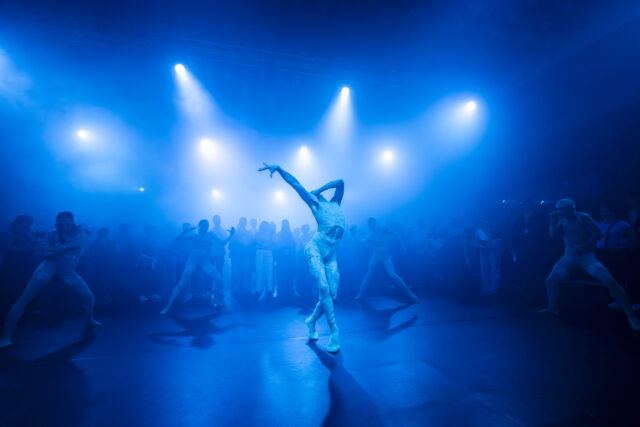
Park Ave. Armory’s massive Wade Thompson Drill Hall has been turned into a flashy nightclub for the North American premiere of the immersive R.O.S.E., running September 5-12.
There are no seats for the three-hour production, so the audience will be on their feet and on the move, shaking and grooving to the show, which features cutting-edge choreography by Sharon Eyal, direction by Gai Behar and Caius Pawson of the record label Young, musical curation by Mattis With of Young, stage and creative design by Daphnée Lanternier, lighting by Alon Cohen, costumes by Maria Grazia Chiuri, and music by DJ Ben UFO. (Audience members can take a break on lounge seating in adjoining reception rooms.)
An armory commission that previously played at New Century Hall in Manchester, R.O.S.E. explodes with freedom, energy, and intimacy as audience and performers meld together as one.
There are several special programs being held in conjunction with R.O.S.E. On September 7 at 7:00, there will be a SLINK rave ($35) with DJs Currency Audio, Laenz, Simisea, rrao, and Enayet, while on September 8 at 6:00 the STUNT QUEEN!!! rave will be led by DJs Kilopatrah Jones, MORENXXX, madison moore, and TYGAPAW, hosted by Xander C. Gaines Aviance and with a poetry reading by Abdu Mongo Ali. And on September 8 at 3:00, “Day for Night: A Salon on Art and Nightlife” ($35) features “Music and Deejaying” with madison moore, Kevin Aviance, and Xander C. Gaines Aviance; “Dance and Club Culture” with Ariel Osterweis and MX Oops; and “The Art of Queer Worldmaking” with Gage Spex, Raúl de Nieves, Dosha, and Jacolby Satterwhite.
Some shows are already sold out, so act fast if you want to catch what should be one of the hottest shows of the year.
[Mark Rifkin is a Brooklyn-born, Manhattan-based writer and editor; you can follow him on Substack here.]
New Museum will host four neighborhood art tours this month (photo courtesy New Museum 2024)
DOWNTOWN ARTISTS: NEIGHBORHOOD TOUR
New Museum
235 Bowery at Prince St.
Thursday, September 5 & 19, $12-$15, 6:00
Saturday, September 14 & 28, $12-$15, 11:00 www.newmuseum.org
The New Museum might be closed until early 2025 while undergoing an expansion, but that doesn’t mean it’s taking time off from being part of its downtown community.
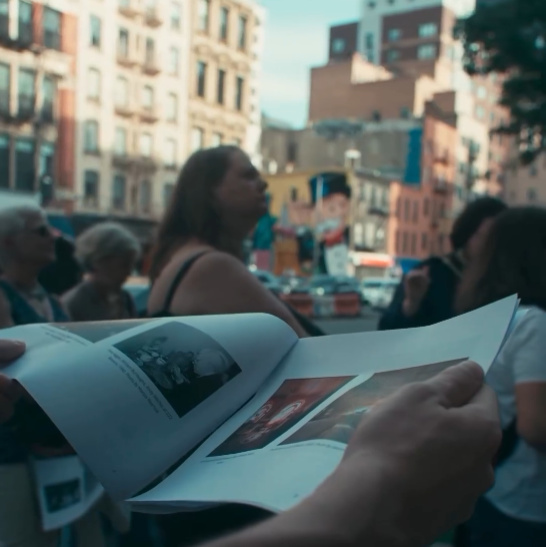
The institution will be hosting four guided walks in September, focusing on the artistic history of NoHo, NoLita, and SoHo from the 1960s to 1980s. On September 5, 14, 19, and 28, teaching artist and poet Rosed Serrano, who was born and raised in the Bronx, will lead groups to the homes, hangouts, and studios of such artists as John Giorno, Lynda Benglis, Adrian Piper, Lorraine O’Grady, Keith Haring, and Jean-Michel Basquiat. You will need your smartphone not just to take pictures but to access the voice amplification system. Tickets are $12 for members, $15 for the general public; you can find out more about some of the Bowery artists here.
[Mark Rifkin is a Brooklyn-born, Manhattan-based writer and editor; you can follow him on Substack here.]
“Did you know that most filmmakers spend their entire lives making some version of the same movie?” Vita (Odessa Young) says in Zia Anger’s My First Film, portraying the director’s onscreen doppelganger.
In 2010, Anger shot her first film, Always All Ways, Anne Marie, which was soon relegated to “abandoned” status on IMDB. In 2015, she made the nine-minute short My Last Film, starring Lola Kirke, Kelly Rohrbach, Rosanna Arquette, and Mac DeMarco, which screened at the New York Film Festival. In 2018, she toured her first movie as part of a live performance that slowly morphed into the feature-length My First Film, which has played numerous festivals and is being shown August 30 at the Roxy before streaming on MUBI. My First Film goes behind the scenes of Anger’s creative process as she revisits her earlier work; Reunion founder Sean Glass calls it “the making of the making of the making of . . .”
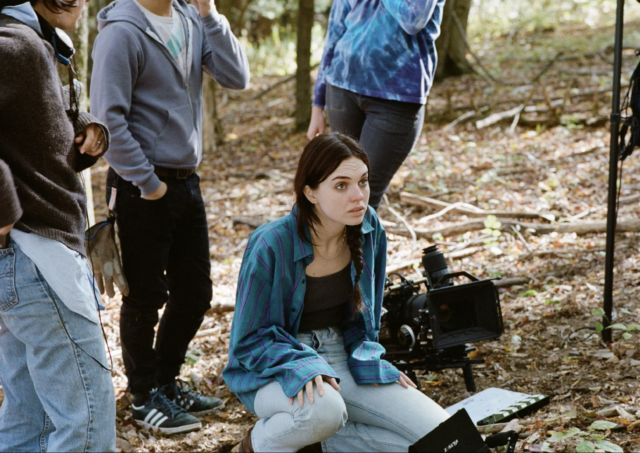
Comparing writing and directing to getting pregnant and giving birth, Anger and cowriter Billy Feldman employ split screens, voice-over narration, typewritten text, and other cinematic elements in blurring the line between fiction and reality, with exciting handheld phototography by Ashley Connor and a cast that includes Young, Devon Ross as the protagonist, Philip Ettinger as Vita’s boyfriend, Cole Doman, Sage Ftacek, Seth Steinberg, and Anger’s father, Ruby Max Fury.
The words “I’m not sure how to start this” are typed at the beginning of the film. “I am really happy you are watching, happier than you could ever know.” The 7:15 screening at the Roxy will be followed by a Q&A with Anger, Connor, Young, Ettinger, Doman, and Steinberg, moderated by actor and writer Annie Hamilton.
[Mark Rifkin is a Brooklyn-born, Manhattan-based writer and editor; you can follow him on Substack here.]
Guy Maddin, Evan Johnson, and Galen Johnson reimagine Alfred Hitchcock’s Vertigo with clips from old films in The Green Fog
VERTIGO (Alfred Hitchcock, 1958) and THE GREEN FOG (Guy Maddin, Evan Johnson, and Galen Johnson, 2017)
Paris Theater
4 West Fifty-Eighth St. at Fifth Ave.
Sunday, August 25, 1:10 Vertigo also screens August 23, 29, 31, September 1
Series continues through October 31 www.paristheaternyc.com guy-maddin.com
Last year, the historic Paris Theater in midtown Manhattan reopened with “Big & Loud,” a festival of classic films screened using state-of-the-art technology, in 70mm with Dolby Atmos sound. The festival is back, kicking things off with the debut of a 70mm print of Alfred Hitchcock’s Vertigo, joined at one show by Guy Maddin’s The Green Fog. The series runs through October 31 with such other greats as James Ivory’s The Remains of the Day, Paul Thomas Anderson’s Boogie Nights and Phantom Thread, Stanley Kubrick’s Spartacus and 2001: A Space Odyssey, David Lean’s Lawrence of Arabia, and John Ford’s The Searchers.
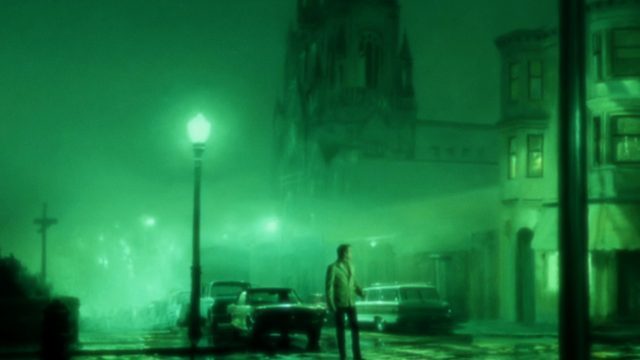
Winnipeg-based filmmakers Maddin, Evan Johnson, and Galen Johnson ingeniously reimagine Alfred Hitchcock’s psychosexual masterpiece, Vertigo, using clips from dozens of movies and television programs in the mesmerizing pastiche The Green Fog. When Maddin, who has made such previous films as Careful, The Saddest Music in the World, and My Winnipeg, which use early-cinema conventions and look like rediscovered, decayed old works, was commissioned by the San Francisco International Film Festival to make a film for its sixtieth anniversary, Maddin turned to the Johnson brothers, his collaborators on The Forbidden Room and Bring Me the Head of Tim Horton, and began poring over movies and TV shows set in the City by the Bay. Along the way they were continually reminded of Vertigo as they recognized locations from the classic thriller about an agoraphobic detective obsessed with a woman who resembles his former love. So the trio decided to re-create Vertigo with found footage, not shot-by-shot like Gus Van Sant did with Psycho but by employing themes, places, pacing, mood, and tension similar to Hitchcock’s, and in about half the time. (The Green Fog runs sixty-three minutes, Vertigo slightly more than two hours.)
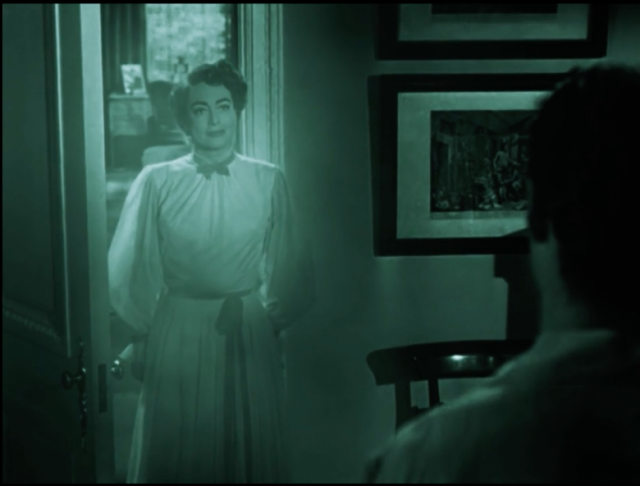
The Green Fog incorporates clips from such genre movies as Sudden Fear, starring Joan Crawford
In sections with such titles as “Prologue,” “Weekend at Ernie’s,” and “Catatonia,” Maddin and the Johnsons follow the general story line of Vertigo,, with the Jimmy Stewart role “played” primarily by Rock Hudson from McMillan & Wife, Vincent Price from Confessions of an Opium Eater, and Chuck Norris from Slaughter in San Francisco and An Eye for an Eye. There’s a rooftop chase, a visit to a flower shop, scenes in restaurants and with paintings in museums, and a trip up a tower. Occasionally a green fog threatens ominously. In the vast majority of the clips, the dialogue has been cut out, so the characters are seen in choppy edits looking at each other in offbeat ways, allowing viewers to infer their own Vertigo-esque narrative. Because viewers are likely not to be familiar with many of the scenes from the movies and thus don’t know the relationships between the characters, issues of sexuality, homoeroticism, and even incest arise as Maddin and the Johnsons redefine the male gaze — so prevalent in Hitchcock films — while passing the Bechdel test.
Snippets of conversation occasionally come through, usually involving people watching surveillance footage on film or monitors or listening to tape recordings, commenting with inside jokes and references to the making of The Green Fog. “What are we looking for, sir?” Sgt. Enright (John Schuck) asks Commissioner McMillan (Hudson), who responds, “I don’t know, but at this point I’ll take anything.” McMillan also says, “That’s the trouble with that old film,” and later sets fire to filmstrips, leading to a series of disasters of epic proportions. And Michael Douglas as Det. Steve Keller from The Streets of San Francisco watches Michael Douglas as Det. Nick Curran from Basic Instinct get out of bed and walk to the bathroom naked. “Boy, you look good, Mike. You ever thought about going into showbiz?” Keller says to Lt. Stone (Malden).
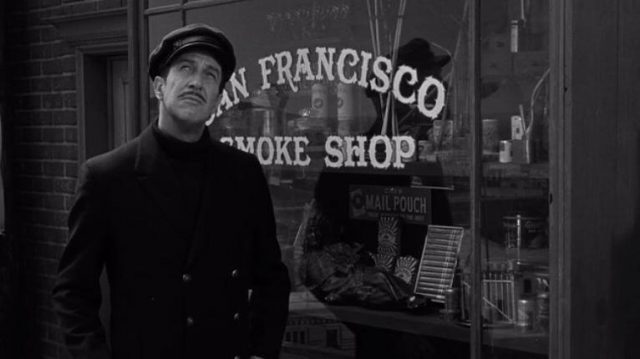
Vincent Price is one of many actors who “portray” John “Scottie” Ferguson (Jimmy Stewart) in mesmerizing cinematic collage based on Vertigo
Many shots echo the doubling mirror image that is at the heart of Vertigo. In a scene from Nicholas Ray’s Born to Be Bad, Gobby Broome (Mel Ferrer) watches what appears to be twin girls looking intently at two paintings in a museum. In a restaurant, a daughter tells her father, “I’m trying to become somebody,” as if there’s another persona waiting to burst out of her. And Lt. Stone puts on clown makeup to try to catch a killer. Among the other actors who show up in the film are Mel Brooks, Lee Remick, Martin Landau, Nancy Kwan, Clint Eastwood, Meg Ryan, Richard Gere, Kim Basinger, Donald Sutherland, Miriam Hopkins, Dean Martin, Fritz Weaver, Sandra Bullock, Claude Akins, Sharon Stone, John Saxon, Joan Crawford, Sidney Poitier, Humphrey Bogart, Joseph Cotten, and Veronica Cartwright, from such movies and TV series as Murder She Wrote, Mission: Impossible, Hotel, Bullitt, High Anxiety, Dark Passage, Star Trek IV: The Voyage Home, The Towering Inferno, It Came from Beneath the Sea, Barbary Coast, The Conversation, Flower Drum Song, The Love Bug, Dirty Harry, A View to a Kill, The Lady from Shanghai, Sans Soleil, Sister Act, So I Married an Axe Murderer, Pal Joey, Invasion of the Body Snatchers, The Ten Commandments, and They Call Me Mister Tibbs! as well as an *NSYNC video.
The intense, titillating score was composed by Jacob Garchik and is performed by the San Francisco–based Kronos Quartet. The Green Fog also evokes Christian Marclay’s The Clock and Telephones, in which the Swiss and American visual and sound artist edited together existing film footage to create narratives based on time and phone conversations, respectively. As with those montage-based works, it’s easy to get caught up in trying to identify the actors and the movies in The Green Fog, but don’t forget that the clips are all being employed to come up with something brand new that stands on its own. Maddin (Tales from the Gimli Hospital,Keyhole) and the Johnsons have made a dazzling love letter to Vertigo, to San Francisco, and to the history of movies themselves, offering a treasure trove of fun worthy of repeated viewings. Maddin has written a special introduction for the Paris screening.
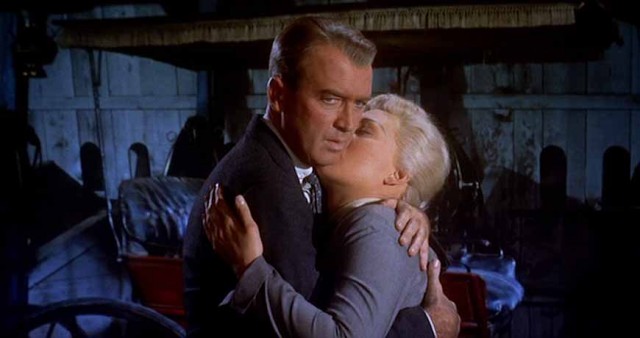
James Stewart and Kim Novak get caught up in a murder mystery in Vertigo
Alfred Hitchcock’s 1958 mind-altering, fetishistic psychological thriller, Vertigo, heavily influenced Guy Maddin, Evan Johnson, and Galen Johnson’s San Francisco montage. Based on Boileau-Narcejac’s 1954 novel, D’entre les morts, the film delves deep into the nature of fear and obsession. Jimmy Stewart stars as John “Scottie” Ferguson, a police detective who retires after his acrophobia leads to the death of a fellow cop. An old college classmate, wealthy businessman Gavin Elster (Tom Holmore), asks Scottie to look into his wife’s odd behavior; Elster believes that Madeleine (Kim Novak) is being inhabited by the spirit of Carlotta Valdes, her great-grandmother, a woman who committed suicide in her mid-twenties, the same age that Madeleine is now. Scottie follows Madeleine as she goes to Carlotta’s grave, visits a portrait of her in a local museum, and jumps into San Francisco Bay. Scottie rescues her, brings her to his house, and starts falling in love with her. But on a visit to Mission San Juan Bautista, tragedy strikes when Scottie can’t get to the top of the tower because of his vertigo. After a stint in a sanatorium, he wanders the streets of San Francisco where he and Madeleine had fallen in love, as if hoping to see a ghost — and when he indeed finds a woman who reminds him of Madeleine, a young woman named Judy Barton (Novak), he can’t help but try to turn her into his lost love, with tragedy waiting in the wings once again.
Scottie experiences quite a nightmare in Alfred Hitchcock classic
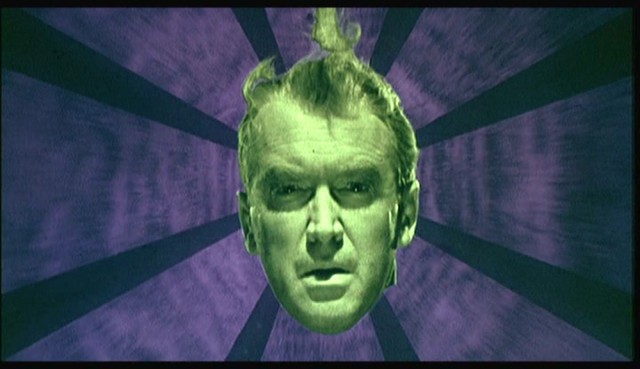
Vertigo is a twisted tale of sexual obsession, much of it filmed in San Francisco, making the City by the Bay a character all its own as Scottie travels down Lombard St., takes Madeleine to Muir Woods, stops by Ernie’s, and saves Madeleine under the Golden Gate Bridge. The color scheme is almost shocking, with bright, bold blues, reds, and especially greens dominating scenes. Hitchcock, of course, famously had a thing for blondes, so it’s hard not to think of Stewart as his surrogate when Scottie insists that Judy dye her hair blonde. Color is also central to Scottie’s psychedelic nightmare (designed by artist John Ferren), a Spirographic journey through his mind and down into a grave. Cinematographer Robert Burks’s use of the dolly zoom, in which the camera moves on a dolly in the opposite direction of the zoom, keeps viewers sitting on the edge of their seats, adding to the fierce tension, along with Bernard Herrmann’s frightening score. Despite their age difference, there is pure magic between Stewart, forty-nine, and Novak, twenty-four. (Stewart and Novak next made Bell, Book, and Candle as part of the deal to let Novak work for Paramount while under contract to Columbia.)
The production was fraught with problems: The screenplay went through Maxwell Anderson, Alec Coppel, and finally Samuel A. Taylor; shooting was delayed by Hitchcock’s health and vacations taken by Stewart and Novak; a pregnant Vera Miles was replaced by Novak; Muir Matheson conducted the score in Europe, instead of Herrmann in Hollywood, because of a musicians’ strike; associate producer Herbert Coleman reshot one scene using the wrong lens; Hitchcock had to have a bell tower built atop Mission San Juan Bautista after a fire destroyed its steeple; and the studio fought for a lame alternate ending (which was filmed). Perhaps all those difficulties, in the end, helped make Vertigo the classic it is today, gaining in stature over the decades, from mixed reviews when it opened to a controversial restoration in 1996 to being named the best film of all time in Sight & Sound’s 2012 poll to a recent digital restoration. Amy Taubin will introduce the August 23 screening of the new 70mm print at the Paris.
[Mark Rifkin is a Brooklyn-born, Manhattan-based writer and editor; you can follow him on Substack here.]
Ralph Arlyck explores aging and death in intimately personal I Like It Here
I LIKE IT HERE (Ralph Arlyck, 2022)
DCTV Firehouse Cinema
87 Lafayette St.
August 23-29
212-966-4510 www.dctvny.org timedexposures.com
“I wanna stay here forever,” a young boy says in his grandfather’s latest documentary, I Like It Here. But as that grandfather, Ralph Arlyck, points out throughout the film, life comes to an end for us all.
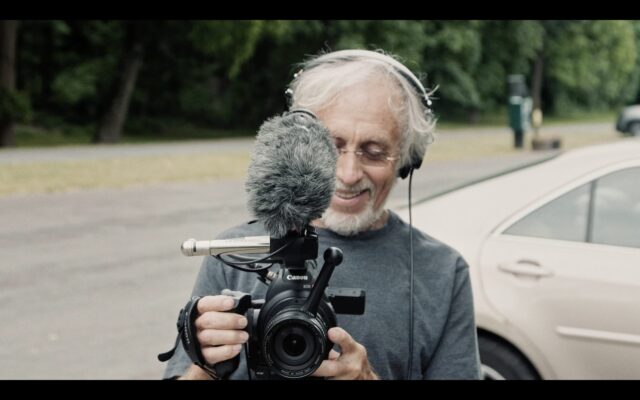
Made over the course of several years, I Like It Here is a wistful, painfully honest exploration of aging and death, written, directed, photographed, and narrated by Arlyck, who was born in Brooklyn in 1940 and raised in Suffern, New York. It started out as a documentary about Arlyck’s upstate neighbor, Erno Szemes, an elderly hermit from Hungary, but the gruff Erno decided he didn’t want to share his life in front of a camera.
The project then morphed into a deeply personal story about facing the end, as Arlyck, whose previous films include 1968’s Natural Habitat, 1980’s An Acquired Taste, 1989’s Current Events, and 2004’s Following Sean, visits friends, lovers, and colleagues from his past, some of whom he hasn’t seen in more than half a century or more, while spending time with his wife, children, and grandchildren. In addition, he speaks with unique strangers he meets along his journey.
“I’m wondering how much my friends are thinking about the upcoming end of the days we’re all walking through, about the absolute finality of what will soon happen,” Arlyck says.
He encounters an Iranian man named Homer attempting to cheat death by walking along the side of a road and pulling a tire connected to his body by a chain. Fellow filmmaker Jack Baran is boisterous about life even though he has suffered two major losses. Arlyck visits his first serious girlfriend, writer Linda Chase; his Colgate buddy Mel Watkins; nonagenarian ski instructor Lou Ambrico and his wife, Pat; graveyard caretaker Jackie Szatko; childless artist couple Harry Roseman and Catherine Murphy; Upstate Films cofounder Steve Leiber; filmmakers Petra Epperlein and Michael Tucker; and therapist Terry Antman. Ralph and his wife, Elisabeth Cardonne, return to their old campus house at Vassar, which is in danger of being torn down, and travel to Paris, where they are surrounded by youth.
Arlyck has the unique skill of being able to get people to share intimate moments from their lives, often with humor. As Leiber laughs while detailing his heart attack, Arlyck tells us, “As I’m questioning him, it strikes me that documentary filmmaking is almost as invasive as the quadruple bypass he had.” At various times, Erno, Elisabeth, and a neurologist ask Arlyck to turn off the camera, but it seems to be infused into his very being, part of his body. He just cannot stop filming.
Despite dealing with numerous types of severe illness and death, I Like It Here is a lovely and poignant record of one man taking stock before he dies. Editor Emmet Dotan weaves in archival footage, clips from some of Arlyck’s films, and, in the second half, many scenes, old and new, of the director enjoying time with his family, from his parents to his grandkids. The title is somewhat misleading; at one point, Arlyck declares, “I love it here. Maintaining it is a bitch, but I must like that too.” He’s talking about more than just his upstate farm as he contemplates being put out to pasture.
Spoiler alert: I Like It Here runs August 23–29 at DCTV Firehouse Cinema, with Arlyck, who is very much still alive, participating in five Q&As opening weekend, joined by Dotan at two and moderated by Alan Berliner, Kent Jones, Gabrielle Glaser, Phillip Lopate, and Chloé Trayner.
[Mark Rifkin is a Brooklyn-born, Manhattan-based writer and editor; you can follow him on Substack here.]