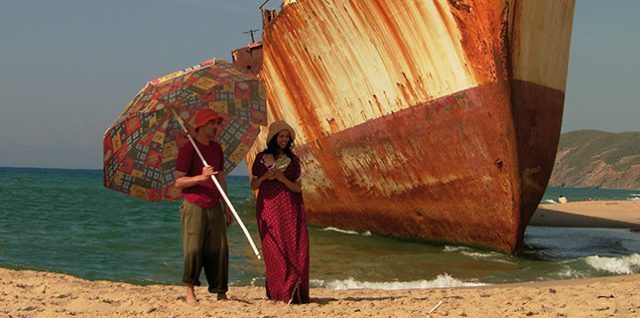
Kamel (Rabah Ameur-Zaïmeche) and Louisa (Meryem Serbah) are outsiders in their own village in BACK HOME
CINÉSALON: BACK HOME (BLED NUMBER ONE) (Rabah Ameur-Zaïmeche, 2006)
French Institute Alliance Française, Florence Gould Hall
55 East 59th St. between Madison & Park Aves.
Tuesday, November 29, $13, 4:00 & 7:30
Series continues Tuesdays through December 13
212-355-6100
www.fiaf.org
 FIAF’s Cinésalon series “Poetic and Political: The Cinema of Rabah Ameur-Zaïmeche” continues November 29 with Ameur-Zaïmeche’s second feature, Bled Number One (Back Home), the follow-up and kind of prequel to Wesh Wesh and the second part of an unofficial trilogy that concludes with Adhen (Dernier Maquis). Kamel (Ameur-Zaïmeche) has returned home to his isolated village of Loulouj in northeast Algeria after having spent several years in France. Meanwhile, Louisa (Meryem Serbah) has left her husband, Ahmed (Ramzy Bedia), but her parents (Meriem Ameur-Zaïmeche and Larkdari Ameur-Zaïmeche) and brother (Soheb Ameur-Zaïmeche) insist she go back to him, saying she is bringing shame on the family. Both Kamel and Louisa feel like outsiders in their own village, which is balancing precipitously between the past and the future. The desperados, a group of young men who are spreading fundamentalist Muslim views, is battling with the patriots, the longtime members of the community, threatening violence on anyone who doesn’t follow the letter of the Koran. During Zerda, the pre-Islamic ritual of slaughtering and serving a bull in which the women are kept separate from the men, Kamel, in his ever-present orange hat, decides to be with the women instead, and the men, feeling shunned, remind him over and over that he is not to eat with them. The treatment of women in this patriarchal society is a central focus of the film. Louisa wants to break free of the chains that bind her, but she takes a bigger risk every time she strays from accepted, outdated convention. And the more Kamel proves to be his own man, the more the other men want to be rid of him. In fact, the patriots closely watch the town border, refusing entry to anyone they don’t want inside.
The film, which was written by Rabah Ameur-Zaïmeche and Louise Thermes, is photographed in a documentary style, with long shots both in time and distance; often what is being said among the characters can’t be heard and is not translated into English, as it is more for setting a realistic pace and a naturalistic flow. The muted, faded greens and blues of the village residences stand in stark contrast to the lush green mountainside and bright blue sky. The few times there is music, it turns out that it is being played live by Rodolphe Burger by the sea; at one point he sings William Blake’s “The Little Vagabond,” about God and the Devil. Bled Number One (“bled” in Algerian means “field” or “terrain”) is a subtle, poetic film laden with sociopolitical undertones, a melancholic yet beautiful work from an auteur who deserves a bigger audience. “To write Bled Number One, I didn’t return at all to Algeria to capture something about today’s youth there. I wrote this story based on my holiday memories,” Ameur-Zaïmeche has said. “But it is also because I felt that things hadn’t really changed, that time passes differently there. You have the time to reflect and be, faced with the elements. . . . A film is a gesture, a burst, a job, an enterprise, an action. An action in life, a pure lesson of life. It is here that we grasp something alive. For it is necessary to remain alive, no matter what else happens.” Bursting with life, Bled Number One is screening at FIAF on November 29 at 4:00 and 7:30; the later show will be followed by a Q&A with ArteEast executive director Jaime-Faye Bean, and both shows will end with a wine and beer reception. “Poetic and Political: The Cinema of Rabah Ameur-Zaïmeche” continues December 6 with Smugglers’ Songs before concluding December 13 with Story of Judas.

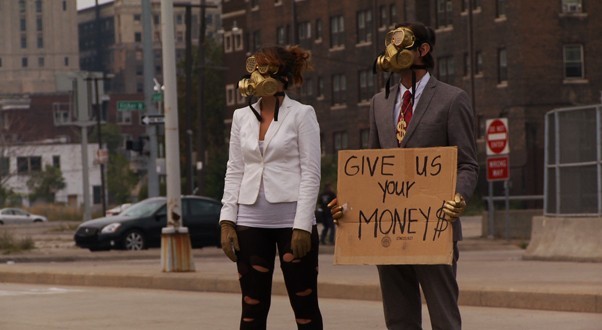

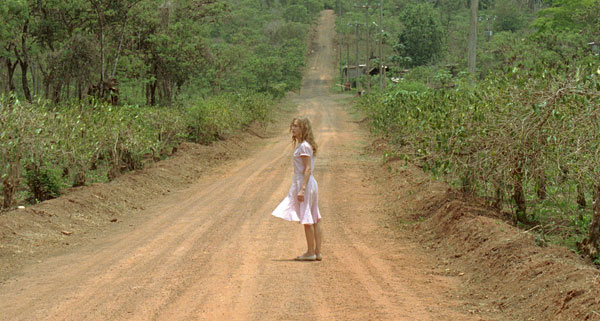
 You will never hear us complaining about too much Isabelle Huppert. The sixty-three-year-old French actress has been all over the place recently, having appeared in no fewer than seven films in 2015–16 in addition to touring the world in Krzysztof Warlikowski’s Phèdre(s), which came to BAM this past September, and appearing with Cate Blanchett in Jean Genet’s The Maids at City Center in 2014. In conjunction with the release of her latest two films, Mia Hansen-Løve’s Things to Come and Paul Verhoeven’s Elle, Metrograph is hosting a seven-movie Huppert retrospective this weekend, with the grand actress on hand on the Lower East Side for a Q&A following Hong Sang-soo’s In Another Country and to introduce Curtis Hanson’s L.A. Confidential. The series also includes Michael Haneke’s The Piano Teacher, Catherine Breillat’s Abuse of Weakness, Hal Hartley’s Amateur, and Ursula Maier’s Hom. as well as Claire Denis’s White Material, which takes place in an unnamed West African nation besieged by a bloody civil war between rebels and the military government. Huppert stars as Maria Vial, who steadfastly refuses to leave her coffee plantation, determined to see the last crop through to fruition. Despite pleas from the French army, which is vacating the country; her ex-husband, André (Christophe Lambert), who is attempting to sell the plantation out from under her; and her workers, whose lives are in danger, Maria is unwilling to give up her home and way of life, apparently blind to what is going on all around her.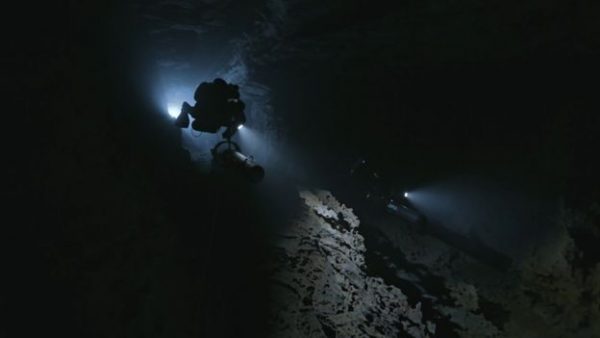
 For his feature-length debut, writer-director Juan Reina was all set to make a documentary in Norway about a group of Finnish friends’ daring attempt to break the world record for longest cave dive. But the narrative quickly changed when two of the divers, Jari Huotarinen and Jari Uusimäki, suffered tragic accidents and died, their bodies trapped underwater. Unable to retrieve the bodies because of safety concerns, the authorities closed off the area to any further diving. But the rest of the Finnish team decides that they cannot leave their friends down there and come up with a plan to secretly dive in and bring them back home for proper burials. A kind of mix between a Werner Herzog adventure documentary, a procedural caper film, and a military rescue drama, Diving into the Unknown follows Sami Paakkarinen, Vesa “Vesku” Rantanen, Kai “Kaitsu” Känkänen, Patrik “Patte” Grönqvist, and others as they decide to risk their lives in the waters that killed their fellow divers. “I do everything I can not to die while diving,” Paakkarinen says early on, later adding, “You should never expect that a dive will go well . . . because then it never does.” Grönqvist notes, “It has to be fun. If it’s not fun, there’s no point in doing it.” But during the rescue attempt, he says, “From the outside this might seem foolishly risky. But life in general can be risky. You cannot prepare for everything that could go wrong. You just cannot practice facing a dead friend at one hundred and ten meters.” No matter how many dives they’ve been on together, each new one comes with its own obstacles and dangers; when the men say goodbye to their respective families, they know deep down that they might not return alive. And it’s not just the physical aspects of diving that place them in jeopardy; several discuss the emotional and psychological trauma that could impact their safety, especially when diving to recover two of their closest friends.