this week in lectures, signings, panel discussions, workshops, and Q&As

NAN GOLDIN: THE PERSONAL IS POLITICAL / THE BALLAD OF SEXUAL DEPENDENCY

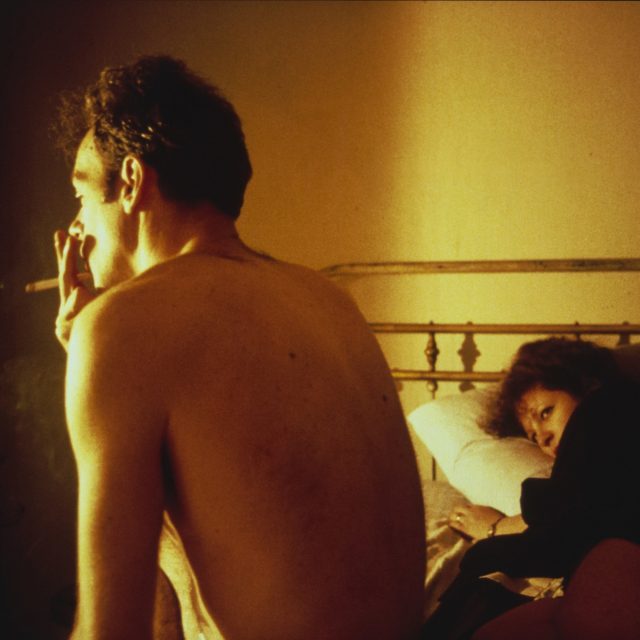
Nan Goldin (American, born 1953). Nan and Brian in Bed, New York City. 1983. Silver dye bleach print, printed 2006, 15 1/2 × 23 3/16" (39.4 × 58.9 cm). The Museum of Modern Art, New York. Acquired through the generosity of Jon L. Stryker. © 2016 Nan Goldin

Nan Goldin, “Nan and Brian in Bed, New York City,” silver dye bleach print, 1983, printed 2006 (the Museum of Modern Art, New York. Acquired through the generosity of Jon L. Stryker. © 2016 Nan Goldin)

Museum of Modern Art
11 West 53rd St. between Fifth & Sixth Aves.
Wednesday, February 8, free with museum admission, 11:30 am
Exhibition continues through April 16, $14-$25
212-708-9400
www.moma.org

“The Ballad of Sexual Dependency is the diary I let people read. My written diaries are private; they form a closed document of my world and allow me the distance to analyze it. My visual diary is public,” Nan Goldin wrote about her seminal 1985-86 multimedia exhibition and book. “There is a popular notion that the photographer is by nature a voyeur, the last one invited to the party. But I’m not crashing; this is my party. This is my family, my history.” Goldin and the Museum of Modern Art are currently inviting everyone to the party, showing The Ballad of Sexual Dependency in its complete audiovisual form through April 16. Consisting of nearly seven hundred portraits set to music by James Brown, Maria Callas, the Velvet Underground, Nina Simone, and Screamin’ Jay Hawkins, Ballad is set primarily amid the heroin subculture of downtown New York from 1979 to 1986, just as AIDS started ravaging the city, as well as in Berlin, Paris, Boston, Provincetown, and Mexico. Born in Washington, DC, in 1953, Goldin, who left home when she was just fourteen, took intimate photos of her chosen family — friends, lovers, junkies, drag queens, and others, including artists Greer Lankton and Vivienne Dick, actress and writer Cookie Mueller, Andy Warhol, Jim Jarmusch, and performer Suzanne Fletcher. Deeply affected by her sister Barbara’s suicide — she killed herself in 1964 at the age of eighteen, when Nan was eleven — Goldin sees the photos as a way to hold on to her memories. The photos are not chic glamour shots but instead captured moments of real life, with natural lighting and what would technically be considered imperfect composition. Yet they have an immediacy and emotion that overstaging and multiple takes would ruin. Although reminiscent of the work of Larry Clark and Diane Arbus, Ballad finds Goldin boldly revealing her life, particularly in two of the most famous shots, one of her boyfriend Brian sitting on the edge of a bed, smoking a cigarette, as sunlight pours in over Goldin’s face on a pillow, her eyes slyly looking at him, while in the other, a horribly beaten Goldin — the culprit was Brian —looks into the camera, her left eye nearly swollen shut, her red lipstick, dangling earrings, and pearl necklace defining her feminism and strength.
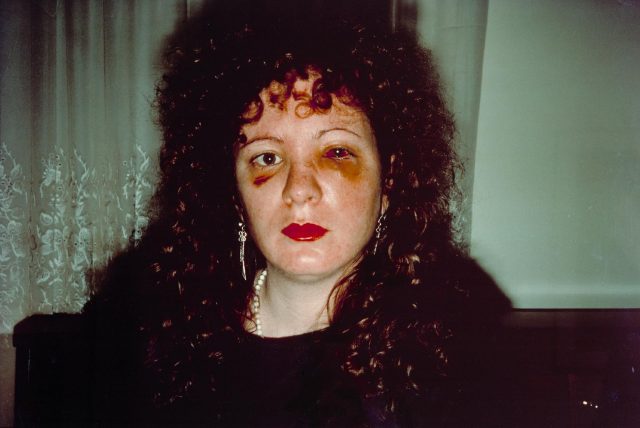
Nan Goldin, “Nan One Month After Being Battered, 1984,” silver dye bleach print, printed 2008 (the Museum of Modern Art, New York. Purchase)

Nan Goldin, “Nan One Month After Being Battered,” silver dye bleach print, 1984, printed 2008 (the Museum of Modern Art, New York. Purchase)

On February 8 at 11:30 am, independent educator Diana Bush will lead a Gallery Session at MoMA, “Nan Goldin: The Personal Is Political,” exploring the relationship between photography, memory, and diary, elements that are central to Goldin’s entire oeuvre, which also includes such books and series as “I’ll Be Your Mirror” and “The Devil’s Playground.” (You can find out more about Goldin in Sabine Lidl’s 2013 documentary, Nan Goldin — I Remember Your Face.) Named after a song in Kurt Weill and Bertolt Brecht’s 1928 classic, The Threepenny Opera (“They’re all the same / In meeting love’s confusion / Poor noble souls / Get blotted in illusion”) — The Ballad of Sexual Dependency is in its own viewing room at MoMA, where visitors feel like guests at this decades-old party, watching photos of acquaintances pass by, each one a not-so-distant memory tinged with joy and sadness. The central slide show is supplemented by numerous posters from the early versions of Ballad as well as silver dye bleach prints of more than a dozen of the photos, including “The Parents’ Wedding Photo, Swampscott, Massachusetts,” “Trixie on the Cot, New York City,” “Nan One Month After Being Battered,” and “Philippe H. and Suzanne Kissing at Euthanasia, New York City.” Goldin also wrote in the Ballad book, “The diary is my form of control over my life. It allows me to obsessively record every detail. It enables me to remember.” Extended through April 16, The Ballad of Sexual Dependency is hard to forget.

DARK NIGHT

DARK NIGHT

Tim Sutton explores the shadowy underbelly of America in DARK NIGHT

DARK NIGHT (Tim Sutton, 2016)
Alamo Drafthouse Downtown Brooklyn
445 Albee Square West
Opens Friday, February 3
718-513-2547
drafthouse.com/nyc

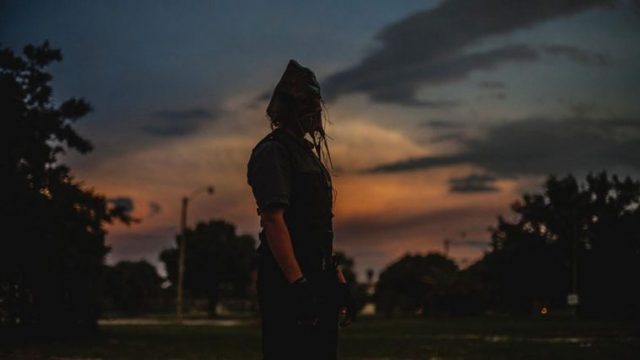
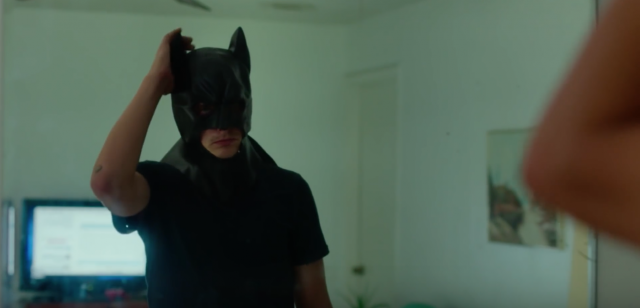
There’s an ominous cloud hanging over Tim Sutton’s deeply poetic Dark Night, a grim, gripping journey into the dark night of America’s soul. The title of Sutton’s third film, following Pavilion and Memphis, also references Christopher Nolan’s 2012 Batman movie, The Dark Knight Rises, for reasons that become apparent about halfway through. Dark Night opens with a close-up of a young woman’s disbelieving eyes, red, white, and blue lights flashing across her face; the camera then pulls back as the woman, wearing an American flag top, lowers her head, taking stock of an unrevealed tragedy. For the next eighty-five minutes, Sutton goes back to the beginning of this fateful day, following the lives of a small group of men, women, and children in a suburban Florida community as they go about their usual business. They play on computers, put on makeup, pet animals, and head over to the mall. One concerned mother and her detached son speak with an off-screen interviewer as if searching for reasons in the aftermath of a horrific event, but in this case it hasn’t happened yet. In many of the vignettes, there is little or no dialogue, as the characters, all nonprofessional actors mostly found on the streets of Sarasota, speak with their actions, particularly when several of the males, including a military vet and a teen with dazzling blue eyes, load firearms. In this Blue Velvet-like town, danger lurks just below the surface.
DARK NIGHT

A cast of nonprofessional actors play realistic characters facing tragedy in DARK NIGHT

Dark Night is photographed by French cinematographer Hélène Louvart (Pina, The Beaches of Agnès) in a documentary style, with fly-on-the-wall shots occasionally broken up by stunning aerial views of perfectly trimmed green lawns and cookie-cutter rooftops that look like video-game targets, static shots of light poles as if they are living creatures, and a striking scene of a woman walking along the outdoor hallway of one of Florida’s ubiquitous motel-like apartment complexes. Canadian singer-songwriter Maica Armata’s (Caro Diaro, MaicaMia) score features five haunting songs, including “Om,” “Oh Well,” and a gloomy, reimagined version of the old standard “You Are My Sunshine,” her ethereal vocals utterly frightening. Evoking such indie works as Larry Clark’s Kids, Gus van Sant’s Elephant, Lance Hammer’s Ballast, and Harmony Korine’s Gummo, the Brooklyn-based Sutton paces the unsettling film with a delicate, disquieting subtlety, the community overwhelmed by an unspoken ennui that’s representative of the dissatisfaction and disconnection being felt all across the country. He might not offer any answers, but he asks many of the right questions, giving the riveting tale an uncomfortable, beguiling immediacy. Dark Night opens February 3 at the Alamo Drafthouse in downtown Brooklyn, with Sutton participating in Q&As following the 6:30 screenings on Friday, Saturday, and Sunday.

TAKE ME (I’M YOURS)

(photo by twi-ny/mdr)

Jewish Museum exhibit gives visitors a chance to go home with actual objets d’art (photo by twi-ny/mdr)

The Jewish Museum
1109 Fifth Ave. at 92nd St.
Thursday – Sunday, $7.50 – $15 (free admission Saturday 11:00 am – 5:45 pm, pay-what-you-wish Thursday 5:00 – 8:00)
212-423-3200
thejewishmuseum.org

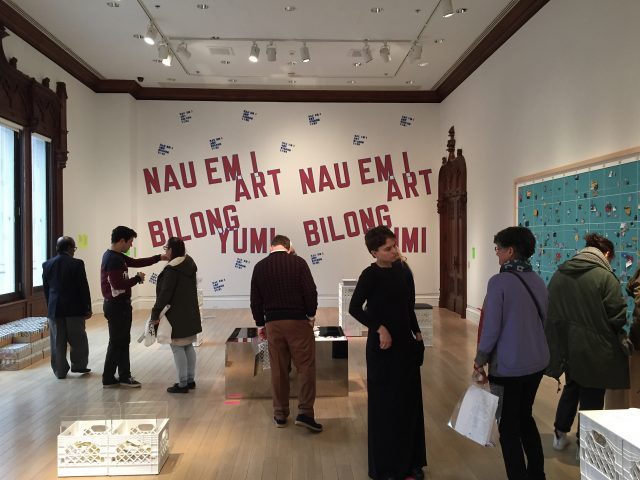
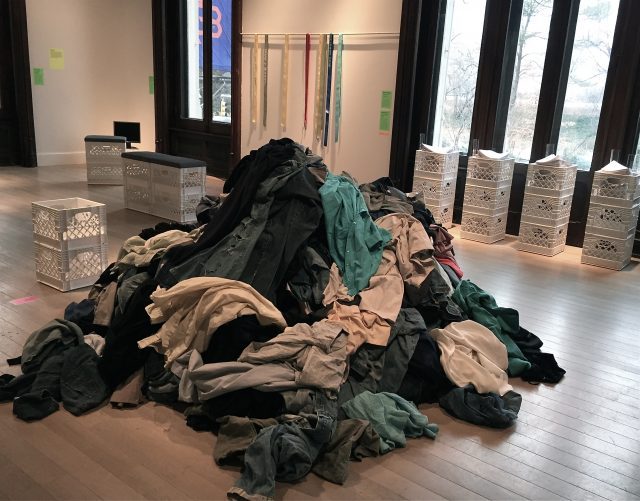
“Don’t just look. Touch, take, share,” the Jewish Museum advises about its interactive exhibition “Take Me (I’m Yours),” which continues through Sunday. In 1995, curator Hans Ulrich Obrist and artist Christian Boltanski teamed up at the Serpentine Gallery in London for a show of the same name, in which a dozen artists created works that visitors could literally take home, exploring such ideas as creation, engagement, interactivity, participation, ownership, value, consumerism, and the art market itself. The Jewish Museum show features pieces by forty-two artists and collectives, several from the original Serpentine presentation; a Kickstarter campaign helped fund approximately ten thousand of each work so visitors could add to their own personal art collection. “In principle a work of art has always been reproducible,” Walter Benjamin wrote in his 1935 essay “The Work of Art in the Age of Mechanical Reproduction,” adding, “Even the most perfect reproduction of a work of art is lacking in one element: its presence in time and space, its unique existence at the place where it happens to be.” Andrea Bowers’s “Political Ribbons,” featuring feminist mottos, were taken from the museum and worn by protesters at the recent women’s march on Washington. Boltanski’s “Dispersion” consists of used clothing that is meant to be taken and used; the ever-changing mound evokes Felix Gonzalez-Torres’s nearby “Untitled (USA Today),” edible (and kosher) sugar-free candies that, when taken, not only change the shape of the work as a whole but reference loss, especially poignant since Gonzales-Torres and his partner both died of AIDS in the 1990s. Carsten Höller’s “Pill Clock (Red and White),” a mechanism high in a corner, slowly dispensing edible capsules one by one, and Ian Cheng and Rachel Rose’s untitled container of fortune cookies call into question material possession as visitors decide whether to take the objects home to keep or to just eat them, which is a completely different experience.

(photo by twi-ny/mdr)

“Take Me (I’m Yours)” is filled with items that call into question consumerism, consumption, and the art market itself (photo by twi-ny/mdr)

The concepts of immateriality and ownership are also raised in such pieces as aaajiao’s “Email Trek,” in which the art is an email; Kelly Akashi’s “Cavelike,” a sound installation; Alison Knowles’s “Shoes of Your Choice,” involving audience performance; James Lee Byars’s “Be Quiet,” in which a slow-moving woman in a dark dress approaches people who are talking and silently gives them a small, circular piece of colored paper that says, “Be Quiet”; General Sisters’ “No One Is Disposable” recycled, sustainable toilet paper that declares “I am not illegal”; and Daniel Spoerri’s “Eat Art Happening,” a large-scale skeleton made of nonkosher sugar paste that will be devoured by museumgoers on February 5 in “Everything Must Go,” providing the sweet taste of death on the last day of the exhibition. Other pieces to look out for are Uri Aran’s untitled plaster casts of the tops of takeout coffee lids, Andrea Fraser’s “Preliminary Prospectuses” detailing art as corporate commodity, Gilbert & George’s anarchistic buttons, Yngve Holen’s wearable “Evil Eye” contact lenses, Jonas Mekas’s “With Thanks to Joseph Cornell and Rose Hobart” filmstrip (a museum employee will cut a segment for those who ask), Yoko Ono’s “Air Dispenser” capsules (which cost a quarter), Rirkit Tiravanija’s “Untitled (Form Follows Function or Vice Versa No. Two)” T-shirts, Daniel Joseph Martinez’s “(America) Adopt a Refugee” kit, and Jonathan Horowitz’s “Hillary 16” poster depicting the official portraits of all the presidents — except with Hillary Clinton following Barack Obama. Scattered throughout the exhibition are definitions of such words and phrases as New Materialism, Economy, Market, Gift, Charity, Relics, Immateriality, Relational Aesthetics, Exchange, and Democratization, placing it all in sociopolitical perspective. Perhaps it is all summed up by Lawrence Weiner’s pidgin English installation “NAU EM I ART BILONG YUMI,” which translates as “The art of today belongs to us.” Among the other artists giving away cool stuff are Luis Camnitzer, Maria Eichhorn, Hans-Peter Feldmann, Alex Israel, Rivane Neuenschwander, Martha Rosler, Allen Ruppersberg (paying homage to Gonzalez-Torres), Tino Sehgal, and Haim Steinbach. (Note that some works are not available on Saturday.) You’re likely to go home with a bag filled with goodies, but how many will you keep long-term as you reevaluate their worth over time? However, the experience will never go away; just be sure not to pocket any items throughout the rest of the museum.

BROOKLYN MUSEUM FIRST SATURDAY: “I SEE MYSELF IN YOU” AND BEVERLY BUCHANAN’S “RUINS AND RITUALS”

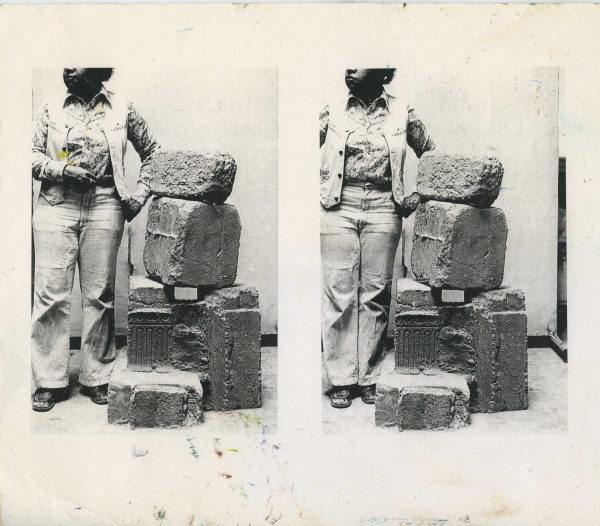
Beverly Buchanan (American, 1940–2015). Untitled (Double Portrait of Artist with Frustula Sculpture) (detail), n.d. Black-and-white photograph with original paint marks, 8½ x 11 in. (21.6 x 27.9 cm). Private collection. © Estate of Beverly Buchanan

Beverly Buchanan, detail, “Untitled (Double Portrait of Artist with Frustula Sculpture), black-and-white photograph with original paint marks, n.d. (Private collection / © Estate of Beverly Buchanan)

Brooklyn Museum
200 Eastern Parkway at Washington St.
Saturday, February 4, free, 5:00 – 11:00
212-864-5400
www.brooklynmuseum.org

The Brooklyn Museum continues its 2017 First Saturdays theme, “A Year of Yes: Reimagining Feminism at the Brooklyn Museum,” on February 4 with a focus on the exhibitions “I See Myself in You: Selections from the Collection” and Beverly Buchanan — Ruins and Rituals.” There will be live performances by Courtnee Roze, OSHUN, Leikeli47, and Everyday People (DJs mOma, Rich Knight, and Lola Chung, hosted by Saada Ahmed and Chef Roblé Ali); a tour of “Beverly Buchanan — Ruins and Rituals” led by curator and artist Park McArthur; an interactive performance inspired by the graphic novel The Other Side of Wall Street by Black Gotham Experience (William Ellis, Adrian Franks, Kamau Ware, and Cliff Washington) with DJ GoodWill; excerpts from SHE’s multimedia choreoplay by Jinah Parker, followed by a discussion with the dancers and Kevin Powell; a hands-on art workshop in which participants can make miniature homes inspired by “Beverly Buchanan — Ruins and Rituals”; a screening of Fit the Description, followed by a community talk with retired detective Clifton Hollingsworth Jr., founder of 100 Blacks in Law Enforcement Who Care, and U.S. Air Force veteran and composer and producer Malik Abdul-Rahmaan; pop-up gallery talks on African diaspora artists and revolutionaries, hosted by teen apprentices; a community resource fair with booths from Cultural Row Block Association on Eastern Parkway (CuRBA), Brooklyn Navy Yard, Black Youth Project 100, NYC Books Through Bars, the Safe OUTside the System Collective from the Audre Lorde Project, and others; a book club discussion about Audre Lorde’s Sister Outsider facilitated by Glory Edim and Jessica Lynne; a kids corner with drumming and storytelling by Garifuna artist James Lovell; and screenings of A Nick in Time and American Falls, part of Bé Garrett’s Legacy Projects, followed by a Q&A with members of the casts; In addition, you can check out such exhibits as “Iggy Pop Life Class by Jeremy Deller,” “The Dinner Party by Judy Chicago,” “Life, Death, and Transformation in the Americas,” “Marilyn Minter: Pretty/Dirty,” and “Infinite Blue.”

QUEER ART AT THE EDGE

 Sheila Pepe (photo by Rachel Stern), niv Acosta (photo by Amos Mac), and ; LJ Roberts

Sheila Pepe (photo by Rachel Stern), niv Acosta (photo by Amos Mac), and LJ Roberts will be at MCNY on February 1 to discuss queer art and identity

Who: Sheila Pepe, niv Acosta, LJ Roberts, Hunter O’Hanian
What: Illustrated talk and panel discussion
Where: Museum of the City of New York, 1220 Fifth Ave. at 103rd St., 212-534-1672
When: Wednesday, February 1, $10-$20 (includes museum admission), 6:30
Why: In conjunction with the current exhibition “Gay Gotham: Art and Underground Culture,” the Museum of the City of New York is presenting the special program “Queer Art on the Edge” on February 1 at 6:30. Queer artists Sheila Pepe (born in Morristown, New Jersey; sculpture and installation), niv Acosta (born and raised in New York City; dance and choreography), and LJ Roberts (born in Detroit; textiles) will show some of their work and relate it to their LGBTQ identity, then take part in a discussion with moderator Hunter O’Hanian, executive director of the College Art Association, to examine the present and future of queer art. The two-floor multimedia “Gay Gotham” exhibition, which continues through February 26, explores the life and times of such diverse artists as Mercedes de Acosta, Robert Mapplethorpe, Cecil Beaton, Mae West, Leonard Bernstein, Andy Warhol, and others; it will remain open for a special viewing following the panel.

BATSHEVA DANCE COMPANY: LAST WORK

(photo by Gadi Dagon)

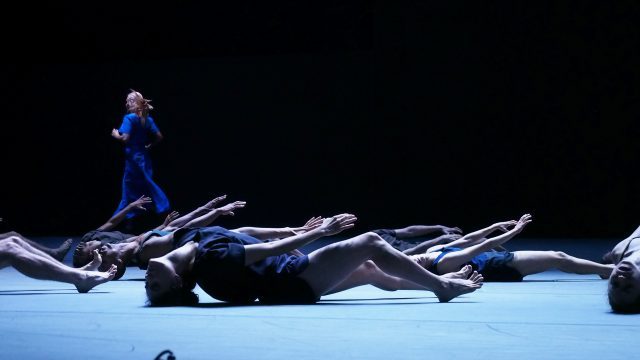
Batsheva Dance Company will perform LAST WORK at BAM February 1-4 (photo by Gadi Dagon)

BAM Howard Gilman Opera House
30 Lafayette Ave. between Ashland Pl. & St. Felix St.
February 1-4, $25-$65, 7:30
718-636-4100
www.bam.org
www.batsheva.co.il

Israeli choreographer Ohad Naharin and his Batsheva Dance Company return to BAM this week with Last Work, which, happily, is not the outstanding troupe’s farewell piece. Previously at BAM with 2014’s Sadeh21 and 2012’s Hora, Batsheva is presenting the New York premiere of the sixty-five-minute Last Work, which debuted in 2015 at the Suzanne Dellal Centre in Tel-Aviv. Gaga guru Naharin’s collaborators include lighting designer Avi Yona Bueno (Bambi), soundtrack designer Maxim Warratt, stage designer Zohar Shoef, composer Grischa Lichtenberger, and costume designer Eri Nakamura; the piece, which melds the personal with the political in unpredictable and surprising ways, will be performed by William Barry, Yael Ben Ezer, Matan Cohen, Omri Drumlevich, Bret Easterling, Hsin-Yi Hsiang, Rani Lebzelter, Ori Moshe Ofri, Rachael Osborne, Nitzan Ressler, Ian Robinson, Kyle Scheurich, Or Meir Schraiber, Maayan Sheinfeld, Yoni Simon, Bobbi Jene Smith, Zina (Natalya) Zinche, and Nakamura. In addition, Tomer Heymann’s new documentary about Naharin and Batsheva, Mr. Gaga, will be shown at BAMcinématek on January 30, followed by a Q&A with Naharin and producer Barak Heymann, moderated by Wendy Perron. The film opens February 1 at Film Forum and the Film Society of Lincoln Center, with several screenings followed by Q&As and Gaga demonstrations.

AN INTERNATIONAL TRIBUTE TO ELIE WIESEL: A COMMUNITY READING OF “NIGHT”

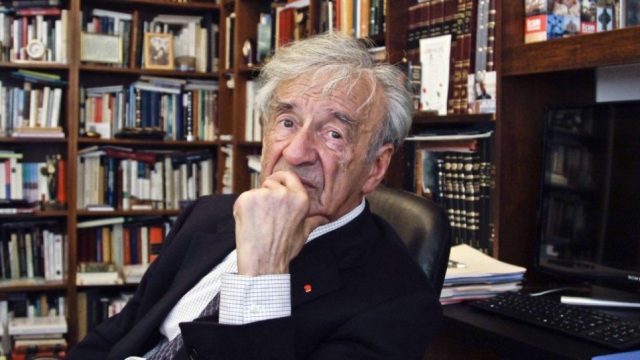
The late Elie Wiesel will be honored with a marathon reading of his first book, NIGHT, at the Museum of Jewish Heritage on January 29 (AP Photo/Bebeto Matthews)

The late Elie Wiesel will be honored with a marathon reading of his first book, NIGHT, at the Museum of Jewish Heritage on January 29 (AP Photo/Bebeto Matthews)

Who: Elisha Wiesel, Andre Aciman, Ambassador Katalin Bogyay, Letty Cottin Pogrebin, Ambassador Dani Dayan, Ambassador François Delattre, Tovah Feldshuh, Joel Grey, Sheldon Harnick, Jessica Hecht, Fanya Gottesfeld Heller, David Hyde Pierce, Bill T. Jones, Daniel and Nina Libeskind, Sheila Nevins, Itzhak Perlman, Ron Rifkin, Geraldo Rivera, Daryl Roth, Brita Wagener, Dr. Ruth Westheimer, more
What: Marathon reading of Elie Wiesel’s Night
Where: Museum of Jewish Heritage — A Living Memorial to the Holocaust, Edmond J. Safra Hall, 36 Battery Pl., 646-437-4202
When: Sunday, January 29, free, 3:00 – 8:00
Why: “In retrospect I must confess that I do not know, or no longer know, what I wanted to achieve with my words,” Elie Wiesel wrote in a 2006 translation of his seminal 1960 memoir, Night, about his and his father’s experience in Auschwitz. “I only know that without this testimony, my life as a writer — or my life, period — would not have become what it is: that of a witness who believes he has a moral obligation to try to prevent the enemy from enjoying one last victory by allowing his crimes to be erased from human memory.” The Museum of Jewish Heritage and National Yiddish Theatre Folksbiene are honoring the legacy of Holocaust survivor and Nobel Laureate Wiesel, who passed away last July at the age of eighty-seven, with a free five-hour marathon reading of Night on January 29 from 3:00 to 8:00. Among the participants are Tovah Feldshuh, Joel Grey, Sheldon Harnick, Jessica Hecht, David Hyde Pierce, Bill T. Jones, Itzhak Perlman, Ron Rifkin, Geraldo Rivera, and Dr. Ruth Westheimer. There will also be free admission to the museum itself, which is currently featuring such exhibitions as “My Name Is . . . The Lost Children of Kloster Indersdorf” and “Seeking Justice: The Leo Frank Case Revisited” in addition to its Core Exhibition that places the Holocaust in context with modern Jewish history. You can join the waitlist for this sold-out event or livestream it for free on Sunday afternoon.