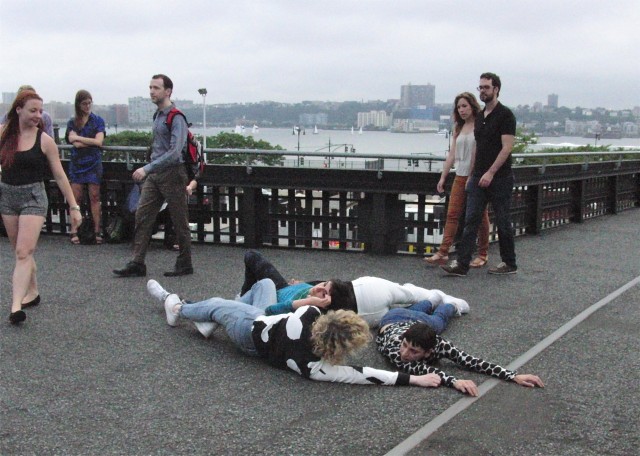
The latest iteration of Maria Hassabi’s Staged series will move be performed in City Hall Park as part of the River to River Festival (photo by twi-ny/mdr)
Multiple locations downtown
June 14-25, free
www.rivertorivernyc.com
lmcc.net
The best free multidisciplinary arts festival of the summer, River to River packs a whole lot into a narrow amount of time. Sponsored by the Lower Manhattan Cultural Council, this year’s activities, which, as always, focus on more experimental presentations, take place June 14-25 at such locations as Governors Island, Federal Hall, the National Museum of the American Indian, the Fulton Center, City Hall Park, and other downtown areas. While everything is free, some performances require advance registration because of space considerations. In addition to the below events, Katja Novitskova’s “EARTH POTENTIAL” Public Art Fund exhibition opens June 22 in City Hall Park, photographer Kamau Ware’s “Black Gotham Experience” interactive storytelling project will pop up at various places throughout the fest, LMCC’s Open Studios allows visitors the chance to meet with dozens of artists, and Kameelah Janan Rasheed’s “A Supple Perimeter” will be on view at LMCC’s Arts Center and Movie Theater Exterior on Governors Island.
Wednesday, June 14, 6:00
Wednesday, June 21, 8:00
Sunday, June 25, 7:00
The Dance Cartel: R2R Living Rooms, with DJ Average Jo and special guests, Pier A Harbor House
One of the most energetic companies around, the Dance Cartel will host a trio of live music and dance performances at the River to River Festival hub, with plenty of audience participation.
Thursday, June 15, 3:00 & 6:00
Monday, June 19, 3:00
Netta Yerushalmy: Paramodernities #2 and #3, National Museum of the American Indian
South Carolina–born choreographer and performer Netta Yerushalmy’s “Paramodernities” series deconstructs landmark dance works within the framework of modernity. For River to River, she will present Paramodernities #2, examining Martha Graham’s Night Journey, and Paramodernities #3, investigating Alvin Ailey’s Revelations, accompanied by scholars who will take part in public discussions. The seventy-five-minute production will move around inside the National Museum of the American Indian.
Thursday, June 15, 7:00
Saturday, June 17, 7:00
Sunday, June 18, 7:00
A Marvelous Order, Fulton Center
Joshua Frankel, Judd Greenstein, Will Rawls, and Tracy K. Smith have collaborated on the multimedia opera A Marvelous Order, which delves into the famous fight between Robert Moses and Jane Jacobs over the future development of New York City. For the River to River Festival, they will present a twenty-five-minute excerpt at the Fulton Center, with Eliza Bagg, Tomás Cruz, Lucy Dhegrae, Christopher Herbert, and Dashon Burton as Robert Moses and live music by NOW Ensemble, conducted by David Bloom.
Friday, June 16, 6:00
Amir Elsaffar: Rivers of Sound — Not Two, the Plaza at 28 Liberty
American jazz trumpeter and composer Amir Elsaffar celebrates the release of his latest record, Not Two (New Amsterdam, June 16), with a two-hour performance at the Plaza at 28 Liberty featuring his seventeen-piece Rivers of Sound orchestra.
Friday, June 16, 3:30
Saturday, June 17, 3:30
Sunday, June 18, 3:30
Jodi Melnick: Moat, Fort Jay, Governors Island
Choreographer, dancer, and teacher Jodi Melnick, who has said, “I am truly, madly, deeply in love with movement,” has teamed up with visual artist John Monti for Moat, a sixty-minute site-specific performance taking place in the moat that surrounds historic Fort Jay on Governors Island.
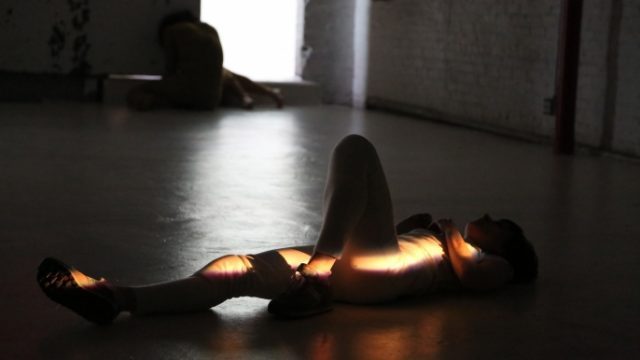
Beth Gill’s Catacomb will be performed in Federal Hall for the River to River Festival (photo by Brian Rogers)
Saturday, June 17, 8:00
Sunday, June 18, 8:00
Monday, June 19, 8:00
Beth Gill: Catacomb, Federal Hall
In May 2016, Bessie Award–winning choreographer Beth Gill presented the site-specific Catacomb at the Chocolate Factory, a dreamlike physical and psychological exploration of what we see and who we are. For River to River, the aching sixty-minute performance moves to historic Federal Hall.
Saturday, June 17, 12 noon – 6:00
Sunday, June 18, 12 noon – 6:00
Saturday, June 24, 12 noon – 6:00
Sunday, June 25, 12 noon – 6:00
The Set-Up: Island Ghost Sleep Princess Time Story Show, the Arts Center at Governors Island
For five years, Wally Cardona and Jennifer Lacey have been collaborating with men and women from multiple dance disciplines, presenting unique performances that push the boundaries of the movement arts. Their project now culminates in a grand finale on Governors Island, with dance masters I Nyoman Catra (Balinese Topeng), Proeung Chhieng (Cambodian), Junko Fisher (Okinawan), Saya Lei (Mandalay-style, classical Burmese), Jean-Christophe Paré (French baroque), Kapila Venu (Indian Kutiyattam), and Heni Winahyuningsih (Javanese refined) and musicians Jonathan Bepler, Reiko Fueting, and Megan Schubert. “Many dances on an ISLAND, a GHOST of what they were, having lost details during a long SLEEP but nevertheless the PRINCESS of their destiny. This TIME it is one STORY, full of fortuitous meetings, grave errors, and happy misunderstandings. It’s a SHOW, folks!” Cardona and Lacey explain. You can see the complete schedule here.
Monday, June 19, 6:00
Tuesday, June 20, 2:00
Wednesday, June 21, 2:00
Faye Driscoll: Thank You for Coming: Play, Broad and Wall Sts.
At last year’s LMCC Open Studios on Governors Island, the endlessly inventive Faye Driscoll offered a work-in-progress showing of the second part of her participatory “Thank You for Coming” series, which began in 2014 with Thank You for Coming: Attendance Play later moved to the BAM Fisher. She now revisits Play, staging a forty-minute version at the intersection of Broad and Wall Sts.
Tuesday, June 20, 4:00 – 8:00
Night at the Museums
Many Lower Manhattan museums and cultural institutions will stay open late on June 20, offering free entry to historic sites along with special programs. Among the participants are the African Burial Ground National Monument, China Institute, Federal Hall National Memorial, Fraunces Tavern Museum, Museum of American Finance, Museum of Jewish Heritage — A Living Memorial to the Holocaust, National Archives at New York City, National Museum of the American Indian, National September 11 Memorial Museum (advance RSVP required), 9/11 Tribute Center, NYC Municipal Archives, Poets House, the Skyscraper Museum, and the South Street Seaport Museum.
Wednesday, June 21, 5:00
Thursday, June 22, 3:00
Friday, June 23, 3:00
Marjani Forté-Saunders: Memoirs of a . . . Unicorn, Melville Gallery, South Street Seaport Museum
Pasadena-born, Harlem based dancer and choreographer Marjani Forté-Saunders, who previously was in the Urban Bush Women Dance Company, brings her solo Memoirs of a . . . Unicorn to the South Street Seaport Museum, a collaboration with media designer Meena Murugesan and sound designer Everett Saunders that relates to the history of Black American magic.
Thursday, June 22, 7:00
Friday, June 23, 7:00
Saturday, June 24, 7:00
Sunday, June 25, 5:00
En Garde Arts: Harbored, Winter Garden, Brookfield Place, 230 Vesey St.
En Garde Arts, which was founded by Anne Hamburger to “catalyze social change” through immersive theater, will stage the sixty-minute site-specific collage play Harbored, about Willa Cather, Lewis & Clark, and Cather’s character Ántonia. The piece, featuring more than fifty performers, is written and directed by Jimmy Maize, with an original score by Heather Christian sung by the Downtown Voices Choir and movement by Wendy Seyb. During the day, you can share your immigration story with them and it just might be incorporated into that night’s show.
Friday, June 23, 6:00
Sunday, June 25, 6:00
Maria Hassabi: Staged? (2016) — undressed, City Hall Park
Last summer, Maria Hassabi presented Movement #2 on the High Line, a dance performed by Simon Courchel, Hristoula Harakas, Molly Lieber, and Oisín Monaghan as people passed by. That morphed into Staged, which ran at the Kitchen in October. Now Hassabi is bringing Staged? (2016) — undressed to City Hall Park, where four dancers will move around Katja Novitskova’s “EARTH POTENTIAL” exhibition.
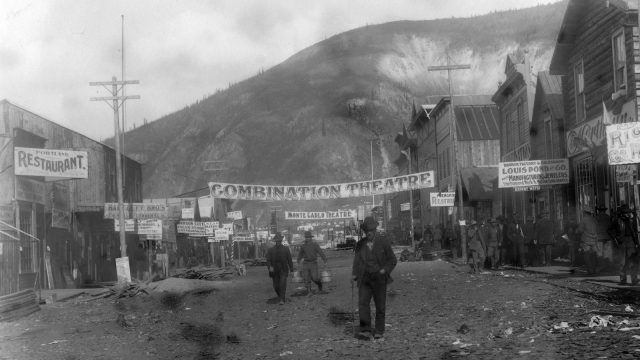
 “What power has gold to make men endure it all?” a title card asks in William Desmond Taylor’s 1928 silent film, The Trail of ’98, based on a novel by Robert Service. Both Taylor and Service were at one time residents of Dawson City, the town in the Yukon in Canada that was at the center of the Klondike Gold Rush in the late 1890s. In June 1978, while construction was just under way to build a new recreation center behind Diamond Tooth Gertie’s Gambling Hall in Dawson, Pentecostal minister and city alderman Frank Barrett uncovered a treasure trove of motion picture stock, hundreds of silent films that had been believed to have been lost forever. Writer, director, and editor Bill Morrison uses stunning archival footage from those films in his elegiac, beautiful documentary, Dawson City: Frozen Time, which brilliantly tells the story of greed, perseverance, and the growth of the entertainment industry in the late nineteenth and early twentieth centuries. After gold was discovered in Dawson, the indigenous Hän people were relocated to Tr’ochëk and some hundred thousand prospectors stampeded in, the gold mining destroying the Hän’s fishing and hunting grounds. Morrison also follows the invention of film itself, celluloid stock that would end up causing many fires, including one every year in Dawson for nine years. Bookended by an original interview with Michael Gates, Parks Canada curator of collections, and his wife, Kathy Jones-Gates, director of the Dawson Museum, the film traces the boom-and-bust fortunes and misfortunes of Dawson, as gambling casinos, movie theaters, hotels, and restaurants are built, including the Arctic, a hotel and restaurant owned by Ernest Levin and Fred Trump, the president’s grandfather, that might have served as a brothel as well. The film is supplemented with photographs by Eric A. Hegg, a giant in the field who left behind glass plates when he ultimately departed Dawson. Among others making their way through Dawson at one time or another are newsboy Sid Grauman, who went on to build Grauman’s Chinese Theatre; New York Rangers founder Tex Rickard; comic superstar Fatty Arbuckle; and Daniel and Solomon Guggenheim, who dominated the mining there.