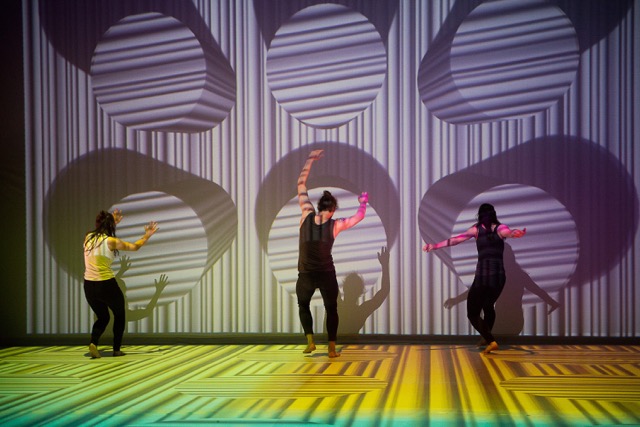
Jody Oberfelder Projects will present The Brain Piece at New York Live Arts June 28 – July 1 (photo by Christopher Duggan)
JODY OBERFELDER PROJECTS: THE BRAIN PIECE
New York Live Arts
219 West 19th St. between Seventh & Eighth Aves.
Wednesday, June 28, gala benefit $200, 7:30
June 29 – July 1, $25-$35, 7:00 & 9:00
212-691-6500
newyorklivearts.org
www.jodyoberfelder.com
New York-based director, choreographer, dancer, and filmmaker Jody Oberfelder’s The Brain Piece, premiering at New York Live Arts June 28 – July 1, continues her exploration of our internal organs, following on her extraordinary 2013 piece, 4Chambers, an immersive, multimedia, interactive journey inside the human heart. Performed by Oberfelder, Mary Madsen, Pierre Guilbault, and Hannah Wendel along with ten dancer docents, The Brain Piece is divided into two parts, “Mind Matters / Head Space” and “World of Brain,” combining film, visual art, installation, dance, music, and text for an audience limited to 72 members. The cerebral, multimedia piece includes her award-winning short film Dance of the Neurons, made with Eric Siegel, which turns firing synapses into a colorful, joyous dance. Oberfelder, a travel and yoga enthusiast and former lead singer of the punk band the Bagdads, founded Jody Oberfelder Projects in 1989 and has previously presented such works as The Titles Comes Last, Moved, Re:Dress, and Throb. The charming, gregarious, always energetic creator took a break from rehearsals to tell twi-ny all about The Brain Piece.
twi-ny: We recently bumped into each other at the Whitney Biennial, where you were serving as a docent for Asad Raza’s “Root sequence. Mother tongue,” an installation of living trees paired with specific objects, one of which you contributed. As museumgoers made their way through the exhibit, I couldn’t help but think of it as a kind of improvisatory dance with nature, especially with you there. What was that experience like?
jody oberfelder: We’re actually called caregivers. The people who pass through sometimes don’t know we’re positioned as such as we, as you describe, do this improvisatory dance with people in conversation. The show has been up since March and we’ve seen the trees go from bare, to blossom, to leafing, and now they can’t wait to get planted outside. Many people have passed through. Asad’s work balances organic, inorganic, and human all in the space. Having a person in the room is as important as the trees and the caregiver’s placed object. I’m learning that conversation is often this invisible thread that links things together in the present.
twi-ny: Your work is very scientific; were you interested in science when you were a kid?
jo: I would not say I grew up with a scientific bent. I had a fourth-grade teacher, Mr. Dowd, who explained the digestive system with panache (“…and out the other end” — we were all snickering). I’ve come to science through the body, and through a curiosity about what makes us alive. There is a beautiful ecosystem within us and a giant cosmos outside of us. Did you ever see that film by Charles and Ray Eames — Powers of Ten — it’s all about zooming out and zooming in. That, to me, is what science is about. Things can be very specific and very vast.
twi-ny: Yes, Powers of Ten is quite eye-opening. How did you find/choose your science collaborators — Dr. Wei Ji Ma, Cecilia Fontanesi, and Ed Lein — and what did each one bring to The Brain Piece?
Word of mouth.
Cecilia is a dancer and a neuroscientist. She met one of my dancers, Mary Madsen, at a party. I loved talking with her from the very beginning. The thing she said, “The brain is everywhere in the body,” totally clicked with my premise of dancers illuminating brain life.
Wendy Suzuki, who helped illuminate the brain-body connection for me, introduced Wei Ji to me. Wei Ji has been a great collaborator. He comes to rehearsals to “fact check” and advise. He’s in Dance of the Neurons. I audited his class at NYU on illusion. We did a combo lecture / performance in Amsterdam.
Another neuroscientist introduced Ed Lein to me: Gary Marcus. My company manager at the time, Clare Cook, was giving him private Pilates lessons. Gary and I had several conversations, which culminated in him saying, “You know, you should meet Ed from the Allen Institute for Brain Science. He specializes in the biology of neurons.” Ed and I had a back and forth on a kind of Skype sketchpad, and he drew little pictures of how neurons are formed that eventually became the literal storyboard for Dance of the Neurons. I embellished, of course, and played with all the ways neurons “dance” and form synaptic connection. I’m most grateful to these scientists, who are also artists.
twi-ny: Without giving too much away, how will the physical space of New York Live Arts come into play? Only the second half will take place in the theater on a proscenium stage, correct?
jo: It’s my hope that there really is no separation between the sections, that the more experience-based portions of the work continue to inform the world of the brain in the theater. There are nine films in part two. When you go to movies, you don’t question that the actors are not that big. I think the problem with live theater is that we’re in a long shot for too long. I’m creating an atmosphere of a giant brain with moving parts. I think this is the nature of brain plasticity: zoom in for close-ups, see what the alignment of neurons are doing at this time, how we’re constantly in a perceptual loop.
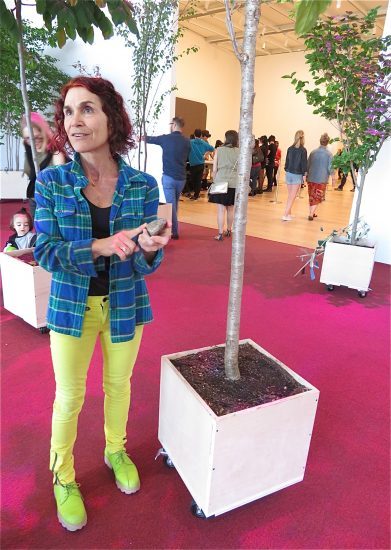
Jody Oberfelder served as a caregiver at the Whitney Biennial (photo by twi-ny/mdr)
twi-ny: 4Chambers involved a significant amount of interaction, at one point bringing the audience into physical contact with the dancers. Will there be anything similar in The Brain Piece?
jo: You’ll see.
twi-ny: Good answer. I only recently learned that the doctor who performed the autopsy on Albert Einstein actually removed his brain and brought it home to study. What is the most unusual thing you learned about the brain while making this piece?
jo: That the brain is a noisy place and we’re constantly trying to figure things out and make sense of the world. And that our bodies are the vehicles for us to sensorially enter the world. Ask a neuroscientist to define “mind” and they have no clear thing to pin down. There were philosophers, then psychiatrists, and now great discoveries in seeing the pictures in the brain, seeing what makes things go off, decay, or become more plastic, make connections: That’s the dance of neurons. But the mind — it’s like vapor. We breathe in present and past. It’s in constant motion. And dancers are the perfect vehicles to convey this movement.
twi-ny: How have the two works brought the heart and the mind together for you?
jo: The heart leads to the mind. When working on 4Chambers, I interviewed Wendy, who talked about the sympathetic and parasympathetic nervous system and how all the way down from our brains our hearts operate. We feel our hearts, but it’s triggered by the mind. You know how what your brain is doing by what your heart is doing, and vice versa. “I can put my hand on your heart and feel your heartbeat, but if I put my hand on your skull, I can’t feel your thoughts.”
twi-ny: Regarding Dance of the Neurons, your choreography has always been very cinematic, and The Brain Piece includes that short film, which has been garnering prizes at festivals. How do you see the two disciplines merging in your work?
jo: Thank you. Someone at a festival said I was a filmic choreographer. I like that. I’m pretty visual. Like a filmmaker, I’m in the business of arranging time and space and hidden narrative. I use a lot of improvisation around ideas and look for dancers who can take the ball and run with it. I like to think that if I give the performers imaginative tasks, the content will form, and it’s my job as a director and choreographer to prepare for a rehearsal with a loose storyboard of possibilities, then go deeply inside the physical investigation for the interaction with audience members, the films, and the onstage content. Devising content is a matter of honing in on what feels right.
I worked with a wonderful dramaturg this time around: Jessica Applebaum. The piece has had many renderings. She helped me not be afraid of the complexity of the subject matter and to go forward making. Details and big picture always in mind. Jessica has also left me a lot of space these last months to figure it out on my own. Today our neuroscientist, Wei Ji, was there to see me finish the finale in our last moments of our last rehearsal!
I love it now. I’m even surprised by it.
twi-ny: I’m very much looking forward to being surprised by it as well. This might be an obvious closing question, but now with the heart and the brain covered, do you anticipate continuing to explore the mind-body connection with different organs as the focus?
jo: The sex organs will probably be combined with the guts. Like when you feel something in your gut. Intuition. Power.


 The sixteenth annual New York Asian Film Festival gets under way June 30 with writer-director Nattawut Poonpiriya’s big Thai hit, Bad Genius. The amazingly smart Lynn (NYAFF 2017 Screen International Rising Star Award winner Chutimon Cheungcharoensukying) switches schools for an opportunity to win a coveted scholarship and go to a better college, with the help of her father, a respected teacher (Thaneth Warakulnukroh). She quickly becomes besties with the popular Grace (Eisaya Hosuwan), who is dating snobby rich kid Pat (Teeradon Supapunpinyo). Lynn mentors Grace, who is not a very good student, and is then hired by Pat’s wealthy father (Sahajak Boonthanakit) to tutor his son to improve his low grades. Soon Grace, Pat, and several of Pat’s other friends (Vittawin Veeravidhayanant, Suwijak Mahatthanachotwanich, Narwin Rathlertkarn, Thanawat Sutat Na Ayutthaya, and Thanachart Phinyocheep) are paying substantial money to Lynn, who has devised unique ways to cheat on multiple-choice tests. As she and Bank (Chanon Santinatornkul), another smart scholarship student — whose parents (Uraiwan Puvichitsutin and Somchai Ruedikunrangsi) run a small laundry, which embarrasses him and drives him to improve his, and their, lot — compete for a prestigious Singapore scholarship, lies, betrayal, greed, and deception lead to major troubles for everyone as the crucial standardized STIC tests approach.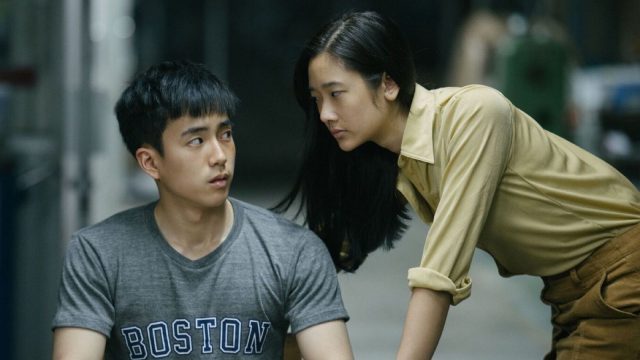
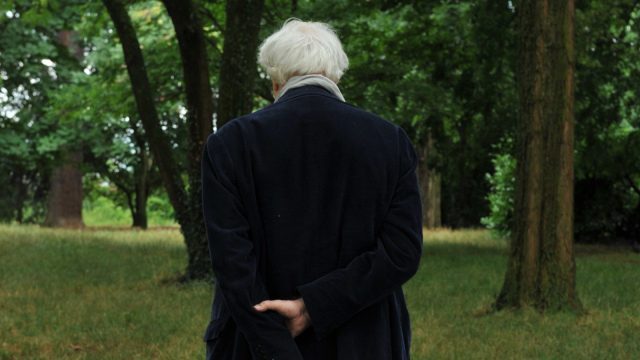
 Auteur and film historian Bertrand Tavernier takes viewers on a fascinating, deeply personal trip into the world of early French movies in the extraordinary My Journey through French Cinema. Inspired by Martin Scorsese’s 1995 A Personal Journey with Martin Scorsese through American Movies and 1999 My Voyage to Italy, the French auteur recounts how he believes that going to the theater as a child helped him survive a serious illness and led to a lifelong love of cinema; he even battled and beat cancer while making this documentary. In more than three hours that fly by surprisingly quickly, Tavernier examines dozens and dozens of French films, not looking at them as a historian or a fan but as a fellow director; in addition, the film unfolds neither chronologically nor thematically but in a delightfully charming stream of consciousness as Tavernier shares personal anecdotes that lead him from film to film and director to director. He begins by describing the first movie that had a major impact on him, Jacques Becker’s Dernier Atout, and moves on to his days working with Volker Schlöndorff for Jean-Pierre Melville, who thought he was a terrible assistant and turned him into a publicist; Tavernier also wrote for Les Cahiers du cinema and Positif. Through voiceover and onscreen appearances, Tavernier spends a lot of time discussing Melville (Bob le flambeur, Le Doulos) and Claude Sautet (Classe tous risques), whom he considers his cinematic godfathers; Becker (Casque d’Or, Le Trou); Jean Renoir (A Day in the Country, Rules of the Game); Marcel Carné (Le jour se lève, Hôtel du Nord); Jean-Luc Godard (Contempt, Pierrot le fou); composers Maurice Jaubert (Port of Shadows, L’Atalante) and Joseph Kosma (Le Chat, House on the Waterfront); and actors Jean Gabin (La Bȇte Humaine, Grand Illusion) and Eddie Constantine (Alphaville, Cet homme est dangereux). Also garnering significant mention are Jean Sacha, Gilles Grangier, Henri Decoin, Jean Delannoy, Edmond T. Gréville, Lino Ventura, and Pierre Schoendoerffer.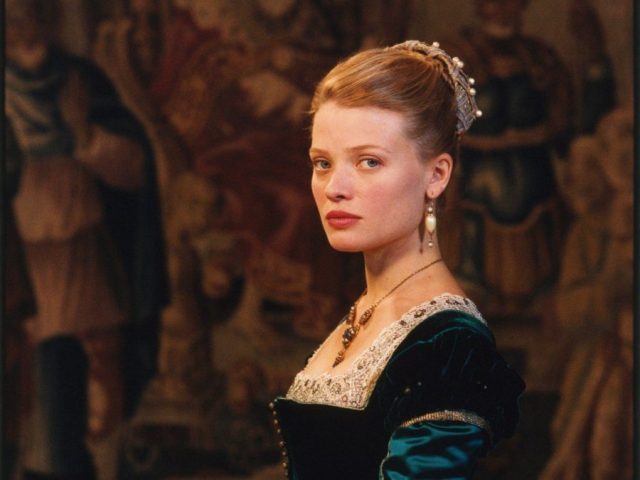
 In Bertrand Tavernier’s sweeping romantic epic, young and beautiful Marie de Mézières (Mélanie Thierry) has a big problem: It seems that every man she meets falls in love with her. Already in a passionate relationship with the heroic Henri de Guise (Gaspard Ulliel), a leader of the Catholics against the Protestant Huguenots in the French Wars of Religion of the 1560s, Marie is suddenly part of a shady deal between her father (Philippe Magnan) and the Duke de Montpensier (Michel Vuillermoz), marrying her off to the rather uninspiring though steadfast Prince Philippe de Montpensier (Grégoire Leprince-Ringuet), who warms to his bride much quicker than she to him. Returning to the battlefield, Philippe asks his mentor, the older and wiser Count de Chabannes (Lambert Wilson), to teach Marie in the ways of the court to prepare her for meeting Catherine de Medici, but even such a solid, moralistic man as Chabannes — who deserted from the army after killing a peasant family, supposedly in the name of his lord and saviour — cannot prevent himself from succumbing to the many charms of his unaware charge. And when she meets the wild and unpredictable Duke d’Anjou (Raphaël Personnaz), the king’s brother is smitten as well. But through it all, Marie, a modern woman who wants to learn to write and make her own choices, remains fiercely drawn to Henri, a forbidden love that threatens dire consequences. Based on the 1662 novella by Madame de La Fayette, The Princess of Montpensier is a thrilling tale of love and war, of honor and betrayal.
 “There’s something about a train that’s magic,” Richie Havens sang in a series of 1980s Amtrak commercials. Master documentarian Albert Maysles goes in search of that magic in his final film, In Transit. In 2014-15, Maysles, who passed away in 2015 at the age of eighty-eight, and his team took several trips on Amtrak’s Empire Builder, described as “America’s busiest long-distance train route,” which carries passengers between Chicago and the Pacific Northwest over the course of three days, following much of the route that explorers Lewis and Clark mapped out in the early nineteenth century. Maysles, Nelson Walker, David Usui, and Ben Wu focus handheld cameras on men, women, and children of all ages and ethnicities as they talk with other passengers about transitions they’re going through. One pregnant woman is past her due date, hoping she makes it to Minnesota to give birth with members of her family. She makes friends with a man who is photographing everywhere they go. A young man has suddenly quit his job to try to make a new life with his high school sweetheart in Indiana. A Native American talks about how he is riding the train to think about his relationship with his partner, which is on the ropes. An abused woman is returning from seeing her daughter for the first time in nearly half a century. Sometimes they’re speaking directly with Maysles, and other times the filmmakers are like flies on the wall, picking up snippets of conversations as the passengers share their hopes and dreams, along with their struggles and fears, in true cinéma vérité fashion. Everyone is open and free, including the conductors. “This is the only job I’ve ever wanted,” one of the trainmen explains.