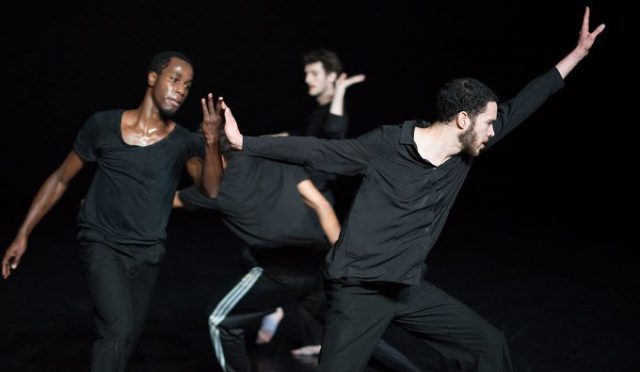
Anne Teresa De Keersmaeker and Salva Sanchis revisit John Coltrane’s A Love Supreme with four male dancers (photo © Anne Van Aerschot)
New York Live Arts
219 West 19th St. between Seventh & Eighth Aves.
September 27-30, 7:30
212-924-0077
newyorklivearts.org
www.rosas.be/en
In December 1964, saxophonist John Coltrane made one of the greatest jazz records of all time, A Love Supreme, a four-part suite consisting of “Acknowledgement,” “Resolution,” “Pursuance,” and “Psalm,” featuring Coltrane on tenor and soprano sax, Jimmy Garrison on double bass, Elvin Jones on drums and percussion, and McCoy Tyner on piano. In 2005, Belgian choreographer Anne Teresa De Keersmaeker and Spanish dancer and choreographer Salva Sanchis created the four-part dance suite A Love Supreme, set to Coltrane’s legendary music; they have now revisited the piece, rewriting it for four male dancers from De Keersmaeker’s Rosas company. The fifty-five-minute dance work, which will be performed by José Paulo dos Santos, Bilal El Had / Robin Haghi, Jason Respilieux, and Thomas Vantuycom, investigates the desire for happiness through mysticism and spirituality, incorporating jazzlike improvisation into the movement, with each dancer interpreting one of the musicians on the record: Vantuycom is Coltrane, Respilieux is Garrison, El Had / Haghi is Tyner, and dos Santos is Jones. When the musicians improvise, so will the dancers.
“Taking on A Love Supreme fits with the idea of revisiting and rewriting Rosas’s repertoire for a new generation of dancers,” De Keersmaeker said in a statement. “What is interesting about the piece, in addition to its intrinsic connection with this milestone of twentieth-century music, is the way it combines improvised and written choreography.” Sanchis, who was part of the original cast in 2005, added, “On the whole, A Love Supreme is more suitable for a dance performance than a simple collection of songs. The music poses a structure with a beginning and an end, offering a kind of dramaturgical accessibility.” The New York City premiere of A Love Supreme runs at New York Live Arts September 27-30 at 7:30, with saxophonist Tony Jarvis performing a tribute to the seminal album at seven o’clock each night. The September 28 show will be followed by a Stay Late Conversation moderated by NYU associate professor and associate chair André Lepecki; there will be a Shared Practice workshop September 30 at 2:00 ($20) with Rosas rehearsal director Bryana Fritz and Respillieux; and on September 30 at 5:00 ($10), NYLA artistic director Bill T. Jones will be joined by music historian Ashley Kahn and bassist and composer Reggie Workman for the special Coltrane program “Bill Chats — The Man and His Music.” Tickets are sold out for all four shows, but there will be a standby line each evening to see what De Keersmaeker calls “essentially a piece about defying gravity. It is a piece about the relationship between mankind and the planet, between the vertical and the horizontal.”




 If you didn’t know any better, you might think that Elvia Lund’s extraordinary Bobbi Jene was a fiction film. Danish director and cinematographer Lund, editor Adam Nielsen, and composer Uno Helmersson have employed narrative story techniques in crafting a bold and intimate tale about fear and desire, romance and ambition. But Bobbi Jene is actually a deeply personal documentary about a woman turning thirty and taking stock of her life. “I want to get to that place where I have no strength to hide anything,” Iowa native Bobbi Jene Smith says, and that is evident from the brief opening scene of Bobbi dancing naked and alone. When she was twenty-one, Bobbi moved to Israel to become a member of the world-renowned Batsheva Dance Company, led by choreographer Ohad Naharin, developer of the unique Gaga movement language. (I’ve seen her dance several times with Batsheva and have been touched and impressed by her abilities.) Now that she’s nearly thirty, Bobbi has decided to go back to America and create pieces herself, which she tells Naharin, with whom she had a relationship. “I love being in the company. I love dancing for you,” she says during their talk at a busy café. “I just feel it’s time for me to go make my own work.” Naharin carefully responds, “So it’s painful, but it’s probably also what you need.” Bobbi is not only leaving the troupe but her boyfriend, twenty-year-old company dancer Or Schraiber, who loves her but does not want to leave Tel Aviv. We see her struggling with her decision, trying to convince herself that she can both make a career in the States while also maintaining a long-distance relationship with Or. Once back in America, Bobbi concentrates on her durational solo piece A Study on Effort, a raw, intense work that combines power with vulnerability as she explores pleasure and pain. As she prepares to perform the piece at the Israeli Museum in Jerusalem, all the different parts of her life threaten to overwhelm her.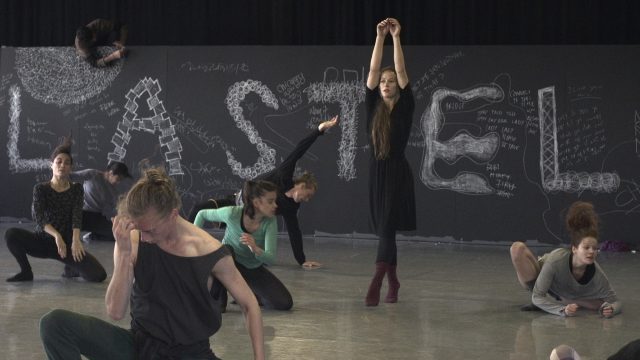

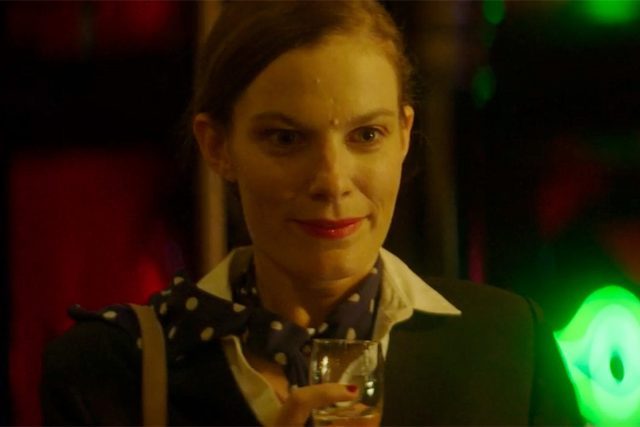
 After her lover, Paul (Damien Bonnard), hangs himself, Gina (Lindsay Burdge), a rather dim flight attendant, hooks up with Jérôme (Bonnard again), a bartender at a strip club. But what is a one-night stand for Jérôme turns into a dangerous obsession for Gina in Nathan Silver’s Thirst Street, a dark comedy that is neither dark nor funny. The problem is that until a rousing finale, Gina and Jérôme are not sympathetic characters that the audience will care about in the slightest. It doesn’t appear that it’s the suicide that drives Gina nuts; she’s already a dull, uninteresting person before that, and Jérôme is not exactly someone you can get behind either. Silver has said that Gina was inspired by Don Quixote, but she’s more of a disappointing combination of the protagonists from Aki Kaurismäki’s Match Factory Girl, Jean-Pierre Jeunet’s Amélie, and Adrian Lyne’s Fatal Attraction as seen through the lens of Brian De Palma and Wes Anderson (especially when it comes to Anjelica Huston’s narration). Burdge (The Midnight Swim, A Teacher) turns in a brave performance, and Esther Garrel is terrific as punk rocker Clémence, Jérôme’s former flame, but the rest of the cast fails to ignite, despite boasting such actors as Jacques Nolot as nightclub owner Franz and Françoise Lebrun as Gina’s landlady. (Silver also once again casts his mother, Cindy, this time as one of Gina’s fellow flight attendants; let’s just say she doesn’t do him any favors with her acting ability.) Silver (Uncertain Terms, Stinking Heaven) never quite grasps what the film should be, resulting in a confusing mess of multiple genres that merely brushes the surface of his tongue-in-cheek (or is it?) narrative. Thirst Street opens September 20 at the Quad, with Silver and Burdge participating in Q&As following the 6:55 screenings on Wednesday, Thursday, and Friday night.