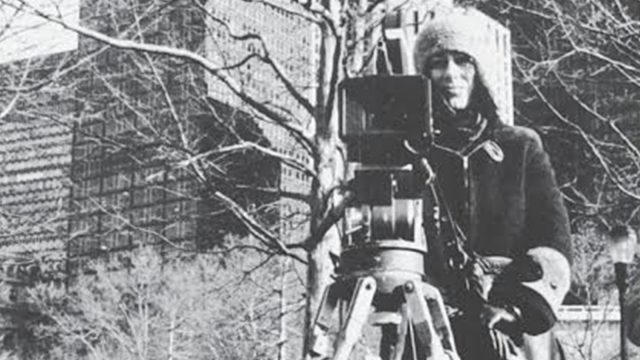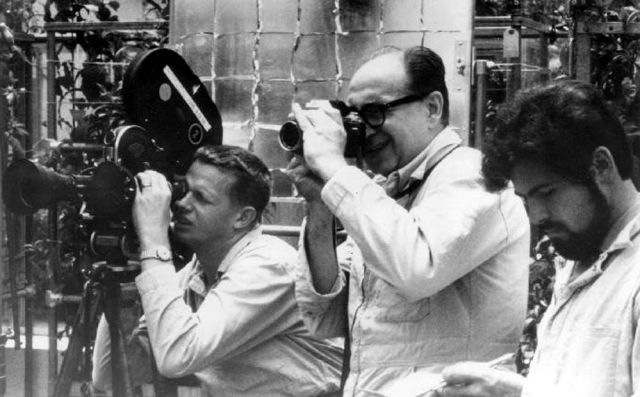
Saul Bass (middle) on the set of his Oscar-winning short Why Man Creates
Metrograph
7 Ludlow St. between Canal & Hester Sts.
Wednesday, August 2, 7:00, and Monday, August 7, 8:45
212-660-0312
metrograph.com
Bronx-born graphic designer Saul Bass had a long and fruitful career designing titles and posters for movies, from 1954’s Carmen to 1995’s Casino, including such all-time greats as Vertigo, The Man with the Golden Arm, Anatomy of a Murder, and Spartacus. He is also responsible for logos for the Girl Scouts, the United Way, Bell Telephone, Geffen Records, AT&T, ALCOA, and many more. But Bass, who passed away in 1996 at the age of seventy-five, was also an Oscar-winning film director, and his legacy is being celebrated on August 2 and 7 at Metrograph with the special program “Why Man Creates — the Work of Saul Bass.” The evening, which will be introduced by visual artist and director Chris Rubino and writer Mayo Simon, is named for Bass’s hugely entertaining 1968 short, Why Man Creates, which won the Academy Award for Best Short Documentary Subject. The twenty-five-minute film traces the history of artistic, scientific, and technological innovation, divided into “The Edifice,” “Fooling Around,” “The Process,” “The Judgment,” “The Search,” and “The Mark” as well as “A Parable” and “A Digression,” using playful animation, an unpredictable score, man-on-the-street interviews, and more, taking on such important issues as hunger, the Big Bang theory, and death, all with a wickedly wry sense of humor. Also on the bill are Bass’s 1980 Oscar-nominated The Solar Film, an early look at solar energy, with Michael Oldfield’s “Tubular Bells” lending it all an Exorcist-like feel; Saul Bass: In His Own Words; a trailer reel; a commercial reel; title sequences; and a special guest. Be sure not to get there late; as Bass, who partnered with his wife, Elaine, on much of his work, noted in a 1977 interview, looking back at the start of his title-designing career, “I had felt for some time that the audience involvement with a film should really begin with the very first frame.” The Bass program, which also includes a week-long revival (August 4-10) of his only full-length feature film, 1974’s Phase IV, is part of the Academy of Motion Picture Arts and Sciences’ new year-long residency at Metrograph, which began last week with George Stevens’s A Place in the Sun.



 “So long space remains, so long sentient beings remain, so long suffering remains, I will remain. In order to serve. That is the real purpose of our life,” His Holiness the 14th Dalai Lama says at the beginning of Mickey Lemle’s documentary, The Last Dalai Lama. For nearly 450 years, the spiritual leader of Tibet has been known as the Dalai Lama, reincarnated to continue the lineage and guide the Tibetan people through his wisdom and compassion. But China, in its ongoing suppression of Tibet, has now decided it will choose the next Dalai Lama, so His Holiness, born Tenzin Gyatso in 1935, has vowed that if necessary, he will reincarnate as someone other than a Dalai Lama, bringing an end to the chain. Lemle introduced the world to the 14th Dalai Lama in 1993 with the release of Compassion in Exile: The Story of the 14th Dalai Lama; the new film, which Lemle wrote, produced, directed, and coedited, was made in conjunction with His Holiness’s eightieth birthday, which was celebrated with a Long Life Ceremony at the Javits Center in New York City (that we attended). The film reveals the Dalai Lama, a Buddhist meditation practitioner who escaped Tibet in 1959 and set up a new home in Dharamsala, India, to be both a mensch and a superstar, a man of deep, philosophical wisdom and great compassion for all sentient beings, as well as a very funny man with an infectious laugh. Lemle (The Other Side of the Moon, Ram Dass Fierce Grace) investigates the history of Tibetan relations with China while exploring the biography of the Dalai Lama, including interviews he made with him in the early 1990s.

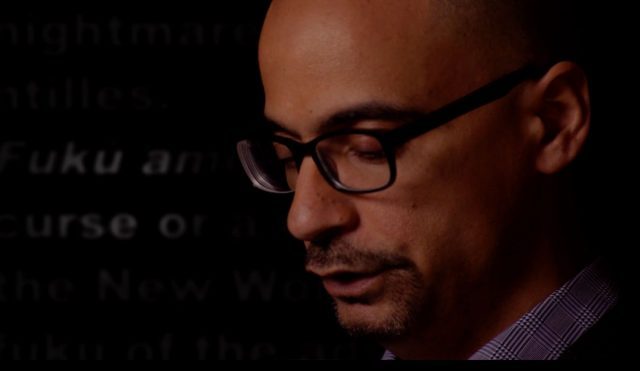
 Oscar- and Emmy-winning director Kirk Simon’s The Pulitzer at 100 boasts a remarkable cast and some of the best lines ever written in the history of American arts and letters. It’s also a self-congratulatory bore. Simon celebrates the centennial of the Pulitzer Prize, first awarded by Columbia University in four categories in 1917, by speaking with a vast array of winners from the worlds of journalism (Carl Bernstein, Martin Baron, Thomas Friedman, Nicholas Kristof, Sheri Fink, David Remnick), fiction (Toni Morrison, Michael Chabon, Junot Díaz, Jeffrey Eugenides), drama (Tony Kushner, Paula Vogel, Ayad Akhtar), music (Wynton Marsalis, John Adams), biography (Robert A. Caro), poetry (Yusef Komunyakaa), photography (John Filo, Nick Ut), and more. He also films Martin Scorsese, Helen Mirren, Natalie Portman, Liev Schreiber, John Lithgow, and Yara Shahidi performing selections from the works of some of their favorite writers, including Philip Roth, Harper Lee, and Eugene O’Neill. Interspersed between all of the literary lathering are interesting tidbits — delivered by such historians as Cyrus Patell, Theodore L. Glasser, Roy Harris, and James McGrath Morris — from the life and times of one Joseph Pulitzer, an Austro-Hungarian merchant’s son who came to America as a mercenary to fight in the Civil War. Pulitzer eventually got involved in newspaper publishing, had yellow-journalism battles with William Randolph Hearst, and left money for Columbia to start the Graduate School of Journalism.