this week in lectures, signings, panel discussions, workshops, and Q&As

CHAVELA

The extraordinary life and career of Chavela Vargas is documented in revelatory documentary

The extraordinary life and career of Chavela Vargas is documented in revelatory documentary

CHAVELA (Catherine Gund & Daresha Kyi, 2017)
Film Forum
209 West Houston St.
October 4-17
212-727-8110
filmforum.org
www.musicboxfilms.com

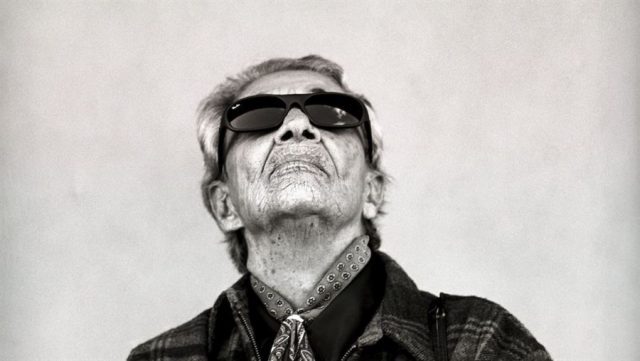
The extraordinary story of beloved Mexican ranchera singer Chavela Vargas is intricately documented in Catherine Gund and Daresha Kyi’s warm and intimate Chavela, opening at Film Forum today. Chavela’s life might seem an all-too-familiar archetype, the tale of a powerful female vocalist, a lesbian performer whose career was wrecked by the lethal combination of a heterosexual macho society, personal demons, and addiction, but Chavela avoids stereotypes and instead delivers a very human portrait. Born in Costa Rica in 1919, Chavela had an unhappy childhood and ran away to Mexico when she was fourteen to pursue a singing career and live a freer life, able to explore her sexual orientation as she grew older. “Her own parents saw her as a strange girl. They realized she was a boyish girl,” composer Marcela Rodríguez says. “Her movement, her hands, and her body language were manly.” Her longtime partner, human rights lawyer Alicia Pérez Duarte, adds, “Chavela created her persona in a very macho world.” Chavela dedicated her life to her music while keeping much of her personal life private — the film drops little more than tantalizing hints about her relationship with artist Frida Kahlo and an evening with Ava Gardner — and her commanding presence and powerful vocal style quickly made her a star in the 1940s and ’50s. “Hers wasn’t a sweet, crystal clear voice,” says cabaret owner Jesusa Rodríguez. “And she always sounded like she’d been torn apart, as if she’d been born with the wounds of life and death.” But at the height of her fame, those wounds started catching up to her as she began drinking heavily, resulting in a fifteen-year hiatus during which many people thought she was dead. The film centers around a never-before-seen 1991 interview Gund conducted with Chavela upon her return to singing, as she speaks more openly and honestly about her sexuality, her family, and her career. She’s a riveting figure, confident and determined, ready to face the world again. “We all have to live in the present. Don’t think about yesterday or tomorrow. Today,” she says.

Editor Carla Gutiérrez seamlessly weaves between archival film and photographs of Chavela performing onstage and in movies, complete with English translations of the heartfelt lyrics; interviews from 1991 and later, as she revels in being a star again; and new interviews with cabaret owners Jesusa Rodríguez and Liliana Felipe, singers Tania Libertad and Miguel Bosé, Federico García Lorca Foundation president Laura García Lorca, artist Martirio, composer and singer José Alfredo Jiménez Jr., whose father wrote many of the songs that made Chavela famous, and Spanish director Pedro Almodóvar, who used her music in his movies and played a major role in her comeback, which took Chavela around the globe, including to her beloved Madrid and to Carnegie Hall. “In her voice, I’ve found one of my best collaborators. And a faithful reflection of myself,” he says in an old clip, a feeling that is shared by many who knew her. Producer-directors Gund (Born to Fly, A Touch of Greatness) and Kyi (Land Where My Fathers Died; Thugs, the Musical) clearly love their subject, and their love is contagious, welcoming viewers into the pure majesty that is Chavela Vargas. (The 6:15 show on October 7 will be followed by a Q&A with Gund and Kyi, moderated by LGBT activist Eliel Cruz; the 2:20 show on October 8 will be followed by a Q&A with Gund and Kyi; the 8:10 show on October 10 will be followed by a Q&A with Gund, moderated by NewFest’s Nick McCarthy; and the 8:10 show on October 17 will be followed by a Q&A with Carnegie Hall show producer Claudia Norman, moderated by Cinema Tropical executive director Carlos Gutiérrez. In addition, Stephanie Trudeau is bringing her one-woman docu-cabaret show Chavela: Think of Me back to the Pangea Restaurant & Supper Club on November 2, 19, and 16.)
112th: DAVID GOODWIN ON LEFT BANK OF THE HUDSON

david goodwin left bank of the hudson

Who: David J. Goodwin
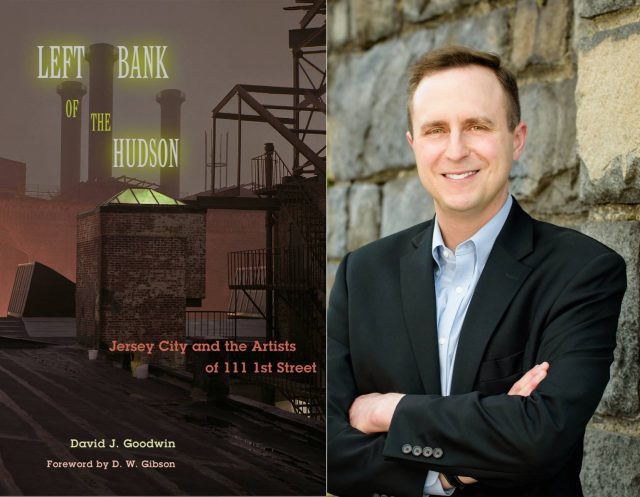
What: Book talk and signing with David J. Goodwin, author of Left Bank of the Hudson: Jersey City and the Artists of 111 1st Street (Fordham University Press, October 2017, $24.95)
Where: Book Culture, 536 West 112th St. between Broadway & Amsterdam Ave., 212-865-1588
When: Tuesday, October 3, free, 7:00
Why: In his blog, Another Town on the Hudson: Jersey City and Its Culture, Fordham University School of Law librarian David J. Goodwin describes himself as “a frustrated fiction writer, aspiring historian, and budding urban homesteader.” A past commissioner and chairman of the Jersey City Historic Preservation Commission and currently a board member of the Jersey City Landmarks Conservancy, Goodwin has just written Left Bank of the Hudson: Jersey City and the Artist of 111 1st Street, a detailed examination of an artist colony that took shape at an old tobacco warehouse in Jersey City in the late 1980s when a group of New York City painters, sculptors, photographers, writers, and filmmakers headed across the river in search of affordable studio space. Goodwin will be at Book Culture in Harlem on October 3 at 7:00 to discuss and sign copies of the book, which includes a foreword by D. W. Gibson, author of The Edge Becomes the Center: An Oral History of Gentrification in the 21st Century. At the talk, Goodwin will delve into the history of 111 First St., gentrification, geographic and architectural options for artists, interaction with government officials, and more. And you don’t even have to cross the Hudson to get there.

THE RED LETTER PLAYS: IN THE BLOOD

(photo © 2017 Joan Marcus)

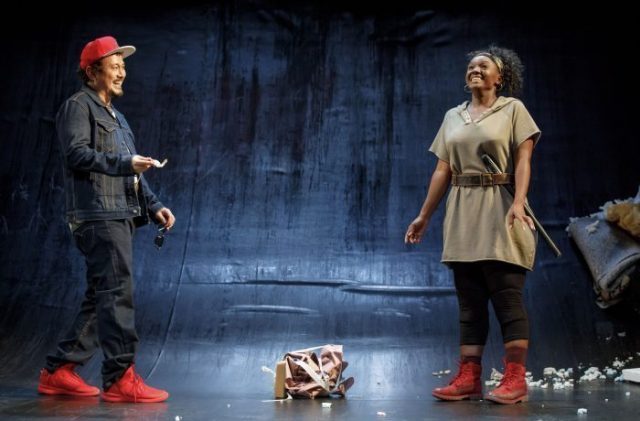
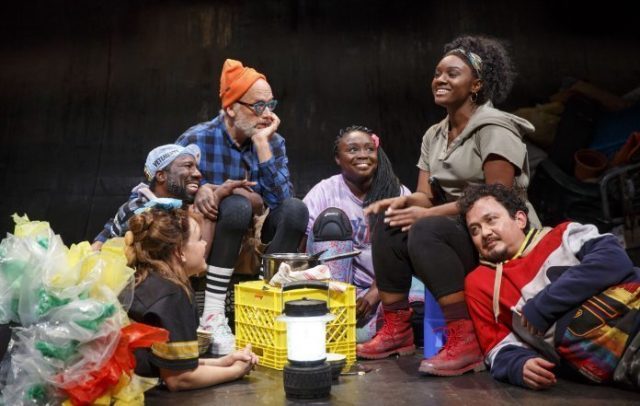
Hester, La Negrita (Saycon Sengbloh) believes a fairy-tale life is possible in Suzan-Lori Parks’s In the Blood (photo © 2017 Joan Marcus)

The Pershing Square Signature Center
The Alice Griffin Jewel Box Theatre
480 West 42nd St. between Tenth & Eleventh Aves.
Tuesday – Sunday through October 15, $30 ($75 starting October 10)
212-244-7529
www.signaturetheatre.org

In Fucking A, the first of the two Red Letter Plays that Suzan-Lori Parks wrote in the late 1990s inspired by Nathaniel Hawthorne’s The Scarlet Letter, the protagonist, Hester Smith, is an ostracized abortionist with an “A” branded near her heart, a single mother with a son in prison, both caught up in a cruel system. In the first Red Letter Play, the extraordinary In the Blood, which is currently running in tandem with Fucking A at the Signature Theatre, the main character is Hester, La Negrita (Saycon Sengbloh), a welfare mother with five young children from five different men. In her case, the “A” is the first letter of the alphabet; she is trying to learn to read and write, without much success. Hester and her kids — Jabber (Michael Braun), Bully (Jocelyn Bioh), Trouble (Frank Wood), Beauty (Ana Reeder), and Baby (Russell G. Jones), all wearing Montana Levi Blanco’s fanciful costumes — live in filth under a bridge, where trash is regularly pumped in. The town blames Hester herself for the predicament she’s in; at the beginning of the play, members of the community yell at her, “That’s why things are bad like they are / cause of girls like that . . . And now we got to pay for it. . . . She don’t got no skills / cept one,” adding, “She knows she’s a no count / Shiftless / Hopeless / Bad news / Burden to Society / Hussy / Slut / Pah!” But Hester adores her children, constantly referring to them as her “treasures,” her “joys.” She wants her life to be a fairy tale; she even tells her kids a bedtime story that serves as an uplifting metaphor about their situation. Hester is desperate to provide for her family, but she sometimes gets in her own way, looking for shortcuts because she doesn’t know any better. Each of the actors playing Hester’s children also doubles as an adult with ties to her: Amiga Gringa (Reeder) is a prostitute who is friends with Hester; the Doctor (Wood) offers her free medical tests and advice; Welfare Lady (Bioh) wants Hester to start helping herself and being more conscientious; Reverend D. (Jones), the father of one of Hester’s kids, keeps avoiding acknowledging their former relationship; and Chilli (Braun), the love of her life, is back in town and looking for her. (The names Reverend D. and Chilli are direct references to Puritan minister Arthur Dimmesdale and Hester Prynne’s husband, Roger Chillingworth, from Hawthorne’s 1850 novel, although the plot is completely different.)

(photo © 2017 Joan Marcus)

Chilli (Michael Braun) meets up with Hester (Saycon Sengbloh) in unique riff on Nathaniel Hawthorne’s The Scarlet Letter (photo © 2017 Joan Marcus)

In the Blood is beautifully written by Pulitzer Prize winner Parks (Topdog/Underdog, The Death of the Last Black Man in the Whole Entire World and superbly directed by Obie winner Sarah Benson (An Octoroon, Samara), never heavy-handed as they explore racism, misogyny, religious corruption, and inefficient government bureaucracy. Louis Thompson’s set has Hester trapped from the outset, a curved metal ramp serving as a Sisyphean non-exit, while bars put Hester in a zoolike cage. Tony nominee Sengbloh (Eclipsed, Hurt Village) gives a deeply heartfelt performance as Hester, La Negrita, a caring woman who just wants her family to be happy. “My lifes my own fault,” she recognizes. “But the world dont help.” Each of the adult characters delivers a soliloquy, called a “confession,” regarding their connection, primary sexual, to Hester, seeing her first and foremost as a sexual object, not as a person with very real problems. “Do not for a moment think I am one of those people haters who does not understand who does not experience — compassion,” the Doctor says. The Welfare Lady explains, “I walk the line / between us and them / between our kind and their kind. / the balance of the system depends on a well-drawn boundary line / and all parties respecting that boundary.” And the Reverend D. admits, “Suffering is an enormous turn-on.” In the Blood, which also features choreography by Annie-B Parson and movement by Elizabeth Streb, is a riveting, deeply intelligent and powerful parable that takes place in the “here” and “now,” marking it as a timeless work about institutionalized social ills that don’t look to be going away any time soon. (Parks will be playing with her band, guitarist Christian Konopka and percussionist Julian Rozzell, on October 7 at 4:15 and 6:30 at the Signature Café + Bar; admission is free and open to the public. There will also be a talkback with members of the cast and crew following the October 5 performance of In the Blood.)

A VERY SORDID WEDDING

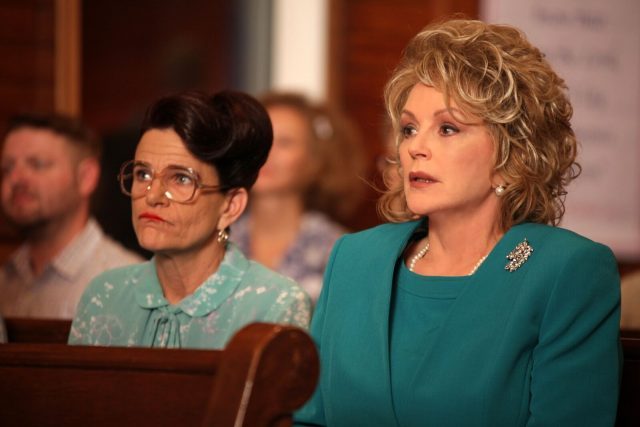
Sissy Hickey (Dale Dickey) and Latrelle Williamson (Bonnie Bedelia) fight for gay rights in A Very Sordid Wedding

Sissy Hickey (Dale Dickey) and Latrelle Williamson (Bonnie Bedelia) fight for LGBTQ rights in A Very Sordid Wedding

A VERY SORDID WEDDING (Del Shores, 2017)
SVA Theatre
333 West 23rd St. between Eighth & Ninth Aves.
Monday, October 2, $20, 8:00
212-924-7771
www.averysordidwedding.com
svatheatre.com

You don’t have to know anything about the Sordid Lives phenomenon to be tickled pink by the latest entry in the series, A Very Sordid Wedding. In 1996, Del Shores’s fourth play, Sordid Lives, debuted in Los Angeles, a very personal work about his coming out to his Southern Baptist family. He turned the play into a 2000 film with an all-star cast, including Bonnie Bedelia, Delta Burke, Beau Bridges, and Olivia Newton-John. That was followed in 2008 by a twelve-episode prequel series on Logo, with Caroline Rhea, Rue McLanahan, Jason Dottley, and a few others taking over some of the roles. And now comes A Very Sordid Wedding, a sequel set in 2015, right after same-sex marriage is made legal throughout the United States. But in Winters, Texas, the Supreme Being trumps the Supreme Court, so the new minister, Reverend Jimmy Ray Barnes (Levi Kreis), has decided to throw an “Anti-Equality Revival” to keep gay marriage out of the county. Latrelle Williamson (Bedelia), however, has had a change of heart since learning that her son, Ty (Kirk Geiger), is gay and in love with Kyle (T. Ashanti Mozelle), so she has decided to fight the church on this issue. Meanwhile, Latrelle’s long-estranged sibling, aging drag performer Brother Boy (Emmy winner Leslie Jordan), meets up with escaped serial killer Billy Joe Dobson (producer Emerson Collins); the divorced Noleta Nethercott (Rhea) strikes up a passionate affair with the hunky, hospitalized Hardy (Aleks Paunovic), making her ex-husband, G.W. (David Steen), jealous; Sissy Hickey (Dale Dickey) has read the Bible cover to cover; Latrelle’s ex-husband, Wilson (Michael MacRae), has settled down with the much younger Greta (Katherine Bailess); Jesus-loving convenience store owner Vera Lisso (Lorna Scott) has helped form a homosexual-hating group; and the saucy Juanita Bartlett (Sarah Hunley) continues to share whatever is in her crazy mind. Also back are Ann Walker as LaVonda Dupree, David Cowgill as Odell Owens, Newell Alexander as bar owner Wardell Owens, Rosemary Alexander as Dr. Eve, and Scott Presley as hairdresser Roger. Things come to a head when a memorial party for Latrelle’s mother (McLanahan) is scheduled to take place at the same time as the antigay service.
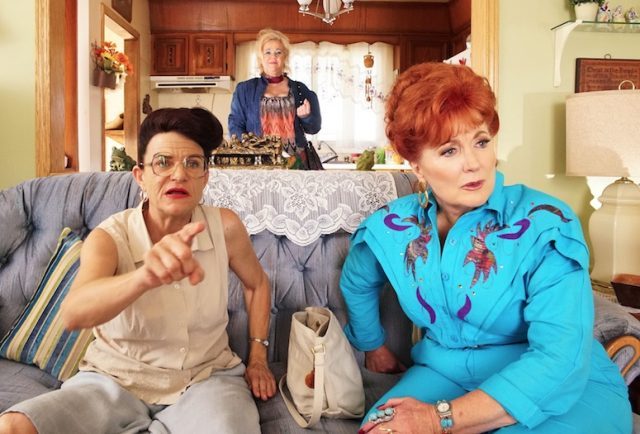

Sissy Hickey (Dale Dickey), Noleta Netercott (Caroline Rhea), and LaVonda Dupree (Ann Walker) can’t believe what they see in latest chapter of cult phenomenon

Sissy Hickey (Dale Dickey), Noleta Netercott (Caroline Rhea), and LaVonda Dupree (Ann Walker) can’t believe what they see in latest chapter of cult phenomenon

A kind of alternate version of Steel Magnolias without the weeping, A Very Sordid Wedding is charming and engaging from the get-go. Except for a treacly finale that is overly preachy, the film treats its timely subject matter with laugh-out-loud humor and a touch of elegance. Two-time Emmy nominee Bedelia (Heart Like a Wheel, Parenthood) is in fine form as the graceful Latrelle, who is the heart and soul of the film, a woman who is more complex than one might initially think as Shores (Southern Baptist Sissies, The Trials and Tribulations of a Trailer Trash Housewife) plays with stereotypes. Of course, she changes her mind about homosexuality and the LGBTQ community primarily because her son is gay, not because of any sudden empathy and compassion for all human beings, but at least she’s willing to stand up for what’s right. There’s plenty of wackiness to go around as well, with lots of lovable characters and some rather poignant moments about love and acceptance of all kinds. In advance of its October 17 release on DVD, Blu-ray, and iTunes, A Very Sordid Wedding is making its red carpet New York City premiere, presented by NewFest, on October 2 at 8:00 at the SVA Theatre and will be followed by a Q&A with Jordan, Rhea, Shores, Collins, Walker, and Blake McIver, who plays Peter in the film and sings “This Is Who We Are” on the soundtrack; there will also be a reception.

NYFF55: FACES PLACES

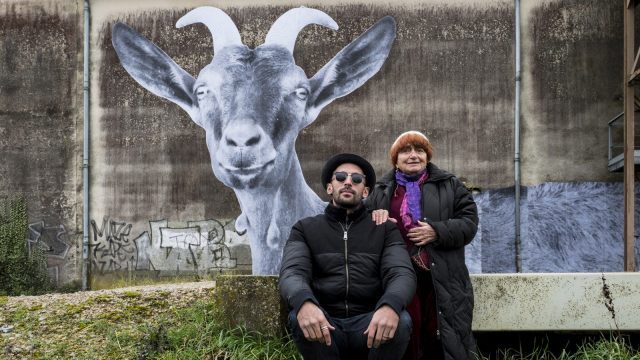
JR and Agnès Varda have a blast in the masterful Faces and Places

JR and Agnès Varda have a blast with people and animals in the masterful Faces and Places

FACES PLACES (VISAGES VILLAGES) (Agnès Varda & JR, 2017)
New York Film Festival, Film Society of Lincoln Center
Sunday, October 1, Alice Tully Hall, $25, 12:30
Monday, October 2, Francesca Beale Theater, $25, 8:30
Festival runs September 28 – October 14
212-875-5601
www.filmlinc.org
cohenmediagroup.tumblr.com

“We’ll have fun making a film,” legendary eighty-eight-year-old Belgian-born French auteur Agnès Varda tells thirty-three-year-old French photographer and street artist JR in Faces Places (Visages Villages), a masterful road movie that may very well be the most fun film you’ll see all year. The unlikely pair first met when Varda, who has made such classics as Cléo from 5 to 7, Vagabond, Jacquot de Nantes, and The Gleaners and I, accepted an invitation from JR, whose practice involves wheat-pasting giant black-and-white photos of men, women, and children on architectural structures, to visit his Paris studio. (JR brought his “Inside Out” art project to Times Square in 2013.) When Varda saw JR’s blow-up of a 1960 self-portrait Varda shot of herself standing in front of a Bellini painting in Venice, the two instantly hit it off and decided to make a film together, heading out in JR’s small photo-booth truck to team up with people in small towns throughout France, including coal miners, dockworkers, farmers, a church-bell ringer, and factory workers. The reactions of the villagers — shrewd, curious, flattered — to JR’s enormous wheat-pasted blow-ups of themselves on their neighborhood walls, barns, abandoned housing, containers, water towers, and other locations are fascinating. “JR is fulfilling my greatest desire. To meet new faces and photograph them, so they don’t fall down the holes of my memory,” Varda, who edited the film with Maxime Pozzi-Garcia, says. Varda and JR make a formidable duo, finding a childlike innocence in their collaboration that is simply captivating to watch.
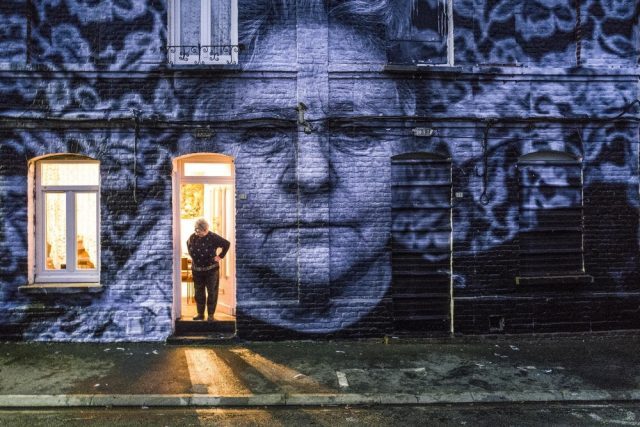
Cinematic collaboration between Agnès Varda and JR results in stunning visions of humanity

Cinematic collaboration between Agnès Varda and JR results in stunning visions of humanity

Varda continually tries to get JR to remove his ever-present dark glasses, remembering how her friend and colleague Jean-Luc Godard once let her take pictures of him without glasses, but JR prefers to maintain his mystery, a man who photographs tens of thousands of people’s faces around the world while never fully showing his own. Varda, who relies on the “power of imagination,” even sets up an afternoon with Godard at his home in Switzerland, preparing by having JR roll her furiously through the same Louvre galleries the protagonists run through in Godard’s Band of Outsiders, but of course nothing with Godard ever goes quite as planned. “Chance has always been my best asset,” Varda proclaims in the film, and it is chance, and the willingness to enthusiastically embrace every moment of life, that helps give Faces Places its immeasurable charm. The film, which features a playful score by Matthieu Chedid (‑M-) and was executive produced by Varda’s daughter, Rosalie Varda-Demy, subtly tackles socioeconomic issues but is primarily a marvelous celebration of genuine humanity. Faces Places is screening at the New York Film Festival on October 1 at Alice Tully Hall and October 2 at the Francesca Beale Theater, with both shows followed by a Q&A with Varda and JR.

BROOKLYN MUSEUM FIRST SATURDAY: BEYOND BORDERS

Proof

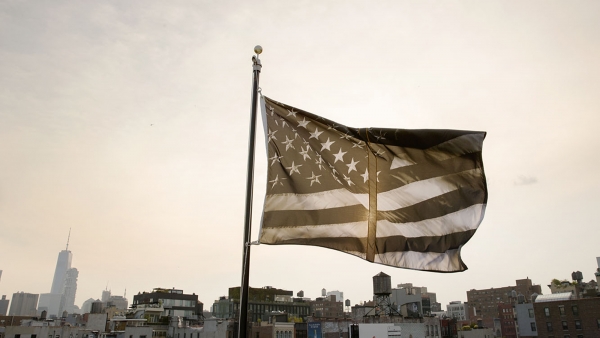
Robert Longo, “Untitled (Dividing Time),” nylon and polyester poplin, hand appliqué, 2017 (courtesy of Creative Time’s “Pledges of Allegiance”)

Brooklyn Museum
200 Eastern Parkway at Washington St.
Saturday, October 7, free, 5:00 – 11:00
212-864-5400
www.brooklynmuseum.org

The Brooklyn Museum’s monthly free First Saturday program returns after its annual September Labor Day weekend break with “Beyond Borders,” an exploration of the immigrant crisis. There will be live performances by Locos por Juana, Batalá New York, and DJ Geko Jones with La Chiquita Brujita and DJ Big Nito; poetry with Cave Canem’s Darrel Alejandro Holnes and Jessica Lanay Moore; an immersive screening of Alejandro Jodorowsky’s mind-bending The Holy Mountain with live performances; a salsa party with lessons by Balmir Latin Dance Company; a hands-on workshop in which participants can make clay vessels; pop-up gallery talks with teen apprentices focusing on works that honor Latinx history; a curator tour of “Proof: Francisco Goya, Sergei Eisenstein, Robert Longo” led by Sara Softness; and a community talk with Movimiento Cosecha about immigrant rights. In addition, the galleries will be open late so you can check out “Arts of Korea,” “The Legacy of Lynching: Confronting Racial Terror in America,” “Infinite Blue,” “A Woman’s Afterlife: Gender Transformation in Ancient Egypt,” “The Dinner Party by Judy Chicago,” and more.

ANNE TERESA DE KEERSMAEKER & SALVA SANCHIS : A LOVE SUPREME

(photo © Anne Van Aerschot)

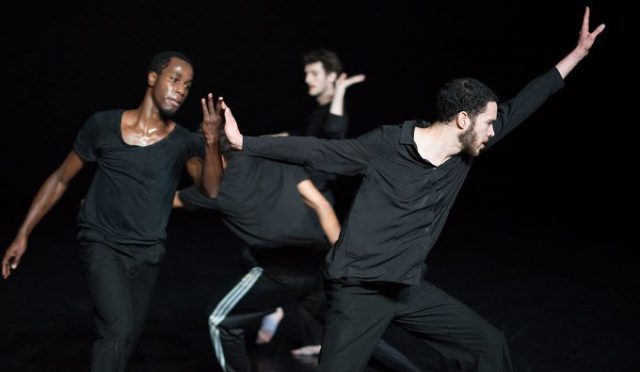
Anne Teresa De Keersmaeker and Salva Sanchis revisit John Coltrane’s A Love Supreme with four male dancers (photo © Anne Van Aerschot)

New York Live Arts
219 West 19th St. between Seventh & Eighth Aves.
September 27-30, 7:30
212-924-0077
newyorklivearts.org
www.rosas.be/en

In December 1964, saxophonist John Coltrane made one of the greatest jazz records of all time, A Love Supreme, a four-part suite consisting of “Acknowledgement,” “Resolution,” “Pursuance,” and “Psalm,” featuring Coltrane on tenor and soprano sax, Jimmy Garrison on double bass, Elvin Jones on drums and percussion, and McCoy Tyner on piano. In 2005, Belgian choreographer Anne Teresa De Keersmaeker and Spanish dancer and choreographer Salva Sanchis created the four-part dance suite A Love Supreme, set to Coltrane’s legendary music; they have now revisited the piece, rewriting it for four male dancers from De Keersmaeker’s Rosas company. The fifty-five-minute dance work, which will be performed by José Paulo dos Santos, Bilal El Had / Robin Haghi, Jason Respilieux, and Thomas Vantuycom, investigates the desire for happiness through mysticism and spirituality, incorporating jazzlike improvisation into the movement, with each dancer interpreting one of the musicians on the record: Vantuycom is Coltrane, Respilieux is Garrison, El Had / Haghi is Tyner, and dos Santos is Jones. When the musicians improvise, so will the dancers.

“Taking on A Love Supreme fits with the idea of revisiting and rewriting Rosas’s repertoire for a new generation of dancers,” De Keersmaeker said in a statement. “What is interesting about the piece, in addition to its intrinsic connection with this milestone of twentieth-century music, is the way it combines improvised and written choreography.” Sanchis, who was part of the original cast in 2005, added, “On the whole, A Love Supreme is more suitable for a dance performance than a simple collection of songs. The music poses a structure with a beginning and an end, offering a kind of dramaturgical accessibility.” The New York City premiere of A Love Supreme runs at New York Live Arts September 27-30 at 7:30, with saxophonist Tony Jarvis performing a tribute to the seminal album at seven o’clock each night. The September 28 show will be followed by a Stay Late Conversation moderated by NYU associate professor and associate chair André Lepecki; there will be a Shared Practice workshop September 30 at 2:00 ($20) with Rosas rehearsal director Bryana Fritz and Respillieux; and on September 30 at 5:00 ($10), NYLA artistic director Bill T. Jones will be joined by music historian Ashley Kahn and bassist and composer Reggie Workman for the special Coltrane program “Bill Chats — The Man and His Music.” Tickets are sold out for all four shows, but there will be a standby line each evening to see what De Keersmaeker calls “essentially a piece about defying gravity. It is a piece about the relationship between mankind and the planet, between the vertical and the horizontal.”