this week in lectures, signings, panel discussions, workshops, and Q&As

WEST SIDE FEST 2024

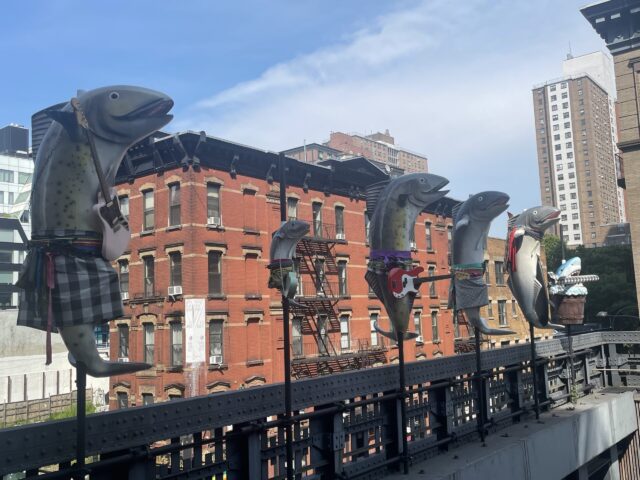
The High Line will host special programming at West Side Fest (photo by twi-ny/mdr)

WEST SIDE FEST
July 12-14, free
Multiple locations between Bank & West Thirtieth Sts.
www.westsidefest.nyc

Every June, the Upper East Side hosts the Museum Mile Festival, when seven or eight arts institutions, including the Met, the Guggenheim, the Cooper Hewitt, the Jewish Museum, and El Museo del Barrio, open its doors for free and turn Fifth Ave. into an arts-based street fair.

The West Side is getting in on the action with its own celebration with the weekend-long West Side Fest, running July 12-14, featuring live performances, guided tours, open studios, interactive workshops, special presentations, and free entry at many locations between Bank and Thirtieth Sts., including the Rubin, Poster House, the Whitney, Hudson Guild, Little Island, the Shed, Dia Chelsea, and the Joyce. Below is the full schedule; a map is available at the above website.

Friday, July 12
NYC Aids Memorial, 7:00 am – 11:00 pm

The Lesbian, Gay, Bisexual and Transgender Community Center, 8:00 am – 10:00 pm

Hudson Guild: Déflorée History Series, with panels by Valerie Hallier, 10:00 am – 5:00 pm

Hudson Guild: Triennial Children’s Art Show, 10:00 am – 6:00 pm

Poster House, free admission, 10:00 – 6:00

Little Island: Creative Break, art workshops, 11:00 am – 1:00 pm

Dia Chelsea, noon – 6:00

Whitney Museum of American Art: Open Studio for Teens, 1:00 – 3:00

IndieSpace/West Village Rehearsal Co-Op: Open Rehearsal by Divine Riot Company of Five Times in One Night, 2:00 – 5:00

Hill Art Foundation: Sound Bath, with musician Daren Ho, 5:00 – 7:00

The Joyce Theater at Chelsea Green Park: Pop-Up Dance Performances by Pilobolus and Dorrance Dance, 5:00 & 6:30

The Shed: Summer Sway, 5:00 – 8:00

White Columns: Exhibition Opening Reception, with works by Michaela Bathrick, Ali Bonfils, Joseph Brock, Eleanor Conover, and Donyel Ivy-Royal, 5:00 – 8:00

Whitney Museum of American Art: Free Friday Nights, advance RSVP required, 5:00 – 10:00

Print Center New York: Print Center After Hours, 6:00 – 8:00

Westbeth Artists Housing x the Kitchen Kickoff Celebration & Poster Sale, 6:00 – 8:00

Rubin Museum of Art: K2 Friday Night, 6:00 – 10:00

Little Island: Teen Night, 7:00 – 8:00

“Wonder City of the World: New York City Travel Posters” is on view at Poster House

Saturday, July 13
High Line: Family Art Moment: Dream Wilder with Us, ages 5–12, 10:00 am – noon

IndieSpace/West Village Rehearsal Co-Op: Open Rehearsal by Divine Riot Company of Five Times in One Night, 10:00 am – 1:00 pm

Poster House, free admission, 10:00 – 6:00

Hudson River Park: Explore & Play, 14th Street Park, 11:00 am – 1:00 pm

Little Island: Creative Break, 11:00 am – 1:00 pm

Westbeth Artists Housing: Penny’s Puppets, 11:00 am – 1:00 pm

Rubin Museum of Art, 11:00 am – 5:00 pm

Center for Art, Research, and Alliances, Javier Téllez: Amerika, 11:00 am – 6:00 pm

High Line: A Celebration of High Line Wellness, 11:30 am – 1:00 pm

The Kitchen: Tai Chi Workshop, 11:30 am – 1:00 pm

Hudson Guild: Triennial Children’s Art Show, noon – 3:00

Poster House Block Party, noon – 5:00

Dia Chelsea, noon – 6:00

Hudson Guild: Déflorée History Series, with panels by Valerie Hallier, 1:00 – 4:00

The Kitchen Poster Sale, 1:00 – 6:00

Westbeth Artists Housing: Art & Craft Market, 1:00 – 6:00

IndieSpace/West Village Rehearsal Co-Op: Open Rehearsal by Ali Keller, 2:00 – 5:00

Print Center New York: Print Activation with Demian DinéYazhi’, 2:00 – 5:00

Westbeth Artists Housing Open Studios, 2:00 – 5:00

Dia Chelsea Soil Sessions: Earth Sounds with Koyoltzintli, advance RSVP required, 2:30

Westbeth Artists Housing: You Are Never Too Old to Play, 7:00 – 9:00
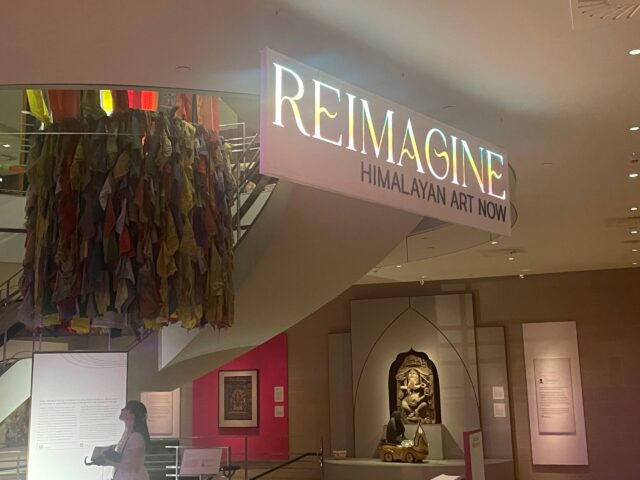
The Rubin reimagines its collection in grand finale (photo byt twi-ny/mdr)

Sunday, July 14
The Lesbian, Gay, Bisexual and Transgender Community Center, 8:00 am – 8:00 pm

Poster House, free admission, 10:00 – 6:00

Whitney Museum of American Art: Free Second Sundays, 10:30 am – 6:00 pm

Hudson River Park Community Celebration, with Ajna Dance Company, henna, and community groups, Pier 63, 11:00 am – 1:00 pm

Center for Art, Research, and Alliances, Javier Téllez: Amerika, 11:00 am – 6:00 pm

Rubin Museum of Art: Family Sunday, 1:00 – 3:00

Westbeth Artists Housing Open Studios and Art & Craft Market, 1:00 – 5:00

Westbeth Artists Housing: Art Take-Over, curated by Valérie Hallier, Claire Felonis, and Noah Trapolino, 1:00 – 6:00

Whitney Museum of American Art: STAFF ONLY, Westbeth Gallery, 1:00 – 6:00

Chelsea Factory: Ladies of Hip-Hop’s Ladies Battle!, 1:00 – 10:00

IndieSpace/West Village Rehearsal Co-Op: Open Rehearsal by Felice Lesser Dance Theater of I AM A DANCER 2.0, 2:00 – 4:00

High Line: The Death Avenue Posse, by the Motor Company, 5:30 & 7:00

[Mark Rifkin is a Brooklyn-born, Manhattan-based writer and editor; you can follow him on Substack here.]
JAPAN CUTS — MOTION PICTURE: CHOKE / THE BOX MAN

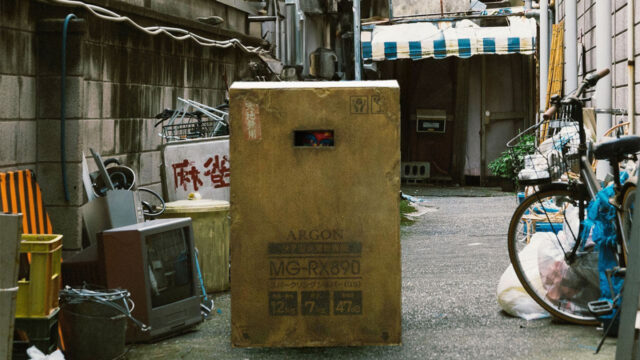
Everyone becomes obsessed with the title character in Gen Nagao’s strange and unusual The Box Man

JAPAN CUTS: FESTIVAL OF NEW JAPANESE FILM
Japan Society
333 East 47th St. at First Ave.
July 10-21, $10-$25
212-715-1258
www.japansociety.org

“I never would have expected to be praised for my tentative steps as an actor at Japan Cuts, a film festival in New York!” eighty-two-year-old Chinese-born Japanese actor Tatsuya Fuji said about winning the Lifetime Achievement Award at this year’s fest at Japan Society. “The last time I visited New York was nearly half a century ago. Back then, Nagisa Oshima’s film, In the Realm of the Senses, was invited to the New York Film Festival, but unfortunately, it couldn’t be screened due to censorship. And now, in 2024, the film I participated in, Great Absence, is being screened in New York, and they’ve even given me an award! I am overwhelmed with emotion!”

It would be a shame for movie lovers to be absent at the seventeenth annual festival, which runs July 10-21 and celebrates new Japanese film with more than thirty features, documentaries, animation, shorts, and a few classics. The opening-night selection is Masanori Tominaga’s Between the White Key and the Black Key, which takes place over the course of one night in the life of jazz pianist Hiroshi Minami. The centerpiece is Shadow of Fire, which concludes Shinya Tsukamoto’s war trilogy that began with Fires on the Plain and Killing and stars Cut Above honoree Mirai Moriyama. The festival comes to an end with the international premiere of Hideaki Anno and Shinji Higuchi’s Shin Godzilla: ORTHOchromatic, a revised version of the 2016 original.

In between there are family-friendly works, romance stories, manga-based cartoons, searches for the meaning of existence, and a samurai tale from Takeshi Kitano. As is my preference every July, I’ve checked out two of the most unorthodox films, a pair that are unexpectedly similar in their use of black-and-white, dialogue, sex, violence, music, small casts, and investigations of loneliness.

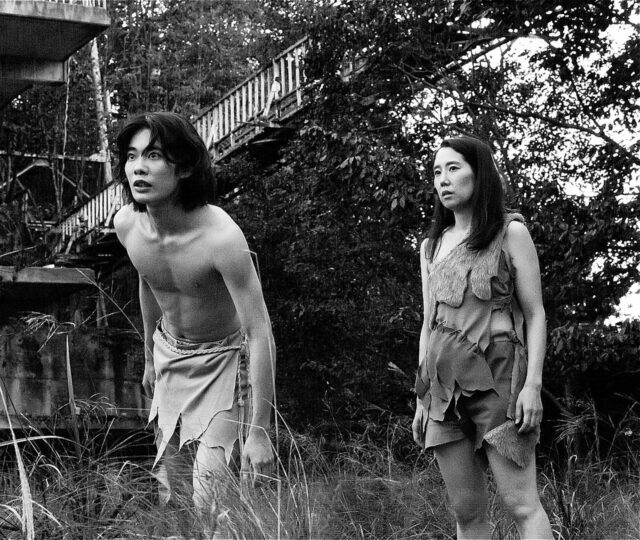
A man (Daiki Hiba) and woman (Misa Wada) fear danger ahead in Gen Nagao’s Motion Picture: Choke

MOTION PICTURE: CHOKE (『映画 (窒息)』/ EIGA CHISSOKU) (Gen Nagao, 2023)
Friday, July 12, 9:00
japansociety.org

Nary a word is spoken in Gen Nagao’s black-and-white Motion Picture: Choke, which is set in a dystopian past/future that is either pre- or postverbal as it explores the inflexibility of the human condition in an unidentifiable time or place. The film begins in total darkness with Kiyoyuki Yoshikawa’s pulsating score, evoking the music of Bernard Herrmann in Alfred Hitchcock thrillers, followed by a frightening figure in black crawling up a woman’s body. The terrified woman (Misa Wada) awakes from the dream, panting, but then goes about her daily chores. Dressed in ragged, primitive clothing reminiscent of what Raquel Welch wore in One Million Years B.C., she scavenges for food, washes herself in a stream, collects water, and weaves by candlelight.

Living in an abandoned three-level concrete building with no outside walls or doors, she seems to enjoy her life. Every so often, a sweet-natured elderly peddler (Minori Terada) stops by to barter by playing a game. Everything is pleasant until a white-robed man (Takashi Nishina) and his two underlings (Yuri Tajima and Hiroshi Niki) brutally attack the woman, leaving her devastated and angry. She constructs a trap for protection that captures a shirtless young man (Daiki Hiba), who she ties to a wall like Jesus on a cross. They ultimately start a charming partnership, learning together how to survive this empty world, but when the evil bandits return, male toxicity rises up as a battle for power ensues — with the woman determined to not play the victim again.

In only his second full-length film, following 2019’s Someday in Love, Nagao is in complete command as he explores multiple genres; perhaps Motion Picture is part of the title to remind the viewer that this is about the cinematic experience as much as it is a history of how women have been treated by men since the beginning of time. Wada (Cape’s Brothers and Sisters, Kiku to Guillotine) is captivating as the woman, who is not about to get taken advantage of twice. She has an understanding of life that the men will never have, especially when she seeks revenge.

The lack of dialogue is no mere gimmick; instead, it harkens to how humans communicate with one another in the most basic of ways in any era, without language, like animals. The film is gorgeously photographed by Sota Takahashi, with stark lighting by Kohei Kajimoto; Yoshikawa’s music shifts genres as well, from ominous and threatening to innocent and playful.

From its opening moments to its startling, accusatory finale, Choke is precisely the kind of film that makes Japan Cuts one of the best festivals of the year.

A nurse (Koichi Sato) contemplates her future in Gakuryu Ishii’s strange and unusual The Box Man

THE BOX MAN (『箱 男 / HAKO OTOKO) (Gakuryu Ishii, 2024)
Saturday, July 13, 5:30
japansociety.org

“Those who obsess over the box man become the box man,” a man in a shabby box whispers early in Gakuryu Ishii’s creepy, bizarre adaptation of Kōbō Abe 1973 novel, The Box Man.

I can now firmly declare that I am obsessed with the box man. But aren’t we all?

The film takes place just as the prosperity of Japan’s Shōwa period is ending in 1973. The first few minutes are in black-and-white, featuring Abe’s street photography, before we meet the box man, aka Myself (Masatoshi Nagase), who declares in voice-over:

“I see right through everything. A fabricated box you put your faith in. It is you people who live inside it. I have abandoned all that is fake, to obtain the real thing. What is more, I can see. You people as you truly are. The hidden shape of this world. Together with this box, the world shall be completely reborn. I am the box man. I gaze at you unilaterally.”

As it turns to color, he continues, “I become identifiable. You may see me, but you pay no attention. You feign ignorance. And yet, just as I once did, if you become overly aware of the box man . . .”

The box man lives in a cardboard box that reaches down to his knees; it is from the Argon company, makers of medical supplies. There’s a rectangular slit on one side so he can see in front of him; the horizontal space resembles a letterboxed film, except in this case it works both ways, from the inside and the outside. He watches us as we watch him.

He moves stealthily through the streets, avoiding unnecessary contact, until he’s being tracked by a photographer with a rifle and threatened by a slingshot-wielding ex-military madman. But soon he finds himself in a small, private hospital run by an older gentleman called the General (Ayana Shiramoto), his assistant, a doctor (Tadanobu Asano), and their nurse (Koichi Sato), where an odd power dynamic unfolds involving self-identity, sex, control over one’s body and mind, who gets to tell their story, and reality itself.

Ishii’s film has been thirty years in the making, when he received Abe’s blessing to go forward with it. The book has previously been adapted into two short films, but this is the first full-length version, with screenwriters Kiyotaka Inagaki and Ishii (Crazy Thunder Road, Punksamurai Slash Down) making significant changes while staying true to Abe’s original vision.

Hideho Urata’s photography gives the film an immersive quality, as if we are all in our own box, which is sort of true whether we’re experiencing it at home on a TV or streaming device or in a theater. When the doctor is questioned by a detective (Yûko Nakamura) in a police interview room, another cop peers through a long slit in a wall, making him another kind of box man. Michiaki Katsumoto’s wide-ranging score guides us through 1940s detective noir, 1960s jangly pop, 1970s thriller, and a hilarious psychedelic scene with an enema.

The Box Man doesn’t always make sense; some plot twists are hard to decipher, and it is too long at two hours, but you won’t be able to look away for even a second. You’ll also wonder what life inside a box could be like, if you’re not already in one, psychologically or physically.

Like Motion Picture: Choke, The Box Man deals with loneliness, sex, violence, love, faith, misogyny, homelessness, and a dark future in which humanity builds cages for themselves and others, as well as how we tell stories — and who gets to tell them. At one point, the box man sees words appear on a wall, expressing, “Within this labyrinth, I shall seek an exit.” But getting out is not going to be easy, for any of us.

The Box Man is screening July 13 at 5:30 at Japan Society, with Ishii on hand for a Q&A. He will also participate in a Q&A following the July 14 showing of his 1995 rite-of-passage drama, August in the Water.

[Mark Rifkin is a Brooklyn-born, Manhattan-based writer and editor; you can follow him on Substack here.]
BARB MORRISON AND DAPHNE RUBIN-VEGA: BOTTOMING FOR GOD

Who: Barb Morrison, Daphne Rubin-Vega
What: Reading, conversation, and audience Q&A
Where: The Wild Project, 195 East Third St. between Aves. A & B
When: Thursday, July 11, $16, 7:00
Why: “the universe has a way of putting us in our place. a way of commanding what we pretend is destiny, what we like to call the journey and what we fool ourselves into believing is karma,” Barb Morrison writes at the beginning of her memoir, bottoming for god. “but the fact of the matter is we’ve already conspired with this entity, this force, this all knowing being, this GOD (or what EVER you wanna call it.) we already made a pact in the board room in between lives. we’ve already sat amongst our judges and jurors, our spirit guides, our guardian angels, our circle of souls and agreed to collaborate on whatever theater piece will take us to a higher consciousness. whatever decisions we THINK we’re making will move us up or down this mortal coil only because it was already agreed to. it was written before we zipped up these space suits. it was litigated at the table where our greatest enemies and best friends tried on costumes to see who will play which role this time around.”

My wife and I have known the Schenectady-born Morrison for many years, on a personal and professional level. A music producer, songwriter, film composer, football fan, multi-instrumentalist, former Gutterboy member, and mentor who has worked with Blondie, Rufus Wainwright, Franz Ferdinand, Asia Kate Dillon, Rachael Sage, Scissor Sisters, and many others, Morrison digs deep in the book, which is billed as “a story about gender euphoria, sobriety, old skool NYC, true love, past lives, and coming home,” in such chapters as “that fucking belt,” “fourteenth & third,” “the sound of a smile,” “shell shock,” and “hysterical and historical.”

Morrison’s summer book tour takes them July 11 to the Wild Project, where they will be joined by two-time Tony-nominated Panamanian American actress Daphne Rubin-Vega, who originated the roles of Mimi Marquez in Rent and Lucy in Jack Goes Boating and has appeared in such other shows as Anna in the Tropics, A Streetcar Named Desire, and Les Misérables as well as on such television series as Smash, Katy Keene, and Hazbin Hotel. The New Jersey–based Morrison will read excerpts from the book, then sit down for a conversation with Rubin-Vega, followed by an audience Q&A. Tickets are $16; signed books will be available for sale.

[Mark Rifkin is a Brooklyn-born, Manhattan-based writer and editor; you can follow him on Substack here.]

CHRONICLES OF A WANDERING SAINT

Argentine writer-director Tomás Gómez Bustillo’s Chronicles of a Wandering Saint is a glowing debut

CHRONICLES OF A WANDERING SAINT (Tomás Gómez Bustillo, 2023)
IFC Center
323 Sixth Ave. at West Third St.
Opens Friday, June 28
212-924-7771
www.ifccenter.com
www.chroniclesofawanderingsaint.com

About thirty-five minutes into Tomás Gómez Bustillo’s gorgeous, elegiac debut feature, Chronicles of a Wandering Saint, a meditative dark comedy on love, faith, and the afterlife, a deeply sad tragedy occurs and the credits begin to roll. But just as the protagonist is reborn at that moment, so is the film itself.

In a small, religious Argentina town, Rita (Mónica Villa) spends much of her time at Saint Rita church, either praying with her three friends, Viviana (Noemí Ron), Beba (Silvia Porro), and Alicia (Ana Silvia Mackenzie), or cleaning, mopping the floors until they glisten. She and her husband, Norberto (Horacio Marassi), live a simple life; they have no children and don’t travel. While Norberto still has a lust for life, Rita looks tired. When Norberto suggests that they go back to the waterfalls they visited on their honeymoon forty years earlier, Rita doesn’t understand why.

“Well, the waterfalls are still the exact same,” she says. He responds, “But we’re not.”

Rummaging through the church basement, Rita comes upon an object she believes to be a statue of Saint Rita, missing for thirty years. Before even seeing it, Father Eduardo (Pablo Moseinco) declares it must be a miracle. However, when, after further research, Rita realizes it’s not Saint Rita, she and Norberto decide to fake it, proceeding with her claim nonetheless. It all goes well, until it doesn’t. But that’s only part of this tender and touching magical realism tale.

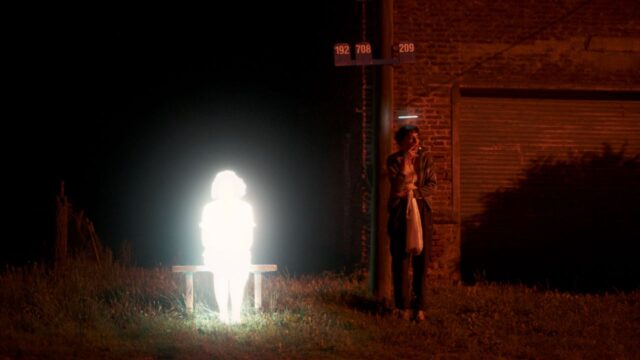
Chronicles of a Wandering Saint is built around the concept of a spiritual glow, as stated in Proverbs 13.9: “The light of the righteous shines brightly, but the lamp of the wicked is snuffed out.”

Early on, Rita is cleaning the floor of the church, and Beba tells her, “Quit mopping so much or those shiny floors will end up blinding us.” Several parishioners gather in the back and sing, “The light from your shining face will illuminate all the paths that lead to eternity.” And when people die, they eventually transform into a blinding white light; one person is actually reincarnated as a lightbulb. In one of the most surreal moments, Luchito (Iair Said), now a moth, can’t keep away from Quique (Mauricio Minetti), a bulb over a woman’s front door.

The film is reminiscent of Apichatpong Weerasethakul’s 2010 Uncle Boonmee Who Can Recall His Past Lives, which is another fascinating integration of the human, animal, and spirit worlds. Bustillo maintains a similar slow pace but adds hilarious scenes beautifully photographed by Pablo Lozano, with spectacular production design by Doriane Desfaugeres, wonderful costumes by Margarita Franco, and a gentle, melancholic score by Felipe Delsart. The film is composed of still shots; the camera moves only once, zooming in on a piano, an instrument we later learn that Rita’s mother played.

When Norberto and Rita are in their kitchen talking about the waterfalls, they are both wearing yellow raincoats, the color echoed in the scrambled eggs and lemon wedge on their plates and the spray bottle on the table. Through the door is an old television set, furthering the idea that the couple, and the other parishioners, are living in an uncluttered, old-fashioned past despite Rita’s use of Facebook and a smartphone. Their old car has a cassette player; when she’s driving, Rita puts on a homemade mix tape that includes a dance-pop cover of Bryan Adams’s “Heaven.”

A shot of Rita sitting alone in a tiny bus shelter, looking downtrodden, surrounded by green grass and trees, a light pole rising behind her, is stunning; next to the shelter is a sign pointing out three nearby locations, but right then Rita has nowhere to go, unsure of which path to take. Not even the book she was reading about el Camino de Santiago, detailing the popular Christian pilgrimage itinerary, can help her now.

Villa (Wild Tales, The Holy Girl) is mesmerizing as Rita, a pious, devoted woman who wants to live up to her namesake. Her performance, especially her eyes, recalls Fellini wife and muse Giuletta Masina, who lit up such films as Nights of Cabiria and La Strada. Rita is not seeking much out of life, only a miracle. But as Norberto tells her, “If you want it to be a miracle, then it is.”

The multi-award-winning Chronicles of a Wandering Saint runs June 28 – July 11 at IFC Center; the LA-based Bustillo will be on hand for Q&As on Friday and Saturday at 7:05, joined by executive producer Samir Oliveros, producers Gewan Brown and Amanda Freedman, and moderators Taylor A. Purdee and Isabel Custodio.

Oh, one last note: Beware those unexpected sneezes. . . .

[Mark Rifkin is a Brooklyn-born, Manhattan-based writer and editor; you can follow him on Substack here.]
GLASS CLOUDS ENSEMBLE: LIKE THE FEATHER TIP OF A GIANT BIRD

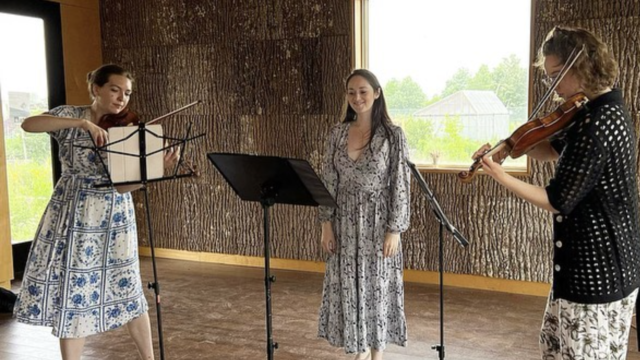
Glass Clouds Ensemble rehearse for special site-specific performance at Earth Matter farm on Governors Island (photo courtesy Glass Clouds Ensemble)

Who: Glass Clouds Ensemble
What: Live performance and farm tour
Where: Urban Farm, Governors Island
When: Saturday, June 29, free with advance RSVP, 2:00
Why: On June 29 at 2:00, New York–based contemporary chamber music collective the Glass Clouds Ensemble will be on Governors Island performing “Like the Feather Tip of a Giant Bird,” a program featuring a piece inspired by Earth Mat­ter NY’s Compost Learning Center and Soil State Farm, next to the Oval and Hammock Grove; the concert will be followed by a tour of the farm, which “seeks to reduce the organic waste misdirected into the garbage stream by encouraging neighbor participation and leadership in composting.” The trio, consisting of violinists Raina Arnett and Lauren Conroy and soprano Marisa Karchin, recently performed at Green-Wood Cemetery in Jody Oberfelder’s moving And Then, Now; the Governors Island program will include a new commission by guest composer Hannah Selin inspired by the farm as well as works by John Downland and Barbara Strozzi, Conroy, and Arnett, joined by special guest Alex Vourtsanis on theorbo.

[Mark Rifkin is a Brooklyn-born, Manhattan-based writer and editor; you can follow him on Substack here.]
FILM SCREENING & CONVERSATION WITH DIRECTOR: 76 DAYS

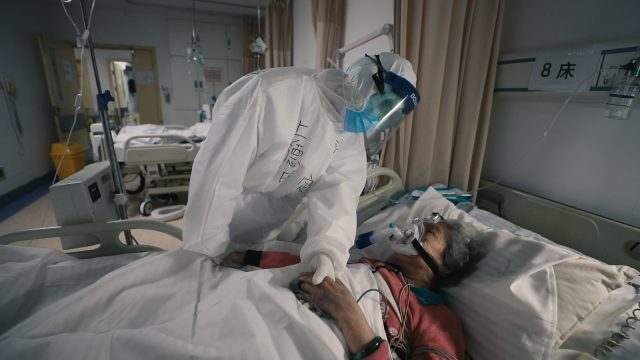
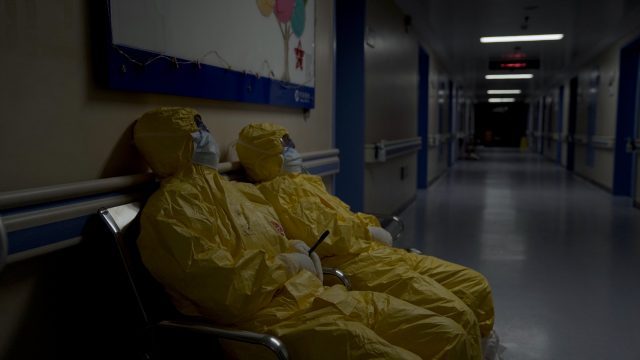
Two essential healthcare workers take a much-deserved brief break in a Wuhan hospital in 76 Days

76 DAYS (Hao Wu, Weixi Chen, and Anonymous, 2020)
China Institute in America
100 Washington St. (use 40 Rector St. entrance)
Wednesday, June 20, $12, 6:00
chinainstitute.org/events
www.76daysfilm.com

The prospect of sitting through a ninety-minute documentary about essential healthcare workers in four hospitals in Wuhan fighting in the early days of Covid-19, during the city’s seventy-six-day lockdown, might seem daunting. But what could have been a difficult, emotional, and political roller coaster about fear and anger, government lies and finger pointing turns out to be a deeply affecting film that celebrates our most basic hopes and humanity.

Chinese director Hao Wu was researching a film about pandemics when, in mid-February, he came upon footage being shot by a pair of reporters in Wuhan, Weixi Chen and a man who has decided to remain anonymous. They had been given full access to four hospitals, where they followed doctors, nurses, patients, and family members for several months. There are no talking heads, and no one speaks directly to the camera; instead, 76 Days offers a fly-on-the-wall perspective that manages to be as uplifting as it is frightening.

The film opens like a sci-fi thriller, as an unidentified group of people in head-to-toe protective gear that includes light-blue masks, long face shields, white Hazmat suits, and blue footies comforts a distraught colleague who is prevented from saying goodbye to her father, who has just died from the novel coronavirus. Near the end of the scene, one of her coworkers tries to calm her down, saying, “We don’t want to see you in distress or pain. What will we do if you fall sick? We all have to work in the afternoon.” Moments later, sick people are banging on a door of the hospital to be let in, like a crowd trying to escape a coming zombie apocalypse, while two workers decide who to admit first. Those exchanges set the stage for the rest of the film, in which doctors and nurses go about their business with a relatively relaxed demeanor, displaying endless empathy and compassion as they care for scared patients with uncertain futures.

Wu focuses on a few specific cases that serve to represent the crisis as a whole, following an elderly couple who both have the virus and are not permitted to see each other even though they are on the same floor, and a young couple who are forced to quarantine in their apartment after the woman gives birth to a baby girl, unable to see their newborn for two weeks. While the nurses fall in love with the infant, who must stay in an incubator and whom they name Little Penguin, the workers have their hands full with the old man, who constantly tries to leave the hospital and doesn’t seem capable of wearing his mask correctly, if at all.

Doctors and nurses in Wuhan care for Covid patients, displaying empathy and compassion during seventy-six-day lockdown

The genuine kindness and concern displayed by the hospital employees is, well, infectious. They are risking their lives at every moment; each encounter is fraught with the possibility that they could contract the virus even with all the PPE. It’s hard not to cringe when they feed the old man, wipe the face of the infant, or use a patient’s phone to call a relative with news, because the reality is that people die from this disease, and Wu is not afraid to show that. It’s a riveting film that immerses you in this global emergency that started right there, at that time; if this doesn’t make you wear a mask, wash your hands, observe social distance protocols, and avoid gathering with others indoors, I don’t know what will.

We also see the empty streets and highways of Wuhan, a city of eleven million people, deserted, with signs advising, “Staying home makes a happy family.” All the action is happening in the hospitals, where the doctors and nurses bond with themselves and the patients, decorate their white Hazmat suits with drawings and sayings (“Clay Pot Chicken: I miss you”), and caution everyone to “be extra vigilant.” The crisis may be over, but those are still words to live by. Winner of the Best Cinematography award at DOC NYC 2020 and nominated for a Best Documentary Gotham Award, 76 Days is screening June 20 at 6:00 at China Institute and will be followed by a Q&A with Wu and film scholar Karen Ma.

[Mark Rifkin is a Brooklyn-born, Manhattan-based writer and editor; you can follow him on Substack here.]
DRAMA DESK AWARDS 2024: CELEBRATING ARTISTIC ABUNDANCE

Aaron Tveit and Sutton Foster will cohost Drama Desk Awards on June 10 (© 2024 Justin “Squigs” Robertson)

DRAMA DESK AWARDS
NYU Skirball Center for the Performing Arts
566 La Guardia Pl.
Monday, June 10, $105-$205, 6:15
nyuskirball.org
dramadeskaward.com

Balcony tickets are still available for the sixty-ninth annual Drama Desk Awards, honoring the best of theater June 10 at the Skirball Center. Founded in 1949, the Drama Desk (of which I am a voting member) does not differentiate between Broadway, off Broadway, and off off Broadway; all shows that meet the minimum requirements are eligible. Thus, splashy, celebrity-driven productions can find themselves nominated against experimental shows that took place in an East Village elevator or Chelsea loft. But that doesn’t mean there won’t be plenty of star power at the awards presentation.

Sutton Foster and Aaron Tveit will cohost the event; among the nominees this year are Jessica Lange for Mother Play, Patrick Page for All the Devils Are Here: How Shakespeare Invented the Villain, Rachel McAdams for Mary Jane, Leslie Odom Jr. for Purlie Victorious: A Non-Confederate Romp Through the Cotton Patch, Sarah Paulson for Appropriate, Brian d’Arcy James and Kelli O’Hara for Days of Wine and Roses, Bebe Neuwirth for Cabaret at the Kit Kat Club, Dorian Harewood for The Notebook, and Michael Stuhlbarg for Patriots. The Drama Desk also does not distinguish between male and female; the acting categories have ten nominees each, regardless of gender, with two winners. Thus, d’Arcy James is competing against his costar, O’Hara, for the same prize, although they both could take home the award.

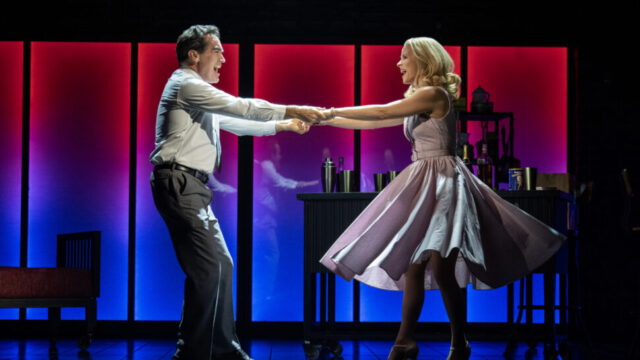
Brian d’Arcy James and Kelli O’Hara are both nominated for Days of Wine and Roses and will participate in the 2024 Drama Desk Awards (photo by Joan Marcus)

Among this year’s presenters are Laura Benanti, Matthew Broderick, Montego Glover, Lena Hall, James Lapine, Debra Messing, Ruthie Ann Miles, Andrew Rannells, Brooke Shields, Seth Rudetsky, Shoshana Bean, Corbin Bleu, James Monroe Iglehart, and Steven Pasquale. O’Hara will perform a special tribute to William Wolf Award honoree André Bishop, Foster and Nikki M. James will both sing, and Nathan Lane will receive the Harold S. Prince Award for Lifetime Achievement. Others being honored are the How to Dance in Ohio Authentic Autistic Representation Team, lighting designer Isabella Byrd, and press agent Lady Irene Gandy.

[Mark Rifkin is a Brooklyn-born, Manhattan-based writer and editor; you can follow him on Substack here.]