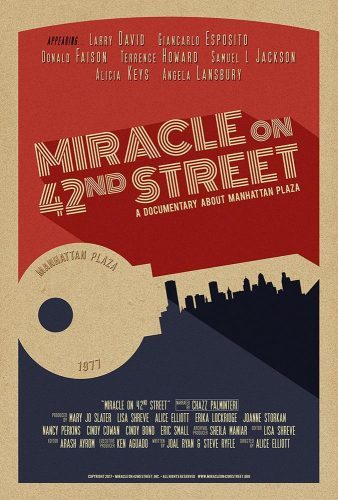
Terrence Howard is one of the performers singing the praises of Manhattan Plaza in Miracle on 42nd Street
MIRACLE ON 42ND STREET (Alice Elliott, 2017)
SVA Theatre
333 West 23rd St. between Eighth & Ninth Aves.
Saturday, November 11, $19, 1:30
Festival runs November 9-16 (various passes $75-$750)
www.docnyc.net
miracleon42ndstreet.org
 If you’ve been watching The Deuce on HBO, you have a pretty good idea of what the Times Square area was like in the 1970s, a haven for drugs, prostitution, massage parlors, and pornography. A few blocks west was the dangerous area known as Hell’s Kitchen, which had a history of gang violence and other troubles. But in the mid-1970s, Richard Ravitch and HRH Construction began building Manhattan Plaza, two commercial skyscrapers, more than forty floors each, a project aiming to revitalize the neighborhood by bringing in upwardly mobile people. But the recession, urban blight, and the lack of interest in moving into the area stopped the building in its tracks until someone — it is still argued exactly who — came up with the idea to transform Manhattan Plaza into an arts community, offering low-income housing to qualified performers working in the Theater District, Times Square, and other parts of the city. Oscar-nominated producer, cowriter, and director Alice Elliott recounts the story of Manhattan Plaza in Miracle on 42nd Street, which is having its world premiere November 11 at the DOC NYC film festival. Situated between Forty-Second and Forty-Third Streets and Ninth and Tenth Avenues, Manhattan Plaza has been home to a vast array of artists, from Tennessee Williams and Dexter Gordon to James Earl Jones and Mickey Rourke; seventy percent of the rooms are allocated for artists on a limited income, with fifteen percent for the elderly and the disabled and fifteen percent for neighborhood residents. Elliott speaks with such actors, musicians, and comedians as Larry David, Alicia Keys, Giancarlo Esposito, Angela Lansbury, Donald Faison, Estelle Parsons, Terrence Howard, and Kenny Kramer, all of whom lived in Manhattan Plaza, as well as Samuel L. Jackson, who worked the night shift there as a security guard. (Two of the producers, Mary Jo Slater and Nancy McLeod Perkins, were also longtime Manhattan Plaza residents.)
They all speak fondly of the welcoming atmosphere that helped them hone their crafts. “For as much as I could have a sense of community, there was a sense of community at Manhattan Plaza,” notes David, who lived across the hall from Kramer; their relationship formed the basis for the Seinfeld characters George Costanza, Jerry Seinfeld, and Cosmo Kramer. “That building raised me,” Faison says. Lansbury calls it a “wonderful sociological experiment.” And Howard adds, “That place nurtured my dreams.” Meanwhile, the behind-the scenes development of the project and history of the location are recalled in interviews with longtime director of operations Richard Hunnings, Shubert Organization chairman Gerald Schoenfeld, former assistant NYPD chief Mickey Schwartz, operations director Rodney Kirk, former NEA chairman Rocco Landesman, 42nd St. Development Corp. founder Fred Papert, and builder Irving Fischer, who proudly says, “This wasn’t just a place to live; it was a community. . . . Manhattan Plaza revitalized the center of the city.” The interviews, some of which were conducted more than five years ago, are intercut with archival footage of New York City streets and Mayors John Lindsay and Abe Beame, along with clips from a 1978 Manhattan Plaza talent night in which David and Kramer both performed. Elliott (The Collector of Bedford Street. Body & Soul: Diana & Kathy) cowrote the film with Joal Ryan and Steve Ryfle; unfortunately, narrator Chazz Palminteri never finds the proper rhythm of the text, regularly emphasizing the wrong words. The sixty-eight-minute film also shows how the idea spread to other cities, where arts-based housing helped rebuild neighborhoods, but in today’s financial climate, it’s hard to imagine any more Manhattan Plaza–like projects popping up in the city. Miracle on 42nd Street is screening November 11 at 1:30 at the SVA Theatre and will be followed by a Q&A with Elliott, Parsons, Palminteri, and Kramer. In addition, the film will be preceded by Lucy Walker’s five-minute short, Oh, What a Beautiful Symphony (A City Symphony).

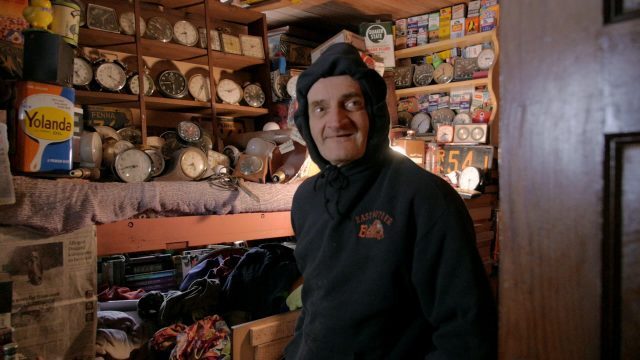
 After appearing on a 2010 episode of the History Channel series American Pickers, Ron Heist gained cult status for the massive structure he had been building in his parents’ large backyard in Butler, Pennsylvania, since 1965. The director of that episode, Guy Fiorita, has now made the bittersweet documentary Mole Man, a fascinating look inside the life and times of a unique man. Born in 1950, Ron has been obsessed with building things since he was a child. Now sixty-seven, toothless, and usually wearing a dark hoodie, Ron has constructed twenty-five buildings and twenty-three cellars linked by narrow passageways on his family’s property. He built it all by hand and by himself, scavenging items from more than seven hundred abandoned homes and factories, many of which had been left vacant following the closing of the Pullman Standard railcar plant in 1982. He refuses to use nails or mortar or even a level, relying on his own feel and intuition. He gets on his motorcycle, puts on his helmet, and meanders through the woods until he finds these houses, then brings back wood, doors, window frames, cinder blocks, chests, and whatever else he can fit on the back of his bike, as well as balls, plungers, clocks, license plates, and other items he collects. “People shouldn’t be as wasteful,” he says while showing off some treasures he has just found. Ron was always different, and his father, Chuck, treated him special; but the film’s real subject is Ron’s prospects: following the recent death of his father, Ron is left with his ninety-year-old mother, Mary, and his future becomes doubtful. The family, including Ron’s brother, Tim, and sister, Christine, who love Ron dearly, think that their mother would be better off in a smaller home, and they don’t have enough money to maintain the house. Meanwhile, they finally get Ron tested by a therapist to confirm that he has autism — he was previously diagnosed as “mentally challenged,” as were many of a lost generation of undiagnosed adults with the condition — and might be eligible for certain health benefits, although they worry about what might happen to Ron if he has to live elsewhere. “His routine, his environment . . . that’s his safety zone,” Tim says. But when Ron tells three of his friends, Sean Burke, Mike, and his cousin-in-law, John Burkert, that he knows where the Piney Mansion is, they believe they might find more than enough valuable objects, particularly some old, classic cars, to keep Ron living at home, so off into the woods they go, on a rather difficult journey. “To see Ron pulled out of that place, I think, would kill him, plain and simple,” John explains. “I just don’t think he’d want to live anymore.”


 Just about everyone who has ever seen Easy Rider has imagined themselves on a bike, rumbling across the country with Captain America (Peter Fonda) and Billy (Dennis Hopper), experiencing whatever comes their way. Newark native Satya de la Manitou did more than that, becoming Hopper’s friend and right-hand man for more than forty years. Their intimate and crazy friendship is told in Nick Ebeling’s debut feature documentary, Along for the Ride, which opens today at Metrograph. It would take quite a character to have spent that much time with Hopper — and live to tell about it — and Satya is just that kind of human being, a tough but sensitive, direct, bold man who leads a wild journey into Hopper’s creative process and personal demons. Ebeling follows Satya as he visits with Hopper’s brother, David; actors Russ Tamblyn, Dean Stockwell, and Michael Madsen (who reads a poem he wrote about Dennis); producers Danny Selznick, Lawrence Schiller, and Fred Caruso; directors Philippe Mora, Wim Wenders, and David Lynch; artists Ed Ruscha and Julian Schnabel and gallerist Tony Shafrazi; musicians and composers Damon Albarn and Jamie Hewlett (of GORILLAZ) and Mark Mothersbaugh (of DEVO); and architect Frank Gehry, who sheds a tear when talking about Dennis. Together, they provide a fascinating look into the depth of Hopper’s abilities as an actor, director, photographer, art lover, drug user, and center of attention. “He did everything well, like most geniuses do,” Satya explains.