Carolee Schneemann’s early paintings and sculptures are a revelation at MoMA PS1 retrospective (photo by twi-ny/mdr)
Doc Fortnight 2018: George (Jeffrey Perkins, 2017) and Carolee, Barbara, and Gunvor, (Lynne Sachs, 2018), MoMA Film, Museum of Modern Art, 11 West 53rd St. between Fifth & Sixth Aves., 212-708-9400, Wednesday, February 21, $12, 7:30
“Art and Practice with Carolee Schneemann,” MoMA PS1, 22-25 Jackson Ave. at 46th Ave., 718-784-2084, Thursday, February 22, free with advance RSVP, 6:00
Exhibition continues at MoMA PS1 Thursday – Monday through March 11, suggested admission $5-$10, free for NYC residents
www.moma.org
www.caroleeschneemann.com
MoMA PS1’s “Carolee Schneemann: Kinetic Painting” is a revelatory exploration of the career of the immensely influential multidisciplinary artist. The seventy-eight-year-old Pennsylvania-born Schneemann will reveal yet more this week during two special programs. On February 21 at 7:30, she will be at MoMA for the world premiere screening of Lynne Sachs’s Carolee, Barbara, and Gunvor, a nine-minute short about Schneemann, Barbara Hammer, and Gunvor Nelson, which is screening with Jeffrey Perkins’s George, about George Maciunas and Fluxus, as part of “Doc Fortnight 2018: MoMA’s International Festival of Nonfiction Film and Media.” Schneemann, Perkins, and Sachs will participate in a discussion after the films; in addition, Alison Knowles will re-create her interactive 1963 piece Shoes of Your Choice. (MoMA PS1 will also be hosting “An Evening in Honor of Carolee Schneemann,” a screening and discussion on March 5 with Melissa Ragona, Jenny Jaskey, Branden W. Joseph, and the artist.) “Carolee Schneemann: Kinetic Painting” continues through March 11, an expansive two-floor survey that shines a light not only on Schneemann’s well-known feminist video and performance pieces but her exceptional paintings and sculptures. Superbly curated by Sabine Breitwieser with consulting curator Branden W. Joseph and organized at MoMA PS1 by Erica Papernik-Shimizu with Oliver Shultz, the show takes deep looks at such Schneemann works as Meat Joy, in which a group of people roll around with raw beef, chicken, and fish; Interior Scroll, in which Schneemann pulls a long strip of paper from her vagina and reads the contents; and Up to and Including Her Limits, for which she strapped herself in a harness and used her body to draw on a surface. In 1993, Schneemann declared, “I’m a painter. I’m still a painter and I will die a painter. Everything that I have developed has to do with extending visual principles off the canvas.” For the Abstract Expressionist Pinwheel, a white-gloved staff member will spin the painting upon request. Like Joseph Cornell, she made shadowbox-type works, and her collections of sharp, often aggressive detritus hang on the walls like three dimensional paintings. Colorado House is a “failed” painting turned into a freestanding sculpture. Magnetic audio tape falls out of the bottom of One Window Is Clear — Notes to Lou Andreas Salomé, a tribute to the Russian-German psychoanalyst and writer.
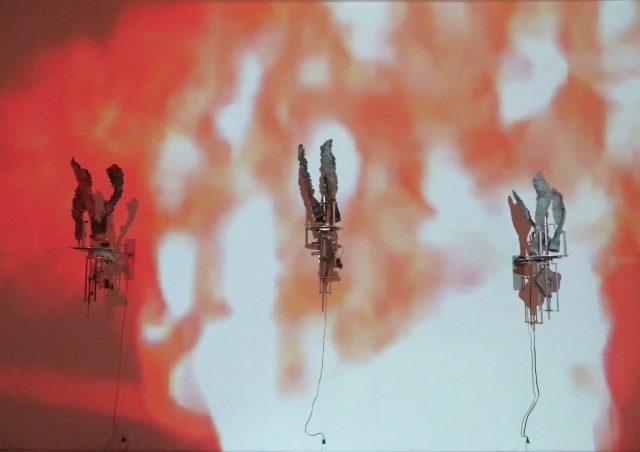
Carolee Schneemann’s Flange 6rpm consists of seven foundry-poured aluminum sculptures that move at six revolutions per minute (photo by twi-ny/mdr)
“My work can take substance from the materials I find,” Schneemann wrote to French poet and activist Jean-Jacques Lebel in 1964, which helps explain Blood Work Diary, a visual document of her menstrual flow. For Body Collage, a naked Schneemann, coated in wallpaper paste and molasses, rolls around in paper shreds. Her body is also one of the main subjects in Fuses, a film in which she makes love with her then-partner, James Tunney, while her beloved cat, Kitch, hangs around nearby. Kitch can be found in several works, but it’s Cluny (and later Vesper) who Schneemann gets perhaps a little too close to in Infinity Kisses. Meanwhile, Vulva’s Morphia is so hot that Schneemann includes four electric fans to cool off the thirty-five vaginal depictions, with such text as “Vulva decodes feminist constructivist semiotics and realizes she has no authentic feelings at all; even her erotic sensations are constructed by patriarchal projections, impositions, and conditioning.” That statement gets to the heart of Schneemann’s six-decade oeuvre, taking back the female body, and the power that comes with that, and redefining it, with no limits. Particularly in the era of #MeToo, “Carolee Schneemann: Kinetic Painting” is an extraordinary exhibition by an extraordinary artist who has never been afraid to make the private public, and political.

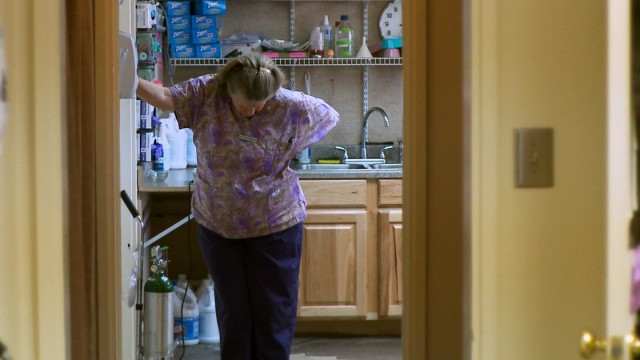
 BAMcinématek celebrates the tenth anniversary of Oscilloscope Laboratories, the independent studio founded by Beastie Boy Adam Yauch in 2008, with five days of films that are representative of its dedication to quality and diversity, screening February 19-22. The series begins on February 19 at 7:00 with After Tiller, in which directors and producers Martha Shane and Lana Wilson manage to humanize one of the most contentious, controversial, and complicated issues of our age: late abortion. In May 2009, Dr. George Tiller, who specialized in third-trimester abortions, was assassinated in front of his clinic in Wichita, Kansas. That left only four doctors in the United States who performed late abortions, each of whom had either trained or worked with Dr. Tiller. “It was absolutely no question in any of our minds that we were going to keep on doing his work,” one of those four doctors, Susan Robinson, says in the film. As After Tiller begins, Dr. Robinson works with Dr. Shelley Sella at Southwestern Women’s Options in Albuquerque, New Mexico, Dr. LeRoy Carhart is a former U.S. Air Force colonel who operates the Abortion & Contraception Clinic of Nebraska, and Dr. Warren Hern is director of the Boulder Abortion Clinic in Colorado. Shane and Wilson follow these four dedicated doctors who continue doing their work despite the personal danger associated with their profession, including harassment, murder, assault, and bombings. “When I walk out the door, I expect to be assassinated,” Dr. Hern says. The filmmakers show the doctors in their offices, meeting with women who are requesting late abortions for various reasons; Shane and Wilson also follow the abortion providers into their homes as they go on with their daily lives, offering an intimate portrait of these men and women who are so often called monsters but are firm in their belief that what they are doing is important and absolutely necessary, performing their jobs with care and understanding. However, Dr. Hern wonders if he should stop providing late abortions and just settle down peacefully with his new wife and adopted son, while Dr. Carhart and his wife opt to move out of Nebraska after a law change and meet resistance as they try to move their clinic to Maryland or Virginia.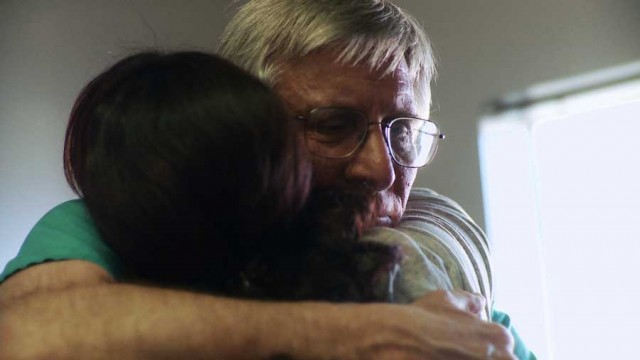
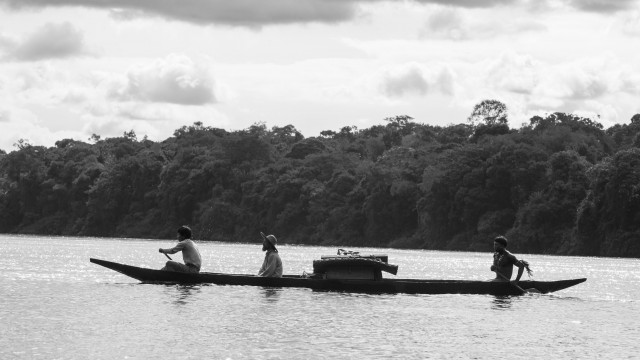
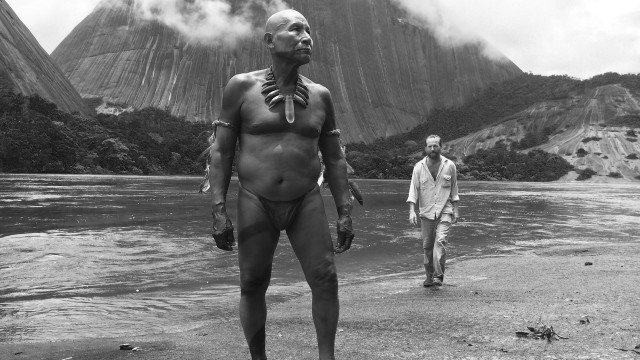
 Colombian writer-director Ciro Guerra takes viewers on a spectacular journey through time and space and deep into the heart of darkness in the extraordinary Embrace of the Serpent. Guerra’s Oscar-nominated film, the first to be shot in the Colombian Amazon in thirty years, opens with a 1909 quote from explorer Theodor Koch-Grünberg: “It is not possible for me to know if the infinite jungle has started on me the process that has taken many others to complete and irremediable insanity.” Inspired by the real-life journals of Koch-Grünberg and botanist and explorer Richard Evans Schultes, Guerra poetically shifts back and forth between two similar trips down the Vaupés River, both led by the same Amazonian shaman, each time guiding a white scientist on a perilous expedition in a long, narrow canoe. Shortly after the turn of the twentieth century, ailing white ethnologist Theo (Jan Bijvoet) and his native aid, Manduca (Yauenkü Migue), seek the help of Karamakate (Nilbio Torres), a shaman wholly suspicious of whites and who believes he is the last of his tribe. However, Theo claims he knows where remnants of Karamakate’s people live and will show him in return for helping him find the magical and mysterious hallucinogenic Yakruna plant that Theo thinks can cure his illness. Forty years later, white botanist Evan (Brionne Davis) enlists Karamakate (Antonio Bolívar Salvador) to locate what is thought to be the last surviving Yakruna plant, which he hopes will finally allow him to dream in order to heal his soul. Evoking such films as Werner Herzog’s Fitzcarraldo and Aguirre, the Wrath of God and Francis Ford Coppola’s Apocalypse Now, Embrace of the Serpent makes the rainforest itself a character, shot in glorious black-and-white by David Gallego (Cecilia, Violencia) in a sparkling palette reminiscent of the work of Brazilian photographer