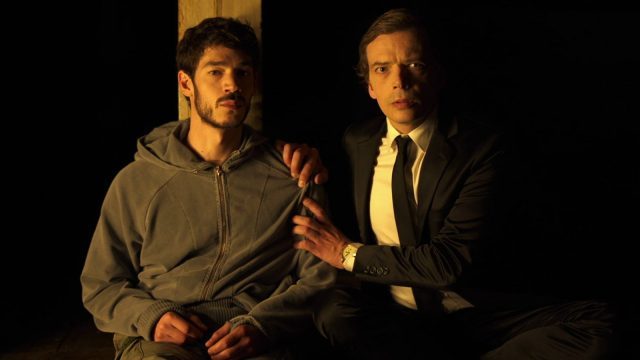
The SDF (Clément Durand) and the Non-Bobo (Frédéric Schulz-Richard) are among six characters searching for sanctuary in Eugène Green’s Waiting for the Barbarians
WAITING FOR THE BARBARIANS (ATTENDANT LES BARBARES VOSTA) (Eugène Green, 2017)
Film Society of Lincoln Center, Walter Reade Theater
165 West 65th St. between Eighth Ave. & Broadway
Tuesday, March 13, 6:30; Friday, March 16, 4:00
Festival runs March 8-18
212-875-5050
www.filmlinc.org
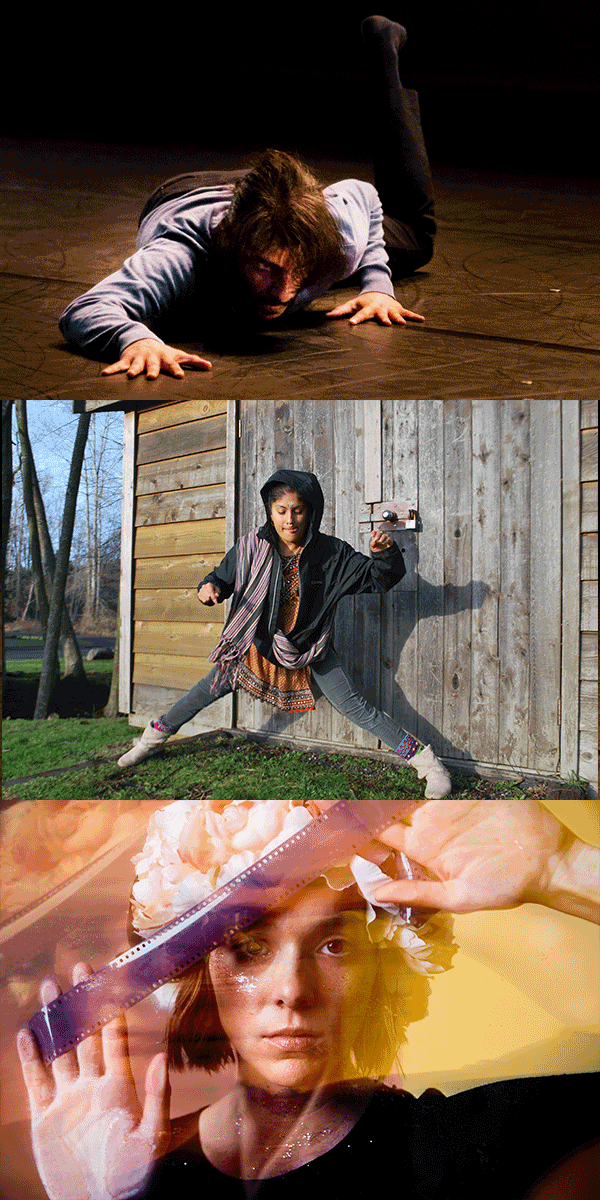
 Six characters are in search of an exit from modern life in Eugène Green’s delightfully surreal and very strange Waiting for the Barbarians, which is screening at the Film Society of Lincoln Center’s “Rendez-Vous with French Cinema” festival on March 13 and 16. American expat Green’s previous two films, La Sapienza and The Son of Joseph, featured gorgeous architecture and lush landscapes; Waiting for the Barbarians opens with a beautiful static shot by cinematographer Raphaël O’Byrne of the Seine on a slightly cloudy day, accompanied by the soothing sounds of rushing water and birds. Green next sets the stage by explaining through photographs and text that what we are about to see is the result of a workshop (Les Chantiers Nomades) in which “The reality of twelve actors and a small crew . . . becomes a fiction expressing the reality of the world.” The film then moves into a dungeonlike basement run by the Mage (Fitzgerald Berthon) and the Magesse (Hélène Gratet), a mysterious couple who live in near-darkness, using only candlelight. There’s a knock on the door, and the Mage answers it. “We were told you’re a mage,” a young man says. “Do you believe what you’re told?” the Mage responds. “In this case, yes,” the man says. The Mage: “Freedom of conscience is guaranteed by secularity.” The man: “We were told we’d be safe here.” The Mage: “What do you fear?” The man: “The barbarians. They’re coming.” The Mage: “How do you know?” The man: “Social media.” It’s a hilarious beginning, all deadpan, a candle illuminating the man’s face like in a Caravaggio painting. The Mage agrees to let them in, if they hand over all of their electronic devices. Over the next seventy minutes, the slow-moving, slow-talking Mage and Magesse conduct odd ritualistic gatherings in which the Poet (Arnaud Vrech), the Bobo (Ugo Broussot), the Bobelle (Chloé Chevalier), the Paintress (Anne-Sophie Bailly), the Non-Bobo (Frédéric Schulz-Richard), and the homeless SDF (Clément Durand) discuss their lives in bizarre, often disconnected statements delivered in a straightforward, direct, almost zombielike manner, which turns pedantic dialogue into very funny riffs on art, politics, class structure, love, parenting, and death.
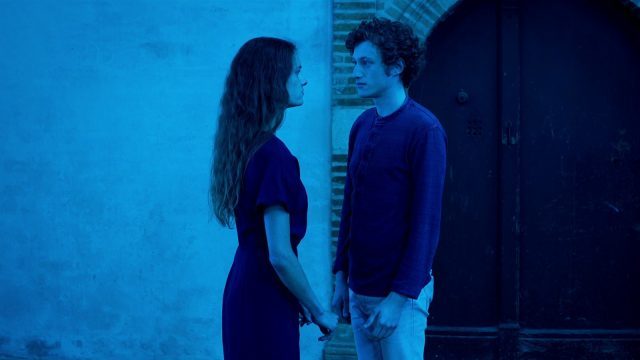
An Arthurian novel is reenacted in blue light in Waiting for the Barbarians
“I’m not the least bit phallocratic, and I always agree with my wife,” the Bobo says. “How can you expect us to know anything if we don’t have internet?” the Bobelle asks. The Paintress explains that she doesn’t paint because “running a paintbrush over a naked, pure, virginal surface feels like an act of unbearable violence.” The Non-Bobo is a politician who has never run for office. The six characters identify the barbarians they are escaping from as the Scythians, the Thracians, the Goths, the Ostrogoths, the Visigoths, the Vandals, the Huns, the Avars, the Alans, the Cumans, the Tatars, the Pechenegs, and the United Statesians. (Green is a Brooklyn native who lives in France and refers to America as “Barbaria” in interviews.) The Poet encounters a ghost named Sophie (Valentine Carette), the daughter of the Mage and Magesse, who says she has been expecting him; her red scarf is the only color amid the blackness. The Non-Bobo lets loose a magnificent eye roll. The Mage examine two works by Nicolas Tournier. They all enter a blue-lit courtyard where they watch apparitions perform scenes from the twelfth-century verse romance Jaufré, a melodrama involving Jaufré (Roman Kané), Brunissen de Montbrun (Marine Chesnais), Taulat de Rougemont (François Lebas), and Mélian de Montmélior (Durand). In introducing the performance, the Mage says, “Fiction is merely an attempt to show something more real than the world,” which describes Green’s film as well. Waiting for the Barbarians is about the fear of contemporary society and its future, of being alone, of not being connected in the twenty-first century, when everyone is on the move all the time, never stepping back and just being in the moment. It is droll and languorous, inscrutable and hysterical, didactic and wryly clever. Be sure to stick around through the end credits, which give updates on the characters. Green likes to make cameos in his films, but there’s no room for him in Waiting for Barbarians; fortunately, you will be able to see him on March 13, when he will take part in a Q&A following the 6:30 North American premiere of the film. “Rendez-Vous with French Cinema” continues through March 18 with films by Vincent Macaigne, Xavier Legrand, Xavier Beauvois, Bruno Dumont, Nobuhiro Suwa, Laurent Cantet, and others.

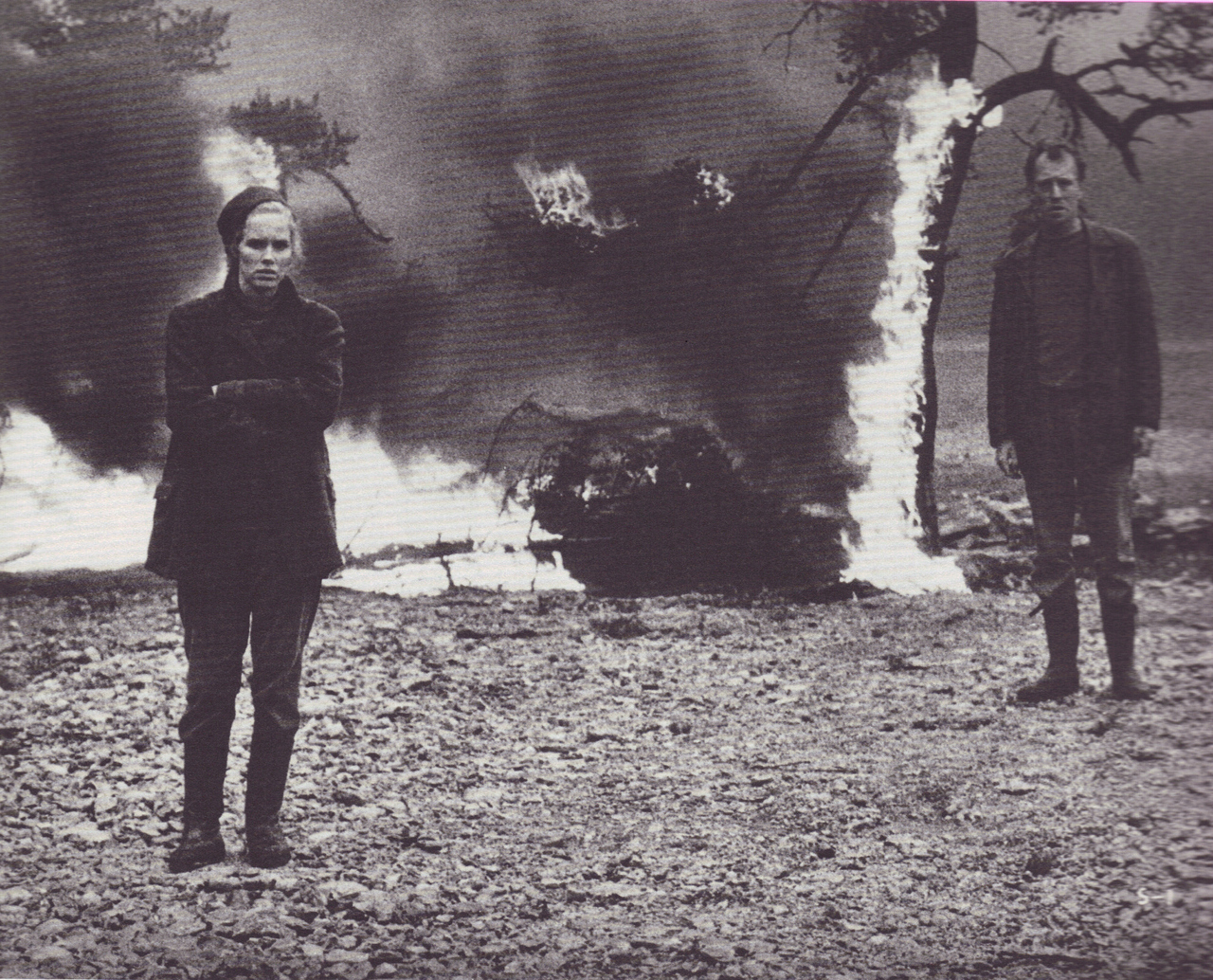
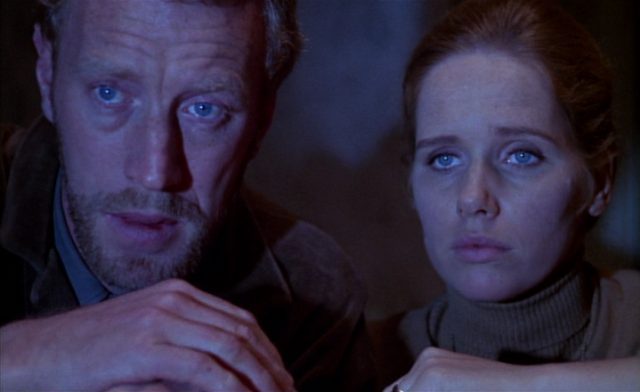
 Longtime Ingmar Bergman muse Liv Ullmann will bet at Film Forum on March 2 for a Q&A following the 6:15 screening of Shame, part of a five-week retrospective celebrating the hundredth anniversary of the Swedish director’s birth. Shame is a brilliant examination of the physical and psychological impact of war, as seen through the eyes of a happily married couple innocently caught in the middle of the brutality. Jan (Max von Sydow) and Eva Rosenberg (Liv Ullmann) have isolated themselves from society, living without a television and with a broken radio, maintaining a modest farm on a relatively desolate island a ferry ride from the mainland. As the film opens, they are a somewhat ordinary husband and wife, brushing their teeth, making coffee, and discussing having a child. But soon they are thrust into a horrific battle between two unnamed sides, fighting for reasons that are never given. As Jan and Eva struggle to survive, they are forced to make decisions that threaten to destroy everything they have built together. Shot in stark black-and-white by master cinematographer Sven Nykvist, Shame is a powerful, emotional antiwar statement that makes its point through intense visual scenes rather than narrative rhetoric. Jan and Eva huddle in corners or nearly get lost in crowds, then are seen traversing a smoky, postapocalyptic landscape riddled with dead bodies. Made during the Vietnam War, Shame is Bergman’s most violent, action-filled film; bullets can be heard over the opening credits, announcing from the very beginning that this is going to be something different from a director best known for searing personal dramas. However, at its core, Shame is just that, a gripping, intense tale of a man and a woman who try to preserve their love in impossible times. Ullmann and von Sydow both give superb, complex performances, creating believable characters who will break your heart. Shame is also being shown February 28, March 1, March 2 at 2:00 and 10:15, and March 3.