Who:Nuala Clarke, Crystal Gandrud, Rob Ward, Megan Mook, Kevin Townley What:“Alchemy and Art on the Spiritual Path” Where:Tibet House NYC and online, 22 West Fifteenth St. When: Monday, March 24, free – $20 – $225, 6:30 Why: “I swim in the sea, and my experience of cold has changed. I can no longer be trusted with the question ‘Is it cold out?’ I experience it without the tightening of torso muscles and raising of shoulders. It has become separate from the whole, less readily identifiable. In my hands it feels like leanness, the appendages pared away to the essential; in my back and around my ribs it tingles; it is fresh on my lips; in my toes it is clear and my chest, above my heart, accepts it as youngness, in need of care. I am an effervescent being.” So writes Irish artist Nuala Clarke in her new book, Irish Moss of a Dead Man’s Skull (the Owl Circus, March 18, $33).
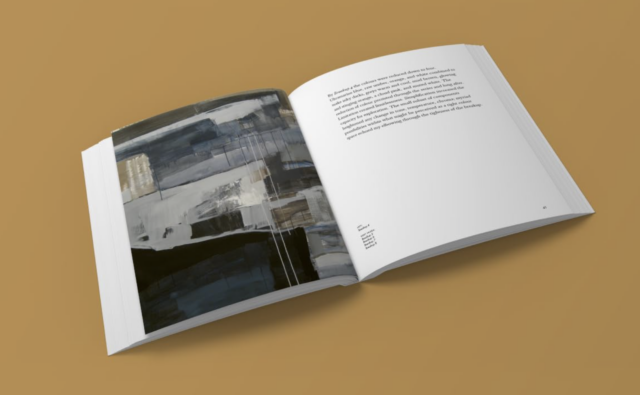
Influenced by the work of Irish alchemist and natural philosopher Robert Boyle (1627–91), author of Experiments and Considerations Touching Colours, with Observations on a Diamond that Shines in the Dark, as well as by installation artist Robert Irwin, serigrapher and ceramicist Robert Brown, and spiritual coach and meditation teacher Robert Chender, Clarke has spent nearly five years “thinking about whether a painting could be prescribed for an ailment.” The result is a work that Clarke calls “an ode to light, color, loss, and the elements.” The 224-page book features 86 full-color images and details the impact each of the four Roberts has had on her art and her meditation practice.
On Monday, March 24, Clarke will launch the book at Tibet House as part of the Dharma Friends series, joined by experimental writer and acquiring editor Crystal Gandrud, Food Will Win the War violist, songwriter, and lead vocalist Rob Ward, and monthly Dharma Friends hosts Megan Mook and Kevin Townley, who will lead guided meditations. Having participated back in 2010 with composer Roarke Menzies, Gandrud, my wife, and others in a performance Clarke curated for her show “You Delight Me” on Shelter Island, I can vouch for how terrific her events are, and this one should offer its own numerous pleasures.
[Mark Rifkin is a Brooklyn-born, Manhattan-based writer and editor; you can follow him on Substack here.]
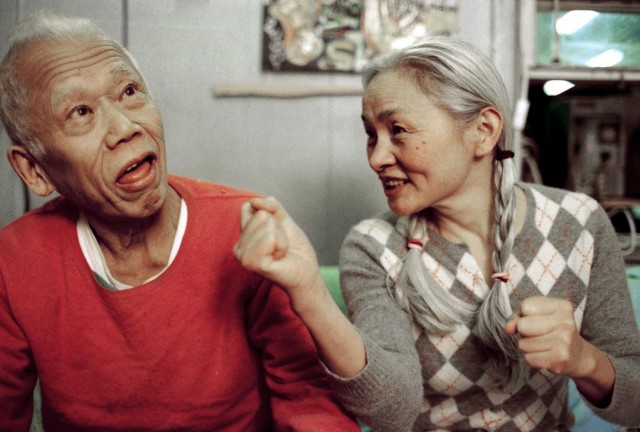
Zachary Heinzerling’s Emmy-winning Cutie and the Boxer is a beautifully told story of love and art and the many sacrifices one must make to try to succeed in both. In 1969, controversial Japanese Neo Dada action painter and sculptor Ushio Shinohara came to New York City, looking to expand his career. According to the catalog for the 2013 MoMA show “Tokyo 1955-1970: A New Avant-Garde,” which featured four works by Ushio, “American art had seemed to him to be ‘marching toward the glorious prairie of the rainbow and oasis of the future, carrying all the world’s expectations of modern painting.’” Four years later, he met nineteen-year-old Noriko, who had left Japan to become an artist in New York as well. The two fell in love and have been together ever since, immersed in a fascinating relationship that Heinzerling explores over a five-year period in his splendid feature-length theatrical debut.
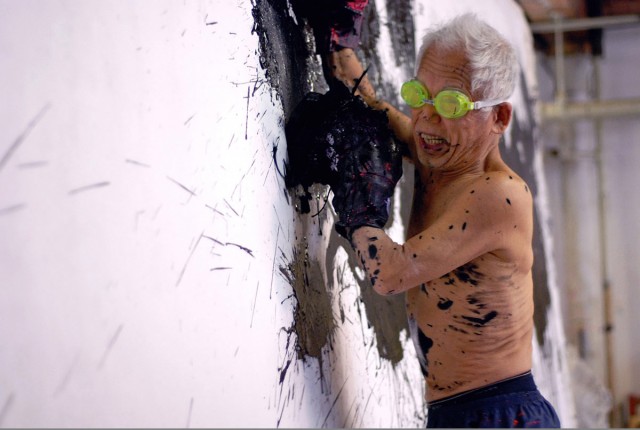
Ushio and Noriko live in a cramped apartment and studio in DUMBO, where he puts on boxing gloves, dips them in paint, and pounds away at large, rectangular canvases and builds oversized motorcycle sculptures out of found materials. Meanwhile, Noriko, who has spent most of the last half century taking care of her often childlike husband and staying with him through some rowdy times and battles with the bottle, is finally creating her own work, an R. Crumb-like series of drawings detailing the life of her alter ego, Cutie, and her often cruel husband, Bullie. (“Ushi” means “bull” in Japanese.) While Ushio is more forthcoming verbally in the film, mugging for the camera and speaking his mind, the pig-tailed Noriko is far more tentative, so director and cinematographer Heinzerling brings her tale to life by animating her work, her characters jumping off the page to show Cutie’s constant frustration with Bullie.
Ushio Shinohara creates one of his action paintings in Emmy-winning Cutie and the Boxer
During the course of the too-short eighty-two-minute film — it would have been great to spend even more time with these unique and compelling figures — the audience is introduced to the couple’s forty-year-old son, who has some issues of his own; Guggenheim senior curator of Asian Art Alexandra Munroe, who stops by the studio to consider purchasing one of Ushio’s boxing paintings for the museum; and Chelsea gallery owner Ethan Cohen, who represents Ushio. But things never quite take off for Ushio, who seems to always be right on the cusp of making it. Instead, the couple struggles to pay their rent. One of the funniest, yet somehow tragic, scenes in the film involves Ushio packing up some of his sculptures — forcing them into a suitcase like clothing — and heading back to Japan to try to sell some pieces. Cutie and the Boxer is a special documentary that gets to the heart of the creative process as it applies both to art and love, focusing on two disparate people who have made a strange yet thoroughly charming life for themselves.
Cutie and the Boxer is screening March 22 at 5:00 as part of the Metrograph series “Scored by Yasuaki Shimizu” and will be followed by a discussion and Q&A with composer Yasuaki Shimizu and writer Yumiko Sakuma. The Saturday tribute also includes a double feature of Hiroyuki Nakano’s 1990 Pace and Nam June Paik’s 1986 Bye Bye Kipling at 2:35 and Buntarō Futagawa’s 1925 silent jidaigeki Orochi at 7:30, which will be introduced by Shimizu, about which he explains, “This film is a silent samurai movie made and released in 1925, directed by Bunta Suga. It is the first production of the Banto Tsumasaburō Production and a landmark work that sparked the ‘sword-fighting boom’ in Japan. This year marks the one-hundredth anniversary of its release! I composed music for a film concert. A few years later, the master film of Orochi was rediscovered, and in 2023, a digital master version was produced. I revised the score for this 4K digital restoration, which was released the same year. This film holds great significance for me.”
[Mark Rifkin is a Brooklyn-born, Manhattan-based writer and editor; you can follow him on Substack here.]
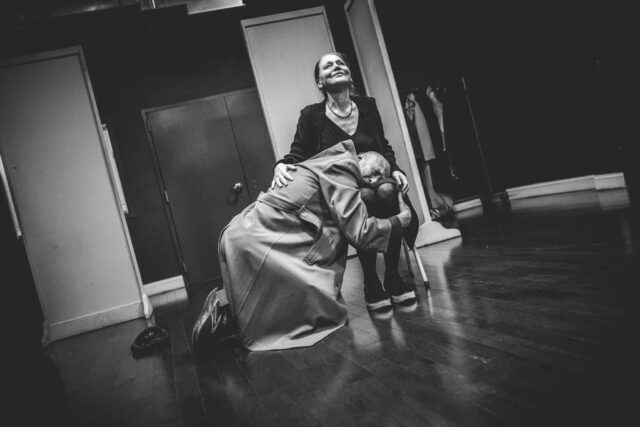
Tamara (Snezhana Chernova) and Ilyin (Roman Freud) reunite after being apart for seventeen years in Five Evenings (photo by Alexandra Vaynshtein)
FIVE EVENINGS
Chain Theatre
312 West Thirty-Sixth St. between Eighth & Ninth Aves.
March 20-30, $49.87 – $71.21 www.fiveevenings.com
“No, this is madness,” Zoya says to Ilyin at the start of Jewish-Soviet playwright Aleksandr Volodin’s Five Evenings, a five-act multigenerational melodrama that is as relevant today as it was when it was first presented in 1959 at the Leningrad State Academic Bolshoi Drama Theater and later adapted into an award-winning 1978 film by Nikita Mikhalkov.
The work is now being revived by director Eduard Tolokonnikov and producer Polina Belkina for a thirteen-show run at the Chain Theatre, with Lana Shypitsyna or Snezhana Chernova as Tamara, Roman Freud as Ilyin, Aleksei Furmanov as Slava, Inna Yesilevskaya as Zoya, and Dima Koan as Timofeev. The ninety-minute play (with intermission) will be performed in Russian with English surtitles; the set design is by Jenya Shekhter, with lighting by Ken Coughlin, sound by Denis Zabiyaka, and costumes by Natasha Danilova.
The story looks at two relationships, between the older Tamara and Ilyin and the younger Katya and Slava. In the second evening, they’re together at Tamara’s, and the two men have a chat while Slava sets the table, a scene that is representative of Volodin’s character development and dialogue:
Ilyin: See how nice it is? When there’s a white tablecloth and flowers on the table; it’s awkward to be petty, rude, or mean. The tablecloth should have creases from the iron — they bring back childhood memories. Slava: How poetic. Ilyin: One must live wisely, without haste. Remember, life’s book is full of unnecessary details. But here’s the trick: You can skip those pages. Slava: Well, this is one page I don’t feel like reading. Aunt Toma can clean up when she gets here. After all, isn’t there a division of labor? Ilyin: Don’t make me angry — get to work.
Katya walks in as Ilyin is teaching Slava how to box, declaring, “What are you doing, you slimy snake? What are you doing?!” A moment later, Ilyin says to Katya, “A demonic woman. Is that a manicure you’ve got there?”
Katya and Slava seek freedom and love in Five Evenings (photo by Alexandra Vaynshtein)
Born in Minsk and raised in Moscow after his mother’s death when he was five, Aleksandr Lifshitz — he changed his last name to Volodin because Lifshitz was too Jewish and was impacting his ability to get published — was drafted into the Red Army during WWII and was injured twice before earning a medal for courage. His first play, The Factory Girl, debuted in 1955 and traveled throughout the USSR. Five Evenings, which deals with time, suffering, resilience, and rebuilding, was followed by such plays as My Elder Sister and Do Not Part with Your Beloved in addition to several screenplays.
A champion of the individual who subtly rejected Stalinism in his works, Volodin died in 2001 in St. Petersburg at the age of eighty-two; his son Vladimir Lifschitz, professor emeritus of computer science at the University of Texas at Austin, revoked the copyright of his father’s plays in Russia after Putin invaded Ukraine. Lifschitz will be at the Chain Theatre to participate in a postshow discussion on March 20.
[Mark Rifkin is a Brooklyn-born, Manhattan-based writer and editor; you can follow him on Substack here.]
Who:John Madera,Kyle Thomas Smith, Josh Wexler What:Writers’ Voices — An Evening of Literary Readings Where:New York Insight Meditation Center, 115 West Twenty-Ninth St. between Sixth & Seventh Aves., twelfth floor, and online When: Sunday, March 16, free with advance RSVP (suggested donation $15), 2:00 Why: “There’s an album called Classical Music for Creativity that is perfect, or almost perfect, for blocking out noise so you can read, write, or study. I suppose you could paint or draw or sculpt or design clothes to it too. You can buy it on iTunes for $7.99. I could look up the track listings and rattle them off for you, but the truth is, I don’t know which track is which, or who composed what, when it’s sounding away in my earbuds. All I know is that when I hit shuffle, there are no lyrics and no singing to distract me, and the orchestras’ crescendos are often all that it takes to bring what I’m writing to a crescendo. Theories like the Mozart effect say that just listening to classical music will raise your IQ. That kind of thing used to be hugely important to me when I was younger, but what’s more important to me now is that the music drowns out other people’s chatter. I don’t want anyone or anything intruding on my flow. Still, there’s too much cabin fever when you write at home past a certain number of days and libraries are so stuffy. Plus, you can’t bring drinks in. So, I go to cafes. I’ve been going to them ever since I was a teenager. It’s good to be around people, and even to hear a dull roar of their voices, just to know you’re a part of something larger than yourself and your confines. It’s even better if you can tune everybody out when you’re around them and for me, Classical Music for Creativity does the trick.”
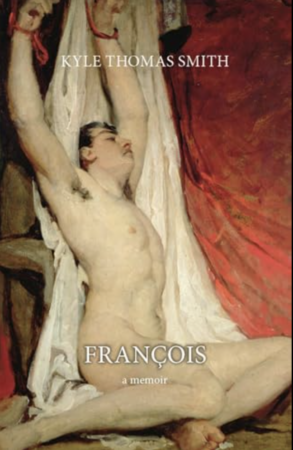
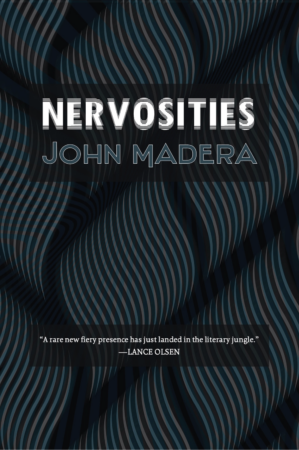
So begins award-winning author Kyle Thomas Smith’s latest memoir, François (StreetLegal Press, 2024), the Chicago-born, Brooklyn-based author’s follow-up to the hilarious 2018 Cockloft: Scenes from a Gay Marriage and the poignant 2010 novel 85A. Smith will be around people on Sunday, March 16, when he appears at New York Insight Meditation Center to read from François, which features William Etty’s dramatic 1828 oil painting Male Nude, with Arms Up-Stretched on the cover. Smith, a practice leader in New York Insight’s Brooklyn sangha, will be joined by New York City–based writer, editor, and publisher John Madera, who will read from Nervosities (Anti-Oedipus Press, 2024), his debut collection of short experimental fiction that includes such stories as “Some Varieties of Being and Other Non Sequiturs,” “Anatomy of a Ruined Wingspan,” and “Notes Toward the Recovery of Desiderata.” Following the readings, Smith and Madera will sit down for a conversation moderated by bookseller, activist, musician, piano teacher, and suicide hotline director Josh Wexler. The event, hosted by the NYI Artist Salon and being livestreamed as well, will begin with presentations by other members of New York Insight’s community.
And just in case Smith is interested, among the works on Classical Music for Creativity are Carl Philipp Emanuel Bach’s Symphony in G Major, Wq. 182 No. 1: I. Allegro di molto, conducted by Hartmut Haenchen; several Vivaldi concertos for violin, cello, mandolin, and/or strings; and Handel’s Music for the Royal Fireworks, HWV 351: IV. La réjouissance, in addition to compositions by Johann Sebastian Bach, Arcangelo Corelli, Mozart, Schubert, Beethoven, and Jean-Philipe Rameau.
[Mark Rifkin is a Brooklyn-born, Manhattan-based writer and editor; you can follow him on Substack here.]
Aliocha (Aurelia Arandi-Longpre) and Jeff (Noah Parker) get close in Who by Fire
WHO BY FIRE (COMME LE FEU) (Philippe Lesage, 2024)
Film at Lincoln Center
Elinor Bunin Munroe Film Center, Francesca Beale Theater
144 West Sixty-Fifth St. between Broadway & Amsterdam Ave.
March 14-20 www.filmlinc.org www.kimstim.com
Winner of the Grand Prix from the Generation 14plus International Jury at the 2024 Berlinale, Quebecois writer-director Philippe Lesage’s Who by Fire (Comme le feu) is two and a half hours of angst, anger, and jealousy, a coming-of-age drama with a harrowing final fifteen minutes.
One of the special prayers recited during the Jewish High Holidays is the poetic psalm Unetaneh Tokef, which describes repentance, prayer, and charity and includes the following lines: “How many shall pass away and how many shall be born, / Who shall live and who shall die, / Who shall reach the end of his days and who shall not, / Who shall perish by water and who by fire, / Who by sword and who by wild beast, / Who by famine and who by thirst, / Who by earthquake and who by plague, / Who by strangulation and who by stoning, / Who shall have rest and who shall wander, / Who shall be at peace and who shall be pursued, / Who shall be at rest and who shall be tormented, / Who shall be exalted and who shall be brought low, / Who shall become rich and who shall be impoverished.” That quote, which was adapted by Canadian singer-songwriter Leonard Cohen into the 1974 song “Who by Fire,” captures the essence of the film, which opens March 14 at Lincoln Center, with Lesage participating in Q&As at the 6:15 screening March 14 and the 3:15 show on March 15.
The story unfolds at a secluded cabin in the gorgeous Canadian woods of Haute-Mauricie, where film director Blake Cadieux (Arieh Worthalter) has invited his former longtime collaborator, screenwriter Albert Gary (Paul Ahmarani), to spend some time. Joining Albert are his college-age daughter, Aliocha (Aurelia Arandi-Longpre), his seventeen-year-old son, Max (Antoine Marchand-Gagnon), and Max’s best friend, the shy, uneasy Jeff (Noah Parker). After a successful series of fiction films, Blake and Albert had a falling out, as the former turned to documentaries and the latter to animated television.
Blake lives with his editor, Millie (Sophie Desmarais), housekeeper, Barney (Carlo Harrietha), cook, Ferran (Guillaume Laurin), and dog, Ingmar (Kamo). Also arriving are well-known actress Hélène Falke (Irène Jacob) and her partner, Eddy (Laurent Lucas).
Over the course of several days, there is a lot of cigarette smoking and wine drinking, discussions about art and responsibility, sexual flirtations, and angry arguments between Blake and Albert that go beyond nasty, in addition to hunting, fishing, and white water rafting in the great outdoors, not all of which goes well.
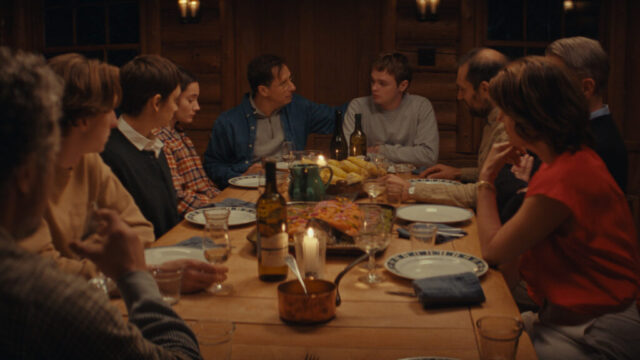
Three uncut dinner scenes anchor Philippe Lesage’s Who by Fire
Who by Fire is anchored by three uncut ten-minute dinner scenes in which tensions flare, primarily involving Blake and Albert, including one in which oenophile Albert accuses Blake of switching out one of his wines. In two of the scenes, cinematographer Balthazar Lab’s camera remains motionless on one end of the long table, while in the third the camera eventually moves around to focus on Albert having an episode.
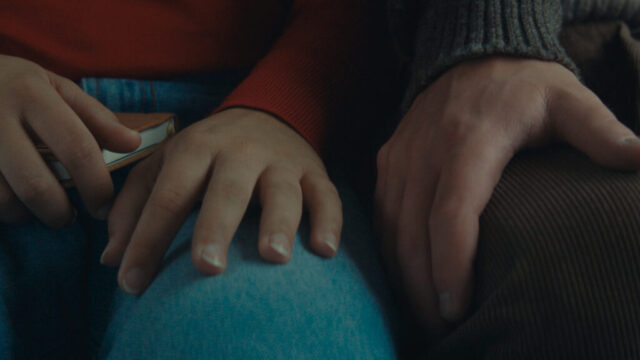
But at the center of the story is Jeff, who is awkward in his thoughts and actions. The film opens with Albert, his children, and Jeff driving on a deserted highway to be met by Blake’s helicopter. The first shot inside the car is of two young people with their hands on their knees; we don’t see their faces but can feel that at least one of them wants to touch the other. We soon learn that it is Aliocha — whose name in Russian translates to “defender of men” — and Jeff (the one who wants their hands and legs to meet). Later, after Max tells Jeff that he once caught his sister looking at S&M porn, Jeff makes a misguided play for her and, shunned, runs into the woods with his tail between his legs and becomes lost. After he is rescued, he grows mad at Blake when he catches the director and Aliocha in an intimate moment.
Most of the characters are either unlikable or not fully defined, so spending more than two and a half hours with them is a lot to ask. The cast does its job admirably, finding their way around some of Lesage’s occasionally meandering script. Cédric Dind-Lavoie’s droning score ranges from lilting to elegiac. A party scene that ends with the characters singing and dancing to the B-52’s song “Rock Lobster” starts out fun but quickly becomes something else, no mere break from the glum atmosphere.
Lesage (Les démons,Genèse) expertly balances the claustrophobic interior scenes by glorying in the beauty of nature, with outdoor scenes that celebrate the world outside. But not everyone is as comfortable as he is in those surroundings, leading to one tragedy that is followed by an even worse one, at least as far as manipulating an audience goes.
Who by Fire raises many of the questions asked in the Unetaneh Tokef, and he answers some of them while leaving plenty open to interpretation, as does Cohen when he asks, “And who shall I say is calling?”
[Mark Rifkin is a Brooklyn-born, Manhattan-based writer and editor; you can follow him on Substack here.]
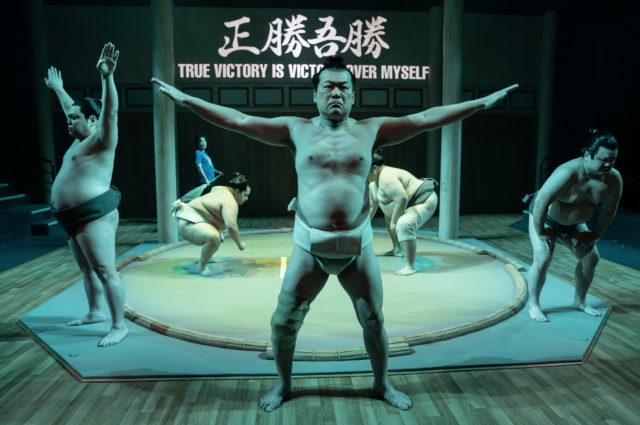
Wrestlers known as rikishi get ready to do battle in Lisa Sanaye Dring’s Sumo (photo by Joan Marcus)
SUMO
Anspacher Theater, the Public Theater
425 Lafayette St. at Astor Pl.
Tuesday through Sunday through March 30, $65-$93
212-539-8500 publictheater.org
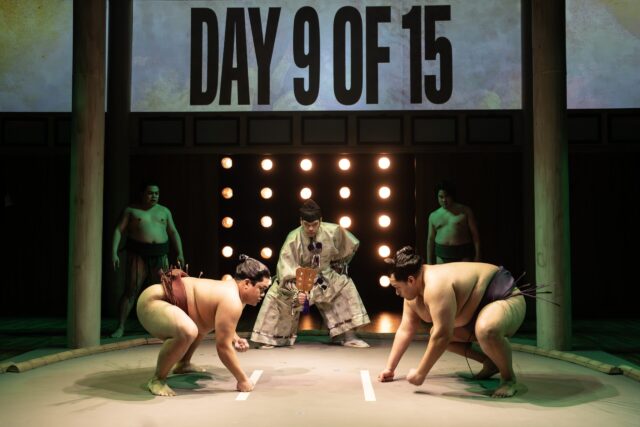
Lisa Sanaye Dring’s Sumo takes audiences inside the ancient Japanese sport and sacred Shinto ritual of sumo, in which large-sized wrestlers known as rikishi do battle in a dohyo, or ring, attempting to push their opponent to the mat or out of the circle. Each competitor wears only a mawashi, or silk belt, around their waist, leaving little to the imagination, as they seek to climb the ladder of success through such san’yaku, or ranks, as the lower jonokuchi, jonidan, and sandanme to the higher sekiwake, ōzeki, and the ultimate yokozuna. Most matches are over in a few seconds, although some can last upwards of a minute.
The tense Ma-Yi Theater Company drama, which premiered in 2023 at La Jolla Playhouse and is now at the Public’s Anspacher Theater through March 30, is too long at two hours and twenty minutes (with intermission), and in its second act it gets caught up in treacly melodrama, but it is still a compelling exploration of dedication, honor, tradition, and respect in a sport Americans know little about, in a changing world that is redefining masculinity and conceptions about the human body.
Mitsuo (David Shih) is an ōzeki known as Kōryū, or Exalted Dragon, who runs a heya, or stable of wrestlers, that consists of the stalwart jūryō Ren (Ahmad Kamal), the makushita Shinta (Earl T. Kim), the sandanme Fumio (Red Concepción), the jonidan So (Michael Hisamoto), and the maezumo Akio (Scott Keiji Takeda), an overeager eighteen-year-old newcomer who is not ready to pay his dues, which includes sweeping up, remaining silent, and pouring tea before earning his way into the dohyo. A trio of kannushi, or Shinto priests (Kris Bona, Paco Tolson, Viet Vo), serve as a Greek chorus as well as the gyoji, or referees, and sponsors who scour the tournaments and practices deciding who they will bankroll.
Speaking directly to the audience early on, they explain, “Rikishi were once gods. Kami! Who fought for ownership of Japan. There were two deities: Takeminakata-no-Kami, god of wind and water, who fought on behalf of the humans. And Takemikazuchi-no-Kami, god of thunder, who fought on behalf of the divine. The imperial family supposedly descends from Takemikazuchi, and if Takeminakata had won instead of Takemikazuchi, Japan wouldn’t have been ruled for centuries by emperors and instead would have been governed by commoners — people like you. Ok, maybe not you.”
Mitsuo starts working Akio hard, seeing promise in him, which rankles the others, who nonetheless sneak in little lessons for Akio when no one else is around; they will be punished if Mitsuo catches them breaking the rules, which Akio doesn’t want to follow. “There is a saying: Before enlightenment, chop wood, carry water. After enlightenment, chop wood, carry water,” So tells Akio, who shoots back, “I’m not here to be enlightened.” A moment later, So, explaining how good they all have it, adds, “In here, we are free. But you have to learn to trust us.”
The rikishi compete in a series of matches, employing such kimarite, or techniques, as harite (a slap), henka (a sidestep), and tachiai (initial charge); train in their heya, where no one else, especially women, are permitted; and, in the case of two of the men, grow extremely close. At one point Akio shares his doubts with Shinta, asking, “Do you think I can do this?” Shinta responds, “I have no idea. Can your body? Probably. It depends.” Akio: “On what?” Shinta: “On if the gods want it.” Akio: “Who?” Shinta: “Whoever you pray to.” Akio: “I don’t pray.” Shinta: “Yes you do.” Shinta poetically discusses what’s at the heart of sumo: “Our bodies are so big, so alive, that we wake everyone who sees. . . . It’s a service. It’s all an offering to her.” Akio repeats, “Her,” to which Shinta says, “Yes. The spirit of sumo is a woman.”
As the heya participates in several tournaments, friendships and relationships get tested and Akio needs to look deep inside himself to figure out who he truly is.
David Shih leads a strong cast in Lisa Sanaye Dring’s Sumo at the Public (photo by Joan Marcus)
Although I’ve never been to a wrestling or sumo tournament, I have seen several boxing bouts, sitting ringside as well as in the upper decks; unsurprisingly, the closer you are to the action, the more exciting it is. The same is true for Sumo; from my second-row aisle seat, I seemed to have a different experience from some of my colleagues, who were in the last row. Every foot stomp, or shiko, gave me a tingle. Wilson Chin’s dramatic set turns two of the Anspacher’s pillars into a prop around the dohyo; when the actors are not in the ring, they are practically in the audience’s lap.
Paul Whitaker’s lighting features five rows of nine lights behind sliding doors that open and close to indicate time and space changes. Hana S. Kim’s lively projections announce details of the matches on the back wall and floor, occasionally fitting neatly within the dohyo. Mariko Ohigashi’s costumes go beyond the miwashi to include elegant kimono, traditional gyoji wear, and contemporary clothing. Fabian Obispo’s sound design and original compositions enhance the atmosphere, setting the pace with Japanese hip-hop before the show and at intermission, blasting out such tunes as Denzel Curry’s “Sumo | Zumo,” ¥ellow Bucks’s “My Resort,” and Yuki Chiba’s “Dareda?”
Be prepared to see a lot of flesh; these are big men who might not win any bodybuilding contests but have sacrificed conventional notions of physical attractiveness for the cause, to be the best at what they do, knowing that when they are done, they will have trouble reconnecting to society, as this exchange details:
Shinta: You can’t leave. So: I’ve given my whole body. Fumio: There’s this pus that comes from my feet. Shinta: Someone got my right ear — no more sound. So: I miss my brothers. Ren: We just do this. Fumio: I could have learned to sail. So: I have no skills. Fumio: It’s just this. Akio: How did you come here? Fumio: My father trained me from when I was a boy. Ren: Because my body needs it. So: My family had too many mouths to feed. Shinta: This was the path that opened before me, so I walked it. Mitsuo: Because I’ve always been the best. All: But only here. Ren: And when I leave here / Shinta: When I retire from here / So: I’ll never leave here. Fumio: When I get kicked out of here, I’ll be / All: Screwed. Akio: Then why do you do it? Ren: Hatakikomi. Because I can. Fumio: Tsuppari. Need. Shinta: Tsuri-otoshi. Beauty. So: Kote-nage. Devotion. Mitsuo: Uwate-nage: You do it to win.
The strong cast is a mix of established actors, such as Shih (Once Upon a (korean) Time,KPOP) and Tolson (The Knight of the Burning Pestle,The Wind and the Rain), and performers making their New York City debuts; all handle themselves well, with a bonus nod to Kamal as Ren, perhaps the most complex of the characters. Shih-Wei Wu provides thrilling live taiko drumming throughout.
As the story continues, it occasionally resembles a special episode of Cobra Kai, the entertaining streaming series that is an extension of the Karate Kid movies, but while that show, in which Ralph Macchio and William Zabka reprise their 1980s roles, has its tongue in its cheek while dealing with teen issues, Sumo takes itself too seriously. Ultimately, Dring (Hungry Ghost,Kairos) and Obie-winning director Ralph B. Peña (The Romance of Magno Rubio,The Chinese Lady) paint themselves into a corner, throwing too much information at the audience and getting bogged down in exposition.
But that doesn’t mean there isn’t much to admire in the play, especially if you are sitting ringside.
[Mark Rifkin is a Brooklyn-born, Manhattan-based writer and editor; you can follow him on Substack here.]
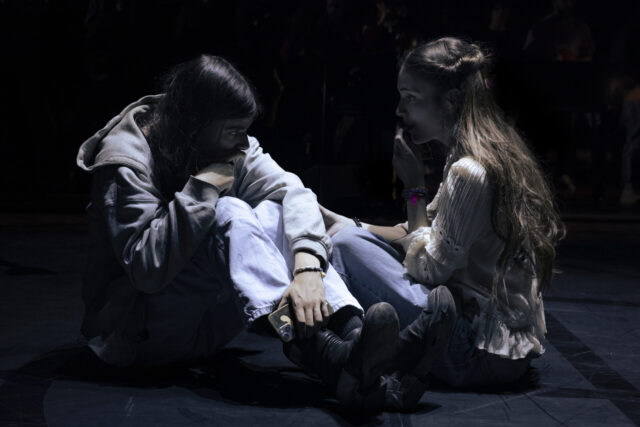
Anne Imhof reimagines Romeo and Juliet in Doom: House of Hope at the armory (photo by Nadine Fraczkowski / courtesy the artist, Galerie Buchholz, Sprüth Magers, and Park Ave. Armory)
DOOM: HOUSE OF HOPE
Park Avenue Armory, Wade Thompson Drill Hall
643 Park Ave. at 67th St.
March 3–12, $60
212-933-5812 www.armoryonpark.org
“What less than doomsday is the prince’s doom?” Friar Laurence asks Romeo in William Shakespeare’s tragic tale Romeo & Juliet.
Because of its massive 55,000-square-foot Wade Thompson Drill Hall, Park Ave. Armory has been home to numerous unique theatrical productions and art installations, involving such unusual elements as thirty tons of clothing (Christian Boltanski’s No Man’s Land), wooden swings hanging seventy feet from the ceiling (Ann Hamilton’s The Event of a Thread), one hundred bleating sheep (Heiner Goebbels’s De Materie), and a dark, mysterious heath (Kenneth Branagh’s Macbeth).
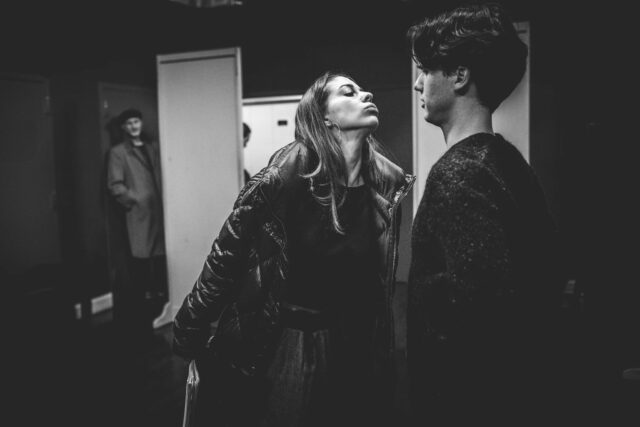
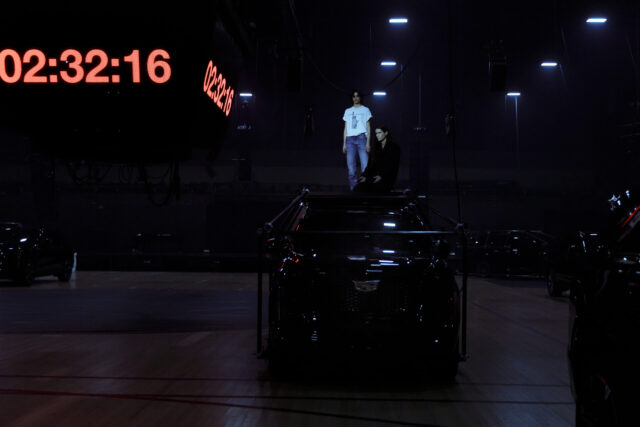
Now Berlin-based Golden Lion winner Anne Imhof has transformed the hall into an enormous prom gym, filling the space with more than fifty actors, dancers (ABT, modern, flexn, line), skateboarders, and musicians, twenty-six Cadillac Escalades, a Jumbotron, and other inspiring elements for Doom: House of Hope, a three-hour multidisciplinary reimagining of Romeo and Juliet, running March 3–12. Curated by Klaus Biesenbach, the durational performance features Sihana Shalaj, Levi Strasser, and Devon Teuscher as Romeo; Talia Ryder and Remy Young as Juliet; assistant director and costumer Eliza Douglas, choreographer Josh Johnson, Cranston Mills, and Connor Holloway as Mercutio; Jakob Eilinghoff, Arthur Tendeng, and Daniil Simkin as Benvolio; and Efron Danzg, vocalist Lia Wang, and Simkin as Tybalt. Among the other characters are Vinson Fraley and Toon Lobach as angels, Perla Haney-Jardine as the critic, Tess Petronio as the photographer, Casper von Bulow as the director and the revolutionary, Coco Gordon Moore as the poet, Tahlil Myth as the storyteller, and Henry Douglas as the gamer, offering yet more twists on the traditional tragedy.
The band, under the musical direction of Ville Haimala, consists of Sharleen Chidiac on guitar, Eilinghoff on bass, Eva Bella Kaufman on drums, and James Shaffer on guitar, with vocals by Lia Wang. The score ranges from Johann Sebastian Bach, Gustav Mahler, Franz Schubert, and Pyotr Ilyich Tchaikovsky to the Doors, Radiohead, and Frank Sinatra, along with original compositions by ATK44, Douglas, Haimala, Imhof, Lia Lia, Jacob Madden, and Strasser. In addition to Shakespeare, the text collects quotes from Jean Genet, Heinrich Heine, and Raymond Moody and writings about George Balanchine, John Cranko, Dieter Gackstetter, Bruce Nauman, Jerome Robbins, Tino Sehgal, and others.
The set is by sub, with sound by Mark Grey and lighting by the masterful Urs Schönebaum, who has dazzled audiences with his work on such previous armory productions as Inside Light and Doppelganger.
As its title states, the immersive show recognizes the doom so many feel now, the increasing anxiety over the state of the planet, while also seeing a potentially bright future.
Romeo (Levi Strasser) and Juliet (Talia Ryder) face doom and hope in Anne Imhof extravaganza at the armory (photo by Nadine Fraczkowski / courtesy the artist, Galerie Buchholz, Sprüth Magers, and Park Ave. Armory)
A few moments after Friar Laurence predicts the worst, Romeo tells him, “Hang up philosophy. / Unless philosophy can make a Juliet, / Displant a town, reverse a prince’s doom.” Perhaps there is a way out of this mess we’re in, although the Bard’s original play does not exactly end happily.
On March 11 at 5:30, Imhof, whose other works include Sex,Natures Mortes, and Angst I–III, will participate in an artist talk about Doom: House of Hope with writer and curator Ebony L. Haynes.
[Mark Rifkin is a Brooklyn-born, Manhattan-based writer and editor; you can follow him on Substack here.]