this week in lectures, signings, panel discussions, workshops, and Q&As

THE CONTENDERS 2018: BLACKkKLANSMAN

BlacKkKlansman

Detectives Flip Zimmerman (Adam Driver) and Ron Stallworth (John David Washington) go undercover to infiltrate the KKK in Spike Lee’s BlacKkKlansman

BLACKkKLANSMAN (Spike Lee, 2018)
MoMA Film, Museum of Modern Art
11 West 53rd St. between Fifth & Sixth Aves.
Sunday, November 25, 2:00
Series runs through January 8
212-708-9400
www.moma.org
www.focusfeatures.com

BlacKkKlansman is Spike Lee’s best fiction film since 1989’s Do the Right Thing, a comic thriller inspired by the real-life story of Ron Stallworth (John David Washington), a Colorado cop who went undercover with the KKK. “Dis joint is based upon some fo’ real, fo’ real sh*t,” the movie announces at the start. Stallworth, wearing an impressive natural afro, is hired by Chief Bridges (Robert John Burke) to diversify the force. When the police hear that Black Power activist Stokely Carmichael, now using the name Kwame Ture (Corey Hawkins), will be speaking at an event sponsored by the Colorado College Black Student Union, the chief and Sergeant Trapp (Ken Garito) send Stallworth in to scout out the situation. There he meets Patrice Dumas (Laura Harrier), a dedicated activist fighting the racist system, with a particular dislike for cops. Seeing an ad for the KKK in the local paper, Stallworth proposes to his bosses that he infiltrate the secretive organization, and they come up with a plan in which Stallworth will gain intelligence over the phone, speaking with local KKK leaders. The only problem is that Stallworth, in a major rookie mistake, used his real name when first talking to Walter Breachway (Ryan Eggold), which complicates the operation. But they proceed, as Detective Flip Zimmerman (Adam Driver) insinuates himself into the group in person, applying for membership and trying to find out about any future marches, cross burnings, or other attacks, gaining the trust of the straightforward Breachway and the goofy Ivanhoe (Paul Walter Hauser), while the nasty Felix Kendrickson (Jasper Pääkkönen) quickly grows suspicious of him. In the meantime, Stallworth develops a phone friendship with Grand Wizard David Duke (Topher Grace) and begins dating Dumas, while Kendrickson’s wife, Connie (Ashlie Atkinson), desperately wants to prove her racism by participating in the KKK’s schemes — which are explicitly limited to “white Christian men.”

Patrice Dumas (Laura Harrier) fights for justice in

Patrice Dumas (Laura Harrier) fights for justice in Spike Lee’s BlacKkKlansman

Written by Charlie Wachtel, David Rabinowitz, Kevin Willmott, and Lee, BlacKkKlansman takes plenty of liberties with the facts — for example, Stallworth has never identified his white partner, Dumas is a fictional character (although based on Angela Davis and Kathleen Cleaver), and the time shifts a few years ahead — but the heart and soul of the story is true, and Lee captures it with gusto. The film is wickedly funny and frighteningly realistic, all too relevant to today’s rising racist hatred around the world. As Dumas teaches Stallworth about his responsibility to the black race, Stallworth does the same with Zimmerman about his Jewishness. “Why you acting like you don’t have skin in the game?” Stallworth asks him. Photographed by Chayse Irvin and edited by Barry Alexander Brown, BlacKkKlansman is also one of Lee’s best-looking, most-accomplished films, featuring a terrific score by Terence Blanchard along with songs by such diverse musicians as James Brown, Prince, the Edwin Hawkins Singers, Looking Glass, and Emerson, Lake & Palmer. Washington — who played a student in Lee’s Malcolm X, starring his father, Denzel Washington — and Driver have a great chemistry that propels the film, which was released on the first anniversary of the Unite the Right white supremacist rally in Charlottesville.

Several lines of dialogue specifically evoke what his happening in America today, and Lee seals the deal with a finale that includes footage of Duke and President Trump refusing to condemn what went down in Virginia on August 12, 2017. (He also has Trump impersonator Alec Baldwin play a not-too-bright white supremacist; actually, none of the racists is endowed with much intelligence.) As is his trademark, Lee pulls no punches; especially effective is how he switches between Jerome Turner (Harry Belafonte) relating the true story of the lynching of Jesse Washington and the Klansmen watching D. W. Griffith’s Birth of a Nation. Because, of course, we all have a skin in this game. BlacKkKlansman is screening November 25 at 2:00 in MoMA’s annual series “The Contenders,” consisting of works the museum believes will last the test of time, which continues through January 8 with such other 2018 films as Morgan Neville’s Won’t You Be My Neighbor? (followed by a discussion with Neville and producer Nicholas Ma), Paul Dano’s Wildlife (followed by a discussion with Dano, cowriter Zoe Kazan, and actors Carey Mulligan and Jake Gyllenhaal), Paul Schrader’s First Reformed (followed by a discussion with Shrader and Ethan Hawke), and John Krasinski’s A Quiet Place (followed by a discussion with Krasinski).

GLORIA: A LIFE

(photo by Joan Marcus)

Christine Lahti portrays feminist icon Gloria Steinem in world premiere production at the Daryl Roth Theatre (photo by Joan Marcus)

Daryl Roth Theatre
103 East 15th St. between Irving Pl. & Park Ave.
Saturday – Tuesday through March 31, $55-$150
gloriatheplay.com

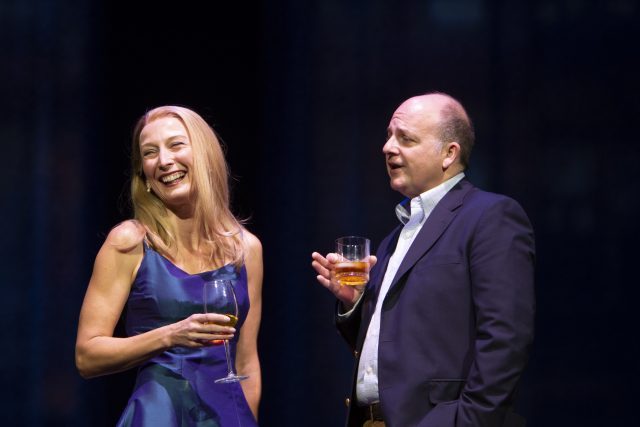
Gloria: A Life is being billed as a play about feminist icon Gloria Steinem, but that’s not completely accurate; it’s really more of an illustrated lecture/performance than a truly dramatic narrative, a relatively chronological recap of her life and career. Told by Oscar, Emmy, and Obie winner Christine Lahti as Steinem, complete with aviator sunglasses, bell-bottoms, and long brown hair, the story evolves as a diverse group of six women take on multiple roles. Tony-nominated writer Emily Mann (Having Our Say, Execution of Justice) and Tony-winning director Diane Paulus (The Gershwins’ Porgy and Bess, All the Way) capture Steinem’s greatest hits, from her early days in journalism, including her breakthrough Playboy bunny exposé, her New York magazine story on abortion, and the harsh misogyny she encountered, to her founding of Ms., her participation in the 2017 Women’s March, and her unfortunately brief marriage to David Bale. Lahti stays primarily in the center of Amy Rubin’s comfy theater-in-the-round set, which features rows of benches, each seat with its own brightly colored pillow back. Actresses Joanna Glushak, Fedna Jacquet, Francesca Fernandez McKenzie, Patrena Murray, DeLanna Studi, and Liz Wisan portray various Steinem friends and enemies, colleagues, and family members, including Coretta Scott King, Bella Abzug, Wilma Mankiller, Florynce Kennedy, Dorothy Pitman Hughes, and Steinem’s mother.

(photo by Joan Marcus)

Christine Lahti is joined by a cast of diverse actresses in Gloria: A Life (photo by Joan Marcus)

Archival footage of Steinem is projected onto two walls of the theater, along with occasional live video of what’s happening onstage, primarily re-creations of actual interviews. It’s all fairly straightforward and lacking any real conflict; Lahti does not attempt to completely transform herself into Steinem — for example, she uses her real speaking voice and doesn’t change costumes or hairstyle to match the passing years — while the other actresses’ portrayals tend to be underwhelming or over the top. But the show is hard not to like as Steinem, now eighty-four and the author of such books as Outrageous Acts and Everyday Rebellions and My Life on the Road, is a captivating figure and Lahti, sixteen years younger and the author of the new essay collection True Stories from an Unreliable Eyewitness: A Feminist Coming of Age, which features advance praise on the back cover from Steinem, is utterly charming as our host.

After ninety minutes, Gloria changes direction and turns into a Talking Circle where the audience in invited to participate in a discussion about the play, Steinem, or other issues related to feminism and the world today. A sign announces, “Lead with love. Low ego. High impact. Move at the speed of trust.” The night I went, Lahti moderated the conversation, but there are often special guests, such as Lena Dunham, Christiane Amanpour, Julie Menin, show consultant Kathy Najimy, Letty Cottin Pogrebin, and Steinem herself. It was a fascinating exchange of ideas about the absence of African American women in second-wave feminism, the decision to not mention Betty Friedan in the play, how the vast majority of the crew and producers are women, and the impact of current activist movements. Among those in the audience were Melissa Silverstein, cofounder and producing director of the Athena Film Festival at Barnard, New York City political stalwart Ruth Messinger, and a woman who once worked for Steinem, a self-described hope-aholic who, after all these years, still believes every one of us can make a difference.

BILL SHANNON: TOUCH UPDATE

(photo courtesy Kelly-Strayhorn)

Bill Shannon’s multidisciplinary Touch Update will be presented at New York Live Arts this week (photo courtesy Kelly Strayhorn Theater)

New York Live Arts
219 West 19th St. between Seventh & Eighth Aves.
November 14-17, $15-$20, 7:30
212-924-0077
newyorklivearts.org
www.whatiswhat.com

Extraordinary multidisciplinary artist Bill Shannon brings his latest project, the multimedia Touch Update, to New York Live Arts this week, accompanied by special programs. Shannon is best known for his performances and unique technique using crutches, as he was born with a degenerative hip condition. But that hasn’t stopped Shannon from skateboarding through the Financial District, moving through Duarte Square and Governors Island, and appearing at the Maker Faire in Queens. Over the years, he has been adding cutting-edge technology to his performances and installations, culminating in Touch Update, which incorporates dance, theater, prerecorded and live video, and a cubist mask onto which images are projected; Shannon met with neuroscientists to get everything just right. “It’s built around basic philosophical questions about humanity: Can people change?” he says in an online promo piece in which he also calls the show “a response to the filter of social and digital media and how humans interact.” The seventy-minute work, which was developed at a residency at the Kelly Strayhorn Theater in Pittsburgh, includes reverse engineering of the Shannon Technique for those who do not require crutches and will be performed by Raphael Botelho Nepomuceno, Ron Chunn Jr., Teena Marie Custer, Anna Thompson and Taylor Knight of slowdanger, Jacquea Mae, Cornelius Henke, and David Whitewolf. The November 15 show will be followed by a Stay Late Conversation moderated by Jennifer Edwards; there will also be a Reverse Engineering Workshop ($15) on November 17 at 1:00 and a lecture, “The Condition Arriving” ($10, $5 with ticket), the same day at 5:00.

SHOAH: FOUR SISTERS / THE LAST OF THE UNJUST

Holocaust survivor Ruth Elias tells her amazing story to Claude Lanzmann — and sings — in The Hippocratic Oath

Holocaust survivor Ruth Elias tells her amazing story to Claude Lanzmann — and sings — in The Hippocratic Oath

CLAUDE LANZMANN’S FOUR SISTERS (Claude Lanzmann, 2017)
Quad Cinema
34 West 13th St. between Fifth & Sixth Aves.
Opens Wednesday, November 14
212-255-2243
quadcinema.com
cohenmedia.net

“You are very well informed,” Holocaust survivor Ruth Elias tells filmmaker Claude Lanzmann in The Four Sisters: The Hippocratic Oath. Thanks to the Paris-born Lanzmann, a French resistance fighter during WWII, we are all very well informed about so many of the atrocities perpetrated by the Nazis, told to him in moving, powerful stories by “living witnesses” for decades. In The Four Sisters, which made its world premiere at the New York Film Festival in October, the Shoah director, who passed away in July at the age of ninety-two, focuses on the extraordinary experiences of four strong women who survived concentration camps, each one originally interviewed for Shoah. “The more I thought about these four women, the more the necessity to bring the spotlight on these female faces of the Shoah seemed important,” Lanzmann explains in his director’s note about deciding to turn them into four separate portraits. “Each of them deals with a little-known chapter of the Holocaust, each from a unique point of view. . . . The incredible strength in each of them has to exist in its own right, and yet the exceptional quality they all share also had to come through — that searingly sharp, almost physical intelligence, and an irrepressible survival instinct which could not be extinguished, despite an apparently certain death awaiting them.” The four-part film is being told in two parts at the Quad beginning November 14, Hanna & Paula and Ruth & Ada.

Ada Lichtman details her time in Sobibór in The Merry Flea

Ada Lichtman details her time in Sobibór in The Merry Flea

In The Hippocratic Oath, Ruth Elias tells her remarkable story from the Nazi occupation of Czechoslovakia in March 1939 to her deportation in April 1942 to Theresienstadt, where she was reunited with and married her boyfriend, to her pregnancy in the winter of 1943, which led to her being sent to Ravensbrück and Auschwitz, where she met Dr. Josef Mengele, who chose to use her baby in an inhuman experiment. Filmed in a little garden, Elias, an accordion player, is firm and direct as she shares the details of precisely what happened, her dark eyes seemingly sent back to Eastern Europe as her words bring it all to vivid life; one can visualize each location, each movement, each glance. The camera occasionally turns to Lanzmann, smoking a cigarette as he listens to her, mesmerized, just as the audience is. Lanzmann is more active in Baluty, walking along the shore in Panama City, Florida, with Paula Biren, whose story begins in Lodz, Poland. An elegant woman, Biren needs a little more prodding to speak, which she does very carefully, with a brutally cold honesty. She describes how Lodz was turned into a ghetto, how she became a police officer there, and then was sent to Auschwitz, where her younger sister and mother were killed, followed by her father’s death shortly thereafter. Lanzmann supplements the film with archival photographs of Lodz. Throughout The Merry Flea, Ada Lichtman is cleaning and mending dolls; it is eerie as viewers eventually find out why. Lichtman, from the Polish town of Wieliczka, relates her story of being captured by the Germans and sent to Sobibór, speaking at a determined, almost eager pace, sometimes skipping around so that Lanzmann has to interject to get her back on track or to go into more specifics, particularly regarding her treatment at the hands of a Nazi officer named Wagner and her description of cattle cars where naked men, women, and children were forced to dance with one another. The camera occasionally shifts to her husband, who she met in the camps; he stares ahead almost blankly, with hollow, haunted eyes, then hides his head in his hands. The sound of traffic outside can be heard, as if coming from another time and place.

Hanna Marton has a frightening tale to tell Claude Lanzmann in Noah’s Ark

Hanna Marton has a frightening tale to tell Claude Lanzmann in Noah’s Ark

Finally, in Noah’s Ark, Lanzmann introduces Hungarian native Hanna Marton, who sits calmly in a chair, holding a small notebook as she speaks in Hebrew, the director sitting right in front of her, nearly knocking knees; in the film’s production notes, Lanzmann explains, “I’ve never heard an account that is as constantly, relentlessly painful as the one that Hanna Marton gave me when I filmed her during the shoot for Shoah in her Jerusalem apartment.” Her eyes sometimes tearing up, Marton, continually on edge and at times defensive, talks about the early Zionist movement in her hometown of Cluj, the capital of Transylvania; discusses how Jews were used by the Hungarian army, which supported Germany and Italy, as living mine detectors; details the creation of the Kolozsvár ghetto in May 1944 as a way to quickly exterminate Jews; and delves into her involvement with the Kastner train, a deal made between Jewish-Hungarian lawyer Rudolf Kastner and Nazi Obersturmbannführer Adolph Eichmann. The Four Sisters is no mere addendum to Shoah, nor is it a footnote to Lanzmann’s long, important career; together, the four films make a powerful statement about hatred and bigotry, about violence and war, and about the indomitable strength and spirit of women, especially during the war and its aftermath. They are also a terrifying reminder that given the state of the world today, it’s not impossible that something like this could happen again, even right here in America, as there are fewer and fewer concentration-camp eyewitnesses, Holocaust deniers litter the internet, nations build walls and fences to keep out refugees, and a sitting president insists that some white supremacists are “very fine people.”

Claude Lanzmann and Benjamin Murmelstein discuss the Holocaust in revealing documentary

Claude Lanzmann and Benjamin Murmelstein discuss the Holocaust in revealing documentary

THE LAST OF THE UNJUST (LE DERNIER DES INJUSTES) (Claude Lanzmann, 2013)
Quad Cinema
34 West 13th St. between Fifth & Sixth Aves.
Wednesday, November 14, 6:35, and Monday, November 19, 6:35
212-255-2243
quadcinema.com
www.cohenmedia.net

For more than forty years, late French filmmaker Claude Lanzmann documented the Holocaust and the birth of the state of Israel in such provocative and powerful films as Israel, Why; Sobibór, October 14, 1943, 4 p.m.; and his nine-and-a-half-hour masterpiece, Shoah. In 1997, he made A Visitor from the Living, built around a 1979 interview with International Red Cross worker Maurice Rossel, who led a delegation inspecting the Nazis’ so-called “model ghetto” of Theresienstadt, which turned out to be a glorified concentration camp. Lanzmann returns to the Czech camp in The Last of the Unjust, an utterly fascinating 218-minute documentary consisting of a series of interviews he conducted in Rome in 1975 with Rabbi Benjamin Murmelstein, the only Jewish Elder to survive the Holocaust. For years, Murmelstein, who was appointed directly by and reported to Obersturmbannführer Adolph Eichmann, has been declared a Nazi collaborator, by writer Hannah Arendt and many others, even being arrested, imprisoned, and tried by Czech authorities. But in The Last of the Unjust, he paints a vivid portrait of everyday life in Theresienstadt, claiming he was not a collaborator but instead was doing whatever he could to improve conditions for the Jews there.

Claude Lanzmann

Claude Lanzmann visits Theresienstadt in film about the model ghetto’s last Jewish Elder

He poignantly describes not knowing about gas chambers and trains to Auschwitz and proudly defends his actions, referring to himself as the “last of the unjust.” Murmelstein has a spectacular memory, vividly recalling specific moments, answering all of Lanzmann’s questions with a bold honesty and correcting long-held misbeliefs concerning Theresienstadt. A cool, cigarette-smoking Lanzmann is seen in the old interviews and he also appears in new footage shot as he visits the camp and other relevant locations, geographically linking the past and the present. Between Murmelstein’s amazing storytelling ability and Lanzmann’s sharing of his personal perspective, the film never gets boring or repetitive over the course of its three-and-a-half-hour length. In the written introduction, Lanzmann states, “It took me a long time to come to the realization that I didn’t have the right to keep this to myself.” He indeed did a great service by not keeping this to himself, making yet another poignant document of the Holocaust as seen through the eyes of a unique and thoroughly intriguing witness. The Last of the Unjust is screening at the Quad on November 14 and 19 at 6:35 (the November 14 show will be introduced by Lanzmann assistant Laura Koeppel) as part of the “Claude Lanzmann’s Cinema of Remembrance” series, which continues through November 21 with such other works as Napalm; Sobibór, October 14, 1943, 4 p.m.; Israel, Why; A Visitor from the Living and The Karski Report; Shoah in two sections; and Tsahal.

DOC NYC: WELCOME TO THE BEYOND

Welcome to the Beyond

Hoyt Richards looks back at a critical decision in his life in Welcome to the Beyond

WELCOME TO THE BEYOND (Brent Huff, 2018)
Cinepolis Chelsea
260 West 23rd St. between Seventh & Eighth Aves.
Tuesday, November 13, 7:30
Festival runs November 8-15
www.docnyc.net
www.welcometothebeyond.com

In the summer of 1978, Hoyt Richards, a gorgeous blond athlete from a large, successful family, was approached by a man on a beach in Nantucket who offered him a bright future. Richards, aka John Richards, appeared to already have it all, but he eventually followed the man, who turned out to be Frederick von Mierers, the leader of the Eternal Values cult, who claimed to be an alien from the planet Arcturus. Former model Brent Huff tells the bizarre story, in many ways a cautionary tale, in Welcome to the Beyond, screening November 13 at DOC NYC. In 2012, while filming a Ford Models reunion, actor, writer, and director Huff (Behind the Orange Curtain, Chasing Beauty) recognized Richards and approached him about making a documentary about his experience with Eternal Values. Richards agreed, and speaks extensively about what happened to him; Huff also meets with many of Richards’s friends and relatives. “There’s definitely a dynamic in this family that’s regrettable,” younger brother Garth says. “That dynamic had to do with, John was always my father’s favorite, and John epitomized what my father would have loved to have been: the blue-eyed, blond-haired, good-looking football player. There’s a cruel twist in all that, is that by my father making John his favorite, he created resentment from every other sibling of John. He put John on an island, and I don’t know how John internalized that, but that wasn’t a pretty place to be.”

Talking about his mother, John, who is one of the film’s producers, admits, “I always just felt like she was on a different planet.” John was the first male supermodel, went to Princeton, partied at Studio 54, and had a major career, but ultimately he came to understand that he was in a cult and that he had to get out. The psychology behind his story is related by Steven Hassan, a former cult member who became a deprogrammer and has written such books as Combatting Cult Mind Control. Richards’s five siblings, cousins, parents, and close friends as well as a fellow former cult member all share their thoughts on a situation that they still don’t really understand: Just why did Richards fall for von Mierers and Eternal Values? Welcome to the Beyond is screening November 13 at 7:30 at Cinepolis Chelsea in the Portraits section of DOC NYC, with Huff, producer Shawn Huff, and editor Pete Speneuk on hand for a Q&A.

DOC NYC: THE PROVIDERS

Chris Ruge is one of three health-care workers trying to make a difference in northern New Mexico in The Providers

Chris Ruge is one of three health-care workers profiled in The Providers trying to make a difference in northern New Mexico

THE PROVIDERS (Anna Moot-Levin & Laura Green, 2018)
IFC Center
323 Sixth Ave. at West Third St.
Monday, November 12, 12:45
Festival runs November 8-15
212-924-7771
www.docnyc.net
theprovidersdoc.com

Most recent polls show that health care is the number one concern of most Americans, ahead of the economy, immigration, the environment, gun violence, and other issues. Filmmakers Anna Moot-Levin and Laura Green travel to northern New Mexico to explore a critical aspect of the health-care crisis in the moving, almost elegiac The Providers, which is making its New York City premiere at the DOC NYC festival. Moot-Levin and Green, both the children of doctors, directed, produced, photographed, recorded the sound, and edited (with Chris Brown) the film, which follows three health-care workers as they deal with poor, underserved patients with empathy, compassion, and understanding in small rural towns. “My job is to try to keep you alive,” nurse practitioner Chris Ruge tells one patient. “Health care is a relationship,” explains physician assistant Matt Probst. And family physician Leslie Hayes points out that once she retires, there is no one to take over for her. Moot-Levin and Green spent one hundred days over three years in Las Vegas, Albuquerque, and Española in New Mexico, going behind the scenes as Ruge, Probst, and Hayes treat men, women, and children, including many adults suffering from alcoholism, opioid abuse, and other addictions. The three providers are part of the ECHO Care program at El Centro clinics, which allows them to see patients who have little or no money; they visit them in the hospital and make house calls, often stopping by just to check on how things are going. “There is so much beauty here. And there is so much pain,” Probst says.

Anna Moot-Levin and Laura Green on the set of The Providers

Anna Moot-Levin and Laura Green on the set of The Providers, their first film

The film also reveals how their dedication to their jobs impact their private lives; Ruge’s wife, nurse midwife Ann Ruge, complains that her husband cares more about his patients than about her, while Probst has to deal with an addicted father and troubled sister. When future funding for ECHO Care is in jeopardy, Chris Ruge notes, “If it ended, it would likely lead to the early death of a lot of our patients.” Another problem is where the next generation of health-care workers will come from to serve these indigent communities; Probst teaches physician assistant students at the University of New Mexico, where he hopes to find young men and women willing to stay local. “I want to go into the medical profession because this community is so far from medical help,” one student, Tiffany, says. The Providers is screening November 12 at IFC in the American Perspectives section of DOC NYC, with Moot-Levin participating in a Q&A after the film.

THE CONTENDERS 2018: THE OTHER SIDE OF THE WIND

Orson Welles on the set of his final film, The Other Side of the Wind

Orson Welles on the set of his final film, The Other Side of the Wind

THE OTHER SIDE OF THE WIND (Orson Welles, 2018)
MoMA Film, Museum of Modern Art
11 West 53rd St. between Fifth & Sixth Aves.
Sunday, November 11, 5:00
Series runs through January 8
212-708-9400
www.moma.org

Throughout Orson Welles’s The Other Side of the Wind, characters make declarations that have been applied to Welles’s work over the years, and what audiences may even be thinking in the first minutes of this, his final film: “Does all this matter?” “What the hell is that?” “I’m bored with the whole story.” “You could tell me what’s going on here.” And “What happens here?” “I’m not really sure, Max.” But that wickedly sly self-referential commentary is one of the many reasons that The Other Side of the Wind is yet another masterpiece by the man who brought the world Citizen Kane, The Magnificent Ambersons, Touch of Evil, F for Fake, and other classics. Welles’s legendary difficulties — budgetary problems, editing and reshoots without his consent, productions that took years to finish — are both the subject and the story of the making of The Other Side of the Wind itself. Welles’s potent skewering of Hollywood was shot in the 1970s and remained incomplete until now; finally, nearly one hundred hours of footage have been edited into a two-hour gem that will be screening November 11 at MoMA in their annual “Contenders” series, made up of films the institution believes will last the test of time. The Other Side of the Wind begins with an equilibrium-challenging blast of grainy scenes photographed with shaky handheld cameras and sudden, disorienting closeups, switching from color to black-and-white, the audio track not quite synced, Michel Legrand’s jazzy noir score underlining the too-rapid pace as all the main characters are introduced. The conceit of the film is that it tells the story of the last day of iconic, ornery auteur J. J. Hannaford’s life, played by iconic, ornery auteur John Huston. (Welles always claimed that Hannaford was not based on himself but on other great directors.) “This little historical document has been put together from many sources,” Hannaford acolyte Brooks Otterlake (Peter Bogdanovich) announces in voice-over at the start, “from all the footage shot by TV and documentary filmmakers and also the students, critics, and young directors who happened to bring 16- and 8mm cameras, having been invited to Jake’s seventieth birthday party.”

John Huston stars as a filmmaker on the last day of his life in The Other Side of the Wind

Peter Bogdanovich and John Huston star in Orson Welles’s The Other Side of the Wind

Once the film calms down, it’s stupendous, a bittersweet takedown of the studio system and the end of an era, with a fabulous cast that covers nearly every aspect of the film world: Susan Strasberg as ruthless, ambitious critic Julie Rich; Edmond O’Brien as actor Pat Mullins; Mercedes McCambridge as Maggie Noonan, Hannaford’s manager; Norman Foster as Billy Boyle, an old-timer who knows how to handle things; Paul Stewart as Matt Costello, another of Hannaford’s old cohorts; Lilli Palmer as movie star Zarah Valeska, the host of the party; Cameron Mitchell as grumbling makeup artist Zimmie; Pat McMahon as journalist Marvin P. Fassbender; Joseph McBride as critic Pister; Tonio Selwart as a financier known only as the Baron; Howard Grossman as biographer Charles Higgam; Geoffrey Land as studio head Max David; Frank Marshall as one of the documentarians; Cathy Lucas as Mavis Henscher, a young woman Hannaford takes a liking to; Stafford Repp (Chief O’Hara on Batman) as Hannaford supporter Al Denny; Dennis Hopper as director Lucas Renard; Benny Rubin as Hollywood agent Abe Vogel; Gregory Sierra as screenwriter Jack Simon, who keeps throwing barbs at Hannaford; and Dan Tobin as the uptight Dr. Bradley Pease Burroughs. Among those being parodied or paid homage to in the casting and the plot are Marlene Dietrich, John Houseman, John Ford, William Wellman, Pauline Kael, Robert Evans, Charles Higham, Cybill Shepherd, and John Milius. Among the party guests are George Jessel, Curtis Harrington, Henry Jaglom, Paul Mazursky, Claude Chabrol, Cameron Crowe, Les Moonves, and Rich Little, who originally played Otterlake but was replaced by Bogdanovich, who extensively interviewed Welles for the seminal book This Is Orson Welles. (And yes, that man in the bathroom stall is William Katt, who would later become the Greatest American Hero, while 1970s/’80s star Cassie Yates is Martine.)

Cinematographer Gary Graver and editor Bob Murawski have done what must have been a nearly impossible job, creating a compelling narrative that interweaves the many styles with the making of Hannaford’s last film, also called The Other Side of the Wind, a somewhat existential erotic tale of a Native American woman played by an unnamed actress (Oja Kodar, Welles’s companion) who’s being followed by a motorcycle rebel portrayed by first-time actor John Dale (Bob Random), a new discovery of Hannaford’s. The film is Hannaford’s attempt to remain relevant in the modern age; it’s shot in bold colors, with plenty of nudity and a hip score that serve as a stark counterpoint to the predominantly black-and-white footage of Hannaford and his exploits. “It’s a whole new business,” Zimmie laments. The Other Side of the Wind is a fitting coda to Welles’s career — although he does not appear in the film, his voice can be heard off-camera at one point — a grand finale lovingly put together with respect and admiration that once again makes us wonder what Welles could have achieved had he not continually run into so much trouble as a filmmaker. The MoMA screening will be followed by a Q&A with producer Filip Jan Rymsza. It will be preceded at 2:00 by Morgan Neville’s overly fanciful They’ll Love Me When I’m Dead, which goes behind-the-scenes of The Other Side of the Wind, detailing the making of the movie through interviews with many of the participants while also delving into Welles’s working process, fundraising methods, and, of course, genius. It’s narrated by Alan Cumming and features Bogdanovich, Kodar, Shepherd, Jaglom, Graver, Random, Marshall, Little, Mitchell, McBride, Simon Callow, George Stevens Jr., Jeanne Moreau, Danny Huston, and others. Neville will take part in a Q&A after the screening.