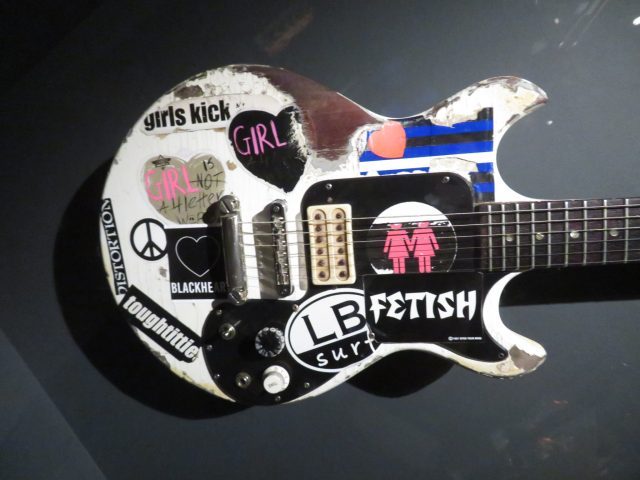
Joan Jett’s 1977 Melody Maker Gibson is part of Met exhibition “Play It Loud” (photo by twi-ny/mdr)
Metropolitan Museum of Art, Met Fifth Ave.
Gallery 199
1000 Fifth Ave. at 82nd St.
Through Through October 1, $25 suggested admission
212-535-7710
www.metmuseum.org
In 2011, the Met hosted “Guitar Heroes: Legendary Craftsmen from Italy to New York,” focusing on the lutherie tradition of Italian Americans in New York and New Jersey, artisans making violins, mandolins, guitars, and other stringed instruments. In the current exhibition “Play It Loud: Instruments of Rock & Roll,” the Met turns it up to eleven, celebrating the stringed and nonstringed apparatus of rock and pop music since the 1950s. In Mott the Hoople’s 1973 staple “All the Way from Memphis,” Ian Hunter refers to his guitar as a “six-string razor,” an “axe,” and “electric junk.” He continues: “Some dude said, ‘Rock ’n’ rollers, you’re all the same / Man, that’s your instrument.’ / I felt so ashamed.” Ian and Mott might not be represented in the Met exhibit — or in the Rock and Roll Hall of Fame — but there’s nothing for anyone to be ashamed of regarding this exciting collection of nearly two hundred items, with most of the instruments displayed in vitrines, like sculptural works of art, which of course they are.
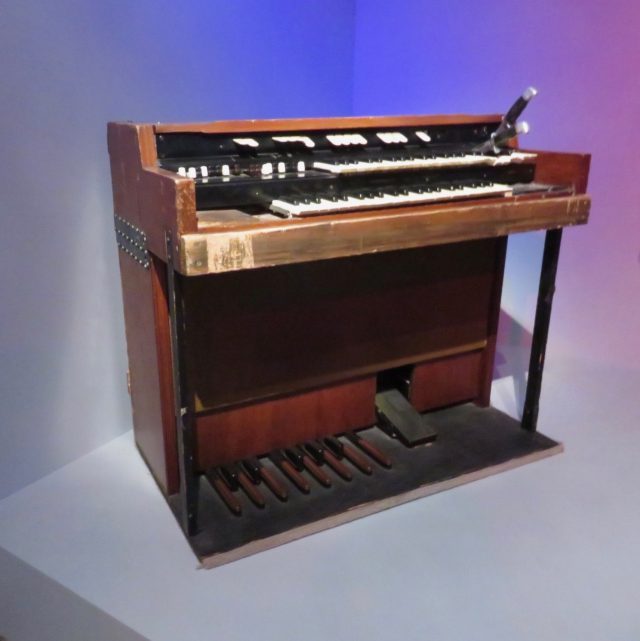
Keith Emerson’s 1960s Modified Hammond L-100 organ features two knives Emerson would stab the keys with (photo by twi-ny/mdr)
Don’t go straight to the labels, which contain information about who made the instrument and who played it on what songs; it’s a lot of fun trying to figure out whose instrument it is. You’re likely to guess twangers by Rick Nielsen of Cheap Trick, Prince, Bo Diddley, Buddy Holly, Ravi Shankar, and Bruce Springsteen, but others will surprise and delight you. One of the first items you’ll encounter is Jerry Lee Lewis’s 1955 Petite Grand Piano; for some reason, the signage refers to Lewis, who is eighty-three, in the past tense. Among the many gems are Chuck Berry’s 1958 Gibson, Louis Jordan’s 1954 Mark VI alto saxophone, Muddy Waters’s 1958 Telecaster known as “the Hoss,” Les Paul’s 1942 “Klunker,” Jimi Hendrix’s 1967 “Love Drops” Flying V, Joni Mitchell’s 1978 GB10NT George Benson Signature, Jack White’s 1964 Airline Res-O-Glas, Joe Perry’s 1985-86 X-100 Blade Runner, Stevie Ray Vaughan’s 1963 “Number One” composite Stratocaster, Robert Trujillo’s 2007–08 “Aztec De La Chloe” five-string bass, Keith Emerson’s 1968 Customized Moog Modular Synthesizer with keyboard, ribbon controllers, and stand, Ian Anderson’s 1975 Model 18-0 flute, Lady Gaga’s 2014 ARTPOP piano with custom housing, and Paul Stanley’s 1979–80 Cracked Mirror Iceman in addition to instruments played by Duane Allman, the Edge, Angus Young, Jeff Beck, Flea, Patti Smith, Ray Manzarek, Paul Butterfield, Nancy Wilson, Clarence Clemons, Steve Vai, Neil Young, Tina Weymouth, Bob Dylan, and dozens more.
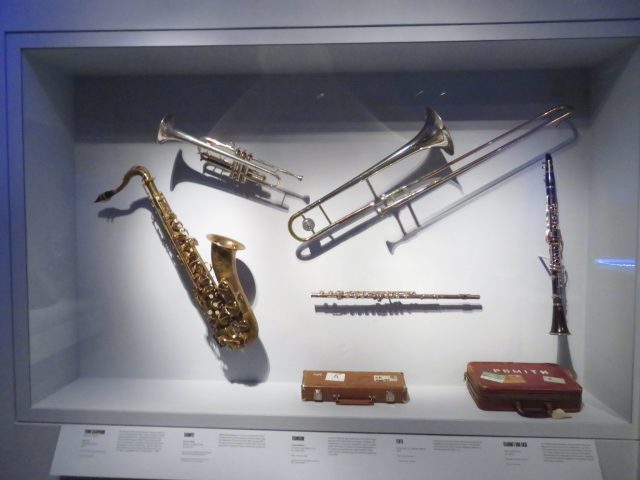
Met exhibition is not just about classic guitars (photo by twi-ny/mdr)
These are not mere artifacts; Jerry Garcia’s Wolf was taken out of the museum so John Mayer could play it at a recent Dead & Co. show at CitiField, and a Stones guitar is out on the road with the band right now. There are several striking guitars from Met fave Steve Miller, who will playing a show in the Grace Rainey Rogers Auditorium on September 28 and contributed to the 2011 “Guitar Heroes” exhibit. Don’t miss Kurt Cobain’s destroyed 1993 left-handed Fender Stratocaster, Eric Clapton’s trippy 1964 “The Fool” SG (and the original headstock, which earns its own vitrine), Pete Townshend’s 1973 Gibson SG Special (which he smashed during a photo shoot and is now encased in Lucite), and a fragment of Hendrix’s 1967 Monterey Pop Fender Stratocaster, which he famously lit on fire. Four guitar greats tell their stories in a circular case that houses their gear and video monitors: Jimmy Page, Keith Richards, Eddie Van Halen, and Tom Morello. (Having seen Morello shred live, I understand exactly why he’s part of this elite quartet.) Several bands display their stage setup, including the Beatles, the Who, Metallica, and the Roots. The exhibition, which was inspired by Brad Tolinski and Alan di Perna’s book Play It Loud: An Epic History of the Style, Sound, and Revolution of the Electric Guitar and is co-organized by the Met’s Jayson Kerr Dobney and the Hall of Fame’s Craig J. Inciardi, is supplemented by vintage concert posters by Lee Conklin, Bonnie MacLean, Rick Griffin, and others. It’s easy to argue why certain musicians are not part of the show (What, no Richard Thompson or Lou Reed?!? Where’s Ritchie Blackmore, Bob Mould, and Johnny Ramone?), but it’s better to just enjoy who is in it. Below are the remaining special events being held in conjunction with the exhibition, which runs through October 1.
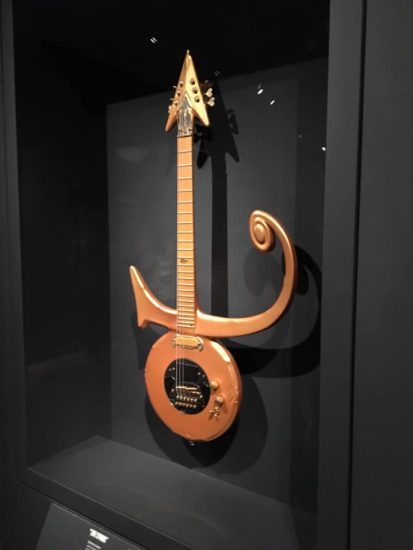
Prince’s 1993 Love Symbol captures his trademark glyph (photo by Cathy Hapka for twi-ny)
Saturday, September 7
Black Rock Coalition: History of Our Future, with the BRC Orchestra, Fantastic Negrito, Nona Hendryx, Vernon Reid, Corey Glover, and Will Calhoun, “Captain” Kirk Douglas, Stew, the Family Stand, Carl Hancock Rux, and Toshi Reagon, Grace Rainey Rogers Auditorium, $25, 7:00
Sunday, September 8
Sunday at the Met — Play It Loud: Instruments of Rock and Roll, panel discussion with Anthony DeCurtis, David Fricke, Holly George-Warren, Jayson Dobney, and Craig J. Inciardi, Grace Rainey Rogers Auditorium, free with Museum admission, 2:00
Friday, September 13
MetFridays: Play It Loud — ETHEL and Friends: Four for Fighting, Great Hall Balcony Bar, 5:00–8:00; screening of Woodstock (Michael Wadleigh, 1970), Bonnie J. Sacerdote Lecture Hall, 6:00; Conversations with . . . curators Jayson Dobney and Craig J. Inciardi, Gallery 199, 6:00; Signs and Symbols of Rock and Roll, with designers from ThoughtMatter, a band-name generator, and a button workshop, Great Hall, 6:00; Building Instruments with Atelier Rosenkrantz, Gallery 681, 6:00; Tie-Dye Workshop, Carroll Classroom, 6:00; Reflections on Woodstock with Chris Molanphy, Art Study Room, 6:30; Lez Zeppelin Live, preceded by discussion with Steph Paynes and Brad Tolinski, free with advance RSVP, Grace Rainey Rogers Auditorium, 7:15; all free with museum admission, 5:00–9:00
Saturday, September 28
Steve Miller Band and Jimmie Vaughan Band in Concert, Grace Rainey Rogers Auditorium, 7:00
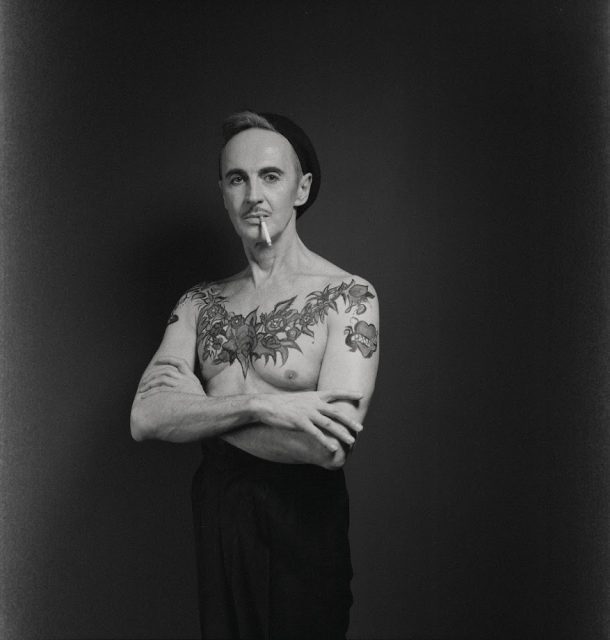
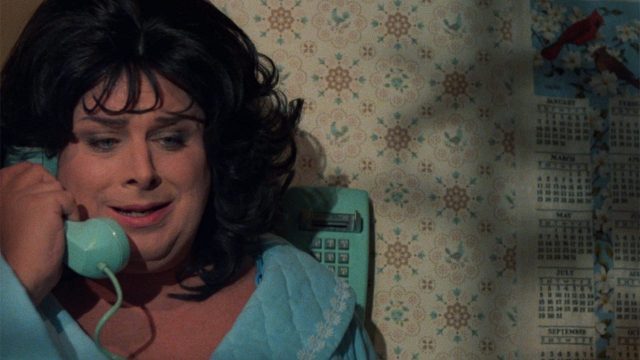
 Camp champ John Waters will be at IFC Center on September 5 for a Q&A and extended introduction at two screenings of a new 4K restoration of his cult classic suburban satire Polyester, joined by costar Ken King, who plays Baltimore Foot Stomper Dexter Fishpaw. The crudely rambunctious film follows the misadventures of the Job-like Francine Fishpaw, ravishingly portrayed by drag queen extraordinaire Divine. Her God-fearing life takes a bitter turn when she catches her nasty, demanding husband, porn purveyor Elmer (David Samson), with his sexpot secretary, Sandra Sullivan (Mink Stole). Her status in the community, so precious to her, is ruined as she becomes an alcoholic, unable to rein in her wildly promiscuous daughter, Lu-Lu (Mary Garlington) — who has the hots for bad boy Bo-Bo Belsinger, played by Dead Boys frontman Stiv Bators!! — or her inhalant-abusing foot-fetishist son. She also receives no emotional or financial support from her skunk of a mother, La Rue (Joni Ruth White). The only one who stands by her is her ultra-strange, simple-minded bestie, the Baby Jane-like although kindhearted Cuddles Kovinsky (Edith Massey), but she finds a glimmer of hope in a handsome hunk of a he-man (Hollywood heartthrob Tab Hunter!!) who tantalizingly keeps showing up on her radar in a flashy white sports car, like Suzanne Somers does to Richard Dreyfuss in American Graffiti.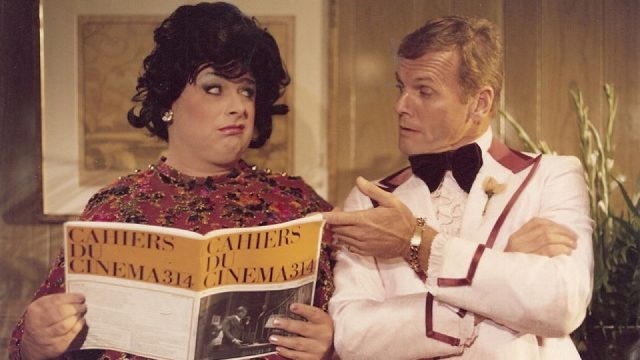

 Eight years in the making, Ognjen Glavonić’s narrative feature debut, The Load, is a tense, gripping drama set amid the NATO bombings during the Kosovo war in Yugoslavia in 1999. After the factory where he worked closes down, Vlada Stefanovic (Leon Lučev) takes a job driving a truck from the countryside to Belgrade. The mission is reminiscent of the ones in Henri-Georges Clouzot’s The Wages of Fear and William Friedkin’s underrated remake,