this week in lectures, signings, panel discussions, workshops, and Q&As

ABB FIA FORMULA-E CHAMPIONSHIP

Twenty-two drivers and eleven teams will be revving it up in Red Hook for the

Twenty-two drivers and eleven teams will be revving it up in Red Hook for the ABB FIA Formula E Championship this weekend

Brooklyn Cruise Terminal
72 Bowne St., Red Hook
Saturday, July 13, and Sunday, July 14, $95-$390
www.fiaformulae.com

Twenty-two drivers and eleven teams will hit the streets of Red Hook for the ABB FIA Formula E Championship grand finale, taking place July 13 and 14 at the Brooklyn Cruise Terminal. On Saturday, the gates open at 7:00 in the morning, with practice on the Red Hook Circuit at 7:30 and 10:00, qualifying at 11:45, and racing at 4:00. On Sunday, the gates open again at 7:00, with practice at 9:00, qualifying at 11:45, and the race at 4:00. Tickets begin at $95 for the grandstand and $390 for the podium lounge. The family-friendly Allianz E-Village is open all day both days, with live performances (beatbox flautist Greg Pattillo, King Charles Unicycle Troupe, banjo and bass duo Coyote Crow, Emphasis Entertainment Dance Crew, others), stunts, technological innovations, autograph sessions, virtual reality simulators, Smorgasburg food, and more ($12, kids under twelve free with adults). Team DS Techeetah, with reigning champion Jean-Eric Vergne and André Lotterer, are currently number one in the standings with 216 points, followed by Audi Sport ABT Schaeffler (Daniel Abt and Lucas Di Grassi) at 173, Envision Virgin Racing (Sam Bird and Robin Frijns) at 150, and the Nissan e.dams team (Sébastien Buemi and Oliver Rowland) at 139. During the races, watch out for Attack Mode, and you can vote to give five drivers a Fanboost.

HITO STEYERL: DRILL

(photo by James Ewing)

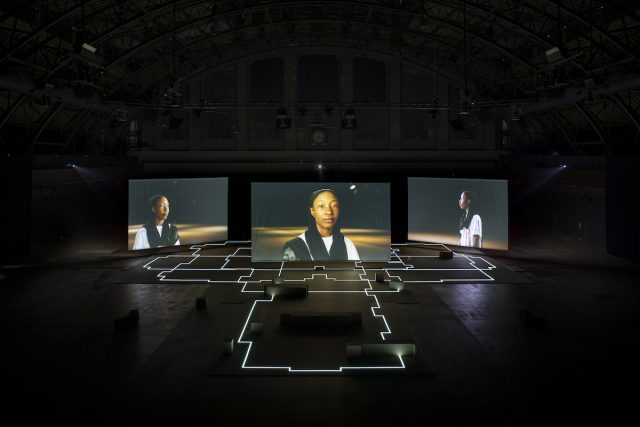
Drill is centerpiece of extensive Hito Steyerl exhibition at Park Avenue Armory (photo by James Ewing)

Park Avenue Armory
643 Park Ave. at 67th St.
Through July 21, $20
armoryonpark.org

“Spare no expense to make war beautiful,” historian Anna Duensing says in Drill, referring to military history. Drill, a three-channel, twenty-one-minute video, is the centerpiece of German artist Hito Steyerl’s site-specific, wide-ranging multimedia installation of the same name at Park Ave. Armory, where it continues through July 21. Projected on both sides of three large screens in the fifty-five-thousand-square-foot Wade Thompson Drill Hall, Steyerl’s film delves into the history of the armory, from its time as the headquarters of the Seventh Regiment of the National Guard, known as a silk-stocking regiment, to its exclusive use by the wealthy and its direct relationship to the founding of the National Rifle Association. Steyerl goes to the armory basement, formerly a shooting range, where bullet holes can still be seen in the walls; includes clips of speeches by antigun activists at a Washington, DC, rally; and follows the Yale University Precision Marching Band as it makes its way through the drill hall, playing music by Jules Laplace based on data sonification from casualty statistics of AR-15 violence and mass shootings, with choreography by Thomas C. Duffy. Among the participants are Nurah Abdulhaqq of National Die-In, Kareem Nelson of Wheelchairs Against Guns, retired school principal and proud gun owner Judith Pearson, and gun violence prevention activist Abbey Clements. A series of interconnected bulbs on the floor occasionally light up in white and red, linking the viewer to what is happening onscreen.

In her 2013 e-flux article “Too Much World: Is the Internet Dead?,” Steyerl wrote, “Data, sounds, and images are now routinely transitioning beyond screens into a different state of matter. They surpass the boundaries of data channels and manifest materially. They incarnate as riots or products, as lens flares, high-rises, or pixelated tanks. Images become unplugged and unhinged and start crowding off-screen space. They invade cities, transforming spaces into sites, and reality into realty. They materialize as junkspace, military invasion, and botched plastic surgery. They spread through and beyond networks, they contract and expand, they stall and stumble, they vie, they vile, they wow and woo.” That statement relates to several of the other works in the show, spread throughout the armory’s period rooms and hallway.
(photo by James Ewing)

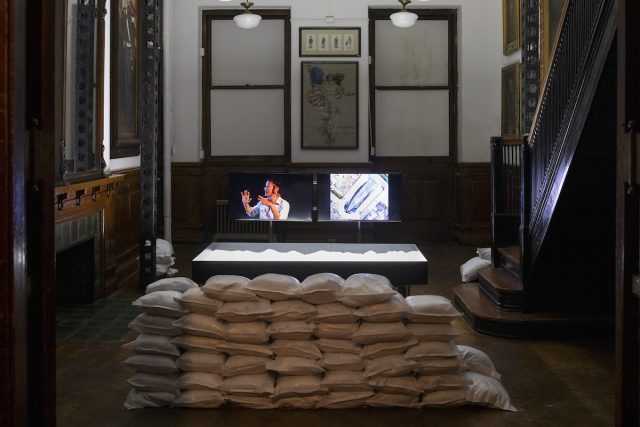
Sandbags offer an uncomfortable place to sit while watching Hito Steyerl’s videos Duty Free Art and Is the Museum a Battlefield? (photo by James Ewing)

In the Parlor, Is the Museum a Battlefield? is an illustrated lecture projected on two screens and a box of white sand as Steyerl investigates the fascinating relationship between art museums and war, starting with a bullet that killed a friend of hers. The audience sits on sandbags, immersed in the narrative that involves the Louvre, the Hermitage, and other arts institutions. “Museums are of course battlefields. They have been throughout history,” she says. “They have been torture chambers, sites of war crimes, civil war, and also revolution.” Although the illustrated lecture was produced for the thirteenth Istanbul Biennial, it feels right at home at the armory, a building initially constructed for the military that now is an arts institution itself. That is followed by Duty Free Art, in which Steyerl delves into income inequality through art, business, and war via freeports, where collectors store their art holdings without having to pay taxes, impacting the global economy.

In the Veterans Room and Library, Hell Yeah We Fuck Die, named for the five most-used English words in songs on the Billboard charts, features concrete and neon sculptures of those words along with video of product testing on robots, while Robots Today ties together narration from Muslim polymath Al-Jazari’s 1205 Automata with shots of a Kurdish city destroyed by the Turkish military in 2016.
(photo by James Ewing)

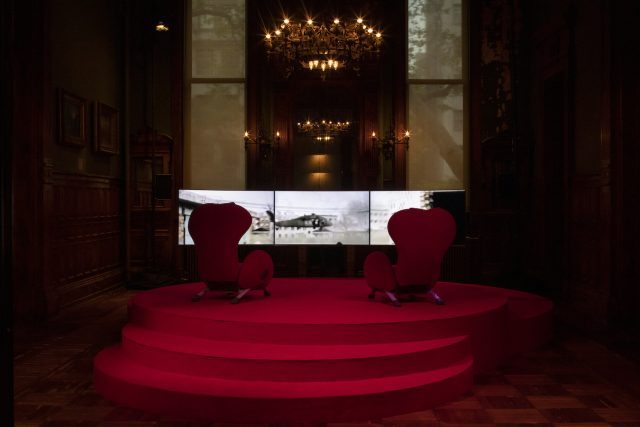
ExtraSpaceCraft offers comfy chairs to watch the Iraqi National Observatory become the Autonomous Space Agency (photo by James Ewing)

Broken Windows is shown at both ends of the central hallway; one end depicts Chris Toepfer and other community activists painting canvases and placing them over broken windows in abandoned buildings in Camden, New Jersey, while at the other end researchers in London test the sound of breaking glass for artificial intelligence. The title of the video takes on added meaning here in New York City given the NYPD’s controversial use of broken windows policing, which believes that targeting smaller crimes will prevent bigger ones.

The show also includes The Tower in the Mary Divver Room and ExtraSpaceCraft in the Board of Officers Room, which are like watching virtual reality video games, while Prototype 1.0 and 1.1 in the Field and Staff Room is a pair of blue robots made of foam-and-aluminum, one standing, the other lying on the floor, as if they had come out of Hell Yeah We Fuck Die after undergoing brutal testing. And in the Colonels Reception Room, Freeplots offers hope for the future amid all the technological mayhem, a collaboration with El Catano Community Garden in East Harlem that consists of flowers blooming in wooden planters filled with horse-manure compost, turning the crates that store art in the freeports into something positive for everyone. The exhibition requires a significant investment of time and concentration; the works are complex, and the videos run more than two hours in total, but Steyerl has a lot to say that is worth paying attention to, even if some of the delivery is less inspiring than others. On July 20 at 3:00 and 5:00 ($10), there will be a performance lecture by Anton Vidokle, Adam Khalil, and Bayley Sweitzer, “The Dead Walk into a Bar,” which promises: “As a staff of identical ushers draws back layers of confusion and pain, the freshly resurrected gradually become aware of the reality of their corporeal reinsertion: perhaps the world of the living is not a world at all; to be alive in this place may merely be an exhibit.”

UNBOUND: DAPPER DAN IN CONVERSATION WITH ELAINE WELTEROTH

dapper dan

Who: Dapper Dan, Elaine Welteroth
What: Book launch with talk and signing
Where: BAM Rose Cinemas, 30 Lafayette Ave., 718-636-4100
When: Wednesday, July 10, $20 event only, $40 with book, 7:00
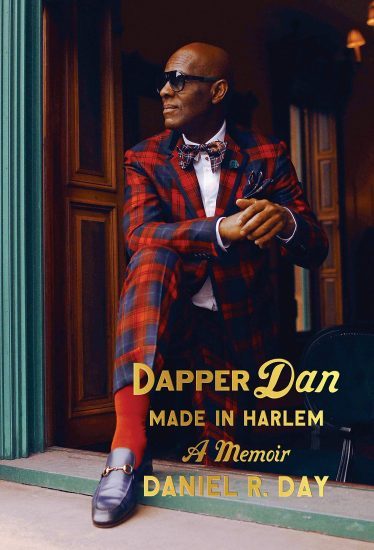
Why: “It was a midnight like any other at the store. The lights were on out front, the door unlocked, the grate rolled halfway up. Dapper Dan’s Boutique was open. My night crew of tailors was in the back filling orders. Jackets, jumpsuits, parkas. Their sewing machines hummed into the wee hours. I was lying on my bed in the little apartment I’d built in back for myself. Most nights, you could find me there, rereading a book of philosophy or spirituality or trying to sneak in a nap,” begins fashion icon Daniel “Dapper Dan” Day’s memoir, Dapper Dan: Made in Harlem. “I had good reasons for never closing the shop and rarely leaving it. For one, a lot of my customers preferred late-night visits, for anonymity during the week or for the after-hours vibe of the weekends. I also had to keep an eye on my employees, who were backdooring my designs. It was my name on the awning out front, and in my world, your name means everything. It was my reputation, my brand, and people came from all over the city and beyond—from Philly and Chicago, Houston and Miami—because they wanted a Dapper Dan. I was the store, and the store was me.” On July 10, the seventy-four-year-old Dapper Dan, who has helped dress such figures as Eric B. and Rakim, Salt-N-Pepa, Big Daddy Kane, Mike Tyson, LL Cool J, Jam Master Jay, Diddy, Naomi Campbell, and Jay-Z, will launch his book with a talk and a signing at BAM Rose Cinemas, presented with Greenlight Bookstore as part of the Unbound series. He will be interviewed by journalist, magazine editor, Project Runway judge, and influencer Elaine Welteroth, author of the new book More Than Enough: Claiming Space for Who You Are. Tickets are $20 for the event and $40 for the event and a copy of Dapper Dan: Made in Harlem.

JANET BIGGS AND SCOTT MacDONALD IN CONVERSATION — THE SUBLIMITY OF DOCUMENT: CINEMA AS DIORAMA

sublimity

Who: Janet Biggs and Scott MacDonald
What: Panel discussion and book launch
Where: Cristin Tierney Gallery, 219 Bowery, second floor, 212-594-0550
When: Thursday, July 11, free with advance RSVP, 6:30
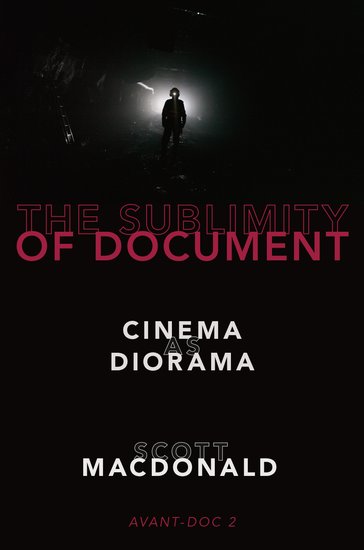
Why: In his new book, The Sublimity of Document: Cinema as Diorama (Oxford University Press, August 1, 2019, $125), author and film history professor Scott MacDonald writes of visual artist Janet Biggs, “I first became aware of Biggs when she visited Hamilton College in the spring of 2017 to present a talk about her work. As she showed stills and clips from recent videos, I was struck by the fact that Biggs had traveled to and filmed particular far-flung locations that I had been introduced to by other filmmakers. . . . I was interested not only that multiple artists would be drawn to these precise locations, but also that, in somewhat different ways, these locations can be dangerous to visit. As I became familiar with Biggs’s work, I came to wonder why an artist would go through the considerable difficulties of visiting distant, potentially dangerous locations, not in order to produce films that might have substantial audiences, but to offer relatively brief visual experiences to comparatively smaller audiences within gallery and museum spaces. I came to realize that my experiences with Biggs’s work offered an opportunity to explore, at least in a small way, the issue of installation cinema versus theatrical cinema.” The book continues with an interview between MacDonald and Biggs that was conducted online.

On July 11, MacDonald and Biggs will be together in person at the Cristin Tierney Gallery for a discussion on film and art in conjunction with the publication of The Sublimity of Document and Biggs’s most recent exhibition, “Overview Effect,” the second part of which, Seeing Constellations in the Darkness between Stars, continues at Cristin Tierney through August 2. MacDonald’s book features interviews with Biggs and more than two dozen other “avant-doc” filmmakers, including Ron Fricke, Laura Poitras, Frederick Wiseman, Bill Morrison, Abbas Kiarostami, and James Benning. Biggs has also contributed the article “Fragility Curve” to the current edition of the Brooklyn Rail, writing about her experiences making her latest films, which deal with Mars. “The earth will remake itself and survive the legacy of its human inhabitants, but will we?” she asks. The conversation with Biggs and MacDonald will be followed by a book signing; in addition, Biggs, who has participated in two twi-ny talks, will be presenting the multimedia performance piece How the Light Gets In July 18 at the New Museum.

MOSTLY MOZART FESTIVAL

(photo by Carl Fox)

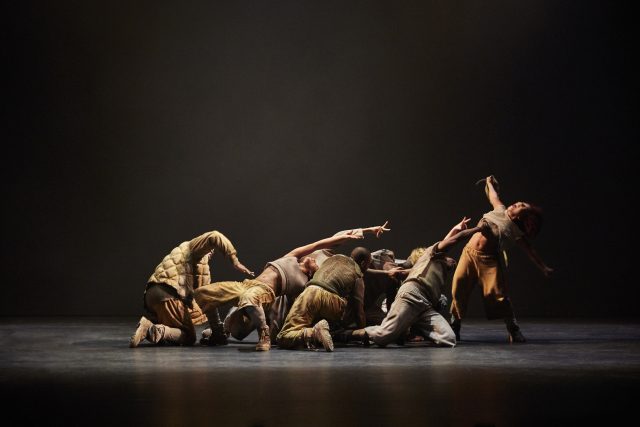
Boy Blue’s Blak Whyte Gray makes a special return engagement at 2019 Mostly Mozart Festival at Lincoln Center (photo by Carl Fox)

Multiple venues at Lincoln Center
July 10 – August 9, free – $120
www.lincolncenter.org

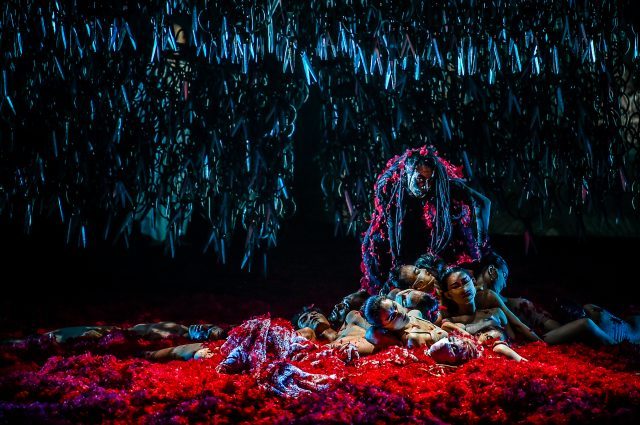
With the demise of the Lincoln Center Festival last year, the institution’s Mostly Mozart Festival has filled in many of the gaps, expanding its breadth to cover much more than classical music and related events. Thus, its fifty-third season is a multidisciplinary affair with a wide variety of dance, theater, music, and film that is mostly non-Mozart. The summer festival begins July 10-13 with the world premiere of Mark Morris Dance Group’s Sport at Jazz at Lincoln Center’s Rose Theater, set to Erik Satie’s “Sports et divertissements,” along with the company’s Empire Garden and V. Other dance programs include a special return engagement of Boy Blue’s Blak Whyte Gray August 1-3 at the Gerald Lynch Theater at John Jay College, with Kenrick “H2O” Sandy and Margo Jefferson participating in a talk after the August 2 performance, and the US premiere of Yang Liping Contemporary Dance’s Under Siege August 8-10 at the David H. Koch Theater, a lavish dance-theater production inspired by historic events in Chen Kaige’s Farewell, My Concubine, the 1993 epic that will be screened July 28 at the Walter Reade Theater. The festival will also be showing Ang Lee’s Crouching Tiger, Hidden Dragon on August 4, which features Oscar-winning production design by Tim Yip, the set and costume designer of Under Siege.

(photo by Ding Yi Jie)

Yang Liping Contemporary Dance’s Under Siege makes its US premiere at Mostly Mozart Festival (photo by Ding Yi Jie)

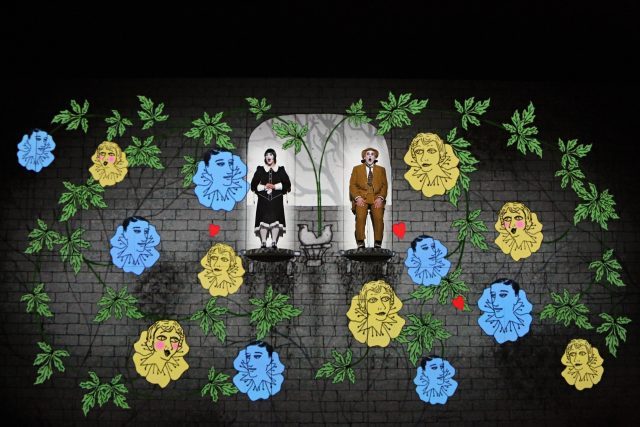
Of course, there is plenty of Wolfgang Amadeus and other classical programs at the festival. The Mostly Mozart Festival Orchestra will present Beethoven’s “Eroica Symphony” July 23-24, Vivaldi’s “The Four Seasons” July 26-27, “Mozart & Brahms” July 30-31, “Beethoven & Schubert” August 2-3, “Joshua Bell Plays Dvořák” August 6-7, and “Mozart à la Haydn” August 9-10, all at David Geffen Hall. British theater group 1927’s production of The Magic Flute July 17-20 at the Koch features the Mostly Mozart Festival Orchestra, a cast from Komische Oper Berlin, colorful animation, and imaginative set design. The intimate series “A Little Night Music” in the Stanley H. Kaplan Penthouse includes performances by cellist Kian Soltani and pianist Julio Elizalde; pianist Michael Brown; vocalist Nora Fischer and guitarist and vocalist Marnix Dorrestein; violinist Pekka Kuusisto and bassist Knut Erik Sundquist; soprano Susanna Phillips and pianist Myra Huang; pianist Martin Helmchen; pianists Lucas and Arthur Jussen in their New York debut; Brooklyn Rider; and pianist Steven Osborne. And on August 4, the Budapest Festival Orchestra will play works by Haydn, Handel, and Mozart at the Geffen, with soprano Jeanine De Bique, conducted by Iván Fischer.

(photo by Michael Daniel)

Mostly Mozart Festival features New York production premiere of The Magic Flute by British theater group 1927 (photo by Michael Daniel)

One of the highlights of the festival is sure to be Davóne Tines and Michael Schachter’s The Black Clown July 24-27 at the Gerald Lynch, a musical theater piece based on Langston Hughes’s 1931 poem, with Tines as the title character, choreography by Chanel DaSilva, and set and costumes by Carlos Soto; the July 25 show will be followed by a talk with Tines, director Zack Winokur, and DaSilva. In addition, there are several free, first-come, first-served events: the panel discussion “Mozart’s Magic Flute: In His Time and Ours” July 20 at 3:00 at the Kaplan Penthouse; the International Contemporary Ensemble (ICE) performing works by Anna Thorvaldsdottir, Bergrún Snæbjörnsdóttir, and Ashley Fure at the David Rubenstein Atrium on July 25 at 7:30; the Mostly Mozart Festival Orchestra, conducted by Louis Langrée, playing Mozart’s “Gran Partita” July 27 at 3:00 at St. Paul’s Chapel; ICE’s “Composer Portraits” program of works by Iranian composers Anahita Abbasi, Aida Shirazi, and Niloufar Nourbakhsh at the atrium August 5 at 7:00; and violinist Tessa Lark and bassist Michael Thurber at the atrium August 8 at 7:30.

IN PERSON EVENT: NO HOME MOVIE

NO HOME MOVIE

Chantal Akerman creates a unique profile of her mother in deeply personal No Home Movie

NO HOME MOVIE (Chantal Akerman, 2015)
IFC Center
323 Sixth Ave. at West Third St.
Tuesday, July 9, 7:30
212-924-7771
www.ifccenter.com
icarusfilms.com

Chantal Akerman’s No Home Movie was meant to be a kind of public eulogy for her beloved mother, Natalia (Nelly) Akerman, who died in 2014 at the age of eighty-six, shortly after Chantal had completed shooting forty hours of material with her. But it also ended up becoming, in its own way, a public eulogy for the highly influential Belgian auteur herself, as she died on October 5, 2015, at the age of sixty-five, only a few months after the film screened to widespread acclaim at several festivals (except at Locarno, where it was actually booed). Her death was reportedly a suicide, following a deep depression brought on by the loss of her mother. IFC is presenting a special screening on July 9, introduced by Akerman translator Corina Copp, who will read from Akerman’s final book, My Mother Laughs.

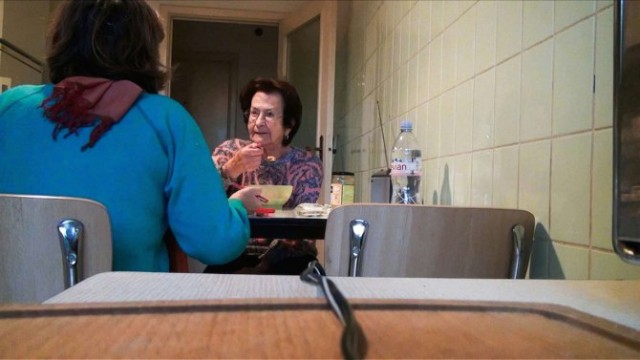
No Home Movie primarily consists of static shots inside Nelly’s Brussels apartment as she goes about her usual business, reading, eating, preparing to go for a walk, and taking naps. Akerman sets down either a handheld camera or a smartphone and lets her mother walk in and out of the frame; Akerman very rarely moves the camera or follows her mother around, instead keeping it near doorways and windows. She’s simply capturing the natural rhythms and pace of an old woman’s life. Occasionally the two sit down together in the kitchen and eat while discussing family history and gossip, Judaism, WWII, and the Nazis. (The elder Akerman was a Holocaust survivor who spent time in Auschwitz.) They also Skype each other as Chantal travels to film festivals and other places. “I want to show there is no distance in the world,” she tells her mother, who Skypes back, “You always have such ideas! Don’t you, sweetheart.” In another exchange, the daughter says, “You think I’m good for nothing!” to which the mother replies, “Not at all! You know all sorts of things others don’t know.”

NO HOME MOVIE

Shots of a tree fluttering in the Israeli wind enhance the peaceful calm of No Home Movie

Later they are joined by Chantal’s sister, Sylviane, as well as Nelly’s home aide. The film features long sections with no dialogue and nobody in the frame; Akerman opens the movie with a four-minute shot of a lone tree with green leaves fluttering in the wind in the foreground, the vast, empty landscape of Israel in the background, where occasionally a barely visible car turns off a far-away road. Akerman returns to Israel several times during the film, sometimes shooting out of a moving car; these sections serve as interludes about the passage of time as well as referencing her family’s Jewish past. At one point, Akerman makes potatoes for her mother that they eat in the kitchen, a direct reference to a scene in Akerman’s feminist classic, Jeanne Dielman, 23 Quai due Commerce, 1080 Bruxelles. Knowing about what happened to both mother and daughter postfilming casts a shadow over the documentary, especially when Chantal tells her mother, “I’m in a very, very good mood. . . . Let’s enjoy it; it’s not that common.” As the film nears its conclusion, there is almost total darkness, echoing the end of life. Through it all, Akerman is proud of her mother; reminiscing about kindergarten, she remembers, “And to everybody, I would say, this is my mother.” No Home Movie achieves that very same declaration, now for all the world to see and hear.

FIRST SATURDAYS: VISUALIZING INDEPENDENCE

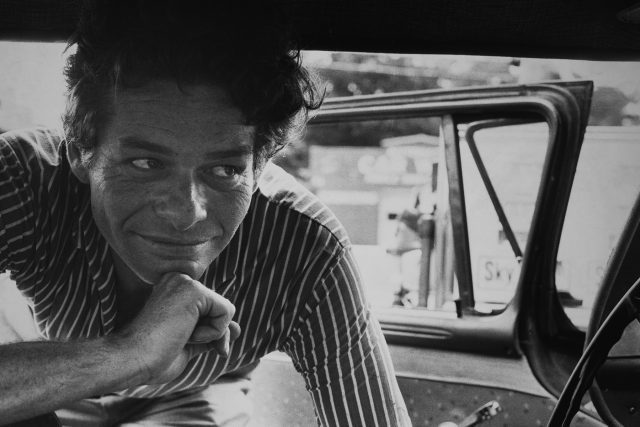
Portrait of Garry Winogrand. Credit: Judy Teller

Screening of Garry Winogrand: All Things Are Photographable is part of free Brooklyn Museum First Saturday program on July 6 (photo by Judy Teller)

Brooklyn Museum
200 Eastern Parkway at Washington St.
Saturday, July 6, free (some events require advance tickets), 5:00 – 11:00
212-864-5400
www.brooklynmuseum.org

The Brooklyn Museum celebrates the 243rd birthday of the United States of America in the July edition of its free First Saturday program. There will be live performances by Brooklyn Maqam musicians, Dj InO, Tunde Olaniran, Snips, and Cumbia River Band; a curator tour of “Garry Winogrand: Color” led by Drew Sawyer; a hands-on workshop in which participants can design wearable art inspired by “Nobody Promised You Tomorrow: Art 50 Years After Stonewall”; a book club discussion with Adreinne Waheed, author of the photo book Black Joy and Resistance, with artist Zun Lee and moderator Delphine Adama Fawundu; teen pop-up gallery talks in honor of the fortieth anniversary of The Dinner Party and creator Judy Chicago’s eightieth birthday; a screening of Garry Winogrand: All Things Are Photographable (Sasha Waters Freyer, 2018), followed by a talkback with Sawyer and Susan Kismaric; Cave Canem poetry readings with JP Howard, Raven Jackson, and Trace DePass responding to “Liz Johnson Artur: Dusha”; and a community talk about the Lesbian Herstory Archives with Flavia Rando, Shawn(ta) Smith-Cruz, Ashley-Luisa Santangelo, and Elvis Bakaitis. In addition, the galleries will be open late so you can check out “Garry Winogrand: Color,” “Nobody Promised You Tomorrow: Art 50 Years After Stonewall,” “Eric N. Mack: Lemme walk across the room,” “Liz Johnson Artur: Dusha,” “One: Egúngún,” “Something to Say: Brooklyn Hi-Art! Machine, Deborah Kass, Kameelah Janan Rasheed, and Hank Willis Thomas,” “Infinite Blue,” “Rembrandt to Picasso: Five Centuries of European Works on Paper,” “Kwang Young Chun: Aggregations,” and more.