this week in lectures, signings, panel discussions, workshops, and Q&As

ABBAS KIAROSTAMI: A RETROSPECTIVE

Abbas Kiarostami

Abbas Kiarostami is subject of comprehensive retrospective at IFC, featuring three talks with Godfrey Cheshire

IFC Center
323 Sixth Ave. at West Third St.
July 26 – August 15
212-924-7771
www.ifccenter.com

“During Godfrey’s several visits to Iran throughout a decade, he formed a relationship with my father that I had rarely seen him having with other writers. I believe this is because of Godfrey’s ability to go beyond the surface, his unique views and interpretations,” Ahmad Kiarostami writes in the foreword to film critic Godfrey Cheshire’s latest book, Conversations with Kiarostami (Film Desk, July 29, $18). In the 1990s, Cheshire went to Iran on multiple occasions to interview writer-director Abbas Kiarostami, helping introduce the new Iranian cinema to the West. Cheshire will be at IFC Center for three special presentations during the fab festival “Abbas Kiarostami: A Retrospective,” a three-week series comprising virtually all of Kiarostami’s shorts and full-length works, from award-winning, well-known tales to rarely screened gems, many in 2K or 4K restorations. Among the films being shown are the Koker Trilogy (Where Is the Friend’s House?, And Life Goes On, Through the Olive Trees), Palme d’Or winner Taste of Cherry, Silver Lion winner The Wind Will Carry Us, the early documentaries First Graders and Homework, and Kiarostami’s first two features, The Traveler and The Report.
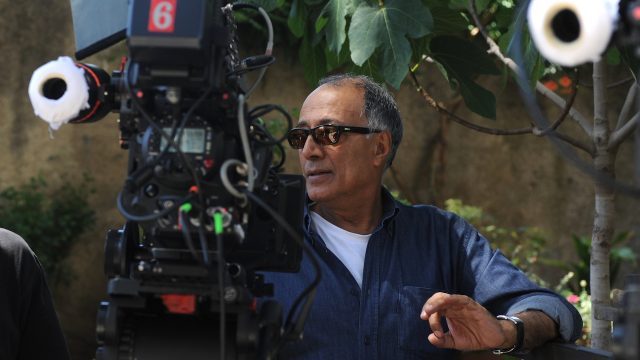
Abbas Kiarostami retrospective will feature three special events with critic Godfrey Cheshire (photo by twi-ny/mdr)

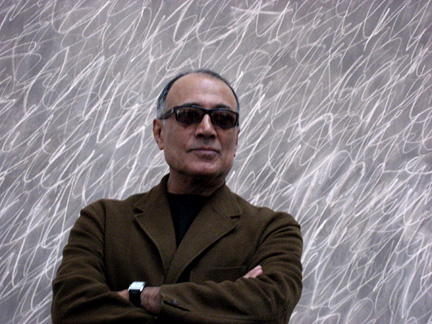
Abbas Kiarostami looks ever-so-cool at MoMA show in 2007 (photo by twi-ny/mdr)

In his Criterion essay on Taste of Cherry, Cheshire writes, “In Abbas Kiarostami’s universe, it might be said, there are no things, only relations between things. Likewise, in his cinema: no films, only relations between films—and within them. And between them and us.” Cheshire will delve into those relations at a trio of talks, beginning July 27 at 7:10 with “Kiarostami and Koker,” focusing on the trilogy and showing Through the Olive Trees. On August 3 at 5:10, for “Unseen Kiarostami,” Cheshire will screen the 1976 comedy A Wedding Suit and talk about that film as well as such other early works as Bread and Alley, Experience, and Fellow Citizen. And on August 4 at 5:20, for “Cinema in Revolution,” Cheshire will be joined by film professor Jamsheed Akrami for a screening of the initially banned Case No. 1, Case No. 2 and a discussion. In his online bio of Kiarostami, Cheshire calls the auteur “the most acclaimed and influential of Iran’s major filmmakers” and notes how in the twenty-first century “Kiarostami broadened his creative focus, devoting more time to forms including photography, installation art, poetry, and teaching,” exemplified by his 2007 exhibition “Image Maker” at MoMA and MoMA PS1. Keep watching twi-ny for reviews of individual films during this must-see retrospective.
HARLEM WEEK: A GREAT DAY IN HARLEM

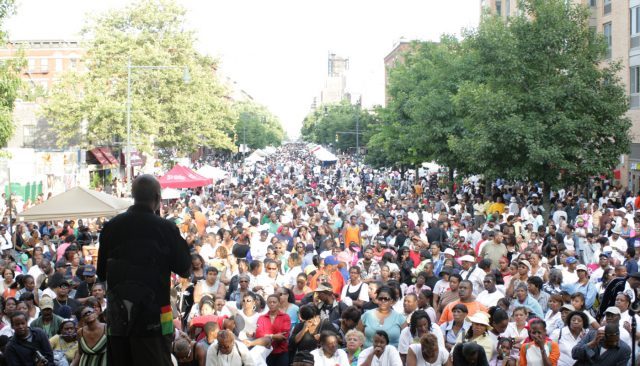
Harlem Week kicks off July 29 with A Great Day in Harlem

Harlem Week kicks off July 28 with the annual celebration “A Great Day in Harlem”

U.S. Grant National Memorial Park
Wes 122nd St. & Riverside Dr.
Sunday, July 28, free, 12 noon – 8:30 pm
Festival runs July 28 – August 31
harlemweek.com

Tens of thousands of people are expected to converge in U.S. Grant National Memorial Park on July 28 for the beloved Great Day in Harlem festival, part of the forty-fifth annual summer Harlem Week celebration. This year’s theme is “Our Local History Creates a Global Impact,” focusing on Harlem’s cultural influence around the world, while the music theme is Bill Withers’s classic “Lovely Day.” A Great Day in Harlem will feature an International Vendors Village from 12 noon to 8:00, the Artz, Rootz, and Rhythm International Cultural Showcase at 1:00, the Regional Gospel Caravan at 3:00 with Bishop Hezekiah Walker, the McDonald’s Gospel Super Choir, Kirk Franklin, and a tribute to Dr. Bobby Jones, a Fashion Fusion Showcase at 4:30 honoring the Black Fashion Museum, and “A Concert under the Stars” at 6:00 with Nicole Bus, Harlem Week music director Ray Chew, and more paying tribute to Spike Lee and the thirtieth anniversary of Do the Right Thing and Robert “Kool” Bell of Kool & the Gang in honor of the group’s fiftieth anniversary. Harlem Week continues through August 31 with such other events as the Youth S.T.E.A.M. Hackathon on August 1, New York City Economic Development Day on August 8, Summer in the City on August 17, Harlem Day on August 18, and Harlem Restaurant Week beginning August 19.

JAPAN CUTS: BLUE HOUR

Blue Hour

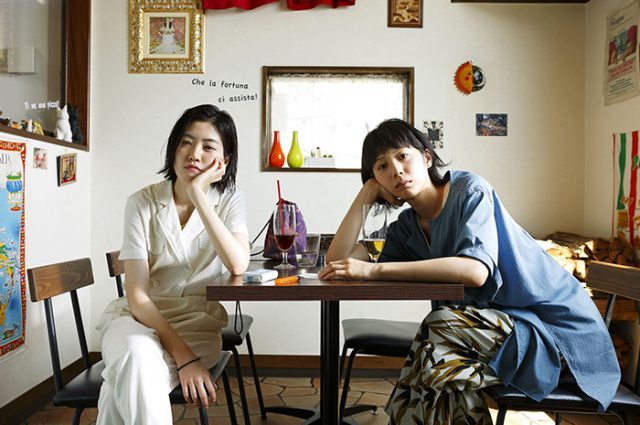
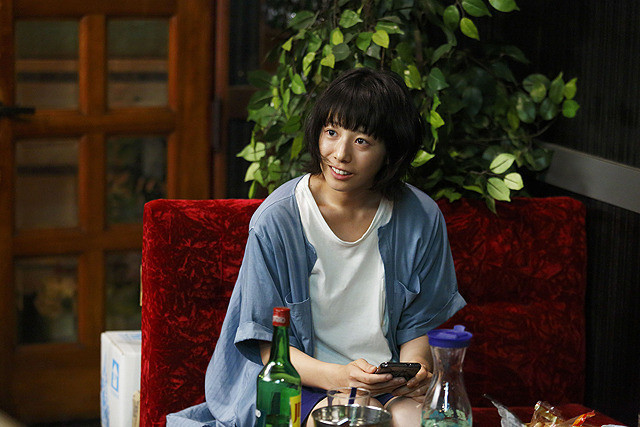
Kiyoura (Shim Eun-Kyung) and Sunada (Kaho) wonder what’s next in Yuko Hakota’s Blue Hour

FESTIVAL OF NEW JAPANESE FILM: BLUE HOUR (BURU AWA NI BUTTOBASU) (ブルーアワーにぶっ飛ばす) (Yuko Hakota, 2019)
Japan Society
333 East 47th St. at First Ave.
Sunday, July 28, 8:00
Festival runs July 19-28
212-715-1258
www.japansociety.org

The Japan Cuts festival at Japan Society concludes July 28 with the North American premiere of Yuko Hakota’s beautiful, wistful Blue Hour. The movie is named after one of the two magic times of day, particularly for filmmakers: The golden hour occurs right after sunrise and before sunset, when the sky turns a warm, golden color, while the blue hour takes place right before sunrise and after sunset, when a colder, deep blue permeates. In the film, Kaho stars as Sunada, a television commercial director with a habit of making poor decisions in her life and career. She’s just turned thirty and wants to do more than produce ads but does not appear to be driven enough. She is married to a kindhearted man-child (Daichi Watanabe) but is having an affair with the married Togashi (Yusuke Santamaria). At a party, she drinks to excess, embarrassing herself in front of her crew. And she hasn’t been home to visit her family in several years. She seemingly could have it all, but she lacks ambition and often seems chilly and aloof to others. “I don’t like people who like me,” she says at one point. Later, she admits, “I don’t know what it’s like to be close.”
Blue Hour

Sunada (Kaho) has trouble finding happiness in Blue Hour

When Sunada mentions to one of her only friends, the impulsive, unemployed, and very charming Kiyoura (Shim Eun-Kyung), that she is getting ready to go home to see her grandmother, Kiyo proclaims that she will drive them there right away, so they get into her car and away they go. We learn a lot about the two women on the road trip — although this is no Thelma and Louise — but even more when they arrive at Sunada’s family’s small farm in the boondocks, where her oddball brother, Sumio (Daisuke Kuroda), lives with their sweet mother (Kaho Minami) and eclectic father (Denden). Sunada looks like she would rather be anywhere else. As Sunada refuses to relate to her significantly un-Ozu-like clan, Kiyo fits right in, always seeking fun in whatever she does, the polar opposite of her friend.

Lovingly photographed in soft hues by Ryuto Kondo, Hakota’s debut is a moving and poignant tale of a woman who has, sadly, apparently given up too soon; she’s an unusual protagonist in that just as she says that she doesn’t like people who like her, she herself is difficult to like. It’s hard not to see her as emblematic of Japan’s current troubled younger generation, one noted for its failure to socialize, date, marry, get a job, or even leave the house. Former teen model Kaho (A Gentle Breeze in the Village, Our Little Sister) wonderfully captures the character’s ennui, while award-winning South Korean actress and former child star Shim (Happy Killers, Miss Granny) is radiant as the ever-positive Kiyo, who is in love with life no matter where it takes her. Blue Hour is a small gem, quirky and insightful, delicate and alluring. The screening will be followed by a Q&A with Hakota, Kaho, and Shim. Among the other films playing at Japan Cuts are Mitsuaki Iwago’s The Island of Cats, Hiroshi Okuyama’s Jesus, and Makoto Sasaki’s Night Cruising in addition to the free panel discussion “The Current State of Film Restoration in Japan” on July 26 at 4:30, which will examine the industry itself and the restoration of Kenji Mizoguchi’s masterpiece Ugetsu.

LIGIA LEWIS: SENSATION 1 / THIS INTERIOR

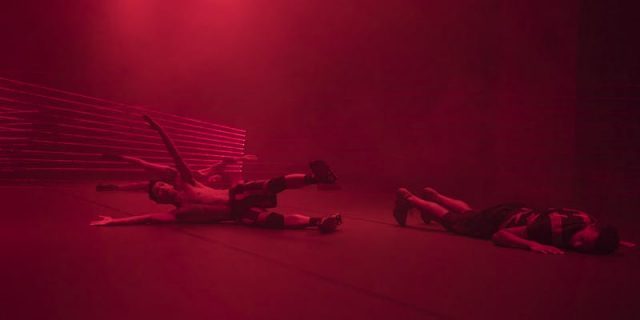
Ligia Lewis, minor matter, 2016. Photo by Martha Glenn.

Ligia Lewis, whose minor matter is seen above, translates Sensation 1 for the High Line this week (photo by Martha Glenn)

The High Line, Fourteenth Street Passage
July 23-25, free with advance RSVP, 7:30
www.thehighline.org
ligialewis.com

Dancer and choreographer Ligia Lewis presents the next iteration of her Sensation series July 23-25 with Sensation 1 / This Interior, the first to be performed outside, taking place at 7:30 each night at the Fourteenth Street Passage on the High Line. Sensation 1 premiered as an indoor solo in 2011, followed the next year by Sensation 2; both pieces involved very slow movement that viewed the body as a sculptural object. Now the Dominican-born, Berlin-based Lewis, who has recently completed a trilogy consisting of Sorrow Swag (2014), minor matter (2016), and Water Will (in Melody) (2018), revisits Sensation with dancers Trinity Bobo, Emma Cohen, Rebecca Gual, Miguel Ángel Guzmán, Stephanie Peña, and Jumatatu M. Poe and music by Lewis’s brother, George Lewis Jr., aka Twin Shadow, focusing on the last note of a song on multiple bodies as a shared experience. Admission is free with advance RSVP.

(photo by twi-ny/mdr)

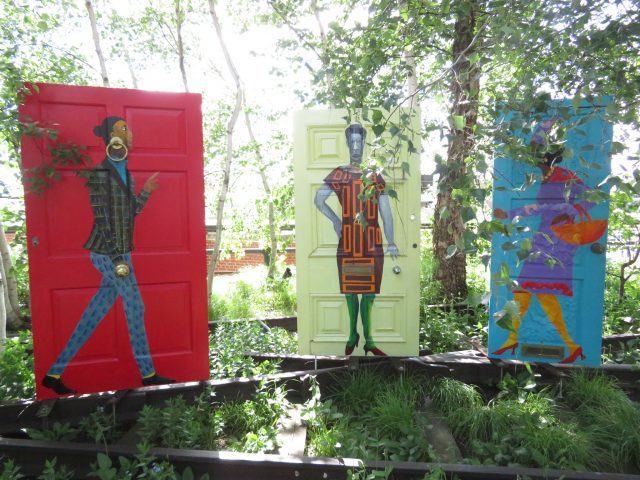
Lubaina Himid’s Five Conversations is part of High Line group show “En Plein Air” (photo by twi-ny/mdr)

Be sure to show up early or stay late and take a walk along the High Line to see its current art commissions. The group show “En Plein Air” comprises works by Ei Arakawa, Firelei Báez, Daniel Buren, Sam Falls, Lubaina Himid, Lara Schnitger, Ryan Sullivan, and Vivian Suter that, like Sensation 1 / This Interior, take advantage of the outdoor location. Also be on the lookout for Simone Leigh’s giant Brick House, a sixteen-foot-high bronze figure of a black woman with long cornrow braids and a skirt that doubles as her body and a dwelling; Ruth Ewan’s Silent Agitator, which demands that it’s “time to organize”; Dorothy Iannone’s I Lift My Lamp Beside the Golden Door, depicting three colorful versions of the Statue of Liberty; and Autumn Knight’s Complete Total Pleasure, a new video about anhedonia, power, race, and control.

And on August 6 at 5:00, the High Line will host “In Conversation: On Top of All This,” a free (with advance RSVP) three-hour gathering on the Spur at Thirtieth St. and Tenth Ave., with poetry, fiction, prompts, and predictions from poet and scholar Lucas Crawford, poet, curator, and artist Anaïs Duplan, and dancer, writer, curator, and choreographer Emily Johnson, including prerecorded audio reflections, readings, and a panel discussion.

RUBIN MUSEUM BLOCK PARTY: POWER PLAY

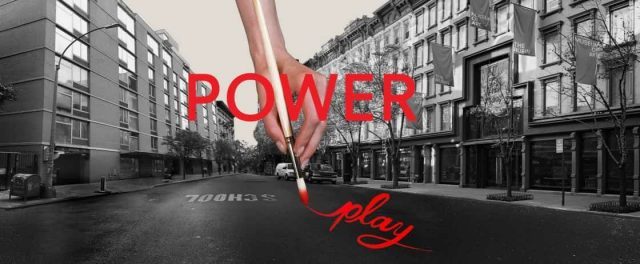
power play

Rubin Museum of Art
West 17th St. between Sixth & Seventh Aves.
Sunday, July 21, free (including free museum admission all day), 1:00 – 4:00
rubinmuseum.org

The Rubin Museum’s yearlong exploration of “Power: Within and Between Us” is at the center of its sixth annual block party, taking place July 21. From 1:00 to 4:00, there will be live performances by Building Beats, Fogo Azul Brazilian Women’s Drumline, and Power Painting Jam, food from Van Leeuwen Ice Cream, People’s Pops, Yanni’s Coffee, Cafe Serai, Sweetface Snoballs, and the Commons Chelsea, and activities led by Grassroots Movement in Nepal, Siddhartha School, Tibetan Community of NY/NJ, YindaYin Coaching, Nepal Hip Hop Foundation, and others. “Power begins within us and flows between us. How can we tap into this potential?” the museum asks. The block party also features the art workshops Power Down (in which you can create their own stress balls), Power On (make a portable lamp), and Power Objects (inspired by the Tibetan Namkha). In addition, you can participate in Flower Power (a collaborative floral feast), Power Couple (tracing hands), Power Nap (a guided meditation), Power Poles (scientific experiments with magnets and metallic sand), Power Trip (learn about Himalayan constellations), Net Walk (study movement in unison with artist Milcah Bassel), Playgami (an AR experience with origami artist Uttam Grandhi), and Power Forward (create wind-powered messages with artist Kyung-Jin Kim). As an extra bonus, there will be free admission to the museum all day (11:00 am – 6:00 pm), so you can check out the exhibits “Charged with Buddha’s Blessings: Relics from an Ancient Stupa,” “Masterworks of Himalayan Art,” “The Power of Intention,” “Reinventing the (Prayer) Wheel,” “The Wheel of Intentions,” “Shrine Room Projects: Wishes and Offerings,” and “The Tibetan Buddhist Shrine Room.”

SECRET HISTORIES — THE FILMS OF KEVIN RAFFERTY & FRIENDS: THE ATOMIC CAFE

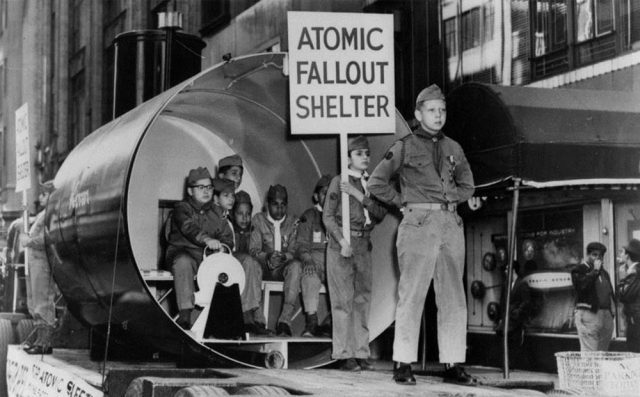
America prepares for the bomb in The Atomic Cafe

America prepares for the bomb in The Atomic Cafe, recently restored documentary about the Cold War

THE ATOMIC CAFE (Kevin Rafferty, Jayne Loader & Pierce Rafferty, 1982)
Metrograph
7 Ludlow St. between Canal & Hester Sts.
Saturday, July 13, 6:30
Series runs July 12-14
212-660-0312
metrograph.com

The time is ripe for a 4K restoration of the absurdist 1982 documentary The Atomic Cafe as President Trump deals with the nuclear capabilities and arsenals of Russia, Iran, and North Korea. Kevin Rafferty, Jayne Loader, and Pierce Rafferty were searching archives for propaganda films when they discovered a treasure trove of military and government shorts about the atomic and hydrogen bombs and how the American people should face any oncoming threats. The three filmmakers, who will be at Metrograph on July 13 at 6:30 to introduce a special screening of the 2018 restoration, weaved sensational footage together into an hour and a half of clips that range from the hysterically funny to the dangerously outrageous. Young students are taught to “duck and cover.” Enola Gay pilot Paul Tibbets Jr. describes how easy it was to fly over Hiroshima and drop the bomb but then admits his shock over the eventual destruction it wrought. Presidents Harry S Truman and Dwight D. Eisenhower discuss the impact of the bombs. A radio duo makes jokes about the decimation. Scenes of the horrific damage to Japanese victims are shown in silence. Vice Admiral W. H. P. Blandy defends the Bikini Atoll test, where island residents are assured everything will be fine — as are soldiers who will be in the vicinity of various tests.

While Russia escalates the Cold War — yes, they were our avowed enemy for quite some time, although the film includes President Richard Nixon joking around with Soviet premier Nikita Khrushchev — and a battle between North and South Korea looms, Americans drink “Atomic” cocktails and dance to “Atomic” songs. The execution of Ethel Rosenberg is explained in disturbing detail. A military officer tells the troops, “Watched from a safe distance, this explosion is one of the most beautiful sights ever seen by man,” and in a training film a military chaplain says to a few soldiers, “You look up and you see the fireball as it ascends up into the heavens; it’s a wonderful sight to behold.” Loader and the Raffertys fill the film with a vast array of black-and-white and color footage of nuclear bombs exploding into immense mushroom clouds, accompanied by a wide range of mood-enhancing music. It would be easy to dismiss most of the archival material in the film as ridiculous, outdated propaganda from a bygone era, but in this age of fake news, social media, lies from the White House, a war on journalism, and a president cozying up to enemies and taking issue with longtime allies, it’s more than a little bit frightening too. The Atomic Cafe is screening in the three-day series “Secret Histories: The Films of Kevin Rafferty & Friends,” which runs July 12-14 and also includes 1991’s Blood in the Face, 1992’s Feed, 1999’s The Last Cigarette, and 2008’s Harvard Beats Yale 29-28, offering unique looks at parts of the American experience.

CITY OF WATER DAY

(photo by David Gonsier)

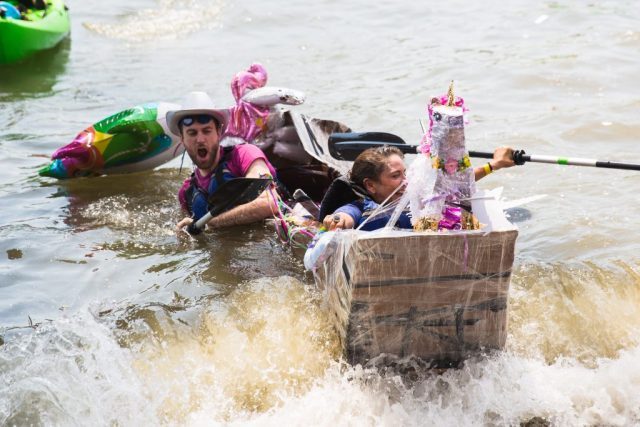
Cardboard Kayak Race is a highlight of City of Water Day (photo by David Gonsier)

CITY OF WATER DAY
Saturday, July 13, free
waterfrontalliance.org

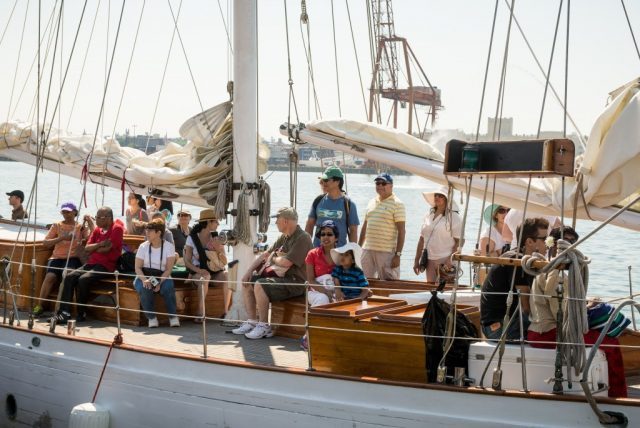
“What water is there for us to clean ourselves?” Nietzsche asked in 1882’s Parable of the Madman. If we’re not careful, we won’t have much clean water to do anything in the future, which is why City of Water Day has become such an important event. The twelfth annual celebration of H2O takes place on July 13, with special water-related activities in all five boroughs, with the South Street Seaport Museum as home base. The ever-popular Con Edison Cardboard Kayak Race is set for Brooklyn Bridge Beach on the Manhattan side at 1:30, but you can watch the kayaks being built at Peck Slip beginning at 10:30. The Waterfront Festival at Piers 16 and 17 features food trucks and booths from such organizations as Animal Haven, Billion Oyster Project, BioBoat, Earth Day Initiative, Hudson River Sea Glass, National Museum of the American Indian, NYC Winter Lantern Festival, Oceana, Shore Walkers, the U.S. Army Corps of Engineers, Untapped Cities, festival host the Waterfront Alliance, and others. Boat tours (free unless otherwise noted) include NYC Sightseeing Cruises at Pier 15; sails at 1:00 and 4:00 ($20) on the South Street Seaport Museum’s 1885 schooner, Pioneer; one-hour sails aboard the schooners Adirondack and America 2.0 from Pier 62; trips on the Fireboat John J. Harvey from Pier 66; a Lower Harbor Cruise from Pier 82 at 11:00 am; and a Landmark Cruise departing from Pier 83.

Boat tours

Numerous boat tours are part of City of Water Day in all five boroughs

The second annual Jamaica Bay Festival, on Beach 108th St. and Beach Channel Dr., features kayaking, fishing, surfing, hiking, bird watching, art, nature, and more. Among the many other events are Boogie Down to the Sound at SUNY Maritime’s Waterfront Open House, a Bronx River Lake Paddle, Community Rowing and Birding at Hunts Point Riverside Park, a Mile Hike and Talk Along the Harlem River in Roberto Clemente State Park, Low-Tide Nature Discovery at Bushwick Inlet Park, Seining the River Wild at Pier 4 Beach, NOAA’s USS Monitor Trail Marker at the Greenpoint Monitor Museum, Shoreline Clean-Up at Sherman Creek Park, the River Project’s Wetlab at Pier 40, Outrigger Paddling from Pier 66 in Hudson River Park, Harlem River Community Rowing at Muscota Marsh Dock, a Sustainability Scavenger Hunt in Nelson A. Rockefeller Park, the Last Harvest Celebration with Solar One in Stuyvesant Cove Park, a Fishing Clinic in Gantry Plaza State Park, Flushing Creek Rising Sea Tours from the Flushing Bay Boat Ramp, a Hunter’s Point South Park Tour, Evening Kayaking at the Alice Austen House Museum, and a Lighthouses in Danger tent outside the National Lighthouse Museum.