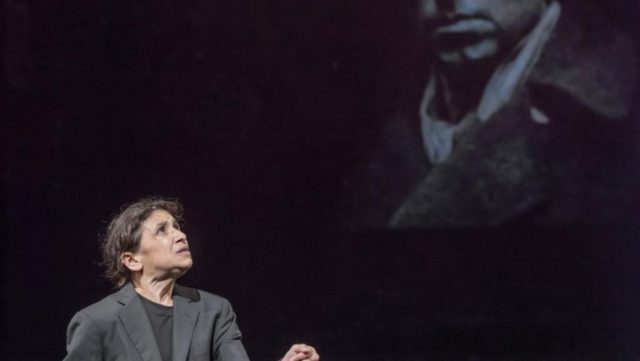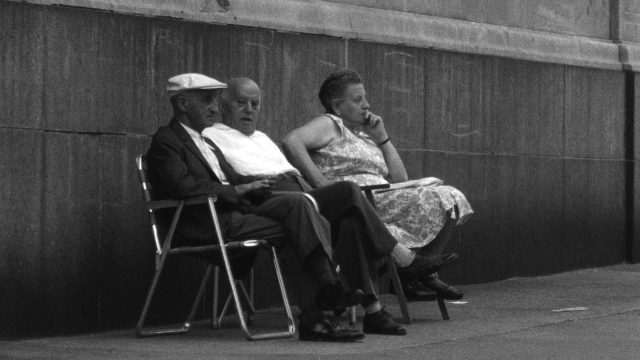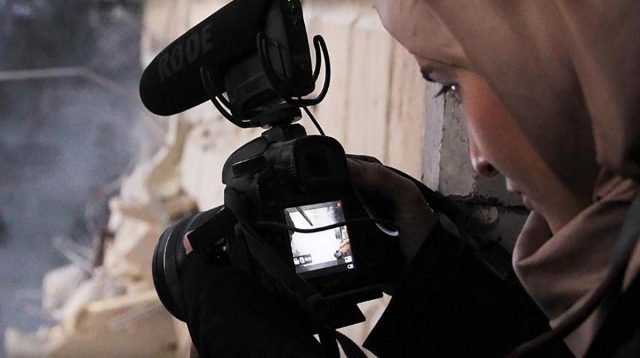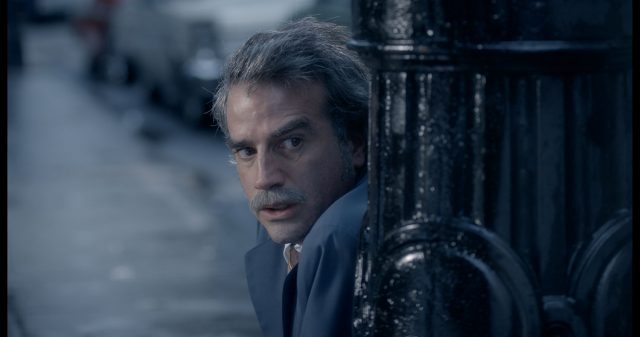
Judith Kalaora will portray Revolutionary War hero Deborah Sampson at the New-York Historical Society this weekend (photo courtesy History at Play & Vincent Morreale Photography)
LIVING HISTORY WEEKENDS
New-York Historical Society, courtyard
170 Central Park West
August 3-4, free with museum admission ($6-$22), 11:00 am – 3:00 pm
Series continues through September 15
212-485-9268 www.nyhistory.org
Last week, the New-York Historical Society hosted “Trans Identity and the Incredible Story of Deborah Sampson, Revolutionary War Hero,” an illustrated lecture by Alex Myers about the life and times of his ancestor Deborah Sampson, whose life he documents in his award-winning book Revolutionary, a fictionalized version of the brave young Colonial woman who disguised herself as a man to become a soldier in the Continental Army, eventually earning a military pension. Sampson herself — actually, History at Play actress Judith Kalaora — will be at the museum August 3-4 for “Revolutionary Summer: Deborah Sampson, Fighting Woman,” a Living History Weekend presentation being held in conjunction with the exhibition “Revolutionary Summer.” From 11:00 am to 3:00 pm each day, Sampson will be in the N-YHS courtyard, leading members of her regiment, the 4th Massachusetts, in military drills and other activities. Living History Weekends continue through September 15 with such other programs as “Fighting on Horseback” August 10-11 and “George Washington’s Encampment” August 17-18 and 24-25.
Brooklyn Museum
200 Eastern Parkway at Washington St.
Saturday, August 3, free (some events require advance tickets), 5:00 – 11:00
212-864-5400 www.brooklynmuseum.org
The Brooklyn Museum gets ready for the West Indian American Day Carnival on Labor Day in the August edition of its free First Saturday program. There will be live performances by Los Habaneros, DJ I.M., DJ TYGAPAW, and Noise Cans; a hands-on workshop in which participants can make Caribbean carnival masks; a Flag Fête workshop and performance with Haitian choreographer and dance instructor Charnice Charmant and Afrobeat dancers; teen pop-up gallery talks on “Liz Johnson Artur: Dusha”; a screening of Khalik Allah’s Black Mother, followed by a talkback with Allah and curator Drew Sawyer; Likkle Bites with food from Caribbean-owned Brooklyn businesses Greedi Vegan and Island Pops; an artist talk with Liz Johnson Artur; and the discussion “Yoruba in Pop Culture” with Grammy winner Chief Ayanda Clarke, presented by the Fadara Group. In addition, the galleries will be open late so you can check out “Garry Winogrand: Color,” “Nobody Promised You Tomorrow: Art 50 Years After Stonewall,” “Eric N. Mack: Lemme walk across the room,” “Liz Johnson Artur: Dusha,” “One: Egúngún,” “Pierre Cardin: Future Fashion,” “Infinite Blue,” “Rembrandt to Picasso: Five Centuries of European Works on Paper,” and more.
Jaleel White stars in Camilo Vila’s 5th of July, which kicks off Queens film fest
Regal UA Midway Theater, Queens Library at Forest Hills, Queens Museum, Queens Brewery
August 2-11 www.festivalofcinemanyc.com
Forest Hills continues its ascent in the film world with the third annual Festival of Cinema NYC, which kicks off August 2 with Hannah Elless’s short Nora Ephron Goes to Prison and the East Coast premiere of Camilo Vila’s 5th of July, about a series of events that befall a man (played by Jaleel White) after the fireworks are over. The films will be preceded by a red carpet and followed by an after-party. The fest continues through August 11, with twenty narrative features, seven documentaries, a handful of free events, and more than seventy international shorts in addition to web series and animation, experimental works, and music videos. On August 7, Indie Film Collective will present the 72 Hour Short Film Challenge, consisting of a dozen shorts made in three days starting with a line of dialogue, a prop, and a genre. You can find out more about Indie Film Collective at a panel on August 6 with founder and creative director Joseph Eulo and his team.
Drew Barnhardt’s wild Rondo screens at the Festival of Cinema NYC on August 9 just before midnight
The Queens Library at Forest Hills and the Queens Museum will be home to several free programs (advance registration required), including “A Different Perspective — a Series of Experimental Films from Around the World,” “Monuments & Flowers” (by Arte East), “Race, Sex & Hold the Mayo!” (by the Asian American Film Lab), Surviving Birkenau: The Dr. Susan Spatz Story followed by a Q&A with director Ron Small, Carnaval de Cuba followed by a Q&A with director Roberto Monticello, and the New York premiere of Matej B. Silecky’s Baba Babee Skazala: Grandmother Told Grandmother. The closing night films on August 10 are Santiago Rizzo’s Quest — the Truth Always Rises, about a troubled middle schooler obsessed with tagging, and Francesco Filippi’s half-hour animated Red Hands, followed by the awards dinner celebration on August 11 at the Queens Brewery.
Photographer Jay Maisel goes through decades of stuff as he moves out of longtime East Village home in Jay Myself
JAY MYSELF (Stephen Wilkes, 2018)
Film Forum
209 West Houston St.
Opens Wednesday, July 31
212-727-8110 filmforum.org
In 1966, Brooklyn-born photographer Jay Maisel moved into the 1898 Germania Bank Building on the corner of Bowery and Spring, purchased with a now astonishing $25,000 down payment. Nearly fifty years later, in early 2015, after decades of taking pictures and collecting tens of thousands of random items, he was forced to sell the graffiti-laden, six-floor, 36,000-square-foot property because of rising maintenance costs; at fifty-five million dollars, it was the largest private real estate deal in New York history. One of his protégés, Stephen Wilkes — who back in the 1970s knocked on Maisel’s door and showed him his portfolio — documents Maisel’s months-long exit from the landmark building as he and a team of assistants sift through the maelstrom and Maisel regales him with stories from his career, which has included shooting for advertising agencies, Sports Illustrated,New York magazine, and jazz legends. “Objects are there for you only if you really see them. If you don’t, they don’t exist. And a lot of people don’t see things,” Maisel philosophizes. “Before you’re going to be able to see, you have to look. And before you can look, you have to want to look. And art is, to some effect, trying to make others see what you see.”
Documentary follows Jay Maisel’s nearly fifty-year history in the Bank on Spring & Bowery
Maisel, a calm man with a penchant for littering his sentences with curses, leads Wilkes through the six floors, showing items from his vast collection, one that borders on hoarding. “Each floor represented a certain partition of his mind,” Wilkes explains. Wilkes speaks with such other photographers as Jeff Dunas, Duane Michals, Dan Winters, Peter Murphy, Matt Dean, Hale Gurland, Barbara Bordnick, Jamie Smith, and Melchior DiGiacomo, who rave about Maisel’s influence and his iconoclastic personality. “He sees all this potential in things that no one else would. He just has such a sense of play,” his daughter, Amanda, says. Maisel, who carries a camera everywhere he goes, constantly snapping pictures, adds, “What I’m trying to do all the time is to try and see things anew, to see things the way a child would see them.”
The quintessentially New York documentary doesn’t dig too deep into his personal life and tends to be overly worshipful, but Maisel, who turned eighty-eight earlier this year, is an engaging character, chomping on a cigar, telling of his studies at Yale with Josef Albers, and going through boxes and boxes (and boxes and boxes) of stuff — what many would call junk — that he refuses to part with as the team from Moishe’s is faced with a virtually impossible situation. “I think there’s a delight in the perception and the enjoyments of objects,” he notes. There’s also a delight and enjoyment in watching this mensch over the course of seventy-eight minutes. Jay Myself opens at Film Forum on July 31, with Maisel and Wilkes participating in Q&As at several shows from July 31 to August 4.
Twitter can be a den of iniquity, where both famous and anonymous people share their vitriolic thoughts on the world at large and specific individuals, starting at the very top with the current president of the United States, who is obsessively twitterpated with the social media site. Twitter seeks to change that in at least a small way with #Tweetups, in which Twitter users can speak with one another face-to-face in large-scale Skype-like meetings held in giant containers. One such container, labeled “What’s Happening?,” will be in Vanderbilt Hall in Grand Central Terminal through August 4, offering #Tweetups to passersby, who walk on a red carpet leading into the container, at the end of which is a giant screen connecting to people in other cities. There is also a screen at the Africa Center along Museum Mile.
A red carpet leads you into personal discussions with people around the world (photo by twi-ny/ mdr)
Admission is free, and there is no advance registration necessary. Presented in conjunction with Shared_Studios, “Tweetup Spaces” is happening in forty cities around the world; there is an hourly schedule available so you can choose what location you want to connect with. For example, on July 31 in Grand Central, you can hook up with tweeters in Gaza at 8:00 am, Dallas at 2:00 pm, and Melbourne at 10:00 pm and take part in “#HereWeAre: Celebrating Women around the World,” focusing on discussions involving such hashtags as #SheInspiresMe, #EffYourBeautyStandards, #YesAllWomen, and #EqualPay; on August 1 at the Africa Center, you can converse with people from Lagos at 11:00 am and London at 4:00 and hang around for “The Twitter Table: What’s Happening?,” a noon lunch connecting Harlem and Lagos, followed by a happy hour. Translators and conversation guides are on site to make sure things go smoothly. You can also watch on small monitors #Tweetups going on in other countries. Twitter a place to bring people together instead of tear them apart? What a novel concept!
Waad al-Kateab documents daily life under constant bombardment in Aleppo in For Sama
FOR SAMA (Waad al-Kateab & Edward Watts, 2019)
Quad Cinema
34 West 13th St. between Fifth & Sixth Aves.
Opens Friday, July 26
212-255-2243 quadcinema.com www.forsamafilm.com
“You’re the most beautiful thing in our life, but what a life I’ve brought you into. You didn’t choose this. Will you ever forgive me?” Waad al-Kateab asks in the extraordinary documentary For Sama. In 2012 during the Arab Spring, Waad, a marketing student at Aleppo University, joined the protests against the regime of President Bashar al-Assad. She started taking photos and cell-phone video, then got a film camera as she became a citizen journalist, documenting the escalating conflict, trying to find moments of joy amid the brutal, senseless murders of innocent men, women, and children. She met and fell in love with heroic doctor Hamza al-Kateab, who was determined to keep his hospital running as the bombings got closer. Waad and Hamza got married, and on January 1, 2016, she gave birth to a healthy girl, Sama.
The film, directed by Waad (who also served as cinematographer and producer) and Edward Watts (Escape from ISIS), is a poignant, unflinching confession from mother to daughter, explaining in graphic detail what the families of Aleppo are going through as Russian and Syrian forces and Islamic extremists maintain a constant attack. “We never thought the world would let this happen,” Waad explains as the body count rises — which she intimately shows, not shying away from shots of bloodied victims being brought into the hospital, a pile of dead children, or a desperate attempt to save the life of a mother and a newborn after an emergency caesarean. “I keep filming. It gives me a reason to be here. It makes the nightmares feel worthwhile,” Waad says.
She captures bombings as they happen, films families huddled inside their homes while machine guns can be heard outside, talks to a child who says he wants to be an architect when he grows up so he can rebuild Aleppo. Because she is a woman, Waad gains access to other women that would not be available to a male filmmaker as they share their stories of love and despair. Waad and Hamza plant a lovely garden to bring color to the dank, brown and gray city. A snowfall covers the turmoil in a beautiful sheet of white. The pitter-patter of rain offers a brief respite. But everything eventually gets destroyed as Waad and Hamza struggle with the choice of leaving with Sama or staying to continue their critical roles in the rebellion, she depicting the personal, heart-wrenching images of war — in 2016, her Inside Aleppo reports aired on British television — he tending to the ever-increasing wounded. “The happiness you brought was laced with fear,” Waad tells Sama in voiceover narration. “Our new life with you felt so fragile, as the freedom we felt in Aleppo.” Winner of the Prix L’Œil d’Or for Best Documentary at Cannes among other awards, For Sama opens at the Quad on July 26; on July 27, Waad, Hamza, and Watts will participate in Q&As with Nermeen Shaikh after the 4:45 show and with Tomris Laffly at the 7:00 screening.
Abbas Kiarostami is subject of comprehensive retrospective at IFC, featuring three talks with Godfrey Cheshire
IFC Center
323 Sixth Ave. at West Third St.
July 26 – August 15
212-924-7771 www.ifccenter.com
“During Godfrey’s several visits to Iran throughout a decade, he formed a relationship with my father that I had rarely seen him having with other writers. I believe this is because of Godfrey’s ability to go beyond the surface, his unique views and interpretations,” Ahmad Kiarostami writes in the foreword to film critic Godfrey Cheshire’s latest book, Conversations with Kiarostami (Film Desk, July 29, $18). In the 1990s, Cheshire went to Iran on multiple occasions to interview writer-director Abbas Kiarostami, helping introduce the new Iranian cinema to the West. Cheshire will be at IFC Center for three special presentations during the fab festival “Abbas Kiarostami: A Retrospective,” a three-week series comprising virtually all of Kiarostami’s shorts and full-length works, from award-winning, well-known tales to rarely screened gems, many in 2K or 4K restorations. Among the films being shown are the Koker Trilogy (Where Is the Friend’s House?, And Life Goes On, Through the Olive Trees), Palme d’Or winner Taste of Cherry, Silver Lion winner The Wind Will Carry Us, the early documentaries First Graders and Homework, and Kiarostami’s first two features, The Traveler and The Report.
Abbas Kiarostami looks ever-so-cool at MoMA show in 2007 (photo by twi-ny/mdr)
In his Criterion essay on Taste of Cherry, Cheshire writes, “In Abbas Kiarostami’s universe, it might be said, there are no things, only relations between things. Likewise, in his cinema: no films, only relations between films—and within them. And between them and us.” Cheshire will delve into those relations at a trio of talks, beginning July 27 at 7:10 with “Kiarostami and Koker,” focusing on the trilogy and showing Through the Olive Trees. On August 3 at 5:10, for “Unseen Kiarostami,” Cheshire will screen the 1976 comedy A Wedding Suit and talk about that film as well as such other early works as Bread and Alley, Experience, and Fellow Citizen. And on August 4 at 5:20, for “Cinema in Revolution,” Cheshire will be joined by film professor Jamsheed Akrami for a screening of the initially banned Case No. 1, Case No. 2 and a discussion. In his online bio of Kiarostami, Cheshire calls the auteur “the most acclaimed and influential of Iran’s major filmmakers” and notes how in the twenty-first century “Kiarostami broadened his creative focus, devoting more time to forms including photography, installation art, poetry, and teaching,” exemplified by his 2007 exhibition “Image Maker” at MoMA and MoMA PS1. Keep watching twi-ny for reviews of individual films during this must-see retrospective.