Who: Musicians, actors, television hosts, and other celebrities What:Global Citizen benefit concert Where:Global Citizen and many streaming sites When: Saturday, April 18, donation suggested, 2:00 pm – 8:00 am Why: Dozens of musicians will be appearing tonight in “One World: Together at Home Special to Celebrate COVID-19 Workers,” an international concert to benefit health-care workers on the front lines of the Covid-19 crisis. Proceeds from the presentation go to the WHO’s Covid-19 Solidarity Response Fund. The show is sponsored by Global Citizen, the nonprofit whose mission statement declares: “Around the world, countless people face daily inequalities — from the LGBTI community, to children with disabilities. We can build a better world, but only if we each raise our voice and take action.” Among those making appearances from their homes during the overnight marathon, which is curated by Lady Gaga (who helped raise $35 million in one week for the charity), are, in one two-hour block, Adam Lambert, Jennifer Hudson, Lang Lang, Milky Chance, Niall Horan, Picture This, Rita Ora, Sofi Tukker, and the Killers; Annie Lennox, Ben Platt, Common, Ellie Goulding, Jack Johnson, Kesha, Michael Bublé, and Sheryl Crow in another two-hour block; and Angèle, Billy Ray Cyrus, Christine and the Queens, Hozier, John Legend, Lady Antebellum, Leslie Odom Jr., Luis Fonsi, and Sebastián Yatra in a third segment.
Also on the bill are the Rolling Stones, Alicia Keys, Amy Poehler, Andrea Bocelli, Awkwafina, Billie Eilish, Billie Joe Armstrong, Celine Dion, Chris Martin, Connie Britton, Don Cheadle, Eddie Vedder, Ellen DeGeneres, Elton John, Heidi Klum, Jack Black, Keith Urban, Kerry Washington, Lily Tomlin, Lupita Nyong’o, Oprah Winfrey, Paul McCartney, Pharrel Williams, Sam Smith, Samuel L. Jackson, Sarah Jessica Parker, Shawn Mendes, Stevie Wonder, Taylor Swift, and Usher, with hosts Stephen Colbert, Jimmy Fallon, and Jimmy Kimmel. Give generously if you can — and stay safe and healthy.
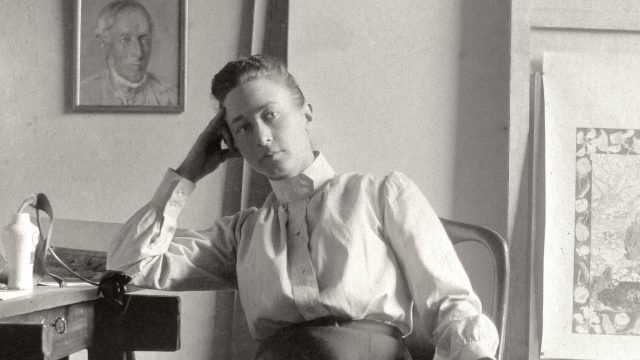
Beyond the Visible profiles the life and work of master abstractionist Hilma af Klint
BEYOND THE VISIBLE: HILMA AF KLINT (Halina Dyrschka, 2019)
Opens virtually April 17, $12 (good for one-week pass)
Live Q&A on April 18 at 3:00 kinonow.com zeitgeistfilms.com
In 2013, a new hero burst onto the art scene, despite being dead for nearly seventy years. First came “Hilma af Klint — A Pioneer of Abstraction,” by all accounts an eye-opening show that toured Europe, followed five years later by the smash Guggenheim exhibit “Hilma af Klint: Paintings for the Future,” which propelled the extraordinary work of the Swedish abstractionist into the mainstream. I fondly remember making my way through the show, mouth agape at the many wonders I was seeing. German director Halina Dyrschka continues the celebration of this previously little-known painter in the documentary Beyond the Visible — Hilma af Klint, which will be available for streaming April 17 through Kino Marquee in association with BAM in Brooklyn and Laemmle Monica Film Center in Los Angeles. Dyrschka and Guggenheim assistant curator David Max Horowitz will participate in a Zoom Q&A with BAM on April 18 at 3:00.
In her debut full-length film, Dyrschka digs deep into who af Klint was, what inspired her unique achievements, and why she had been overlooked until the 2010s. “Now we have a real scandal,” German art critic and af Klint biographer Julia Voss says. “Suddenly, more than fifty years after history was written, completely out of the blue, at least for the general public, we discover this woman who painted abstract works before Kandinsky, creating this huge oeuvre, fully independently, and by a kind of miracle it’s all stayed together. It’s like finding a time capsule in Sweden. And now we have to ask: How should we integrate it?”
Born in Stockholm in 1862, af Klint incorporated physics, mathematics, the natural world, and spiritualism into her paintings, abstract canvases that predated Wassily Kandinsky and Piet Mondrian, who both, like af Klint, died in 1944. She didn’t exhibit any of her work until 1906, and after that only sparingly. Upon her death, her estate was not permitted to show anything for twenty years; her first posthumous exhibition was held in LA in 1986.
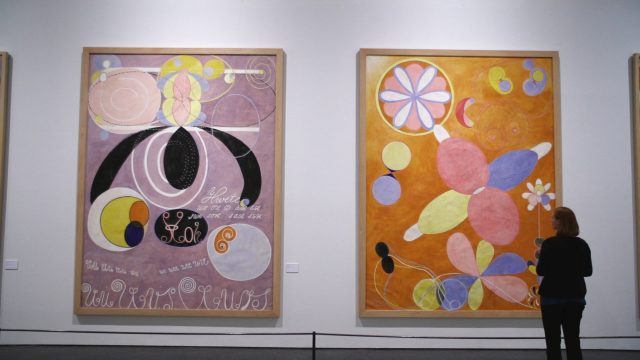
“We are not here forever,” Dyrschka narrates early in the film. “So it is not at all astonishing that someone once wondered about what it means to be in the world and how everything fits together — and came up with a huge answer. The strange thing is I only found out about it more than one hundred years later. Art history has to be rewritten.” Among the others lobbying for af Klint’s ascension into the art canon are artists Josiah McEhleny and Monika von Rosen, novelist Anna Laestadius Larsson, art historians Ernst Peter Fischer and Anna Maria Bernitz, Eva-Lena Bengtsson of the Royal Academy of Fine Arts in Stockholm, collector Valeria Napoleone, and gallerist Ceri Hand, offering different perspectives of the value and legacy of her her work. Lending more personal insight are Ulla af Klint, the widow of Hilma’s nephew Erik (from a 2001 interview); Johan af Klint, Ulla’s son, who ran the Hilma af Klint Foundation, which oversees the artist’s 1,500 paintings and 26,000 pages in notebooks; and Marie Cassel and Brigitta Giertta, descendants of two of Hilma’s closest friends. Together they paint a compelling portrait of the iconoclastic af Klint, who filled her work with cutting-edge and fringe philosophy and science. But you don’t have to agree with her offbeat world view to fall in love with her gorgeous canvases, many of which are displayed in the film.
The extraordinary canvases of Swedish artist Hilma af Klint are on view in Beyond the Visible
Curator Iris Müller-Westermann explains, “Never in her lifetime did she put any of her abstract work on show. Hilma af Klint’s project was something much grander than what we today call ‘art.’ It was all about seeing the world we live in in a larger context, to understand who we really are in a cosmic perspective.”
Cinematographers Alicja Pahl and Luana Knipfer often let the camera linger on peaceful shots of water, flowers, the sky, and other natural elements that morph into Klint’s paintings and reenactments of af Klint working on a large-scale painting on the floor of her studio. Petra van der Voort reads excerpts from af Klint’s writings in voice-over, narrating from books that we can follow along with, zooming in on her penmanship, while Damian Scholl supplies a wide-ranging, eclectic score.
“She was well educated, she had a mind of her own, and she painted like nobody else,” Johan af Klint says. McElheny points out, “In order to tell the history of abstraction now, you have to rewrite it.” Beyond the Visible confirms that it’s time for a new history.
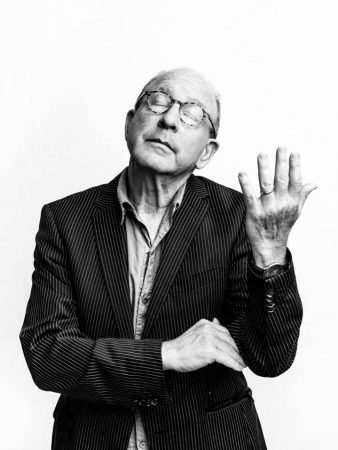
Jerry Saltz will discuss his new book and the state of art during the age of corona in live online conversation (photo courtesy Jerry Saltz)
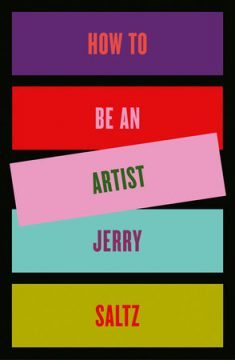
Who:Jerry Saltz, Barbara Pollack, Anne Verhallen What: Book and art talk with Jerry Saltz Where: Livestream (email info@artatatimelikethis for password) When: Friday, April 17, free, 4:00 Why: Rock star art critic Jerry Saltz’s latest book has come along at just the right moment. How to Be an Artist (Riverhead Books, March 2020, $22) guides you through the creation of art — by anyone, regardless of talent and skill — espousing a dedicated work ethic, something that many of us are paradoxically demonstrating more than ever now that we’re stuck at home. “I have tried every way in the world to stop work-block or fear of working, of failure. There is only one method that works: work. And keep working,” Saltz, the Pulitzer Prize-winning senior art critic for New York magazine, writes in the book. “Every artist and writer I know claims to work in their sleep. I do all the time. Jasper Johns famously said, ‘One night I dreamed that I painted a large American flag, and the next morning I got up and I went out and bought the materials to begin it.’ How many times have you been given a whole career in your dreams and not heeded it? It doesn’t matter how scared you are; everyone is scared. Work. Work is the only thing that takes the curse of fear away.”
On March 17, Barbara Pollack and Anne Verhallen launched Art at a Time Like This, a website that features the work of a different artist every weekday, focusing on the question “How can you think of art at a time like this?” Among the participating artists are Ai Weiwei, Mickalene Thomas, Jacolby Satterwhite, Lynn Hershman Leeson, Dread Scott & Jenny Pollak, Marilyn Minter, and Dan Perjovschi, presenting new and older paintings, photographs, and videos, all of which illuminate in some way the crisis we are facing together, the onslaught of Covid-19, which has shut down galleries and museums around the world.
A social media icon, Saltz will join Pollack and Verhallen on April 17 at 4:00 for a live online conversation about the state of art on a planet in lockdown. “Jerry Saltz is a natural for livestream because he is the completely accessible art critic, dedicated to reaching all kinds of art lovers, from the aficionado to the art-curious,” Pollack told twi-ny. “His new book puts forth the insane idea that anyone can be an artist, or at least artistic. Of course, people love him for this!”
As someone who has been writing about art for nearly twenty years, I’ve been forced to reconsider how we all experience art during this pandemic, looking at it onscreen, right next to Facebook, Google, and my day-job site. Obviously it’s not the same, and I have to admit I at first had trouble adjusting, but I’m getting more used to it every day. But can you critique a work of art you’ve seen only online, not in person? When viewed in real life, you can sense a painting’s texture, its physical presence; a photograph can envelop you and shake your surroundings loose; and videos can beam out from unique sculptural installations. But when is the next time any of us is likely to step foot in a gallery or museum in the five boroughs (or elsewhere)? What will things be like once they do reopen? Will crowds descend on MoMA and the Met like they did before corona?
In his October review of the new MoMA for New York magazine, a piece entitled, “What Does the New MoMA Mean for Modernism? And What Was Modernism Anyway?,” Saltz wrote, “Here’s how art has already moved on. Modernism is now just part of art history to artists, and not even the only or best part.” How will art move on after Covid-19? What will become part of art history? I can’t wait to hear what Saltz has to say about what will become of art’s future.
Newly minted talk show host Emily Hampshire is obsessed with her bitmoji
Who:Michelle Visage,Ross Mathews,Katherine Moennig, host Emily Hampshire What:Hump Day livestreamed talk show benefiting the Actors Fund Where:The Actors Fund YouTube page When: Wednesday, April 15, suggested donation, 2:00 Why:Schitt’s Creek might be over, but you can still keep getting your Emily Hampshire fix on Wednesdays during the pandemic with Hump Day with Hampshire, a livestreamed talk show hosted by Hampshire, who played everyone’s favorite motelier, Stevie Budd, on the Canadian comedy. On April 15 at 2:00, Hampshire, who also starred in 12 Monkeys, Made in Canada, and Blood, will be joined by singer, author, and radio and TV personality Michelle Visage (RuPaul’s Drag Race, Strictly Come Dancing), author and podcaster Ross Mathews (The Tonight Show with Jay Leno, RuPaul’s Drag Race), and actress Katherine Moennig (The L Word, Ray Donovan). In addition to virtual interviews, be on the lookout for such games as “Show Us Your Junk (Drawer),” “What Is Your quarROUTINE,” and “Phone a Friend Roulette.” The series is a benefit for the Actors Fund, so if you can, please donate, although you don’t have to in order to watch and enjoy.
“I couldn’t ask for a better creative distraction than hosting a show that not only helps raise money for an important cause but also lets me connect with a dream-team roster of guests without having to leave my apartment or even put on pants!” Hampshire, who is utterly charming as host, said in a statement. “There’s such an insane amount of stress in the world right now, and if we can do something a little fun for all the stir-crazy people out there and help the industry, that means everything to me.” You can also catch up with previous episodes; Bobby Berk, Sophia Bush, Annie Murphy, and Adam Rippon appeared on April 1 and Gigi Gorgeous, Noah Reid, Sarah Levy, and Lance Bass on April 8.
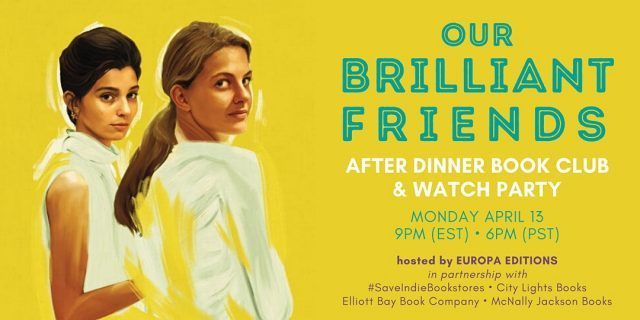
Who: Ann Goldstein, Michael Reynolds,Alexander Chee,Sarah Treem What: Live discussion, reading, and watch party to benefit #SaveIndieBookstores Where:McNally Jackson Zoom meeting When: Monday, April 13, advance registration required here, suggested donation $5 and up, 9:00 Why: Fans of Elena Ferrante’s novels, which include The Days of Abandonment, The Story of a New Name, and The Lost Daughter, will gather online on April 13 at 9:00 for a book club and watch party hosted by Ferrante’s publisher, Europa Editions, along with City Lights Books in San Francisco, the Elliott Bay Book Company in Seattle, and McNally Jackson Books here in New York City. The event begins at 9:00 with a live conversation and chat about Ferrante’s work and the HBO adaptation My Brilliant Friend, followed at 9:50 by a reading from her latest book, The Lying Life of Adults (Europa Editions, November 2019, $26) and a watch party at 10:00 of episode five of the second season of the series, The Betrayal, which is directed by Italian auteur Alice Rohrwacher, the writer-director of such international successes as Heavenly Body,The Wonders, and Happy as Lazzaro. (Note that the show will not be aired over the livestream but must be watched over HBO.) The discussion features Ferrante’s English-language translator, Ann Goldstein, who will read an excerpt from the new novel; Europa editor in chief Michael Reynolds; writer, professor, and poet Alexander Chee; and writer and producer Sarah Treem (The Affair, In Treatment). The mysterious and elusive, pseudonymous Ferrante will not be participating, of course. Suggested donation is $5 (or more if you can afford it), with all proceeds benefiting #SaveIndieBookstores.
As part of Focus Features’ free Movie Mondays livestreaming series, director Wes Anderson will participate in a Q&A on April 13 following a 5:00 watch party for his 2012 gem, Moonrise Kingdom. In such unique films as Rushmore,The Royal Tenenbaums, and The Grand Budapest Hotel, black-comedy master Anderson has created a bizarre collection of characters who seem to live in their own alternate realities. In Moonrise Kingdom, he has once again assembled an oddball assortment of men, women, and children in a terrifically clever and entertaining fairy tale all its own. Tired of being abused by his fellow Khaki Scouts and dismissed by his foster parents, twelve-year-old orphan Sam Shakusky (Jared Gilman) runs away from Camp Ivanhoe on the island of New Penzance, much to the chagrin of dedicated scout master Randy Ward (Edward Norton). Meanwhile, twelve-year-old loner Suzy Bishop (Kara Hayward) is fed up with her life as well, which she mostly spends listening to Benjamin Britten, reading fairy tales (fictitious stories made up by Anderson), watching the world through a pair of ever-present binoculars, and despising her parents (Bill Murray and Frances McDormand).
Afraid of what might have happened to the children, the local police officer, Captain Sharp (Bruce Willis), gets involved, as does a stern woman from social services (Tilda Swinton) and, eventually, a very different kind of scout, Cousin Ben (Jason Schwartzman). The proceedings are overseen by a narrator (Bob Balaban) who ends up being more than just an omniscient presence. Moonrise Kingdom is an absolute gem of a film, an exciting, original tale about growing up, told in a fabulously funny, deadpan manner that combines slapstick humor with wildly ironic elements, filled with the endless wonders of childhood, although it is most definitely not for children. Newcomers Gilman and Hayward appear wise beyond their years in the lead roles, with outstanding support from an all-star cast, most prominently Norton as the by-the-book scout master on a mission. Written by Anderson with Roman Coppola and featuring a lovely score by Alexandre Desplat, Moonrise Kingdom is one of the best films of 2012, by a director whose imagination never ceases to amaze. Focus Movie Mondays continues April 20 with Kevin Smith’s Mallrats and April 27 with Paweł Pawlikowski’s My Summer of Love.
Who: Michael Urie, Nathan Winkelstein What:Live discussion of “Queen Mab” speech from Romeo & Juliet Where:Red Bull Theater’s website,Vimeo,Facebook (and Zoom for up to fifty participants; requires advance registration here) When: Monday, April 13, free, 7:30 Why: Red Bull Theater’s RemarkaBULL Podversations streaming series kicks off April 13 at 7:30 with actor Michael Urie discussing Mercutio’s “Queen Mab” speech from William Shakespeare’s Romeo & Juliet with host Nathan Winkelstein, the company’s associate producer. Red Bull specializes in Jacobean and Shakespearean works; Urie (Ugly Betty, Buyer & Cellar) starred in the troupe’s 2017 adaptation of Nikolai Gogol’s 1836 satire, The Government Inspector. The monologue, delivered in Act 1, Scene 4, begins: “O, then, I see Queen Mab hath been with you. / She is the fairies’ midwife, and she comes / In shape no bigger than an agate-stone / On the fore-finger of an alderman, / Drawn with a team of little atomies / Athwart men’s noses as they lie asleep.” Urie portrayed Mercutio in Folger Theatre’s 2005 production of the play, directed by PJ Paparelli. If you want to participate in the live chat, you need to register in advance for the Zoom feed here.