this week in lectures, signings, panel discussions, workshops, and Q&As

FOOTBALL AS AMERICA: MATTHEW BARNEY AT METROGRAPH

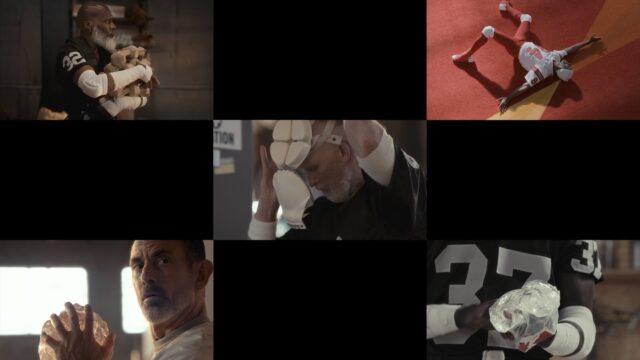
Matthew Barney’s multichannel Secondary will be shown on a single screen at Metrograph (image © Matthew Barney, courtesy of the artist, Gladstone Gallery, Sadie Coles HQ, Regen Projects, and Galerie Max Hetzler)

SECONDARY
Metrograph
7 Ludlow St. between Canal & Hester Sts.
Saturday, May 3, 5:00
metrograph.com
secondary.matthewbarney.net
online slideshow

It was the hit heard round the world.

On August 12, 1978, the New England Patriots were playing a preseason game against the Oakland Raiders at Oakland-Alameda County Coliseum. Late in the second quarter, the Pats have a third and eight at the Raiders twenty-four-yard line. QB Steve Grogan calls the 94 Slant, and wide receiver Darryl Stingley heads downfield. At the ten-yard line, Stingley reaches for the overthrown pass and is crushed in midair by two-time Raiders All-Pro safety Jack Tatum, known as the Assassin for his punishing style of play. Stingley immediately crumples to the ground. Four Oakland defenders look down at Stingley and walk away; Patriots wide receiver Russ Francis stands over his fallen teammate, knowing something is wrong. The twenty-six-year-old Stingley is wheeled off the field on a stretcher, a quadriplegic for the rest of his life; he died in 2007 at the age of fifty-five. Tatum wasn’t penalized on the play and never apologized to Stingley, claiming it was a legal hit and that he had done nothing wrong. Tatum, who died in 2010 at the age of sixty-one, was also involved in the Immaculate Reception on December 23, 1972, in a playoff game against the Steelers; with twenty-two seconds left and Pittsburgh down by one, future Hall of Famer Terry Bradshaw was facing a fourth and ten from his own forty. He ran to his right and threw a pass down the middle. Tatum smashed into Steelers running back Frenchy Fuqua, the ball popped up into the air, and future Hall of Famer Franco Harris picked it up by his shoestrings and ran forty yards into the end zone for the winning score.

Filmmaker and installation artist Matthew Barney was eleven years old when Tatum pummeled Stingley. Seeing the collision over and over again on replay did not prevent Barney from becoming a star quarterback in high school in Idaho. But at Yale, he switched from sports to art, beginning his “Drawing Restraint” series in 1987 and making his Jim Otto Suite in 1991–92, about orifices, bodily fluids, energy, Harry Houdini, and Raiders Hall of Fame center Jim Otto, who wore the number double zero, mimicking the letters at the beginning and end of his palindromic last name.
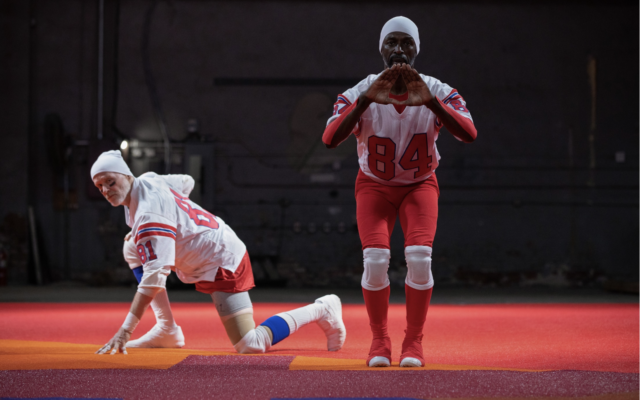
Violence in football takes center stage as a metaphor for America in Matthew Barney’s Secondary (image courtesy Matthew Barney Studio, © Matthew Barney / photo by Julieta Cervantes)

In 2023, Barney said farewell to his longtime Long Island City studio with Secondary, a five-channel video installation that used the Tatum-Stingley play to explore violence in athletic competition. Barney transformed the studio, which was right on the East River, into a football stadium, with a long, artificial turf surface divided into geometric patterns of different colors, centered by his “Field Emblem,” his Cremaster logo, an ellipse with a line going through it, evoking –0-. There were monitors in all four corners of the field, along with a three-sided mini-jumbotron hanging from the ceiling. Visitors could sit on the field or a bench; there was also a painting on the wall, an owners booth filled with football paraphernalia, and a ditch with broken piping and mud dug into the concrete. Outside, on the facade facing the water, there was a digital countdown clock next to graffiti that said, “Saboroso,” which means “delicious.”

Written and directed by Barney, photographed by Soren Nielsen, and edited by Kate Williams, the film — which lasts sixty minutes, the length of a football game — has now been reimagined on a single screen, where it will be shown at Metrograph on May 3 at 5:00, in conjunction with the publication of a two-volume companion book (Rizzoli, April 2025, $115), featuring contributions from Eric Banks, Jonathan Bepler, Raven Chacon, Mark Godfrey, Juliette Lecorne, Helen Marten, Maggie Nelson, and David Thomson; Barney will be at Metrograph for a postscreening discussion with book editor Louise Neri and Banks, followed by a reception with signed books available for purchase.

The multichannel version kicks off with indigenous rights activist Jacquelyn Deshchidn, a Two-Spirit Chiricahua Apache and Isleta Pueblo soprano, composer, poet, and public speaker, performing an alternate national anthem, a none-too-subtle jab at a league that still has teams using offensive Native American names and imagery. The cast, primarily consisting of dancers and choreographers, features movement director David Thomson as Stingley; Raphael Xavier as Tatum; Shamar Watt as Raiders safety Lester “the Molester” Hayes; Wally Cardona as Grogan; Ted Johnson as Francis; Isabel Crespo Pardo, Kyoko Kitamura, and Jeffrey Gavett as the line judges and referees; Barney as Raiders Hall of Fame QB Ken “the Snake” Stabler, who died of colon cancer but was discovered to have had high Stage 3 chronic traumatic encephalopathy (CTE), the disease that affects so many football players, brought on by getting hit so much in the head; and Thomas Kopache as Raiders owner Al Davis, whose motto was “Just win, baby,” no matter the cost. (Football fans will also notice cameos by actors portraying such Raiders favorites as wide receiver Fred Biletnikoff and defensive end John “the Tooz” Matuszak, who became an actor and died in 1989 at the age of thirty-eight from an opioid overdose.) The actors are generally much older than the people they represent, several of whom never made it to the age the performers are today.

The experimental film does not have a traditional chronological narrative; instead, Barney focuses on Tatum, Hayes, and Stingley training in slow motion in equipment rooms as if preparing for a ballet, Grogan making a football out of a gooey substance and then practicing with it, members of Raiders Nation shouting and cheering in fierce black-and-silver Halloween-like costumes, and players venturing into the muddy ditch, the broken pipe echoing Stingley’s shattered body. The music, by sound designer Jonathan Bepler, envelops the audience in a parade of noises, from hums and breathing to clangs and screams. Shots of the Manhattan skyline and the East River beckon to another life outside. The screens sometimes display the same footage, while other times they are different; it is like the viewer is at a football game, with the choice whether to watch the quarterback, the defensive alignment, or other fans in the stands. There is no actual pigskin in the film.
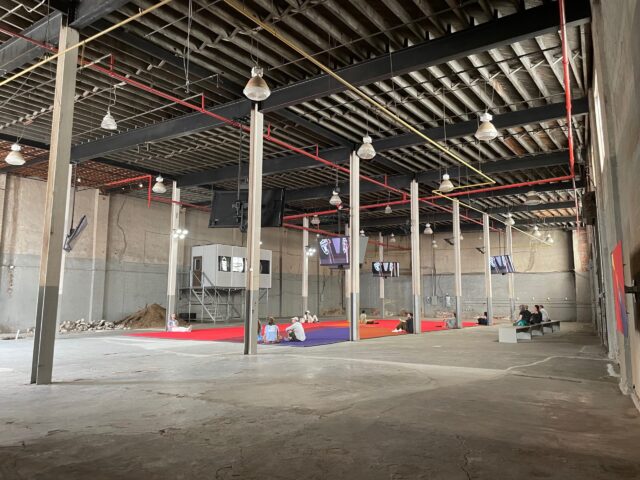
Matthew Barney turned his LIC studio into a multimedia installation (photo by twi-ny/mdr)

The game of football has always been lionized for its violence. Even as the league changes rules to try to protect the quarterback, kick returners, and receivers, the sports networks repeatedly show brutal hits like the one on Dolphins quarterback Tua Tagovailoa against the Cincinnati Bengals that resulted in severe head and neck injuries. When we think of Washington Redskins quarterback Joe Theismann, the first thing we remember is the career-ending injury he suffered on Monday Night Football in 1985 at the hands of New York Giants linebackers Lawrence Taylor and Harry Carson, brutally shattering his leg, and not his 1982–83 MVP season when he led his team to a Super Bowl victory over the Dolphins.

But Barney (River of Fundament, “Subliming Vessel”) is not merely commenting on football. Secondary is about America itself, its rituals and celebrations, its embracing of violence on and off the field. It’s about our lack of respect for the human body and one another, about a country torn apart into blue and red states like opposing teams, ready to do whatever is necessary to just win, baby.

[Mark Rifkin is a Brooklyn-born, Manhattan-based writer and editor; you can follow him on Substack here.]

ANANSI’S GOLD: YEPOKA YEEBO AT THE AFRICA CENTER

Who: Yepoka Yeebo, Stuart A. Reid
What: Anansi’s Gold: In Conversation with Yepoka Yeebo and Stuart Reid
Where: The Africa Center, 1280 Fifth Ave. between 109th & 110th Sts., and online
When: Wednesday, April 30, free with advance RSVP, 6:30
Why: “In a castle by the sea in Accra, our man was telling his story. Outside, the sky was so bright it was almost white. In the shallows next to the castle, the waves were pale gray with white caps. Farther out to sea, they turned a shimmering blue. Huge fishing canoes rocked gently, close to shore. On the horizon, container ships lined up, waiting to dock. The air smelled of salt and smoke and brine. The castle — Osu Castle — was cut off from the rest of Accra by palm trees and checkpoints. It was a maze of archways and staircases and parapets, patched together over four centuries. Some of its walls were brightly whitewashed. Others were gray concrete, slick with algae. Ancient cannons and soldiers with assault rifles lined the castle’s walls. Even without stepping into its underground dungeons, you could tell that unspeakable things had happened here. In a heavily guarded room at the heart of the castle, a haze hung in the air as our man began. The history of Ghana, he said, had a secret chapter. Kwame Nkrumah, the country’s first president, had revealed it on his deathbed in 1972.”

So begins British-Ghanaian journalist Yepoka Yeebo’s true-crime bestseller, Anansi’s Gold: The Man Who Swindled the World (Bloomsbury, April 2025, $19.99), which tells the story of con artist supreme John Ackah Blay-Miezah, who perpetrated a long, complicated financial fraud that involved a CIA-funded military junta, Ghanaian statesman Ako Adjei, former Nixon attorney general John N. Mitchell, and several of Kwame Nkrumah’s cabinet ministers, among others, stretching from Ghana to Philadelphia.

In conjunction with the release of the paperback edition of the book, which won the Jhalak Prize and the Plutarch Award for Biography, Yeebo will be at the Africa Center on April 30 at 6:30, speaking with writer and editor Stuart A. Reid, author of The Lumumba Plot: The Secret History of the CIA and a Cold War Assassin.

Admission is free with advance RSVP; the event will also be livestreamed on YouTube and Facebook.

[Mark Rifkin is a Brooklyn-born, Manhattan-based writer and editor; you can follow him on Substack here.]
TIME AND “TIME AGAIN”: TRISHA BROWN AT THE JOYCE

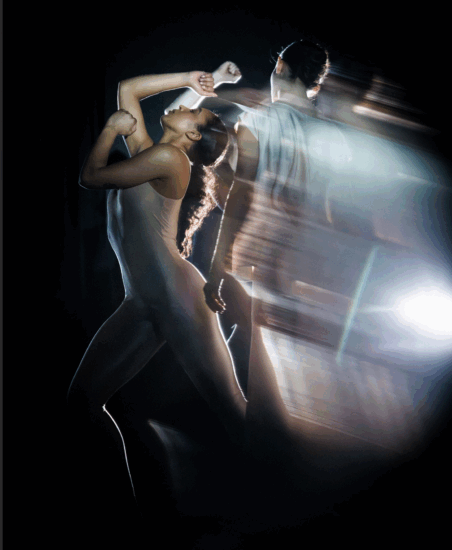
Opal Loop / Cloud Installation #722503 is part of Trisha Brown season at the Joyce (photo by Maria Baranova)

TRISHA BROWN DANCE COMPANY
The Joyce Theater
175 Eighth Ave. at Nineteenth St.
April 29 – May 4, $52-$72
www.joyce.org

For its 2025 season at the Joyce, Trisha Brown Dance Company looks back at its seminal Unstable Molecular Structure Cycle while also forging ahead into the future.

Running April 29 through May 4, the program features three dances, beginning with the world premiere of Time again, which explores the concept of change, repetition, chance, and familiarity. Choreographed by Lee Serle, who was mentored by Brown in 2010 through the Rolex Mentor and Protégé Initiative, the work features set and visual design by Mateo López, who was mentored by William Kentridge in 2012–13 in the Rolex program, lighting by Jennifer Tipton, and music by Australian sound artist Alisdair Macindoe. It will be performed by TBDC members Savannah Gaillard, Rochelle Jamila, Burr Johnson, Ashley Merker, Patrick Needham, Jennifer Payán, and Spencer James Weidie.

Following intermission, the company returns with two pieces from the Unstable Molecular Structure Cycle, which executive director Kirstin Kapustik calls “a series of works that embrace fluidity, unpredictability, and the beauty of constant change.” First up is 1980’s Opal Loop / Cloud Installation #722503, a collaboration with Japanese fog artist Fujiko Nakaya that invites the audience “to bring together images within themselves.” Merker, Needham, Payán, and Weidie perform to the sounds of water passing through high-pressure nozzles, with costumes by Judith Shea and lighting by Beverly Emmons.

The evening concludes with 1981’s Son of Gone Fishin’, which Brown called “a doozey. In it I reached the apogee of complexity in my work.” The full ensemble randomly selects sections of Robert Ashley’s score from his three-opera opus Atalanta, with costumes by Shea and lighting by Emmons evoking the original set design by Donald Judd.

To dive deeper, there will be a Curtain Chat following the April 30 performance.

[Mark Rifkin is a Brooklyn-born, Manhattan-based writer and editor; you can follow him on Substack here.]

DEMOCRACY IN ACTION: EMERGENT CITY, INNOVATION, AND THE BROOKLYN WATERFONT

Documentary traces community battle against rezoning of Industry City in Brooklyn

EMERGENT CITY (Jay Arthur Sterrenberg & Kelly Anderson, 2024)
DCTV Firehouse Cinema
87 Lafayette St.
Opens Friday, April 25
www.dctvny.org
www.emergentcitydoc.com

“Everybody wants to live, work, shop, spend money in Brooklyn,” real estate journalist Michael Stoler said in a July 2012 episode of The Stoler Report. “Why’s everybody want Brooklyn?”

Carlos Scissura of the Brooklyn Chamber of Commerce responded, “Look, there’s no other place in America that anyone should be, period.”

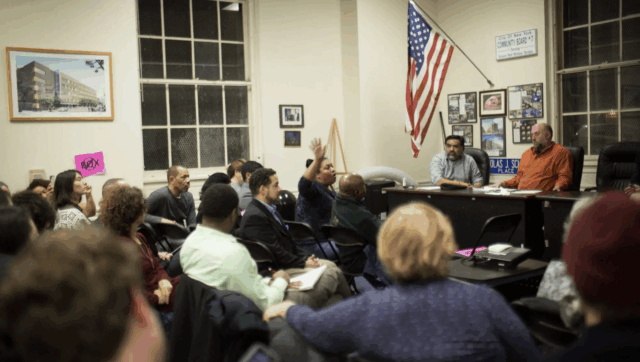
That exchange kicks off Emergent City, Jay Arthur Sterrenberg and Kelly Anderson’s documentary tracking the rezoning battle of Industry City, comprising sixteen buildings on the Brooklyn waterfront, from the time that developers started buying up property there after the devastation of Hurricane Sandy in the fall of 2012 through the end of 2022, when a decision was ultimately reached.

Sterrenberg and Anderson are flies on the wall during a seemingly endless series of meetings, town halls, protests, hearings, and other gatherings over the course of ten years, during which Industry City CEO Andrew Kimball and attorney Jesse Masyr, backed by such billion-dollar companies as Jamestown and Belvedere Capital and real estate investor Angela Gordon, defend their plan to rezone the Sunset Park industrial waterfront for commercial and retail use and luxury hotels.

The fight against the project, as it goes through the six-stage approval process — Scoping, Certification, Community Board, Borough President, Planning Commission, and City Council — is led by tenant organizer Marcela Mitaynes, later the Community Board 7 house chair; Antoinette Martinez of the Protect Our Working Waterfront Alliance; Southwest Brooklyn Industrial Development Corporation executive director Ben Margolis; UPROSE Climate Justice Center executive director Elizabeth Yeampierre; Community Board 7 land use chair John Fontillas and chair César Zuñiga; city council director of land use and planning Renae Widdison; and others.

Caught in the middle is city councilmember Carlos Menchaca, who is trying to negotiate a community benefits agreement that will make both sides happy, which appears to be an impossible task.

“How do you retain the working-class character of the community, how do you keep it a walk-to-work community and keep it industrial, but not at the expense of our lives?” Yeampierre asks, noting that “catastrophic events are heading our way.”

Trying to find perspective, Margolis says, “It’s not that this is the ideal scenario. The ideal scenario is that the waterfront is owned by the city, and everybody can choose how to make it work. That’s just not the reality.”

Kimball refers to the area as an “innovation district,” talking to several local small business owners who have decided to lease space in Industry City, seeing it as a boon for the community, while others argue that it will invariably lead to higher rents, gentrification, and displacement.

Finally, after a decade of contentious and volatile discussion, a surprising resolution settles the matter.

A vivid portrait of democracy in action, with all its flaws and inherent prominence of power, money, and politics, Emergent City opens April 25 at DCTV Firehouse Cinema, with eight postscreening Q&As through May 1 featuring Sterrenberg and Anderson and such guests as Menchaca, Widdison, Mitaynes, Martinez, cinematographer Alex Mallis, executive producer Stephen Maing, field producer Betty Yu, city councilmember Alexa Avilés, and moderators Max Rivlin-Nadler, Oscar Perry Abello, Siddhant Adlakha, Alyssa Katz, and Firehouse Cinema director of programming Dara Messinger

[Mark Rifkin is a Brooklyn-born, Manhattan-based writer and editor; you can follow him on Substack here.]
FINDING LIGHT IN THE DARKNESS: FOR THE LIVING AT THE JCC

Holocaust survivor Marcel Zielinski revisits Auschwitz with his granddaughter, Chen, in For the Living

FOR THE LIVING (Marc Bennett & Tim Roper, 2024)
Marlene Meyerson JCC Manhattan
334 Amsterdam Ave. at West Seventy-Sixth St.
Thursday, April 24, $19.95, 7:00
www.jccmanhattan.org
www.forthelivingmovie.com

“When considering the question, What makes us human?, we must also ask, What might render us less than human? And more importantly, What makes us inhumane?” narrator Tim Roper says at the beginning of For the Living, a powerful and important documentary he codirected with Marc Bennett.

Near the end of the film, Yale professor and On Tyranny author Timothy Snyder points out, “Recognizing that someone else is a human being is a really demandingly high threshold. If you can get to that, then a lot of other problems will solve themselves.”

In the documentary, which is having a special screening April 24 at the Marlene Meyerson JCC Manhattan on the Upper West Side, Roper and Bennett use the 2019 Ride for the Living as the centerpiece of their exploration of dehumanization and genocide and the need for empathy and compassion.

In 2014, software developer and long-range cyclist Robert Desmond traced the liberation path, a twenty-five-day, 1,350-mile bike ride from London to Auschwitz, stopping off at historic locations related to WWII and, more specifically, the Holocaust. The next year, Desmond, a British Jew, established the Ride for the Living, in which groups of bikers travel from Auschwitz to Krakow, following the rode that ten-year-old Marcel Zielinski and many others walked after being freed from the concentration camp in 1945. Zielinski became a regular rider at the annual event, establishing a close relationship with Desmond; despite their age gap of more than fifty years, they consider themselves brothers.

The film cuts between the preparation for the 2019 Ride for the Living, archival Holocaust footage, and brief explorations of twentieth-century genocides in Turkey, Cambodia, Bosnia, and Rwanda as well as the treatment of Indigenous peoples in what would become America and African slavery.

Zielinski returns to his childhood home and visits Auschwitz with his granddaughter, Chen, sharing terrifying details of what he experienced. Bernard Offen, who survived five camps as a child and lost fifty-nine members of his family in the Holocaust, emphasizes how important it is to tell the story, a critical theme through the film.

Rabbi Michael Paley notes, “We shouldn’t come as tourists just to see [Auschwitz]; we should come as witnesses, we should bear witness.” Nuremberg prosecutor Ben Ferencz demands, “Crimes against humanity should not be tolerated.”

Krakow Jewish Community Center CEO and ride participant Jonathan Ornstein explains, “The most important message is not being a bystander, they say. There will always be good people, and there will always be bad people, and I think the way the world goes is largely dependent on the ones in the middle.”

Roper and Bennett also speak with Zimbabwe genocide survivor and international human rights lawyer Gugulethu Moyo, United States Holocaust Memorial Museum founding project director Rabbi Michael Berenbaum, USC Shoah Foundation executive director emeritus Stephen Smith, Emory psychology professor emeritus Frans de Waal, University of Illinois at Chicago social emotional learning chair Kimberly Schonert-Reichl, and Anti-Defamation League CEO Jonathan Greenblatt.

In the latter part of the 117-minute film, the focus turns to dehumanization and antisemitism, as practiced by the Nazis and even world leaders today, referencing how Hitler was influenced by America’s belief in manifest destiny, a concept that is now being practiced by Vladimir Putin in Russia and the current US administration.

“I grew up thinking that we learned the lessons of the Holocaust, and I’ll say living here, in the heart of Europe for eighteen years, that I don’t think those lessons were learned,” Ornstein says. “With antisemitism on the rise, with Holocaust denial on the rise, I’m shocked by things that happen all around Europe; I’m shocked by things that happen in the United States.”

University of New England philosophy professor David Livingstone Smith explains, “There are great advantages to be reaped by doing bad things to others, by exterminating them,” adding that in certain “circumstances, with the psychology we have, very many of us would yield to that way of thinking.”

And astrophysicist Neil deGrasse Tyson posits, “It’s pretty clear when you look at the history of atrocities, it’s not just simply hatred; it’s like a psychological delusion that has to be put into place so that you can carry this out on a large scale.”

The film — which opens with Talking Heads’ “Road to Nowhere” and concludes with Joan Osborne’s version of Bruce Springsteen’s more hopeful “Further On Up the Road” — was made prior to the current administration, but it’s hard not to think about what is happening right now in the United States involving illegal immigrants, deportation, and antisemitism. Words such as dehumanization and empathy are again being discussed every day.

“It’s bigger than a Jewish thing; this is a human tragedy,” Desmond says.

And it’s far from over.

Roper, Bennett, and producer Lisa Effress will participate in a Q&A following the 7:00 screening at the JCC. The film is also being shown April 23 at 6:30 at Iona University in New Rochelle before traveling to festivals in Dubuque, Boulder, Flint, Detroit, and the Berkshires. The next Ride for the Living is scheduled for June 25–29; registration is now open.

[Mark Rifkin is a Brooklyn-born, Manhattan-based writer and editor; you can follow him on Substack here.]
DRIFTING THROUGH TIME: LEE KANG-SHENG AT METROGRAPH

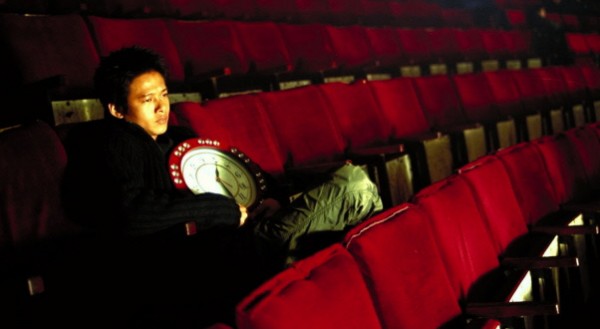
Hsiao-kang (Lee Kang-sheng) has a thing about time in Tsai Ming-liang film

Hsiao-kang (Lee Kang-sheng) has a thing about time in Tsai Ming-liang film

WHAT TIME IS IT THERE? (NI NA BIAN JI DIAN) (Tsai Ming-liang, 2001)
Metrograph
7 Ludlow St. between Canal & Hester Sts.
Monday, April 21, 4:40
Series runs April 19 – May 4
212-660-0312
metrograph.com

Malaysian-born Taiwanese filmmaker Tsai Ming-liang’s What Time Is It There? is one heck of an existential hoot. When his father (Miao Tien) dies, Hsiao-kang (Lee Kang-sheng), who sells watches on the street in Taipei, becomes obsessed with a series of things: a strange woman (Chen Shiang-chyi) who insists on buying Hsiao-kang’s own watch and then leaves for Paris; François Truffaut’s The 400 Blows (Tsai’s “all-time favorite film”); urinating in whatever is near his bed instead of going to the bathroom; and changing clocks to Paris time. Meanwhile, his mother (Lu Yi-ching) is determined to follow ridiculous rituals to bring her husband back, and the woman in Paris (Cecilia Yip) goes through a number of bizarre events as well. There is not a single camera movement in the film (except for in the 400 Blows film clips); the scenes are shot by Benoît Delhomme in long takes, often lingering before and after any action — when there is any action. The dialogue is spare, ironic, and hysterical. If you like your movies straightforward and linear, then this is not for you, but it’s easy to love this absolute riot of a film. And yes, that person sitting on the bench in the cemetery is exactly who you think it is.

One of several Tsai films in which Lee portrays a version of Hsiao-kang, What Time Is It There? is screening April 21 at 4:40 as part of “Drifting Through Time: Focus on Lee Kang-sheng,” Metrograph’s tribute to Lee’s thirty-five-year career as an actor, screenwriter, and director, in conjunction with the US release of Constance Tsang’s Blue Sun Palace, in which Lee portrays an immigrant working in Flushing; the series also features such films as Tsai’s The Wayward Cloud, Vive l’amour, The Hole, and I Don’t Want to Sleep Alone and Lee’s Help Me Eros. Lee will be at Metrograph April 25–27 to introduce The Hole and for Q&As following screenings of Blue Sun Palace with Tsang and costar Ke-Xi Wu, Help Me Eros, and the triple pack of Tsai’s Boys (Xiaohai), My Stinking Kid, and Single Belief.

[Mark Rifkin is a Brooklyn-born, Manhattan-based writer and editor; you can follow him on Substack here.]
HOME IS WHERE THE ART IS: THE FRICK IS BACK — AND BETTER THAN EVER

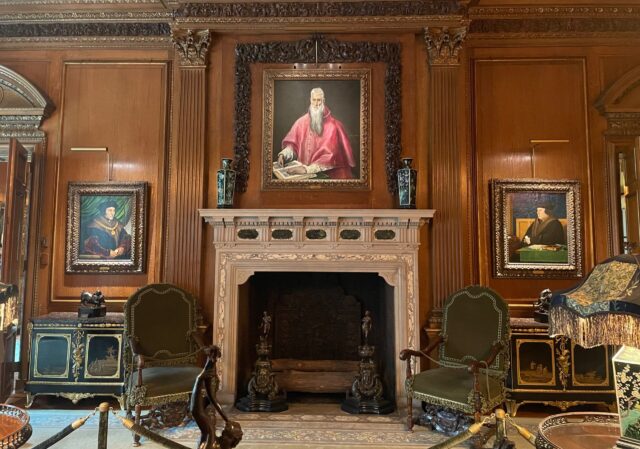
El Greco’s St. Jerome is once again flanked by Hans Holbein the Younger’s Sir Thomas More and Thomas Cromwell (photo by twi-ny/mdr)

THE FRICK COLLECTION
1 East 70th St. at Fifth Ave.
Wednesday – Sunday, $17-$30 (pay-what-you-wish Wednesdays 2:00–6:00)
www.frick.org

The Frick is my happy place.

Judging by the smiles on the faces of the hundreds of other Fricksters I encountered at a recent members preview of the reopened Fifth Ave. institution, I am far from the only one.

In 1913, American industrialist and art collector Henry Clay Frick commissioned the architecture firm of Carrère and Hastings to design the building as both a private home and a public resource. Frick died in 1919 at the age of sixty-nine; his daughter, Helen Clay Frick, served as a founding trustee of the collection and, in 1920, established the Frick Art Reference Library. In 1931, the building was adapted into a museum by architect John Russell Pope. The Frick Collection opened on December 11, 1935, for distinguished guests; three days later, ARTnews editor Alfred M. Frankfurter wrote that it is “one of the most important events in the history of American collecting and appreciation of art.”

The Frick closed in March 2020 for a major renovation, temporarily moving its remarkable holdings to the nearby Breuer Building on Seventy-Fifth and Madison, the former home of the Whitney. On April 17, the Frick will reopen to the public, with ten percent more square footage, going from 178,000 square feet to 196,000, including 60,000 square feet of repurposed space and 27,000 square feet of new construction, increasing the gallery space by thirty percent, highlighted by the unveiling of the second floor, which has been converted from administrative offices to fifteen rooms of masterpieces. The renovation and revitalization also features a new Reception Hall, Education Room, and 218-seat auditorium.

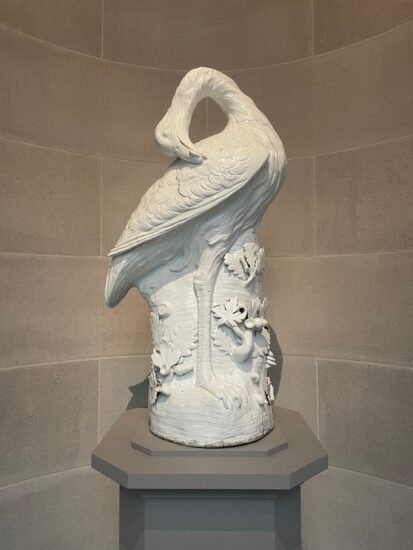
The 1732 Great Bustard resides on a pedestal near the Garden Court fountain (photo by twi-ny/mdr)

The main floor will be familiar to anyone who has ever visited the Frick; amid some minor changes, the twenty rooms have remained mostly intact. The Gainsboroughs are in the Dining Room, Boucher’s The Four Seasons are in the West Vestibule, four Whistler portraits stand tall in the Oval Room, Fragonard’s The Progress of Love series populates the Fragonard Room, and Goya’s Portrait of a Lady (María Martínez de Puga?) brings mystery to the East Gallery.

El Greco’s Purification of the Temple can be found in the Anteroom, Tiepolo’s Perseus and Andromeda in the East Vestibule, and Vecchietta’s The Resurrection in the Octagon Room. John C. Johansen’s portrait of Henry Clay Frick enjoys primo placement in the Library, where he is joined by Gilbert Stuart’s 1795 portrait of George Washington and numerous canvases by such British artists as Reynolds, Gainsborough, Romney, Turner, and Constable, whose Salisbury Cathedral from the Bishop’s Grounds has delighted me over and over again.

The Garden Court, with its peaceful fountain surrounded by columns, plantings, and Barbet’s Angel, is one of the loveliest indoor respites in the city.

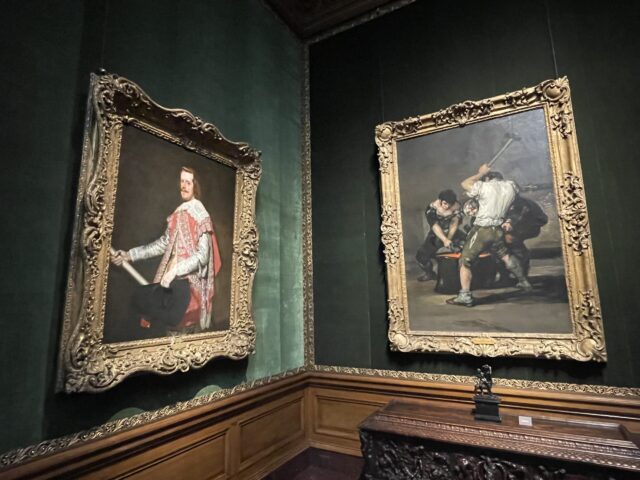
Velázquez’s King Philip IV of Spain and Goya’s The Forge hang catty corner in the West Gallery (photo by twi-ny/mdr)

The glorious West Gallery houses many of the greatest hits, from Rembrandt’s stunning 1658 Self-Portrait and Velázquez’s regal King Philip IV of Spain to Goya’s gritty The Forge and Veronese’s enigmatic parable The Choice Between Virtue and Vice, along with a pair of gorgeous Turner port scenes, Corot’s captivating landscape The Lake, Vermeer’s Mistress and Maid, portraits by El Greco, Hals, Goya, and Van Dyke, and more than a dozen small mythological sculptures.

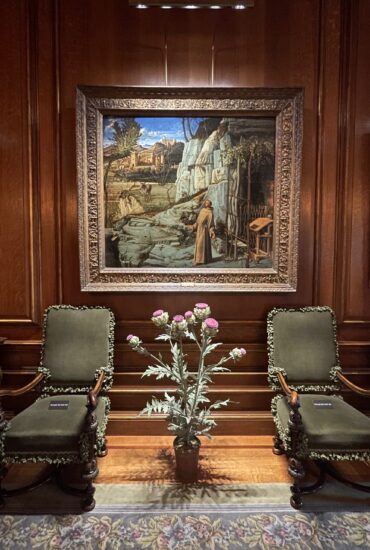
Bellini’s St. Francis in the Desert no longer has its own room but is coping (photo by twi-ny/mdr)

The centerpiece of the Frick has always been the Living Hall, with magisterial furniture, chandeliers, large vases, and a five-hundred-year-old Persian carpet. On one wall, Titian’s Pietro Aretino and Portrait of a Man in a Red Hat flank Bellini’s St. Francis in the Desert, which in the Frick Madison had its own room. Opposite that trio is the pièce de résistance: El Greco’s elongated St. Jerome stares out above the fireplace; to his left and right, respectively, are Hans Holbein the Younger’s stunning portraits of archenemies Thomas Cromwell and Sir Thomas More, the latter, in my opinion, the most spectacular portrait in the history of Western art. Its name, the Living Hall, could not be more appropriate, as it feels lived in.

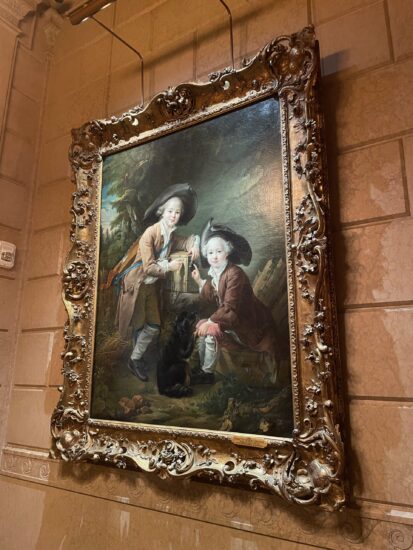
Drouais’s The Comte and Chevalier de Choiseul as Savoyards is near the base of the stairs (photo by twi-ny/mdr)

The South Hall offers two Vermeers, Girl Interrupted at Her Music and Officer and Laughing Girl, facing a Frick fan favorite, Bronzino’s Lodovico Capponi, with its cleverly placed sword. After years of appearing behind the ropes that bar visitors from going upstairs, Drouais’s The Comte and Chevalier de Choiseul as Savoyards, depicting two young boys smiling like the cat who ate the canary, can now be approached before you make your pilgrimage to newly sanctified land.

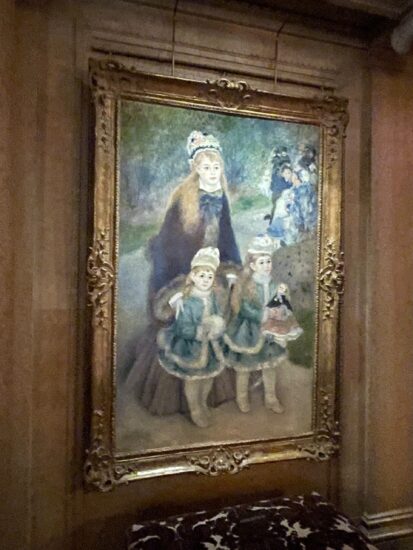
And then, there it is: the Grand Stairway leading to the previously off-limits second floor. The looks as people make their way to the steps are fascinating, a mix of bated breath, yearning, excited anticipation, and even stealth, as if some museumgoers still can’t believe it is allowed. At the landing is a decorative screen and an Aeolian-Skinner organ that was once played by Archer Gibson for Henry and at dinner parties. At the top is Pierre-Auguste Renoir’s La Promenade, a lush oil of a woman and two young twin sisters that used to reside near the base of the stairs and now serves as a fine introduction to the myriad treasures upstairs.

Pierre-Auguste Renoir’s La Promenade greets visitors at the top of the Grand Stairway (photo by twi-ny/mdr)

The second floor is a mazelike procession of tighter spaces where the Fricks lived, again adorned with dazzling classics and lesser-known works that were not regularly on view in the past. Corot’s Ville-d’Avray and The Pond are in the Breakfast Room, with sets of jars and wine coolers and Théodore Rousseau’s The Village of Becquigny. Manet’s The Bullfight can now be found in the Impressionist Room, joined by Degas’s The Rehearsal and Monet’s Vétheuil in Winter, which had numerous people gasping. “I don’t remember ever seeing this before,” one woman said, and others nodded. Don’t miss Watteau’s The Portal of Valenciennes in the Small Hallway.

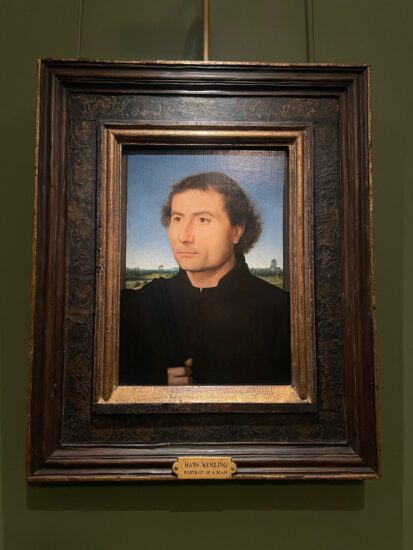
Hans Memling’s Portrait of a Man is now upstairs in the Sitting Room at the Frick (photo by twi-ny/mdr)

The Gold-Grounds Room gathers such religious works as Fra Filippo Lippi’s The Annunciation, Piero della Francesca’s The Crucifixion, and Paolo Veneziano’s The Coronation of the Virgin. Although there is a user-friendly app that tells you where everything is, I preferred searching on my own and was thrilled when I finally located Hans Memling’s Portrait of a Man in the Sitting Room, a depiction of an invitingly calm, laid-back man. Ingres’s Louise, Princesse de Broglie, Later the Comtesse d’Haussonville, another Frick fave, now holds court in the Walnut Room, near Houdon’s marble Madame His.

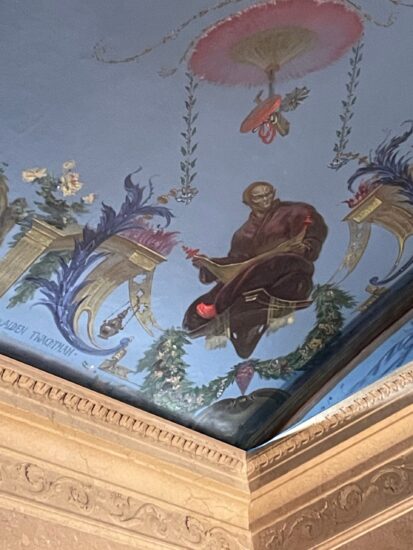
Among the other second-floor galleries are the Clocks and Watches Room, the Du Paquier Passage, the Boucher Room and Anteroom, the Ceramics Room, the Medals Room, and the Lajoue Passage, each with their own charm. And be sure to check out the hallway ceilings, covered in a beautiful mural with fabulous detail in the corners and ends.

The corners of the second-floor ceiling murals hold tiny gems (photo by twi-ny/mdr)

As recently retired former Frick director Ian Waldropper notes in the Frick’s Essential Guide, “The reopening of the renovated Frick Collection is cause for celebration.” It’s an inspiring place to visit old friends and make new ones, to see masterpieces in literal and figurative new light. One way the Frick has not changed is that the institution still does not allow any photos or videos, except at the early members and press previews. At first, I wasn’t going to take any pictures, but then I heard a few guards say, “Get out your cameras now, because you won’t be allowed to starting April 17.”

My happy place is back, and just in time.

There are two current special exhibitions; “Highlights of Drawings from the Frick Collection,” continuing in the Cabinet through August 11, consists of a dozen rarely displayed works, from Pisanello’s haunting pen and brown ink Studies of Men Hanging and Whistler’s surprising black chalk and pastel Venetian Canal to Goya’s brush and brown wash The Anglers and the coup de grâce, Ingres’s graphite and black chalk study for Louise, Princesse de Broglie . . .

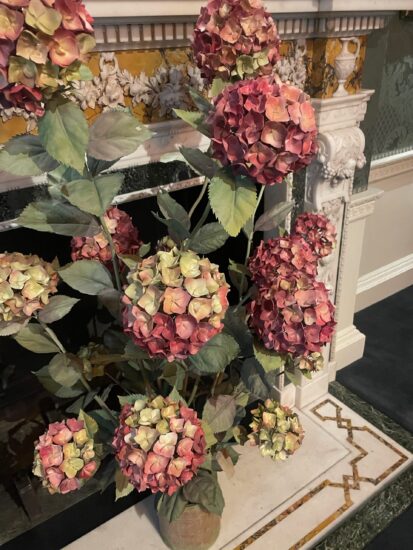
Vladimir Kanevsky’s porcelain hydrangeas can be found in the Breakfast Room (photo by twi-ny/mdr)

Meanwhile, for “Porcelain Garden,” US-based Ukrainian artist Vladimir Kanevsky has installed porcelain flowers in nineteen locations throughout the Frick, on the floor and on tables, in vases and pots, creating a dialogue between the fragile plants and the museum’s many treasures; you’ll find lilacs in the Dining Room, foxgloves in the West Vestibule, cascading roses and white hyacinths in the Fragonard Room, dahlia branches and anemones in the Portico Gallery, and a lemon tree in the Garden Court, among others.

And from June 18 to August 31, “Vermeer’s Love Letters” unites the Frick’s Mistress and Maid with the Rijksmuseum’s Love Letter and the National Gallery of Ireland’s Woman Writing a Letter, with Her Maid.

Below are only some of the scheduled programs, with more to come.

Friday, April 18
Gallery Talk: A Home for Art, Library Gallery, free with museum admission, 6:00 & 7:00

Gallery Talk: Closer Look at Vermeer’s Mistress and Maid, West Gallery, free with museum admission, 6:00 & 7:00

Friday, April 25
Gallery Talk: A Home for Art, Library Gallery, free with museum admission, 6:00 & 7:00

Saturday, April 26
Spring Music Festival: Jupiter Ensemble, Lea Desandre, Anthony Roth Costanzo, Stephen A. Schwarzman Auditorium, 7:00

Thursday, May 1
Spring Music Festival: Takács Quartet and Jeremy Denk, Piano, Stephen A. Schwarzman Auditorium, 7:00

Saturday, May 3
Spring Music Festival: Sarah Rothenberg, Solo Piano, Stephen A. Schwarzman Auditorium, 7:00

Sunday, May 4
Spring Music Festival: Alexi Kenney, Violin and Amy Yang, Fortepiano, Stephen A. Schwarzman Auditorium, 7:00

Thursday, May 8
Sketch Night, free with advance RSVP, 5:00
Spring Music Festival: Emi Ferguson, Flute and Ruckus, Baroque Ensemble, Stephen A. Schwarzman Auditorium, 7:00

Friday, May 9
Stephen K. and Janie Woo Scher Fellow Lecture: The Milicz Medals of Johann Friedrich of Saxony and the Subtleties of Political Art in the Age of Reformation, with Maximilian Kummer, Ian Wardropper Education Room, free with advance RSVP, 6:00

Sunday, May 11
Spring Music Festival: Mishka Rushdie Momen, Solo Piano, Stephen A. Schwarzman Auditorium, 5:00

[Mark Rifkin is a Brooklyn-born, Manhattan-based writer and editor; you can follow him on Substack here.]