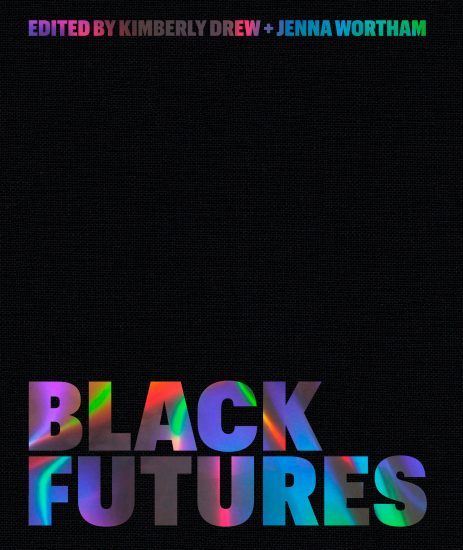
Who: Kimberly Drew, Jenna Wortham, Raquel Willis, Naima Green What: Livestream Unbound discussion Where:BAM / Greenlight Bookstore When: Monday, December 7, $15 ($45-$50 with book), 7:00 Why: BAM’s ongoing literary program, “Unbound,” copresented with Greenlight Bookstore, goes virtual with the launch of Black Futures (Penguin Random House, $40). Edited by Kimberly Drew and Jenna Wortham, the book features contributions from Alicia Garza, Alexandra Bell, Hank Willis Thomas, LaToya Ruby Frazier, Zadie Smith, Dawoud Bey, Jackie Sibblies Drury, Kara Walker, Ta-Nehisi Coates, Amy Sherald with Kehinde Wiley, and dozens of other creators, divided into such chapters as “Power,” “Joy,” “Justice,” “Ownership,” and “Legacy.” In their introduction, Drew and Wortham explain, “‘The Black Futures Project’ started a few years ago as a Direct Message exchange on Twitter and has evolved into a shared desire to archive a moment. In developing Black Futures, we sought to answer the question: What does it mean to be Black and alive right now?” The book explores that idea through photography, essays, recipes, screenshots, poetry, memes, social media posts, paintings, song lyrics, and other prismatic text and imagery. You can hear an excerpt from the book here.
On December 7 at 7:00, writer, curator, influencer, and activist Drew and culture writer and Still Processing podcast host Wortham will be joined by transgender artist and activist Raquel Willis (whose “Welcome to the Trans Visibility Era” is included in Black Futures) and artist Naima Green (who contributed “Documenting the Nameplate” with Azikiwe Mohammed) to talk about the book, which is nonlinear and is meant to “provoke you, entice you, enrage you, spark joy, and call you to action.” Tickets are $15, or $45-$50 with a copy of the book, depending on whether you can pick it up in person or need it shipped; a portion of the ticket revenue will be split between BAM and the Campaign Against Hunger, a Brooklyn-based emergency food and community support organization that advances equity for the underserved, helping “build self-determination, engaging in grassroots activism, and investing in civic life,” which is needed now more than ever during the Covid-19 crisis.
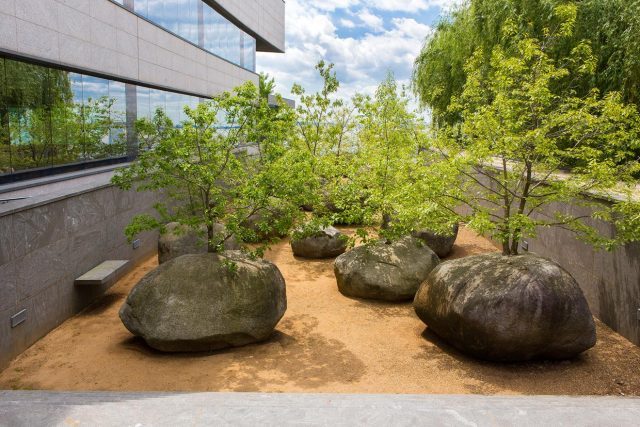
Andy Goldsworthy will discuss Garden of Stones, his permanent installation at the Museum of Jewish Heritage, in Zoom talk (photo courtesy the Museum of Jewish Heritage)
Who: Andy Goldsworthy, Jack Kliger What: Live Q&A Where:Museum of Jewish Heritage Zoom When: Sunday, December 6, free with RSVP, 11:00 am Why: In the summer of 2003, British sculptor, land artist, and photographer Andy Goldsworthy installed Garden of Stones outdoors in the 4,150-square-foot garden at the Museum of Jewish Heritage — A Living Memorial to the Holocaust, a collection of eighteen massive rocks that had small holes hollowed out in them in order to place dwarf oak saplings inside, planted by Holocaust survivors and members of their families at a special ceremony. The number eighteen is represented in Hebrew by the letters chet (ח) and yod (י), which form the word chai, which means “life.” The work offers a twist on the traditional Jewish cemetery, where people leave pebbles on headstones when visiting graves that are surrounded by growing grass, a kind of life out of death.
Goldsworthy, who interacts with the natural world like no other artist, has been profiled in such documentaries as Leaning into the Wind and Rivers and Tides, which reveal his deep connection to the earth and his often time-consuming process. On December 6 at 11:00 am, in “Creating Garden of Stones,” he will discuss his methods specifically relating to the project in a live Zoom talk and Q&A with Museum of Jewish Heritage president and CEO Jack Kliger. The ever-changing permanent installation takes on new meaning while the country struggles through a horrific health crisis that has led to more than 280,000 American deaths, with many funerals happening virtually instead of in person and cemetery visits few and far between. Admission is free with RSVP.
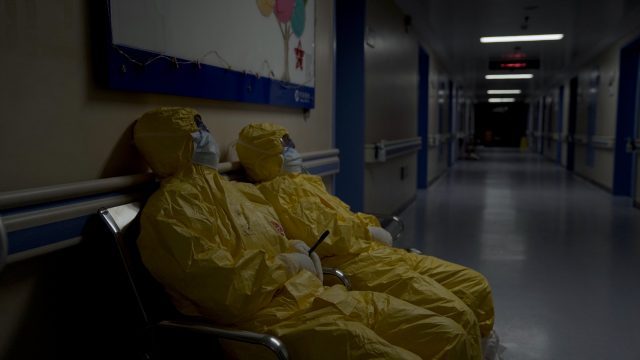
Two essential healthcare workers take a much-deserved brief break in a Wuhan hospital in 76 Days
76 DAYS (Hao Wu, Weixi Chen, and Anonymous, 2020)
Opens virtually at Film Forum at Home on Friday, December 4 Live Q&A Tuesday, December 8, 7:00 filmforumhome.org www.76daysfilm.com
The prospect of sitting through a ninety-minute documentary about essential healthcare workers in four hospitals in Wuhan fighting in the early days of Covid-19, during the city’s seventy-six-day lockdown, might seem daunting. But what could have been a difficult, emotional, and political roller coaster about fear and anger, government lies and finger pointing turns out to be a deeply affecting film that celebrates our most basic hopes and humanity.
Chinese director Hao Wu was researching a film about pandemics when, in mid-February, he came upon footage being shot by a pair of reporters in Wuhan, Weixi Chen and a man who has decided to remain anonymous. They had been given full access to four hospitals, where they followed doctors, nurses, patients, and family members for several months. There are no talking heads, and no one speaks directly to the camera; instead, 76 Days offers a fly-on-the-wall perspective that manages to be as uplifting as it is frightening.
The film opens like a sci-fi thriller, as an unidentified group of people in head-to-toe protective gear that includes light-blue masks, long face shields, white Hazmat suits, and blue footies comforts a distraught colleague who is prevented from saying goodbye to her father, who has just died from the novel coronavirus. Near the end of the scene, one of her coworkers tries to calm her down, saying, “We don’t want to see you in distress or pain. What will we do if you fall sick? We all have to work in the afternoon.” Moments later, sick people are banging on a door of the hospital to be let in, like a crowd trying to escape a coming zombie apocalypse, while two workers decide who to admit first. Those exchanges set the stage for the rest of the film, in which doctors and nurses go about their business with a relatively relaxed demeanor, displaying endless empathy and compassion as they care for scared patients with uncertain futures.
Wu focuses on a few specific cases that serve to represent the crisis as a whole, following an elderly couple who both have the virus and are not permitted to see each other even though they are on the same floor, and a young couple who are forced to quarantine in their apartment after the woman gives birth to a baby girl, unable to see their newborn for two weeks. While the nurses fall in love with the infant, who must stay in an incubator and whom they name Little Penguin, the workers have their hands full with the old man, who constantly tries to leave the hospital and doesn’t seem capable of wearing his mask correctly, if at all.
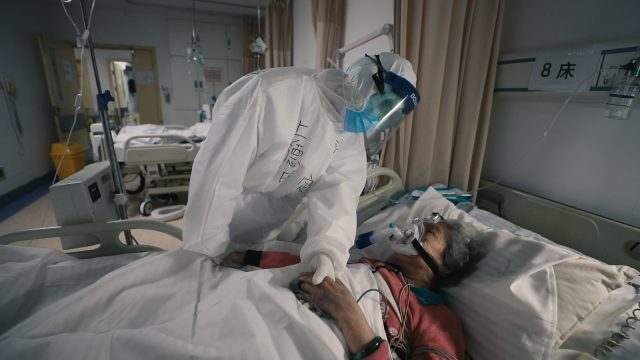
Doctors and nurses in Wuhan care for Covid patients, displaying empathy and compassion during seventy-six-day lockdown
The genuine kindness and concern displayed by the hospital employees is, well, infectious. They are risking their lives at every moment; each encounter is fraught with the possibility that they could contract the virus even with all the PPE. It’s hard not to cringe when they feed the old man, wipe the face of the infant, or use a patient’s phone to call a relative with news, because the reality is that people die from this disease, and Wu is not afraid to show that. It’s a riveting film that immerses you in this global emergency that started right there, at that time; if this doesn’t make you wear a mask, wash your hands, observe social distance protocols, and avoid gathering with others indoors, I don’t know what will.
We also see the empty streets and highways of Wuhan, a city of eleven million people, deserted, with signs advising, “Staying home makes a happy family.” All the action is happening in the hospitals, where the doctors and nurses bond with themselves and the patients, decorate their white Hazmat suits with drawings and sayings (“Clay Pot Chicken: I miss you”), and caution everyone to “be extra vigilant.” As the crisis continues to surge around the world and here in America, where politics trumps safety, those are indeed words to live by. Winner of the Best Cinematography award at DOC NYC 2020 and nominated for a Best Documentary Gotham Award, 76 Days launches virtually at Film Forum on December 4; Wu will share more about the documentary and his process in a free, live Q&A on December 8 at 7:00.
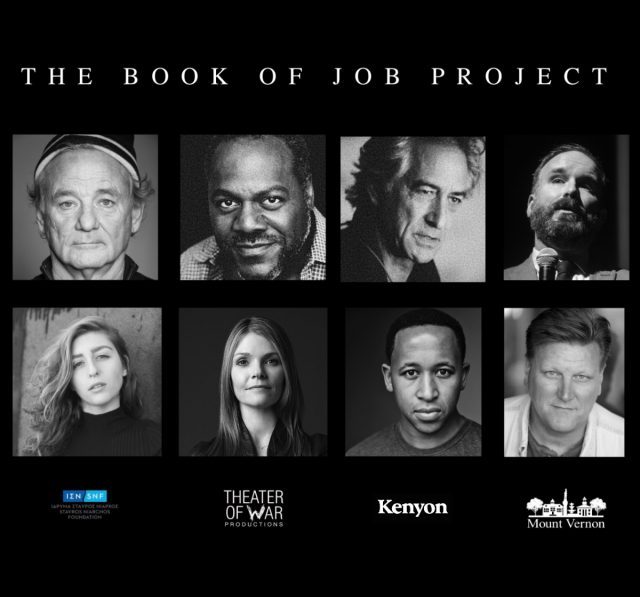
Who: Bill Murray, Frankie Faison, David Strathairn, Marjolaine Goldsmith, Kathryn Erbe, Nyasha Hatendi, Bryan Doerries, Matthew T. Starr, more What: Dramatic reading and interactive community discussion Where:Theater of War Zoom When: Sunday, December 6, free with RSVP, 4:00 Why: “So Satan went forth from the presence of the Lord, and smote Job with sore boils from the sole of his foot even unto his crown.” That was only one of many indignities the patient, blessed Job is forced to endure in the Bible as questions of faith and righteousness are brought to bear. How would Job react to 2020? Theater of War has been extremely busy during the pandemic lockdown, presenting dramatic readings of King Lear, Antigone, Oedipus the King, and other classic works, relating them to public health and social justice issues happening around the country today in light of the George Floyd protests and the Covid-19 crisis. On December 6, Bill Murray, Frankie Faison, David Strathairn, Marjolaine Goldsmith, Kathryn Erbe, and Nyasha Hatendi will read from the Book of Job, translated by Stephen Mitchell and directed and adapted by artistic director Bryan Doerries, who will also facilitate a conversation with Mayor Matthew T. Starr of Mount Vernon, Ohio, and other local community leaders in Knox County; Theater of War is in the midst of a yearlong virtual residency at Kenyon College, which is located in Gambier, Ohio. Knox County is named after Henry Knox, an officer in the American Revolution who later served as secretary of war.
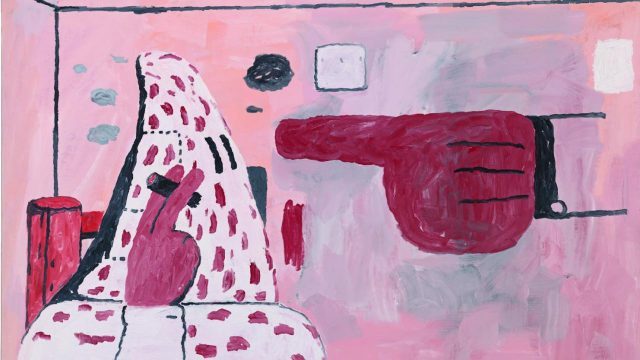
Philip Guston, Scared Stiff, oil on canvas, 1970 (courtesy of the Estate of Philip Guston and Hauser & Wirth)
There’s been much heated discussion in art circles about the postponement of a major Philip Guston exhibition for ideological reasons. Initially scheduled to open at the National Gallery this past June, it was delayed because of the pandemic to February 2021 at the Tate Modern in London. But then the retrospective, which was also set to travel to the Museum of Fine Arts Boston and the Museum of Fine Arts Houston, was put on the shelf until 2024 over concerns that some of Guston’s fabled imagery involving cartoonish Ku Klux Klan characters in white hoods would be misunderstood in the wake of the Black Lives Matter movement and other current sociopolitical issues. In a statement, the National Gallery explained, “We are postponing the exhibition until a time at which we think that the powerful message of social and racial justice that is at the center of Philip Guston’s work can be more clearly interpreted.
“We recognize that the world we live in is very different from the one in which we first began to collaborate on this project five years ago. The racial justice movement that started in the U.S. and radiated to countries around the world, in addition to challenges of a global health crisis, have led us to pause.
“Collectively and individually, we remain committed to Philip Guston and his work. We plan to rebuild the retrospective with time to reconsider the many important issues the work raises.”
Impassioned debate ensued among art-world cognoscenti, including cries of censorship and extreme political correctness. The four institutions ultimately decided to move the exhibit to 2022 with extensive signage placing some of Guston’s images in contemporary context, which of course makes sense for almost any retrospective, especially one called ‘Philip Guston Now.’ But the controversy got me thinking about how we see art in 2020 and beyond, since these questions would not have been front and center for the Guston show prior to the events of this year.
So I visited several New York City museums to investigate whether it is still possible to look at art through a 2019 lens. For good or bad, it’s not. Will it ever be? Should it ever? Let’s go.
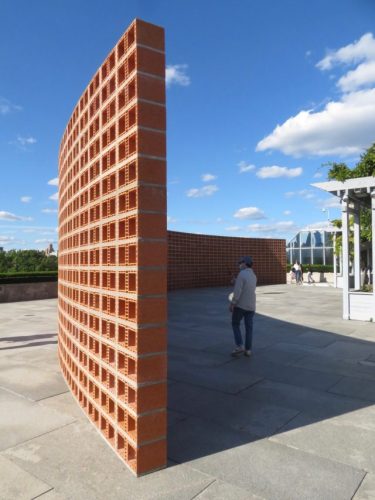
Héctor Zamora’s Lattice Detour is an artistic intervention on the Met roof (photo by twi-ny/mdr)
The Metropolitan Museum of Art’s blockbuster exhibition “Making the Met, 1870–2020,” which was planned and partially installed prior to the pandemic lockdown, opens with an advisory note:
“In June, in the wake of the violent deaths of George Floyd and other Black Americans at the hands of the police and the ensuing Black Lives Matter protests, the Met joined the nationwide call for justice. As a first step, the museum released a series of antiracism commitments, covering all of its activities, from programming to further diversifying our staff, with the goal of fostering an environment of equity, inclusivity, and dialogue.
“These events have intensified our reflections about the museum’s role in society, some of which resulted in updated and expanded texts for the show. Looking forward, we believe this moment will inspire institutional change and create new forms of engagement in the latest chapter of our history, which begins now, in 2020.”
Héctor Zamora’s Roof Garden Commission at the Met, Lattice Detour, was also well under way prior to the pandemic, but new perspectives now emanate from it as a result of what New York City has undergone since mid-March, when arts institutions, restaurants, office buildings, and other indoor venues were shut down — many of which are still closed or operating at limited capacity, as the Met is. Lattice Detour is a curved wall, echoing Richard Serra’s Tilted Arc, running across much of the Met roof. The structure is composed of hollow terracotta bricks that were inspired by the celosia of Zamora’s childhood in Mexico City, building elements with geometric patterns that allow in light and ventilation. Thus, you can stand on either side of the wall and see through it; as interventionist sculpture — it is more than a hundred feet in length and eleven feet high — it blocks the usual view of Central Park and the south and west skylines, but you can still see through the bricks and take in the sun.
The only way to get to the roof is via one specific elevator, which often has a long line. For those visitors who are avoiding elevators, you’re out of luck, but there’s a maximum of two people for every trip, and I was fortunate enough to be able to go up by myself. Inside the Met, everyone is wearing masks and trying to maintain social distancing as they go room to room, some of which can get significantly more crowded than others. So the Roof Garden usually is, quite literally, a breath of fresh air, even with masks still on. But in this case, instead of being welcomed by a lovely vista of blue and green, you are instantly constricted by a large reddish-brown object blocking access to part of the space, evoking how much of New York is closed off to us.
“I find that the architecture of New York is largely designed to block the view, not to let you see in,” Zamora says in the exhibition brochure. “I think a lot about the social and legal rules that make public space inhabitable for everyone, and about their inflexibility, since those rules create an area that is totally alienated and uninhabitable for people, one where the sense of freedom is increasingly constrained. At a time when the limits imposed by political, economic, ideological, and institutional systems are restricting the freedom and rights of cultures, I propose a reflection based on what it means to build a permeable curved wall in a such a significant space for culture and history. Could it be that it is too late to try to reverse what we have decided or to unlock all those barriers that are petrifying us in the face of the need to make decisions?”
But perhaps more important than all that is how instantly pleasing Lattice Detour is, how it invites us into its space, draws us into its spell. Most visitors snap away with their cameraphones without thinking about the overtly political commentary involving Mexico, the United States, and legal and illegal immigration; does it matter, as long as the work itself engages us?
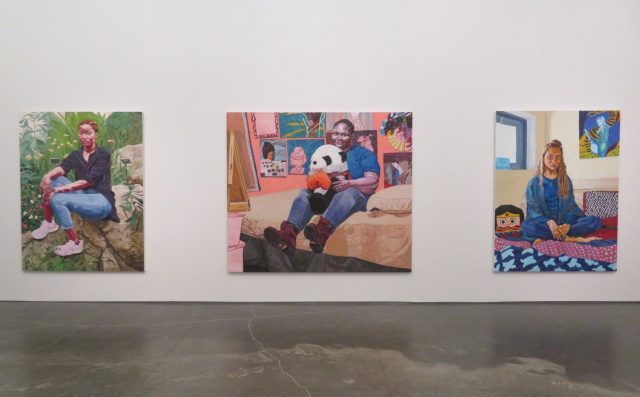
Jordan Casteel’s “Within Reach” at the New Museum features dozens of portraits of BIPOC men, women, and children (photo by twi-ny/mdr)
JORDAN CASTEEL: WITHIN REACH PETER SAUL: CRIME AND PUNISHMENT
New Museum
235 Bowery at Prince St.
Tuesday – Sunday through January 3, $12-$18 www.newmuseum.org
At the New Museum, thirty-one-year-old Denver native Jordan Casteel’s first solo museum retrospective, “Within Reach,” consists primarily of more than three dozen glorious large-scale portraits of BIPOC men, women, and children. Her subjects are friends, family, and people she knows from the neighborhood or encounters on the street; each portrait is made from a photograph that Casteel re-creates as faithfully as possible. “I’m not imagining or adding language, props, or a symbology that wasn’t already there,” she notes in an online conversation with Hanya Yanagihara, which you can watch here.
Many of the works, which are named after the subjects — most of whom look back directly at the viewer, taking possession of the gaze — date from the 2013–14 series “Visible Man” and 2017’s “Nights in Harlem” in addition to more recent paintings of her students at Rutgers University-Newark. Cansuela sits on her bed, holding a stuffed panda. Jenna is poised on some rocks in a garden. Lourdes and Karina hold each other while sharing a chair. In individual portraits, Jiréh, Devan (emulating Egon Schiele), Elijah, Jerome, and Jonathan are all nude, sitting on couches, chairs, or beds.
In the interview, she continues, “The images for me become the catalyst that I don’t want to ignore, that there is a clear guideline for who this person is and what is important to them that I need to honor. But with that, I am also acknowledging my relationship to them. . . . I just don’t allow myself a whole lot of room to imagine who they are; I try to see them for who they are as they presented themselves to me and reflect back my experience of them.”
Painted with great skill by Casteel detailing every muscle, every facial gesture, every background furthering her anthropological style, the works recall August Sander’s People of the 20th Century, in which the German photographer sought to document as much of humankind as he possibly could. But in the twenty-first century, and particularly in post–George Floyd America, is it possible to see portraits of Black bodies without thinking of the many Black victims of police brutality? It clearly is not Casteel’s intent; she is celebrating each person’s uniqueness, who they are at this very moment, not who or what they may be later. It might be my own white fragility or oversensitivity, but Miles and Jojo, their skin tinted an alluring blue, do not look happy, staring out at us with accusation. One of the only canvases without a human figure is Memorial, in which a ribboned flower wreath is balanced over a garbage can on a street corner. I can’t help but connect Memorial with Miles and Jojo and the portraits throughout the rest of the exhibit, or with photographs I see in the news of murdered Black and brown men, women, and children, one after the other.
It’s also hard not to prescribe some kind of current sociopolitical bent to the works when seen in contrast to the New Museum’s other major current show, “Peter Saul: Crime and Punishment.” There is no subtlety in the eighty-six-year-old California-born, New York–based Saul’s approximately five dozen works, large-scale cartoonish paintings going back to 1963 that feature wild depictions of Mickey Mouse, Superman, George W. Bush, Ronald Reagan, Angela Davis, Joseph Stalin, Mao Zedong, Newt Gingrich, Kim Jong-un, John Wayne Gacy, and Donald Trump, among others, as Saul shares his ferocious opinions on wealth, power, class, race, religion, and ethnocentrism. Many of the titles hold nothing back as well: GI Christ, Saigon, Yankee Garbage, Human Dignity, Stupid Argument, Washington Crossing the Delaware, and President Trump Becomes a Wonder Woman, Unifies the Country, and Fights Rocket Man. Even the name of the show, “Crime and Punishment,” evokes the relationship of police, the law, and citizens; I thought of how often white officers are not arrested, tried, and/or convicted for the killing of Black and brown people, considering whether they feel even the slightest bit of the guilt that overwhelms Raskolnikov.
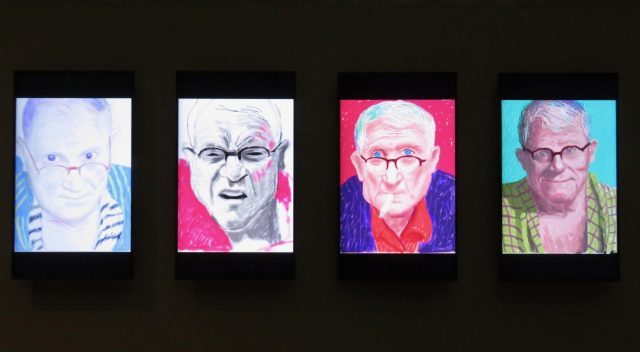
David Hockney’s “Drawing from Life” at the Morgan Library includes digital portraits (photo by twi-ny/mdr)
DAVID HOCKNEY: DRAWING FROM LIFE BETYE SAAR: CALL AND RESPONSE
Morgan Library & Museum
225 Madison Ave. at 36th St.
Wednesday – Sunday through January 31 (Saar) and May 30 (Hockney), $13-$22 www.themorgan.org
Echoing the words of Jordan Casteel, eighty-three-year-old British artist David Hockney says about his latest exhibition, “Drawing from Life,” at the Morgan Library: “I always think the world is full of variety, and it should be reflected in my art ’cause I see it that way. When I get to know people, you see more in the face. Everything, even the smallest sketch, involves the human heart.” The two-gallery show comprises some 125 self-portraits and portraits on paper of a handful of friends, family, and colleagues from the 1950s to today, comprising multiple depictions over the years of fashion designer Celia Birtwell; Hockney’s mother, Laura; curator Gregory Evans; master printer Maurice Payne; and the artist himself. The works reveal Hockney’s development as an exquisite draughtsman and colorist, even as he moves from paper to Polaroid collages and the iPhone and iPad.
It’s exciting to follow the same figures thorugh the decades, to see them as Hockney sees them across eras of change. Yet I couldn’t help but imagine whether Casteel would be able to do the same thing, if she were ever so inclined, to revisit James, Charles, Stanley, Harold, or Q in ten or twenty or fifty years, since their life expectancy differs greatly from that of white British elites. Just check the actuarial tables. And the daily paper.
Meanwhile, upstairs at the Morgan, ninety-four-year-old LA-based Betye Saar’s “Call and Response” gets right to the point, a series of powerful assemblages and installations that confront race in America by overturning and reclaiming traditional imagery. Accompanied by the first public display of her sketchbooks, the show features such seminal works as Serving Time, a metal bird cage with locks, keys, and human figures; Supreme Quality, in which Aunt Jemima is holding a pair of pistols; A Loss of Innocence, a white dress covered in racial epithets, hanging over a small chair, a shadow on the wall adding a ghostly quality; and Still Ticking, consisting of more than a dozen stopped or broken clocks. Time might have run out on many, but Saar keeps on fighting the status quo with her artistic genius and innate ability to tell stories using found objects.
VIDA AMERICANA: MEXICAN MURALISTS REMAKE AMERICAN ART, 1925–1945
Whitney Museum of American Art
99 Gansevoort St.
Thursday – Monday through January 31, $18-$25 whitney.org
One of the key campaign promises Donald Trump made when running for president in 2015–16 was to build a wall across the southern border of the United States in order to keep out Mexicans. “They’re bringing drugs, they’re bringing crime, they’re rapists — and some, I assume, are good people,” he famously said.
Continuing through January 31 at the Whitney, “Vida Americana: Mexican Muralists Remake American Art, 1925–1945” is an expertly curated exhibit of nearly two hundred works by more than sixty Mexican and American artists that highlights the influence the former had on the latter. Curator Barbara Haskell writes in the catalog, “By portraying social and political subject matter with a pictorial vocabulary that celebrated the country’s pre-Hispanic traditions, the murals invested the age-old technique of fresco painting with a bold new vitality that rivaled the avant-garde trends sweeping through Europe, while at the same time establishing a new relationship between art and the public by telling stories that were relevant to ordinary women and men. Nothing in the United States compared.” The show might focus on art from seventy-five to ninety-five years ago, but it goes a long way to humanizing a culture that has been demonized by America’s current administration (as does Zamora’s Lattice Detour).
Among the standouts are Alfredo Ramos Martínez’s Calla Lily Vendor (Vendedora de Alcatraces), a portrait of a woman in long braids carrying several dozen giant lilies on her back, in front of a cubist background; Diego Rivera’s Lower Panel of Detroit Industry, North Wall, part of a massive mural created for the Detroit Institute of the Arts depicting men at work in a factory; David Alfaro Siqueiros’s haunting Echo of a Scream, in which a child cries out amid a massacre; and José Clemente Orozco’s Landscape of Peaks, with sharp objects forging a path to nowhere.
Divided into such sections as “Romantic Nationalism and the Mexican Revolution,” “Epic Histories,” “Rivera and the New Deal,” and “Art as Political Activism,” the works, which are placed in context alongside pieces by such American artists as Jacob Lawrence, Charles White, Elizabeth Catlett, Edward Weston, Aaron Douglas, Thomas Hart Benton, Philip Evergood, Jackson Pollock, Ben Shahn, and Guston — several of whom are also represented in Jonathan Horowitz’s show at the Jewish Museum (see below) — have a contemporary relevance that speaks to what is happening between America and Mexico today, Black, white, and brown bodies caught up in a whirling maelstrom of change. Trump’s slurs against Mexicans only help to fuel a fierce urgency that hovers over it all.
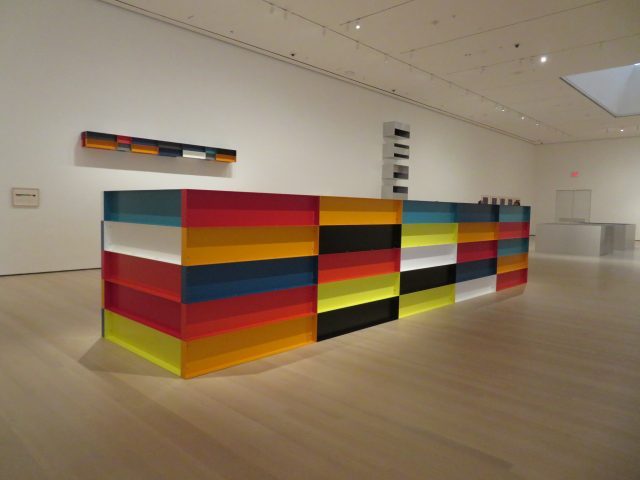
Time and space are key to Donald Judd exhibit at MoMA (photo by twi-ny/mdr)
JUDD
Museum of Modern Art
11 West 53rd St. between Fifth & Sixth Aves.
Through January 9, $14-$25 www.moma.org
Even art that is not political in any way feels different now. In his 1987 “Statement for the Chinati Foundation,” the art museum he founded in Marfa, Texas, Donald Judd wrote, “It takes a great deal of time and thought to install work carefully. This should not always be thrown away. Most art is fragile and some should be placed and never moved again. Somewhere a portion of contemporary art has to exist as an example of what the art and its context were meant to be. Somewhere, just as the platinum-iridium meter guarantees the tape measure, a strict measure must exist for the art of this time and place.” MoMA’s “Judd” retrospective was installed prior to the pandemic, but it is tailor-made for this time and place of social distancing. Exhibition curator Ann Temkin noted in a MoMA “Virtual Views” video in April that his works are “the original self-distancers.”
More than sixty pieces are spread across the sixth floor, from oils, drawings, and woodcuts to boxes, wall progressions, and other objects — along with his famed rejection of the word “minimalist” when referring to his work, he was no fan of “sculpture” either — composed of anodized and enameled aluminum, cold- and hot-rolled steel, plexiglass, plywood, copper, galvanized iron, and other materials, often in bright, distinct colors. Not only are the pieces themselves situated far enough apart from one another that you can have private time with each, particularly as long as MoMA is observing limited capacity restrictions, but the items contain their own unique positive and negative space in Judd’s use of form, shape, and color. You can’t walk between the twenty-one small and shiny stainless-steel squares lined up in three rows on the floor, but you are invited to wander among a series of large anodized aluminum clear boxes and peer inside to see panels of color.
The spaces in between and within are essential to experiencing Judd’s oeuvre, from his familiar vertical stacks that rise from floor to ceiling, the evenly spaced intervals as integral as the physical segments; to six plywood boxes constructed at an angle that seems to produce an optical illusion, taunting you to step inside; to narrow, horizontal enameled aluminum wall units in multiple colors that that are sometimes hollow in the center, allowing you to look through them; to Douglas Fir plywood and orange plexiglass pieces that resemble unfinished shelving crying out to be stocked with dry goods.
There is no obvious path to follow as you traverse the exhibition, lending an ease and comfort to how you interact with Judd’s organically infectious objects, offering personal time with each, although the security guard will be quick to warn you if you get too close to anything. In the 1994 documentary Bauhaus, Texas: The American Artist Donald Judd, released the year he died at the age of sixty-five, Judd said, “There is no space as in something that continues throughout everywhere, and that there is no time that goes on and on and on and is something all by itself. They’re made by something happening in them, in the case of time, or by something existing in them, in the case of space. But the time and space in themselves are just the way we feel about it.”
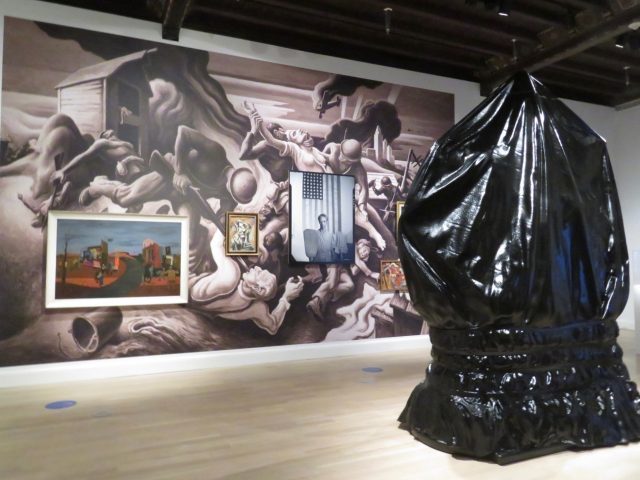
Jonathan Horowitz takes on racism and anti-Semitism in “We Fight to Build a Free World” at the Jewish Museum (photo by twi-ny/mdr)
WE FIGHT TO BUILD A FREE WORLD: AN EXHIBITION BY JONATHAN HOROWITZ
The Jewish Museum
1109 Fifth Ave. at Ninety-Second St.
Thursday – Monday through January 24, free through December 31 thejewishmuseum.org
In his introduction to “We Fight to Build a Free World,” which was nearly fully installed prior to the pandemic lockdown, fifty-four-year-old New York multimedia artist and curator Jonathan Horowitz explains, “Today violent acts against Jewish people in the United States are at a historic level. Continuing a trend of the past five years, 2019 represented the highest number of anti-Semitic hate crimes since the Anti-Defamation League began tracking them in 1979. This drastic rise in incidents — and it should be noted that hate crimes are vastly underreported — is not limited to Jewish people. Violence against Black, Muslim, Latinx, and LGBTQ individuals has increased alarmingly over the same period as well, often in acts the government does not designate as hate crimes. For instance, Black people in the United States are killed by police at three times the rate of white people, and 2020 is on pace to have the most police killings of Black people since 2013.
“Clearly, the rise in anti-Semitism is part of a broader political and cultural scourge. Ethno-nationalism has become a dominant political force in the United States, as it has around the globe. The current crop of authoritarian leaders and their xenophobic rhetoric call to mind Europe in the 1930s. It is within this broader context that I chose to think about the show.” The museum added the following note in response to the murder of George Floyd, making an already relevant exhibit that much more timely: “There is an intensifying awareness at this moment of how systemic racism functions at all levels of society. In the wake of these dramatic events, the topics and questions raised by this exhibition are seen in a new light and with ever-greater urgency.”
Named after a painting by Ben Shahn that is part of the exhibit, “We Fight to Build a Free World” features approximately eighty works that deal with social justice, bigotry, fascism, racist violence, slavery, economic inequality, and BIPOC empowerment. It ranges from Gerardus Duyckinck’s 1720–28 portrait of Jewish American painter-craftsman Moses Levy to thirty-six political posters commissioned for the show, making such statements as “Our Planet Can’t Wait,” “Using Sign Language Will Make You a Better Person,” “We Are Ruined by the Things We Kill,” and “Every Age Has Its Own Fascism,” by such artists as Judith Bernstein, Tania Bruguera, Marilyn Minter, Sue Coe, Xaviera Simmons, and Marcel Dzama.
Glenn Ligon repeats “I Do Not Always Feel Colored” over and over on a wooden board until the words become distorted. Gordon Parks’s American Gothic, Washington, D.C. Government Charwoman replaces Grant Wood’s painting of a white midwestern farm couple with the photo of a Black woman standing in front of the American flag and holding a broom and a mop. Robert Colescott reimagines a seminal historical moment in George Washington Carver Crossing the Delaware: Page from an American History Textbook, recalling Saul’s twist on the same subject at the New Museum. Philip Evergood’s The Hundredth Psalm painting of four Klansmen lynching a Black man over a fire takes us right back around to Guston, bringing all of the above exhibitions full circle. (Now if only they would turn down the volume on Horowitz’s #OscarsSoWhite Best Picture two-channel video, which echoes annoyingly and repetitively throughout the floor.)
Horowitz’s show was created as a direct rejoinder to what is happening under the Trump administration — as evidenced by Untitled (August 23, 2017 – February 18, 2018, Charlottesville, VA), a sculpture that purports to be a black tarp covering the Robert E. Lee statue in Charlottesville — but even it can be seen through new eyes in relation to the BLM protests against police brutality and the internal and external hatred and suppression promoted openly by the federal government. One of Horowitz’s 2020 pieces is titled What Am I? Who Are We?; the two-part work consists of an enlarged reproduction of anti-Nazi propagandist Arthur Szyk’s 1946 drawing Pilgrims, which contains a Jewish star, a menorah, two ships, and the Hebrew phrase “If I am not for myself, who will be for me?” next to a mirror on which is screenprinted the rest of the quote: “If I am only for myself, what am I?”
As the end of 2020 nears, one of the most challenging years in American history, those are questions that artists, curators, and museumgoers will be asking for a long time to come.
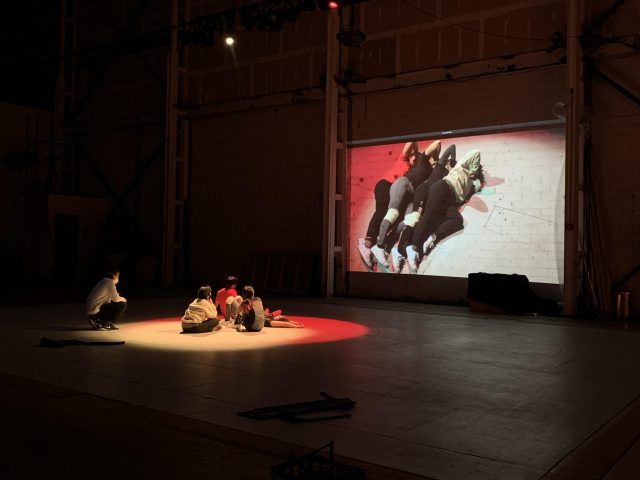
The Crossing marks Kenneth Tam’s live, virtual debut at the Kitchen OnScreen (rehearsal photo courtesy Lumi Tan and Kenneth Tam)
Who:Kenneth Tam,Lumi Tan What: Kenneth Tam’s first live performance Where:The Kitchen OnScreen Zoom When: December 5-6, free with RSVP, 7:00 Why: Brooklyn-based multidisciplinary artist Kenneth Tam has been in residence at Queenslab in Ridgewood since October 30, preparing a new work for the Kitchen, following all Covid-19 protocols as he rehearses the piece and prepares for its livestream debut December 5-6. Performed by Martin Richard Borromeo, Paulina Meneses, James Lim, and Resa Mishina, The Crossing explores issues of race, gender, identity, ritual, and assimilation in relation to Asian Americans and Culturally Based Fraternal Organizations, centering on Taoist funeral rites, probate ceremonies, and the brutal hazing death of Baruch college freshman and pledge Michael Deng in 2013 while running through the gantlet known as the Glass Ceiling. Admission is free with RSVP; the December 6 performance will be followed by a Q&A with Tam (All of M, Breakfast in Bed) and Kitchen curator Lumi Tan. You can see previous Kitchen OnScreen projects here by Baseera Khan, Autumn Knight, and Ka Baird with Max Eilbacher.
Katelyn Halpern and Paul Pinto’s Living Room video is part of “EdgeCut: Sanity”
Who:Malena Dayen,Karen Lancel & Hermen Maat,Caitlin & Misha,Katelyn Halpern,Paul Pinto,divinebrick,Chris SooHoo What: 3D live, interactive experience Where:New York Live Arts When: Saturday, December 5, $7-$15, 1:00 – 4:00 Why: On October 10, EdgeCut introduced us to the remarkable NowHere platform for the first part of its collaboration with New York Live Arts, “Captivity,” five hours of short performance works, discussions, and networking in which audience members navigated through different levels in order to watch livestreamed events in little pods and hang out with curators, creators, and other visitors in their pods. You could steer through fantastical landscapes, float in space, and pull up next to another pod and talk about where you’d been so far or where you were off to next, with cameras on so your face is visible on the front of your pod. I’ve tried just about every form of online entertainment while we’re all sheltering in place and arts venues are closed, and nothing else comes close to this one, even given various hiccups that require patience.
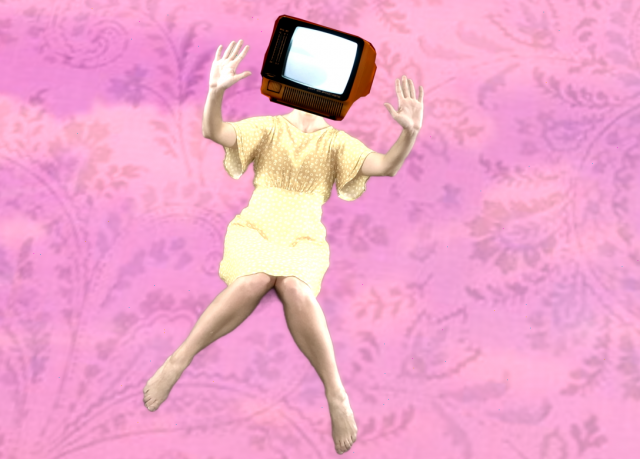
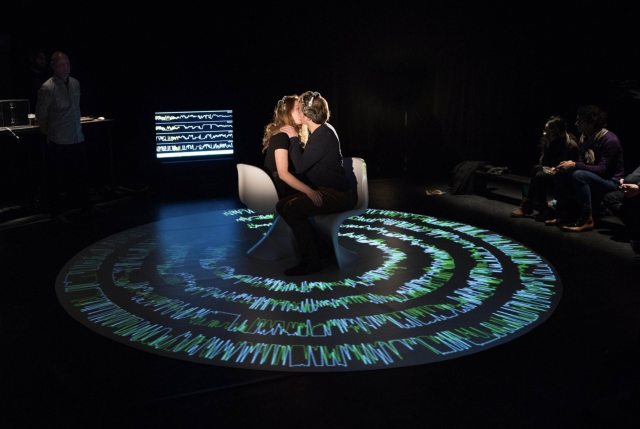
The second iteration, “Sanity,” takes place December 5 from 1:00 to 4:00, a more manageable three hours that will feature four unique rooms. In the Growth Room, you can catch director and singer Malena Dayen’s opera While You Are with Me and the bright and colorful Living Room music video of dancing television heads by multidisciplinary artists Katelyn Halpern and Paul Pinto; in the Worry Room, you can let out steam with Caitlin & Misha’s Infinite Worries Bash, a participatory installation of electroacoustic piñatas that inquires, “Can the destruction of these interactive worry vessels create space for clarity?”; in the Transformation Room, you can meditate to divinebrick and Chris Soohoo’s Performance Prayer; and in the Kissing Room, you can share private moments courtesy of intimacy agents Karen Lancel and Hermen Maat, who ask, “Can we measure a kiss and what kissers feel together?”
Intimacy agents Karen Lancel and Hermen Maat explore what online kissing is like at “EdgeCut: Sanity”
Curated by Heidi Boisvert and Kat Mustatea, the EdgeCut program, which originally convened at the New Museum’s NEW INC incubator for art, tech, and design for in-person presentations, is now seeking to expand and redefine the virtual 3D experience during the pandemic lockdown, exploring the question “How do we create collective experience and transformative gatherings in this moment of ‘a crisis within a crisis’ that speak to transition, change, healing, humanity?” The works were chosen through an open call; the finale of the trilogy, “Humanity,” is scheduled for February 13, 2021. Tickets range from $7 per room to $15 for the full experience, which has to be seen to be believed.