this week in music

DIVIDE LIGHT: AN EXCLUSIVE OPERA FILM SCREENING

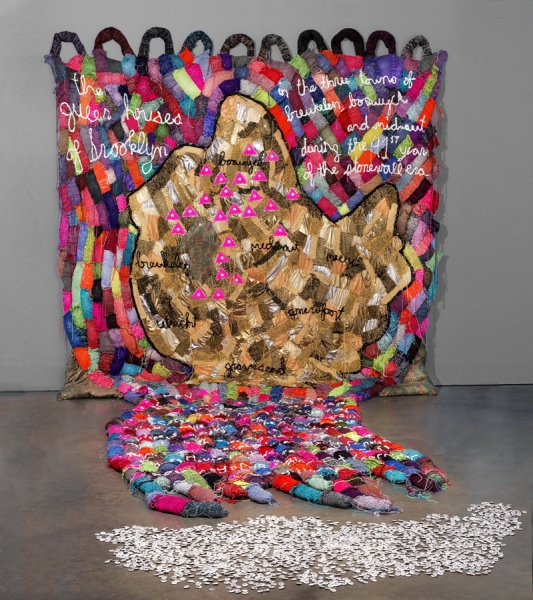
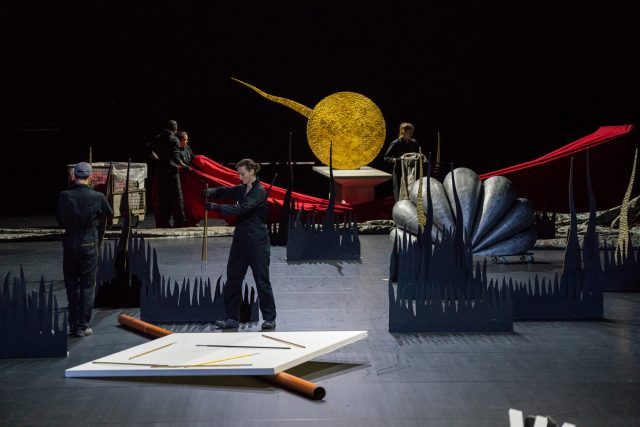
(photo by Skyler Smith)

Lesley Dill’s Divide Light will have a special screening April 18 at SVA Theatre (photo by Skyler Smith)

SVA Theatre
333 West Twenty-Third St. between Eighth & Ninth Aves.
Thursday, April 18, $15, 8:00
www.nohrahaimegallery.com
www.dividelight.com

On April 18, multidisciplinary American artist Lesley Dill will present an exclusive screening of her experimental opera, Divide Light, at the SVA Theatre. The opera, based on the complete poetry works of Emily Dickinson, was conceived and created by Dill, with music by Richard Marriott, performed by New Camerata Opera, accompanied by the Curiosity Cabinet String Quintet; the film is directed by Ed Robbins. The multimedia opera, which debuted at the Montalvo Arts Center in the summer of 2008, links the nineteenth-century Transcendental movement to the present day, using words, music, black-and-white and color projections, and extravagant costumes. Among the Dickinson poems in the opera are “For Each Ecstatic Instant,” “I Am Afraid,” “I Am Alive,” “Much Madness,” “The Soul,” and “The Loneliness.” Tickets are $15 and must be purchased in advance; seating is limited.

IN PERPETUAL FLIGHT: THE MIGRATION OF THE BLACK BODY

(photo by Steve Vaccariello)

Alvin Ailey dancer and choreographer Hope Boykin will perform at “In Perpetual Flight: The Migration of the Black Body” presentation at Schomburg Center (photo by Steve Vaccariello)

The Schomburg Center for Research in Black Culture
Langston Hughes Auditorium
515 Malcolm X Blvd.
Tuesday, April 16, free with advance registration, 6:30
www.nypl.org

Carnegie Hall’s wide-ranging, multidisciplinary Migrations: The Making of America festival comes to the Langston Hughes Auditorium at the Schomburg Center for Research in Black Culture on April 16 for “In Perpetual Flight: The Migration of the Black Body.” Through dance, music, and theater, the program traces the journey toward liberation of the black body across time in the US, from the slave trade and the Great Migration to the Civil War and the Back to Africa movement, exploring its impact on contemporary American culture. The evening, held in conjunction with the fiftieth anniversary of Dr. Barbara Ann Teer’s National Black Theatre and its current NBT Beyond Walls initiative, features four live performances and presentations by Alvin Ailey dancer and choreographer Hope Boykin, screenwriter, playwright, and director Keith Josef Adkins, Obie-winning actress and singer Kenita R. Miller, composer and sound designer Justin Hicks, NBT CEO Sade Lythcott, and NBT artistic director Jonathan McCrory, utilizing works from the Schomburg Center archives from such seminal figures as James Baldwin, Harriet Powers, Marcus Garvey, Harriet Tubman, and Jacob Lawrence. “This event is allowing us to acknowledge the consistent flight, movement, and navigation black people have been engaged in within this country ever since the black body was ripped from the shores of Africa — human bodies stripped from home and forced into slavery,” McCrory said in a statement. “That perpetual flight has produced four hundred years of migration that have generated moments of agitation, acceleration, acclimation, and aspiration.” Admission is free; advance registration is strongly recommended.

ONASSIS FESTIVAL 2019: DEMOCRACY IS COMING

Lena Kitsopoulou’s

Lena Kitsopoulou’s is part of Onassis Festival at Public Theater

Public Theater and other venues
425 Lafayette St.
April 10-28
212-539-8500
www.publictheater.org
www.onassisfestivalny.org

The English word “democracy,” and the concept of ruling by the common people, comes from Greek classical antiquity. The Public Theater, in partnership with Onassis USA, hearkens back to those origins in the 2019 Onassis Festival: Democracy Is Coming. From April 10 to 28, the Public and such other venues as La MaMa will present live performances, discussions, and more exploring the meaning and role of democracy from its early days to the present time, as fascism rears its ugly head in America and around the world. Below are only some of the many highlights.

Wednesday, April 10
through
Saturday, April 13

Relic, solo performance by Euripides Laskaridis, examining the current Greek crisis, Shiva Theater at the Public, $35, 8:00

Wednesday, April 10
through
Sunday, April 28

Socrates, new play by Tim Blake Nelson, directed by Doug Hughes, and starring Michael Stuhlbarg, Niall Cunningham, David Aaron Baker, Teagle F. Bougere, Peter Jay Fernandez, Robert Joy, Miriam A. Hyman, and others, Martinson Hall at the Public, $85

Saturday, April 13
Brunch, Tragedy & Us, book talk with Simon Critchley interviewed by Paul Holdengräber, the Library at the Public Theater, free with advance reservation, 11:30

Choir! Choir! Choir!, community singalong created by Daveed Goldman and Nobu Adilman, free with advance reservation, Public Theater lobby, 5:00

(photo by Miltos Athanasiou)

Euripides Laskaridis’s Relic runs April 18-20 at the Public Theater (photo by Miltos Athanasiou)

Sunday, April 14
Democracy Is the City, panel discussion with Alfredo Brillembourg, Karen Brooks Hopkins, and Kamau Ware and a live performance by Morley, Shiva Theater, 2:00

Monday, April 15
Public Forum: Of, by & for the People, featuring a conversation with Oskar Eustis, Suzan-Lori Parks, and Kwame Anthony Appiah and live performances by André Holland and Diana Oh, Shiva Theater, $25, 7:00

Thursday, April 18
through
Saturday, April 20

Antigone: Lonely Planet, Lena Kitsopoulou’s comic version of Sophocles’s tragedy, Shiva Theater, $35

Monday, April 22
Public Shakespeare Presents: What’s Hecuba to Him? Tragic Greek Women on Shakespeare’s Stage, commentary and readings from Euripides and Shakespeare with Professor Tanya Pollard, Isabel Arraiza, Tina Benko, Phylicia Rashad, and Ayana Workman, Martinson Hall, $35, 7:00

TRIBECA FILM FESTIVAL 2019: SPECIAL EVENTS AT THE BEACON

Tribeca Film Festival

Francis Ford Coppola will be at the Tribeca Film Festival screening and discussing Apocalypse Now: Final Cut

Beacon Theatre
2124 Broadway at 75th St.
Tribeca Film Festival runs April 25 – May 5
212-465-6000
www.tribecafilm.com
www.msg.com/beacon-theatre

The hottest events of the 2019 Tribeca Film Festival are taking place on the Upper West Side at the Beacon Theatre, where screenings, discussions, and live performances will feature Wu-Tang Clan, Spinal Tap, Francis Ford Coppola, the Trey Anastasio Band, and Martin Scorsese with Robert De Niro. Tickets are going fast, so act now if you want to catch any of these special presentations.

Thursday, April 25
Tribeca TV: Wu-Tang Clan: Of Mics and Men (Sacha Jenkins, 2019), followed by a live performance by Wu-Tang Clan, $116, 8:00

Friday, April 26
Movies Plus: Between Me and My Mind (Steven Cantor, 2019), followed by a live performance by the Trey Anastasio Band, 8:00

Tribeca Film Festival

Wu-Tang Clan will play live at the Tribeca Film Festival after screening of Wu-Tang Clan: Of Mics and Men

Saturday, April 27
Anniversary Screenings: This Is Spinal Tap (Rob Reiner, 1984), followed by a discussion with Christopher Guest, Michael McKean, Harry Shearer, and Rob Reiner and a live performance by Spinal Tap, $46-$256, 8:00

Sunday, April 28
Directors Series: Martin Scorsese with Robert De Niro, 2:00

Anniversary Screenings: Apocalypse Now: Final Cut (Francis Ford Coppola, 1979), world premiere of fortieth anniversary 4K Ultra HD restored version, with special Meyer Sound VLFC, followed by a discussion with Francis Ford Coppola, $46-$116, 5:00

DIARY OF ONE WHO DISAPPEARED

An older photographer (actor Wim van der Grijn) interacts with his imaginary younger self (tenor Andrew Dickinson) in

An older photographer (actor Wim van der Grijn) interacts with his imaginary younger self (tenor Andrew Dickinson) in Diary of One Who Disappeared (photo © Jan Versweyveld)

BAM Howard Gilman Opera House
Peter Jay Sharp Building
230 Lafayette Ave.
April 4-6, $28-$140, 7:30
718-636-4100
www.bam.org
www.transparant.be

A World War I–era song cycle inspired by an aging Czech composer’s infatuation with a young woman seems an unlikely subject for Ivo van Hove’s usual theatrical treatment, but the Belgian director and Flemish opera company Muziektheater Transparant have reinterpreted Leos Janáček’s Diary of One Who Disappeared in a quietly affecting sixty-five-minute production that is making its US premiere at BAM’s Howard Gilman Opera House this week. In the summer of 1917, the sixty-three-year-old Janáček began an eleven-year epistolary relationship with twenty-six-year-old Kamila Stösslová. Both were married; over eleven years, Janáček wrote more than seven hundred letters to her declaring his undying love, while Stösslová answered only intermittently, replying fewer than fifty times, and without Janáček’s intimate passion. Janáček used Stösslová as his muse; she inspired several of his operas and the song cycle Diary of One Who Disappeared. At BAM, the attractive set, designed by van Hove’s longtime partner, Jan Versweyveld, is a long, horizontal darkroom with photography equipment and a piano nearly hidden within a small bookshelf, behind which is a sleeping area; a low ceiling makes it feel like the performers are trapped in a mysterious diorama. The romantic story is told as a fantasy memory, as an older photographer (actor Wim van der Grijn) interacts with his imaginary younger self (tenor Andrew Dickinson), cast as a young farmer enticed into a torrid affair with a young Romany woman, Zefka (mezzo soprano Marie Hamard). (Janáček often referred to Kamila in his letters as a “black Gypsy girl.”)

(photo © Jan Versweyveld)

Leoš Janáček’s Diary of One Who Disappeared gets the Ivo van Hove treatment at BAM (photo © Jan Versweyveld)

When the old photographer enters through a door in the back of the set, he is carrying an urn, the ashes of his late wife, and he admits he gave her only half his heart. He walks around the stage reciting lines from Janáček’s letters as Zefka and the younger man sing songs with lyrics taken from anonymous poems published in a 1916 newspaper. The lovely music is played by pianist Lada Valešová, with an offstage choir of Raphaële Green, Annelies Van Gramberen, and Naomi Beeldens contributing background vocals. Belgian composer Annelies Van Parys has added tender musical fragments that expand on Janáček’s themes.

The pacing is slow and genuine, with van Hove adding some of his signature multimedia touches, including live video of the two men developing a picture of Zefka, the use of an old-fashioned overhead projector, and footage of a naked woman beamed onto the actor’s body, as if she is deep within him. Versweyveld’s sensual lighting goes from cold blues to fiery reds. It’s a heartfelt story of unrequited love that spurred great creativity; inspired by Stösslová, Janáček also wrote Glagolitic Mass, Sinfonietta, and String Quartet No. 2 as well as characters in The Cunning Little Vixen, The Makropulos Affair, and Katya Kabanová. “I know that my compositions will be more passionate, more ravishing: you’ll sit on every little note in them. I’ll caress them; every little note will be your dark eye,” he wrote to her. It was an unrequited love that makes for a moving piece of theater.

FIRST SATURDAYS: FRIDA KAHLO

Nickolas Muray, Frida in New York, carbon pigment, 1946 (printed 2006), © Nickolas Muray Photo Archives (photo courtesy Brooklyn Museum)

Nickolas Muray, Frida in New York, carbon pigment, 1946 (printed 2006), © Nickolas Muray Photo Archives (photo courtesy Brooklyn Museum)

Brooklyn Museum
200 Eastern Parkway at Washington St.
Saturday, April 6, free (some events require advance tickets), 5:00 – 11:00
212-864-5400
www.brooklynmuseum.org

The Brooklyn Museum celebrates Frida Kahlo in the April edition of its free First Saturday program. There will be live performances by Renee Goust, Calpulli Mexican Dance Company (Puebla: The Story of Cinco De Mayo), and Pistolera (with visuals by Screaming Horses), as well as Yas Mama!’s El Noche de las Reinas with Lady Quesa’Dilla and DJ sets by Hannah Lou and Shomi Noise, hosted by Horrorchata; pop-up poetry with Danilo Machado, Jimena Lucero, and Francisco Márquez; the community talk “Art and Disability” with Dior Vargas and Kevin Gotkin; pop-up gallery talks of “Life, Death, and Transformation in the Americas” with teen apprentices; a hands-on workshop in which participants can adorn instant photos with a Kahlo-like flourish; and an “Archives as Raw History” tour focusing on disabled artists and visitors with archivist Molly Seegers. In addition, the galleries will be open late so you can check out “Frida Kahlo: Appearances Can Be Deceiving,” “Eric N. Mack: Lemme walk across the room,” “One: Do Ho Suh,” “One: Egúngún,” “Something to Say: Brooklyn Hi-Art! Machine, Deborah Kass, Kameelah Janan Rasheed, and Hank Willis Thomas,” “Infinite Blue,” “A Woman’s Afterlife: Gender Transformation in Ancient Egypt,” “Kwang Young Chun: Aggregations,” and more.

DIARY OF ONE WHO DISAPPEARED

(photo © Jan Versweyveld)

Leoš Janáček’s Diary of One Who Disappeared gets the Ivo van Hove treatment at BAM (photo © Jan Versweyveld)

BAM Howard Gilman Opera House
Peter Jay Sharp Building
230 Lafayette Ave.
April 4-6, $28-$140, 7:30
718-636-4100
www.bam.org
www.transparant.be

You can always expect something unexpected from Belgian director Ivo van Hove, and such is the case with his latest production at BAM, Diary of One Who Disappeared. The Tony and Olivier Award winner has staged the Arthur Miller double play of A View from the Bridge and The Crucible on Broadway, a three-and-a-half-hour rotating version of Ingmar Bergman’s Scenes from a Marriage at New York Theatre Workshop, and the massive four-plus-hour Kings of War at BAM, among other shows that can blow your mind. This week he’s back at BAM with the US premiere of Flemish opera company Muziektheater Transparant’s Diary of One Who Disappeared, a sixty-five-minute adaptation of Leoš Janáček’s song cycle, inspired by the sixty-three-year-old Czech composer’s relationship with twenty-six-year-old Kamila Stösslová. “I don’t have words to express my longing for you, to be close to you,” Janáček wrote to Stösslová. “I know that my compositions will be more passionate, more ravishing: you’ll sit on every little note in them. I’ll caress them; every little note will be your dark eye.” The work features actor Wim van der Grijn, tenor Andrew Dickinson, mezzo soprano Marie Hamard, pianist Lada Valešová, and a choir trio of Raphaële Green, Annelies Van Gramberen, and Naomi Beeldens. The set and lighting is by Jan Versweyveld, with costumes by An D’Huys and four new musical fragments by Annelies Van Parys.