this week in music

LEGACY, MEMORY, AND IMPERMANENCE: CELEBRATING MEREDITH MONK AT IFC

Meredith Monk looks at her past, present, and future in Billy Shebar’s celebratory and deeply affecting documentary

MONK IN PIECES: A CONCEPT ALBUM (Billy Shebar, 2025)
IFC Center
323 Sixth Ave. at West Third St.
July 24–31
www.ifccenter.com
monkinpieces.com

Near the beginning of Billy Shebar’s revelatory documentary, Monk in Pieces, composer Philip Glass explains that Meredith Monk “was a self-contained theater company. She, amongst all of us, I think, was the uniquely gifted one — is the uniquely gifted one.” It’s an important correction because Monk, at eighty-three, is still hard at work, creating live performances and films that defy categorization.

While several of her earliest projects were met with derision in critical circles, today she is revered for her remarkable output, although it is still impossible to put her into any kind of box. At one point in the documentary, a chorus of Monk scholars sings her praises; one says, “She’s achieved so much, has received so many accolades, and yet she’s this unknown,” a second notes, “She kind of falls through the cracks of music history,” and a third admits, “We don’t know how to talk about her.”

Written, directed, and produced by Shebar — whose wife, coproducer Katie Geissinger, has been performing with Monk since 1990 — and David Roberts, Monk in Pieces does a wonderful job of righting those wrongs, celebrating her artistic legacy while she shares private elements of her personal and professional life. Born and raised in Manhattan, Monk details her vision problem, known as strabismus, in which she is unable to see out of both eyes simultaneously in three dimensions, which led her to concentrate on vocals and the movement of her physical self. She studied Dalcroze Eurhythmics: “All musical ideas come from the body; I think that’s where I’m coming from,” she says. All these decades later, her distinctive choreography and wordless tunes are still like nothing anyone else does.
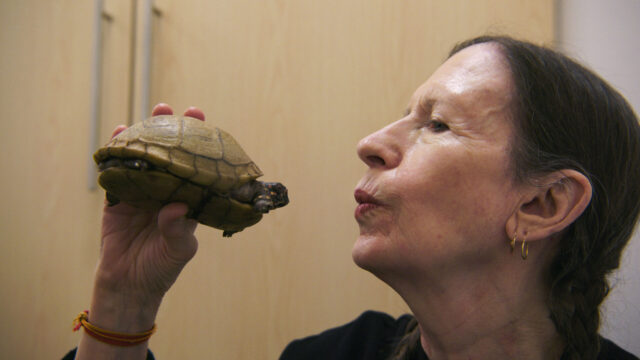
Meredith Monk shares a special moment with her beloved turtle, Neutron

Unfolding at a Monk-like unhurried pace, the ninety-five-minute documentary is divided into thematic chapters based on her songs, including “Dolmen Music,” “Double Fiesta,” “Memory Song,” “Turtle Dreams,” and “Teeth Song,” while exploring such presentations as Juice (1969), the first theatrical event to be held at the Guggenheim; Education of the Girlchild (1973), in which a woman ages in reverse; Quarry (1976), a three-part opera about an American child sick in bed during WWII; Impermanence (2006), inspired by the sudden death of her partner, Mieke von Hook; and her masterwork, Atlas (1991), in which the Houston Grand Opera worries about her numerous requests and production costs, whether the piece will be ready in time, and if it even can be considered opera. There are also clips from Ellis Island, Book of Days, Facing North, and Indra’s Net, her latest show, which was staged at Park Ave. Armory last fall. In addition, Monk reads from her journals in scenes with playful animation by Paul Barritt.

Monk opened up her archives for the filmmakers, so Shebar, Roberts, and editor Sabine Krayenbühl incorporate marvelous photos and video from throughout Monk’s career, along with old and new interviews. “It was her voice that was so extraordinary, not only the different kind of sounds she could make, but the imagination she was using in producing the sound . . . totally individual,” Merce Cunningham says. WNYC New Sounds host John Schaefer gushes, “I don’t know when words like multimedia and interdisciplinary began to become in vogue, but Meredith was all of those things.” Her longtime friend and collaborator Ping Chong offers, “She had to fight to be acknowledged in the performing arts world because critics were saying that what she was doing was nonsensical, was crazy, was not serious; in a way, it’s a fight to survive. Pain is where art comes from. . . . Art has to come out of need. And now she’s an old master.”

And Björk, who recorded Monk’s “Gotham Lullaby,” touts, “Meredith’s melody making is like a timeless door that’s opened, like a gateway to the ancient is found. It definitely affected my DNA. . . . Her loft that she has lived in for half a century is an oasis in a toxic environment.” Among the other collaborators who chime in are longtime company member Lanny Harrison; composer Julia Wolfe; and David Byrne, for whom she created the opening scene of his 1986 film, True Stories, and who says he learned from Monk that “you can do things without words and it still has meaning, it still has an emotional connection.”

Some of the most beautiful moments of the film transpire in Monk’s loft, where she tends to her beloved forty-two-year-old turtle named Neutron, puts stuffed animals on her bed, meditates while staring at windows lined with Tibetan prayer flags, composes a new song, looks into a mirror as she braids her trademark pigtails, and sits at her small kitchen table, eating by herself. Surrounded by plants and personal photographs, she moves about slowly, profoundly alone, comfortable in who she is and what she has accomplished, contemplating what comes next.

“What happens when I’m not here anymore?” Monk, who received the 2014 National Medal of Arts from President Barack Obama, asks while working with director Yuval Sharon, conductor Francisco J. Núñez, and performer Joanna Lynn Jacobs on a remounting of Atlas for the LA Philharmonic in 2019. “It’s very rare that anybody gets it.”

Monk in Pieces goes a long way toward rectifying that, filling in the cracks, helping define her place in music history.

Monk in Pieces runs July 24-31 at IFC Center; there will be Q&As following the 6:45 screenings on July 24 with Monk, Shebar, and producer Susan Margolin, moderated by Schaefer; on July 25 with Monk, Shebar, and Margolin, moderated by violist Nadia Sirota; and on July 26 with Shebar.

[Mark Rifkin is a Brooklyn-born, Manhattan-based writer and editor; you can follow him on Substack here.]
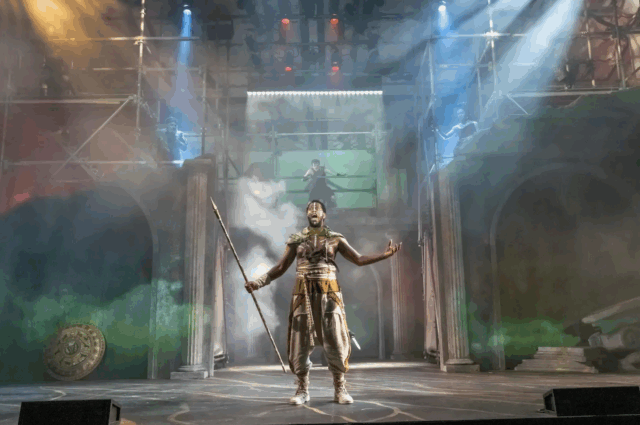
MEMNON: THE MISSING BATTLE OF THE TROJAN WAR

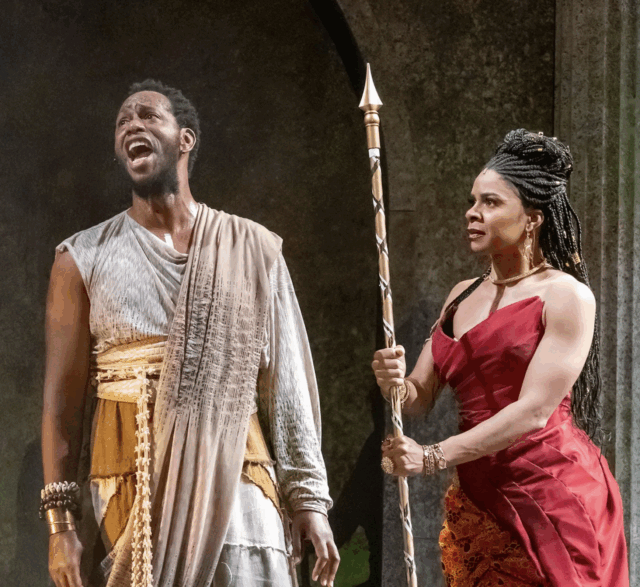
Eric Berryman resurrects a Greek hero in Classical Theatre of Harlem’s Memnon (photo by Richard Termine)

UPTOWN SHAKESPEARE IN THE PARK: MEMNON
Classical Theatre of Harlem
Richard Rodgers Amphitheater, Marcus Garvey Park
18 Mt. Morris Park W.
Tuesday – Sunday through July 27, free (advance RSVP recommended), 8:30
www.cthnyc.org

Writer Will Power and director Carl Cofield follow up their 2021 Richard III reimagination, Seize the King, with Memnon, a bold antiwar missive about a key battle in the legendary fight between the Achaeans and the Trojans about eight hundred years ago.

Presented by the Classical Theatre of Harlem at the Richard Rodgers Amphitheater in Marcus Garvey Park through July 27 at part of its Uptown Shakespeare in the Park series, Memnon zeroes in on the little-known title character, an Ethiopian king, in the mold of Black Panther, who appears in some ancient texts (Virgil’s Aeneid, the extant Aethiopis) and on cups, vases, and mirrors. Priam (Jesse J. Perez), the king of Troy, is mourning the death of his son Hector, a warrior who was killed by Achilles (Jesse Corbin). Priam believes that Hector was “Troy’s last hope,” while Polydamas (David Darrow), Priam’s trusted adviser, declares, “So now without him, our hero gone, our men / Soon slaves to Hades or other men / Our wives violated / And children’s bones crushed by boots.”

But then Polydamas suggests that Priam turn to his nephew, Memnon (Eric Berryman), who self-exiled to Ethiopia many years before under mysterious circumstances. “Never will I call this man of which you speak. Never, I say! / He is us only in lineage, not in spirit / No, his treacherous soul belongs to others / And he has proven that,” Priam argues vociferously. “He is nothing to me!”

Helen (Andrea Patterson), the queen of Troy, entreaties Priam to reconsider; she left her husband in Sparta, abducted or of her free will, as various tales have it, with Paris, Hector’s brother, and the Greek cuckold’s furor led to the Trojan War. “In Troy Helen is Helen at home Helen is hell / In Troy Helen has choice at home no free will / So the place that is home may be truly foreign / And the new place foreign may be true indigen,” Helen says, adding, “Caught up you are in who is foreign / And who is citizen. / Why not who is true and what false?”

Priam eventually relents, and, though hesitant at first, Memnon arrives with his army, although he first speaks of a peaceful resolution to the war. “In Ethiopia, able we are / To speak through disagreements and sidestep bloodshed,” Memnon explains. Priam wants to know how many enemies he has killed, and by what methods, but Memnon tells him, “We didn’t kill we captured to calm them. . . . Once I slaughtered two hundred men myself, in one single battle / Not proud of that.”

Soon Memnon is facing off with Antilochus (David Darrow), son of Nestor (Jesse J. Perez), the king of Pylos. “Your father Nestor, an old man in a young man’s game / He should not be here at war, and neither should you / I see through your brave mirage, men should not slay boys,” Memnon, holding a shield made by the god Hephaestus, warns Antilochus. “Vacate now as I will not attack but, if you should be so bold / To use sword, javelin, and shield against me / Young man, no choice will I have but to end you / Think on this, Antilochus, and think well.”

He doesn’t think well enough.

Next, Nestor appeals to Achilles to fight Memnon, not only to defend the Achaeans, but to seek revenge for his childhood friend Patroclus, who was killed by Hector. Achilles initially does not want to get involved. “To kill again I could easily do, summon the dark and blanket battle fields / With slumbering, lifeless men. But to what end, Nestor?” Achilles asks. “I despise not the Trojans, but gods that play chess with souls of men / These devilish immortals are set on us as their light amusements.” However, Nestor convinces Achilles to take up arms against Memnon, so the two heroic figures, neither of whom wants to shed more blood, are face-to-face in heated battle.

Memnon (Eric Berryman) and Helen (Andrea Patterson) consider their fate as battle awaits (photo by Richard Termine)

Told in iambic hexameter, Memnon is laced with references to immigrants that ring true with what is happening in America today. In response to Helen’s statement about who is foreign and who is citizen, Priam answers, “Is this a man true who loves Troy? That makes the citizen.” Polydamas notes, “Helen became not foreigner but blood to us.” And Memnon, when deciding whether to return to Troy and join his uncle’s cause, considers, “Now times there were when reminded I was / That Troy and I were not the same, that I / Was Troy but not fully Trojan, kin and / Not kin, still would I tuck feelings away. . . . I am of the east and yet / This Troy still calls. I cannot abandon her fully / Though I have tried. / It makes no sense, to fight for that which has proven / Time and time again that you will forever be other.”

Riw Rakkulchon’s set is a multilevel crumbling castle with stairs leading to platforms within scaffolding. Yee Eun Nam’s projections are primarily atmospheric abstractions that morph from black and white into color. Frederick Kennedy’s sound and music has to contend with loud noises in the park but ultimately prevails. Celeste Jennings’s costumes range from regal to battle armor to Memnon’s African-influenced garb, accompanied by white sneakers. The lighting, by Alan C. Edwards, adjusts to the setting sun and the shifts in narrative style, from extended dialogues to rousing dance interludes choreographed by Tiffany Rea-Fisher and performed by Jenna Kulacz, Madelyn LaLonde, Alyssa Manginaro, Caitlyn Morgan, Erik Penrod Osterkil, Tiffany “2Ts” Terry, and Travon M. Williams.

Berryman (Primary Trust, Get Your Ass in the Water and Swim Like Me) is captivating as Memnon, a thoughtful man, strong in mind and body, who favors peace but is thrust into war. His diction is initially heavy with broken English but becomes smoother as he spends more time with Priam and Helen. Perez (Party People, Informed Consent) moves smoothly between Priam and Nestor, both of whom speak loudly, fathers seeking revenge no matter the cost. Patterson (cullud wattah, Confederates) makes the most of her moments as Helen, while Darrow (All Is Calm, the Revival) excels as Polydamas and Antilochus, with several of his longer scenes receiving well-deserved exit applause, and artist, musician, and fitness trainer Corbin (The Lion . . . & the Wardrobe) shows off his muscles as Achilles.

The play unfurls almost too rapidly, with a few plot holes and a lot of exposition that at times makes it feel like something is missing, and some of the contemporary language sticks out like a sore thumb — for example, when Memnon says, “We will always be a nation sliced apart / Haves and have nots, belongs and kind of belongs.” But Power (Flow; Fetch Clay, Make Man) and Cofield (The Bacchae, King Lear) have done Greek tragedy a service by resurrecting a true hero with a unique understanding of glory.

[Mark Rifkin is a Brooklyn-born, Manhattan-based writer and editor; you can follow him on Substack here.]

HIDDEN GEMS: BED-STUY STooPS SUMMER FESTIVAL

STooPS 2025 SUMMER FESTIVAL
Stuyvesant Ave. & Decatur St., Brooklyn
Saturday, July 26, free (advance registration recommended), 1:00 – 7:00
www.stoopsbedstuy.org
www.eventbrite.com

The twelfth annual STooPS Arts Crawl and Block Party takes place on July 26 on Decatur St. between Lewis and Stuyvesant Aves. in Brooklyn, with live music and dance, workshops, and visual art on the stoops and shared spaces of Bedford–Stuyvesant. This year’s theme is “Echoes of Greatness: Celebrating Bed-Stuy’s Hidden Gems,” honoring the lesser-known treasures in the neighborhood. The festivities begin at 1:00 with a block party lasting until 7:00, hosted by Koku with ToniBNYC, a Kiddie Korner by Bridges: A Pan-Afrikan Arts Movement, collaborative visual art by Ovila Lemon/Mut’Sun, and healing workshops by Akika Flower Essences & Apothecary and Essence of Ase. There will be art crawls at 1:30 and 4:00, led by Shanna Sabio of GrowHouse NYC, with Carmen Carriker, Courtney Cook, Ariana Carthan/Wukkout!, Brooklyn Ballet, Qu33n Louise, Nia Blue, and Púyaloahí. Kendra J. Ross Works and Soul Science Lab headline the show. This year’s awardees are Ovila Lemon, Richard Cummings, Valerie Ferguson, Monique Scott, Larry Weekes, and Damon Bolden.

“The summer festival is more than a celebration — it’s a bridge between Bed-Stuy’s past and its future,” STooPS founding director Kendra J. Ross said in a statement. “By bringing art to the stoops, we make space for neighbors to connect across generations and experiences. In a time of change, this is how we honor what’s been while shaping what’s next — together.”

All events are free but advance registration is recommended.

[Mark Rifkin is a Brooklyn-born, Manhattan-based writer and editor; you can follow him on Substack here.]

THE JOY OF RESISTANCE: RACHAEL SAGE, KRISTEN FORD, AND HANNAH JUDSON AT MERCURY LOUNGE

Who: Rachael Sage and the Sequins, Kristen Ford, Hannah Judson
What: Joy = Resistance Tour
Where: Mercury Lounge, 217 East Houston St.
When: Thursday, July 24, $15 in advance, $20 at door, 6:00
Why: The Joy = Resistance Tour pulls into Mercury Lounge on July 24, as Rachael Sage and Kristen Ford are joined by Hannah Judson for what should be a special night of music and inclusivity. MPress Records founder Sage will be performing with her longtime trio, the Sequins: Trina Hamlin on harmonica, Andy Mac on drums, and Kelly Halloran on violin; they will be celebrating the release of Sage’s latest single, “Live It Up,” while highlighting songs from her upcoming album, Canopy, along with old favorites. The L.A.-based Ford will be playing tunes from her debut full-length, Pinto, out August 22 from Righteous Babe; produced by Grammy winners Ani DiFranco and John Driskell Hopkins, it includes such tracks as “Wild Heart,” “Whiplash,” and “White Man’s Dream.” Judson, a Chicago-based French-American singer-songwriter, will be featuring tunes from her latest LP, Satellites Grace the Sky Like Tumbleweeds (Boneyard Records), which boasts such numbers as “Feather,” “Take the Angel Down,” and “Ocean Blue Eyes.”

On the gorgeously poetic “Just Enough” from Canopy, the New York City–based Sage sings, “I feel love in the morning when you wake me up / Love in the middle of the day don’t stop / I feel love in the evening, fills my cup just enough . . . shalalala. . . .” Discussing the tune, she says, “At first listen, [it] seems like a romantic love song and to some degree it started out that way when I was first writing it. But the longer I’ve played it live out on tour the more now it feels like it’s equally a mantra to oneself about being enough as you are: lovable enough, accomplished enough, attractive enough, smart enough . . . all the things that, for instance, a best friend or any loved one might acknowledge in you are truly, unconditionally, and authentically enough.”

There should be plenty of enough at Mercury on July 24 when Sage, Ford, and Judson take the stage on the Lower East Side.

[Mark Rifkin is a Brooklyn-born, Manhattan-based writer and editor; you can follow him on Substack here.]
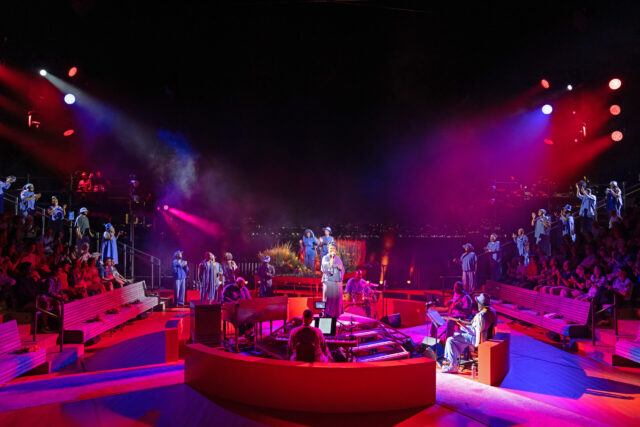
OEDIPUS REIMAGINED: THE GOSPEL AT COLONUS ON LITTLE ISLAND

Revival of The Gospel at Colonus on Little Island tells story of redemption and retribution (photo by Julieta Cervantes)

THE GOSPEL AT COLONUS
The Amph at Little Island
Pier 55, Hudson River Park at West Thirteenth St.
July 8-26, $10 standing room, $25 seats sold out, 8:30
littleisland.org

One of the grandest theatrical events of the summer is taking place on Little Island, Shayok Misha Chowdhury’s rousing, impassioned adaptation of Lee Breuer and Bob Telson’s The Gospel at Colonus, a spirited, spiritual retelling of the Oedipus and Antigone myths.

In 1983, Obie winner and Mabou Mines founding co-artistic director Breuer (Mabou Mines DollHouse, Peter and Wendy) teamed up with composer Telson (Chronicle of a Death Foretold, Bantú) to reimagine Robert Fitzgerald’s version of Sophocles’s Oedipus at Colonus as a Pentecostal revival meeting. The show debuted at BAM’s Next Wave Festival and was mounted on Broadway five years later, with Morgan Freeman as the Messenger; Oedipus was portrayed by Clarence Fountain and the Five Blind Boys of Alabama.

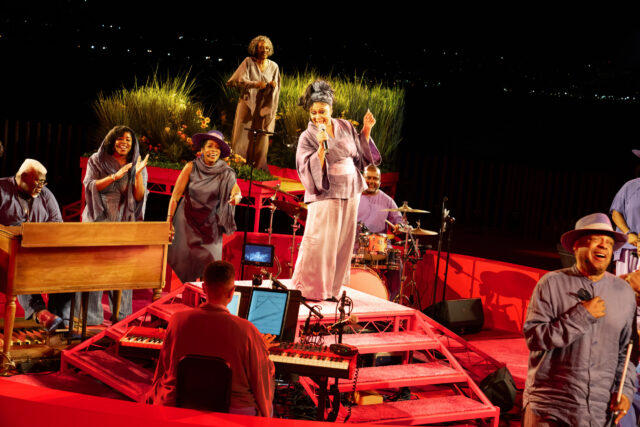
A tale of witness and testimony, of redemption and retribution, The Gospel at Colonus is a revelation at the Amph, where it begins each night amid the glow of sunset over the Hudson. David Zinn’s set is bathed in red; much of the action occurs in a broken circle in the center surrounding a four-step platform, in front of a yellow foot bridge running between high grass. Stacey Derosier’s lighting, switching from red to green to blue, illuminates Montana Levi Blanco’s loose-fitting purple and sackcloth gray costumes, a combination of Greek togas and Sunday finest. Garth MacAleavey’s sound design allows nature to mingle with the crisp, clear music and dialogue.

Stephanie Berry (On Sugarland, Déjà Vu) is sensational as the Preacher, serving as a kind of narrator and oracle. “Think no longer that you are in command here, / But rather think how, when you were, / You served your own destruction / Welcome, brothers and sisters, / I take as my text this evening the Book of Oedipus,” she announces at the start. “Oedipus! Damned in his birth, in his marriage damned, / Damned in the blood he shed with his own hand! / Oedipus! So pitifully ensnared in the net of his own destiny.”

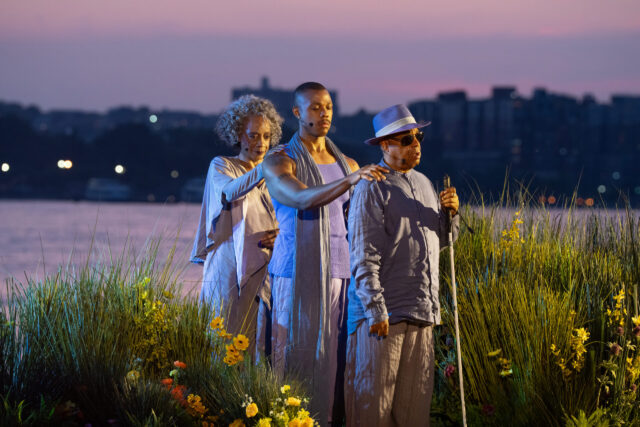
Stephanie Berry, Davóne Tines, and Frank Senior portray different aspects of Oedipus (photo by Julieta Cervantes)

Oedipus — portrayed as a group by blind jazz vocalist Frank Senior, opera bass-baritone Davóne Tines, and Berry — has already blinded himself for having unknowingly killed his father and married his mother, Jocasta, who then hanged herself, and fathered four children with her, two sons, Eteocles and Polyneices, and two daughters, Antigone (Samantha Howard) and Ismene (Ayana George Jackson). Eteocles is a traitor and Polyneices (Jon-Michael Reese) a usurper, taking opposite sides in an upcoming battle, while Antigone and Ismene seek peace.

“Let every man in mankind’s frailty / Consider his last day; and let none / Presume on his good fortune until he find / Life, at his death, a memory without pain. / Amen,” Evangelist Antigone says.

On his journey, Oedipus encounters Jocasta’s brother, Deacon Creon (Dr. Kevin Bond), the former king, who has been tasked with returning Oedipus to Thebes; a friend (falsetto Serpentwithfeet), who welcomes him to Colonus; Pastor Theseus (Kim Burrell), who vows never to drive him away; and the Balladeer (Brandon Michael Nase), who initially refuses Oedipus and Antigone entry into his church and later questions Testifier Polyneices’s attempt to get back in his father’s good graces.

Kim Burrell rips the roof off the joint several times at Little Island (photo by Julieta Cervantes)

Pulitzer finalist Chowdhury (Public Obscenities, Rheology) beautifully flows Breuer’s poetic dialogue (his book earned him a Tony nomination) into Telson’s gospel, blues, and R&B score, featuring Breuer’s potent, emotional lyrics. (Breuer, who died in January 2021 at the age of eighty-three, and Telson, who at seventy-six is still making music, also collaborated on such other projects as Sister Suzie Cinema, The Warrior Ant, and Bagdad Cafe — The Musical.) “Who is this man? What is his name? Where does he come from?” a choragos (Brandon Michael Nase) demands, as if he could be addressing any of us. “Child, I’m so glad you’re here / There’s hope for me / There’s a prophecy . . . I’ve been waiting for a sign / to ease my troubled mind,” Oedipus (Senior and Tines) sings in “Through My Tears.” Oedipus (Tines) later tells Polyneices, “Once you held the power / And when you did you drove me out / Made me a homeless man / You are no son of mine.” But soon Serpentwithfeet is praying, “Let not our friend go down / In grief and weariness / Let some just God spare him / Any more distress” in “Eternal Sleep.”

Burrell tears the roof off the joint — or she would have if the Amph had a roof — in a pair of rip-roaring numbers, “Jubilee (Never Drive You Away)” and “Lift Him Up,” that gets the crowd moving and grooving, hooting and hollering. Among the other notable songs are “Live Where You Can,” “You’d Take Him Away,” and “Evil,” although the finale, “Let the Weeping Cease,” feels unnecessary. Music directors Dionne McClain-Freeney and James Hall lead a terrific band, consisting of McClain-Freeney on piano, Butch Heyward on organ, Bobby Bryan on guitar, Booker King on bass, Jackie Coleman on trumpet, Taja Graves-Parker on trombone, Jason Marshall and Isaiah Johnson on baritone sax, Kevin Walters on alto sax, and Clayton Craddock on drums; the horns perform on high scaffolds at the corners of the stage nearest the river; the superb James Hall Worship & Praise choir includes Pastor Charles, Schanel Crawford, Jaqwanna Crawford, Jacquetta Fayton, Angie Goshea, Robyn McLeod, TJ Reddick, Teddy Reid, Vischon Robinson, Lenny Vancooten, Eugene Marcus Walker, and Darlene Nikki Washington.

In the closing hymn, Serpentwithfeet declares, “There is no end.” That statement is certainly true of the Greek myth of Oedipus; there is no end to the myriad ways this twisted, heart-wrenching can be told, and The Gospel at Colonus on Little Island is among the most inventive, nourishing the soul for ninety glorious minutes.

[Mark Rifkin is a Brooklyn-born, Manhattan-based writer and editor; you can follow him on Substack here.]
HITS AND MISSES: MIKE FORNATALE’S 1970 BIRTHDAY SHOW AT THE CUTTING ROOM

MURDERERS’ ROW PRESENTS MIKE FORNATALE’S 1970 SHOW
The Cutting Room
44 East 32nd St. between Madison & Fifth Aves.
Thursday, July 10, $27.83, 7:00
212-691-1900
thecuttingroomnyc.com

When he turned sixty-four in 2018, singer, guitarist, and producer Mike Fornatale put together a special show consisting of songs from 1964 — not just famous tracks but deep cuts and B-sides he dug. “I decided a few years ago that, starting with 1964 — the year I started loving music again after walking away from it, while still in kindergarten, during the Fabian/Avalon/Rydell era (something I still haven’t forgiven Philadelphia for) — I was going to assemble a group of stalwart musicians and singers every year and do a show consisting of great songs from the corresponding year,” he said in 2024. “We had a blast with 1964, ’65, ’66, ’67, and ’68. I’m going to do this every year for as long as I can still stand up. Hey! I can still stand up!”

On July 10, Fornatale, who has performed with the Left Banke, the Monks, Moby Grape, the Washington Squares, and Losers’ Lounge, will be at the Cutting Room to celebrate his seventy-first birthday by playing songs from 1970 — they are one year off because of Covid. Among the stalwart musicians and singers joining him, a revolving group he calls Murderers’ Row, are Lauren Agnelli, Russ Alderson, Emilie Bienne, Rembert Block, Tom Clark, Tommy DeVito, Lizzie Edwards, Pam Fleming, Dave Foster, Jeff Hudgins, J. J. Jordan, Stephanie Marie, David Milone, Charly Roth, Tom Shad, Carlton J. Smith, Erica Smith, Peter Stuart Kohman, Tommy Von Voigt, Jahn Xavier, Tony “Z” Zajkowsky, and Jim Allen. Fornatale compiles the setlist and decides who will play what; don’t necessarily expect to hear the biggest songs of the year, like “Bridge Over Troubled Water,” “(They Long to Be) Close to You,” and “American Woman,” but then again, who knows?

Murderers’ Row veteran Jim Allen of the Lazy Lions and the Ramblin’ Kind told twi-ny, “It’s always a blast and an honor to be among such a powerful assemblage of players and singers, reveling in the great anthems and obscurities of the past.”

Fornatale is packing so much in that he will be hosting the second half later this fall. But as he promises, “Hits! Misses! Things you’ve never heard before! And just some other stuff that I really like! How many songs? TONS OF ’EM!! Don’t worry! You’ll be sitting down!”

He also doesn’t refer to these shows as a series; he prefers crusade.

“We’re going to do it every year. I hope I can make it at least as far as, oh, I don’t know, eighty-six? Eighty-seven?” he recently posted on Instagram. “I want to make DeVito play the tympani on ‘Life in a Northern Town.’”

[Mark Rifkin is a Brooklyn-born, Manhattan-based writer and editor; you can follow him on Substack here.]
WHAT IS THIS? MOZART’S DON GIOVANNI — A ROCK OPERA AT THE CUTTING ROOM

Mozart’s Don Giovanni — A Rock Opera offers a new take on a classic (photo by Ken Howard)

MOZART’S DON GIOVANNI — A ROCK OPERA
The Cutting Room
44 East 32nd St. between Madison & Fifth Aves.
Through July 7, $39-$125, $25 food & beverage minimum per person, 7:00
212-691-1900
thecuttingroomnyc.com
www.dgrocks.com

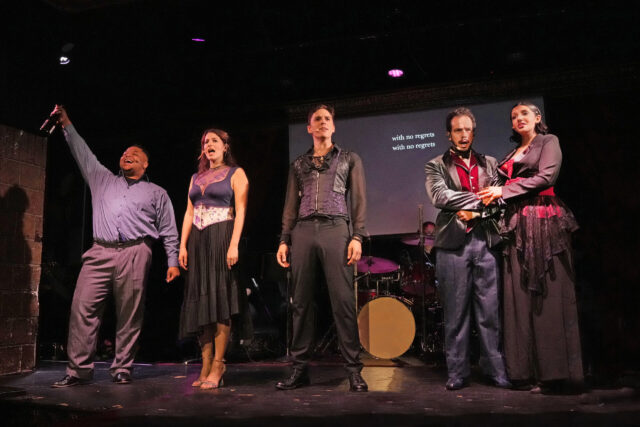
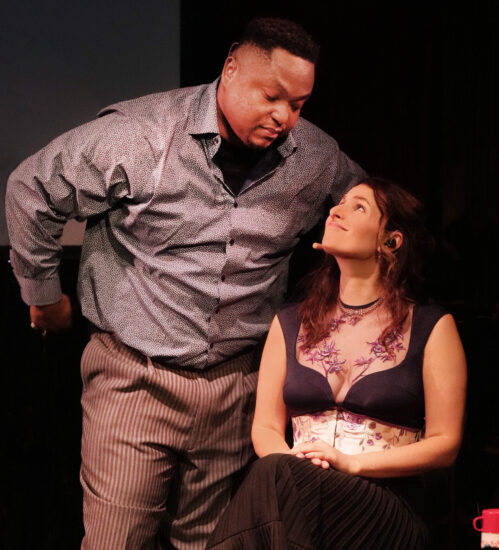
Rachel Zatcoff is superb as Donna Elvira in Adam B. Levowitz’s rock opera adaptation of Mozart’s Don Giovanni at the Cutting Room; if only the rest of the production lived up to her excellence. Mozart’s 1787 tale, with a libretto by Lorenzo DaPonte, is returning to the Met this fall, a two-hundred-minute extravaganza directed by Ivo van Hove and conducted by Yannick Nézet-Séguin and Daniele Rustioni; producer, director, and orchestrator Levowitz’s English-language version has been streamlined to about two hours, primarily by eliminating the subplot involving Zerlina and Mesetto.

The crux of the central story is still intact. After bedding Donna Anna (Anchal Dhir), the dashing Don Giovanni (Ryan Silverman) is challenged to a duel by her father, the Commander (Edwin Jhamaal Davis). Giovanni implores the older man to walk away, but his pride gets the best of him, and Giovanni kills him. Anna then insists that her fiancé, the weak-kneed Don Ottavio (Felipe Bombonato), defend her honor and kill Giovanni, which is not really in his wheelhouse.

Meanwhile, a former lover of Giovanni’s, Elvira, has been searching for “the bastard who left me,” prepared to “take a bow knife and slice his heart from his chest . . . for the maidens he deflowered.” Giovanni and his right-hand man, the clownish Leporello (Richard Coleman), keeper of The Almanac of Fornication, come upon a woman they do not recognize at first, and Giovanni turns to woo her until he sees that it is indeed Elvira, who tells him she wants to castrate him. He runs away.

Levowitz’s plot grows more and more silly as Anna and Ottavio seek revenge, Giovanni keeps trying to increase the number of women he has seduced, Elvira has to decide whether she actually loves or hates Giovanni, and Leporello serves Giovanni through thick and thin, providing comic relief that is mostly thin.

Leporello (Richard Coleman) and Donna Elvira (Rachel Zatcoff) know something is afoot in rock opera (photo by Ken Howard)

Mozart’s Don Giovanni — A Rock Opera is misguided from the start. The conceit is that we are gathered at the Cutting Room at the invitation of Baroness Margarete Voigt on December 5, 1891, the centennial of Mozart’s death at the age of thirty-five. We are told in a letter that we are in for “an evening of elegance, fine food and drink (for a modest indulgence), sensuality, and sublime music,” which sets the bar far too high for what ensues.

For two hours, Leporello makes anachronistic, self-referential jokes that fall flat, like “I won’t block your Dopamine / No, no, no, no, no, no / Cue Giovanni and scene” and “Not my circus, not my monkeys / I’m just here for vegan snacks.” The eight-piece band, consisting of two guitars, two trumpets, three trombones, bass, drums, and piano, often feels out of sync; songs work best when it’s just pianist and conductor Nevada Lozano accompanying the singer. There were significant problems with the surtitles projected onto the back screen, as they got stuck or just vanished; in addition, there were numerous typos (rogue/rouge, savoir/savior), and what was being sung was not always exactly what was on the screen. While the sentences still meant the same thing, the slight differences were distracting. Projections that were supposed to identify locations got lost on the carved facade above the stage. The acting was a mixed bag, ranging from excellent to, well, not so excellent. There were also issues with the microphones, which were so close to the performers’ mouths that the sound squealed through the speakers; only the classically trained soprano Zatcoff (The Phantom of the Opera, Candide) kept her mic at a distance, letting her lovely voice sound more naturally through the space. Debbi Hobson’s costumes make it look like the characters are not always in the same time period.

I’m all for reimagining the classics in any way possible, but this Don Giovanni had me aching for something more traditional.

Early on, Anna asks, “My God, What Is This?” After seeing the show, I have the same question.

[Mark Rifkin is a Brooklyn-born, Manhattan-based writer and editor; you can follow him on Substack here.]