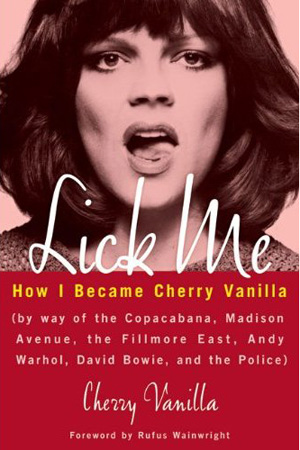
Borders, 2 Penn Plaza
Tuesday, December 7, free, 2 5:00
www.borders.com
www.cherry-vanilla.com
Poet, actress, songwriter, publicist, Mad woman, and all-around good-time girl Cherry Vanilla holds nothing back in her free-wheeling memoir, LICK ME: HOW I BECAME CHERRY VANILLA (Chicago Review Press, November 2010, $24.95). Born Kathleen Anne Dorritie in 1943 and raised in Queens, Vanilla tells of a life filled with lots of sex, lots of drugs, and lots of rock & roll. A chronic bedwetter as a child, she later developed OCD, picking at cuts and blemishes all over her body. She dreamed of being in show business, first working at Madison Ave. advertising firms before getting involved in the burgeoning downtown arts scene, hanging out at the hottest clubs and enjoying a never-ending stream of lovers. She starred in Warhol’s off-Broadway show PORK and went from groupie to music publicist to poet and performer; her stories about working with David Bowie just as he was trying to break through in the States are intimate and revealing — and might come as quite a surprise for longtime Bowie fans. She talks in-depth about her desire to bed such men as Kris Kristofferson, Warren Beatty, Leon Russell, and Bowie — but you’ll have to read the book to find out which attempts were successful. Among the many celebrities she meets in her ever-evolving career, some who became close friends, others just passing through her wild life, are Mick Jagger, Patti Smith, Joel Schumacher, Debbie Harry, Helmut Newton, Joni Mitchell, Don Johnson, Melanie Griffith, Sting, Candy Darling, Ringo Starr, Angie Bowie, Rudolf Nureyev, and Mick Ronson, and she shares some very interesting details about many of them. But Vanilla never comes off as needlessly gossipy or self-aggrandizing; instead, LICK ME is an honest portrait of a woman who knew what she wanted and went after it. The book also includes excerpts from her 1970s diaries and a sixteen-page black-and-white insert that features several shots of her in two of her favorite positions, either partially or fully unclothed. Cherry Vanilla will be at the Penn Plaza Borders on December 7, discussing her outrageous life and signing copies of the book, joined by special guest May Pang, who figures in a story in the book about Cherry trying to give John Lennon a special birthday present from Ringo.


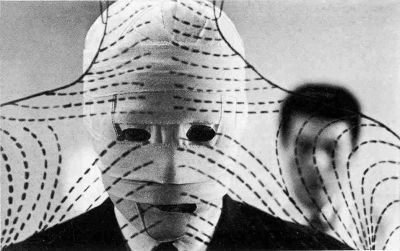
 Japanese novelist Kôbô Abe and director Hiroshi Teshigahara collaborated on five films together, including the marvelously existential WOMAN OF THE DUNES in 1964 and THE FACE OF ANOTHER two years later. In THE FACE OF ANOTHER, Tatsuya Nakadai (THE HUMAN CONDITION, KILL!) stars as Okuyama, a man whose face has virtually disintegrated in a laboratory accident. He spends the first part of the film with his head wrapped in bandages, a la the Invisible Man, as he talks about identity, self-worth, and monsters with his wife (Machiko Kyo), who seems to be growing more and more disinterested in him. Then Okuyama visits a psychiatrist (Mikijirô Hira) who is able to create a new face for him, one that would allow him to go out in public and just become part of the madding crowd again. But his doctor begins to wonder, as does Okuyama, whether the mask has actually taken control of his life, making him as helpless as he was before. Abe’s remarkable novel is one long letter from Okuyama to his wife, filled with utterly brilliant, spectacularly detailed examinations of what defines a person and his or her value in society. Abe wrote the film’s screenplay, which tinkers with the time line and creates more situations in which Okuyama interacts with people; although that makes sense cinematically, much of Okuyama’s interior narrative, the building turmoil inside him, gets lost. Teshigahara once again uses black and white, incorporating odd cuts, zooms, and freeze frames, amid some truly groovy sets, particularly the doctor’s trippy office, and Tōru Takemitsu’s score is ominously groovy as well. As a counterpart to Okuyama, the film also follows a young woman (Miki Irie) with one side of her face severely scarred; she covers it with her hair and is not afraid to be seen in public, while Okuyama must hide behind a mask. But as Abe points out in both the book and the film, everyone hides behind a mask of one kind or another.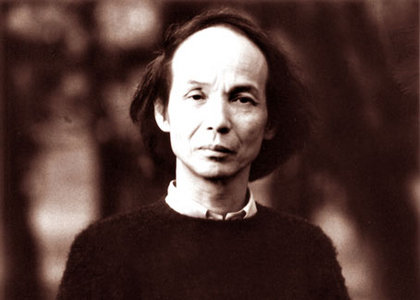
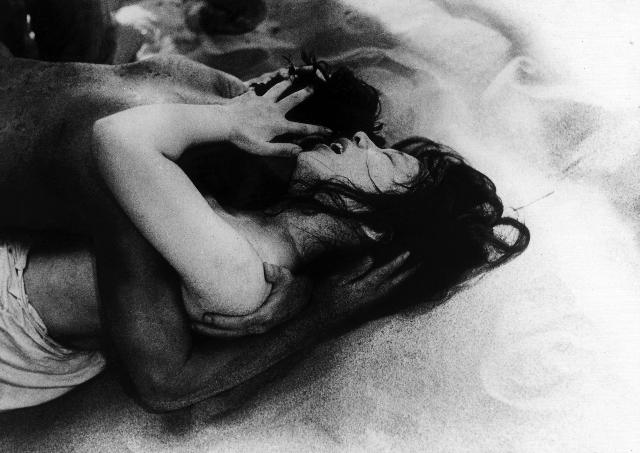
 Hiroshi Teshigahara’s Sisyphean tale, based on Kobo Abe’s marvelous novel, tells the story of an entomologist (Eiji Okada) out in the desert looking for insects when he comes upon a village of people living in the sand dunes — and he is unknowingly sucked into their world. Kyōko Kishida stars as the title character. See the movie — just wait till you get to the psychedelic head trip scene — but be sure to read the book as well; the scenes of the man trying to escape by climbing up the sand will feel oddly familiar to anyone who has ever been trapped in a seemingly inescapable situation. Teshigahara, who died in April 2001, adds surreal visual elements that make the film an unusually compelling though basically simple story. Abe also collaborated with Teshigahara on PITFALL (OTOSHIANA), THE FACE OF ANOTHER (TANIN NO KAO), and THE MAN WITHOUT A MAP (MOETSUKITA CHIZU).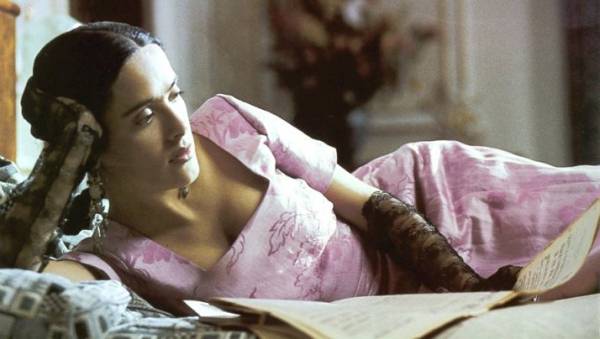
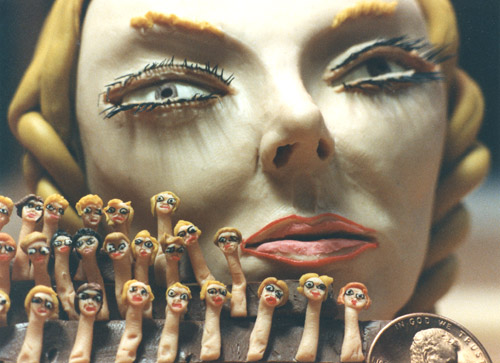
 Salma Hayek is terrific as Mexican artist Frida Kahlo in this uniquely creative biopic from Julie Taymor. Kahlo’s tumultuous twenty-five-year relationship with muralist and communist Diego Rivera (Alfred Molina) is the centerpiece of the film, which comes alive with bright colors, Elliot Goldenthal’s Oscar-winning score, splendidly bizarre animation from the Brothers Quay, and a fun group of supporting actors that includes Antonio Banderas, Ashley Judd, Valeria Golino, Edward Norton, and Geoffrey Rush as Leon Trotsky. Kahlo documented her difficult life on canvas, and Taymor uses those paintings in engaging and dramatic ways.