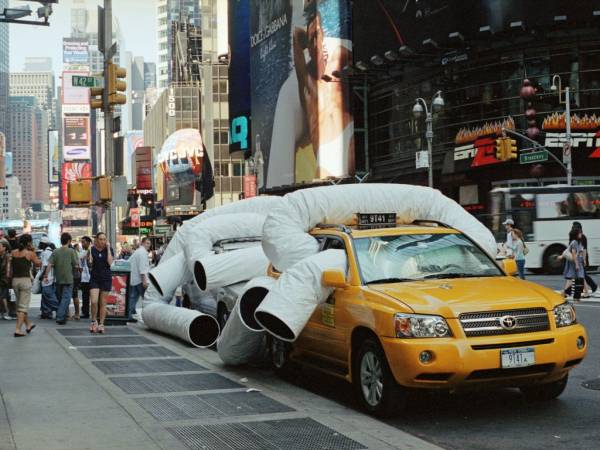
Flux Factory auction, which takes place online and at December 15 gala, includes Kathryne Hall’s digital C-print “Tubisms: Cars: Times Square” (© 2007 by Kathryne Hall)
Center 548
548 West 22nd St. between Tenth & Eleventh Aves.
Wednesday, December 15, $15-$1,000, 7:00
718-707-3362
www.fluxfactory.org
Long Island City’s Flux Factory, “a not for profit arts organization supporting innovation in things,” will be holding its annual auction Wednesday night in Chelsea, with live performances, light food and drink, and an impressive list of artists selling works to benefit the art collective. Among the participating artists are Andrea Dezsö, Dan Colen, Kathryne Hall, Marie Losier, Molly Surno, Peter Doig, Ryan McNamara, Stefany Anne Golberg, Swoon, and Ward Shelley, with Angela Washko, Daupo, Douglas Paulson, Elizabeth Larison, Gabriela Vainsencher, Sarah Glidden, and Will Harris serving as “knock-off” live artists, creating customized copies on demand. Guests of honor Elizabeth Dee and city councilmember Jimmy Van Bramer will also be feted by a performance by Alison Ward, video art by Jaime Iglehart, Matthew-Robin Nye’s creative seating, silkscreening by Bread and Butter Collective, and DJ Sondies leading a dance party. You don’t have to attend the festivities in order to bid on the works, which are all detailed online.



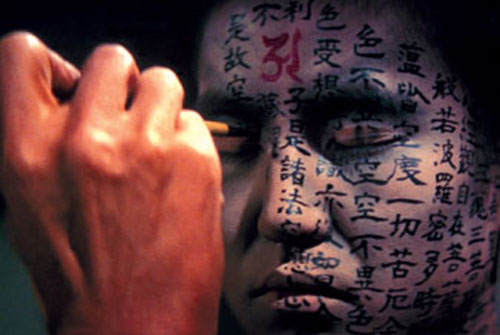
 Masaki Kobayashi paints four marvelous ghost stories in this eerie collection that won a Special Jury Prize at Cannes. In “The Black Hair,” a samurai (Rentaro Mikuni) regrets his choice of leaving his true love for advancement. Yuki (Keiko Kishi) is a harbinger of doom in “The Woman of the Snow.” Hoichi (Katsuo Nakamura) must have his entire body covered in prayer in “Hoichi, the Earless.” And Kannai (Kanemon Nakamura) finds a creepy face staring back at him in “In a Cup of Tea.” Winner of the Special Jury Prize at Cannes, KWAIDAN is one of the greatest ghost story films ever made, four creepy, atmospheric existential tales that will get under your skin and into your brain. The score was composed by Tōru Takemitsu, who said of the film, “I wanted to create an atmosphere of terror.” He succeeded.