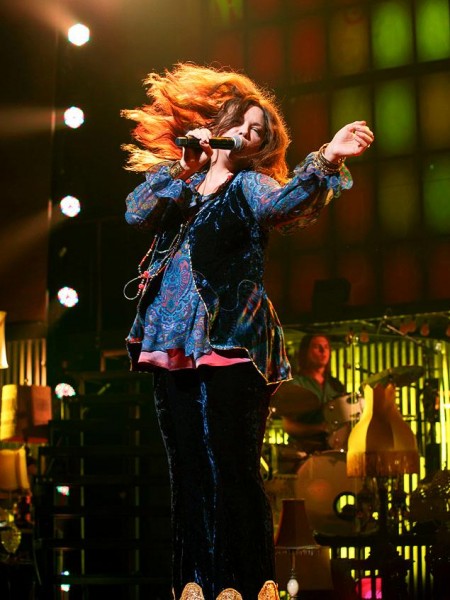
Mary Bridget Davies channels Janis Joplin in disappointing Broadway musical (photo by Joan Marcus)
Lyceum Theatre
149 West 45th St. between Sixth & Seventh Aves.
Tuesday – Sunday through March 30, $28- $140
anightwithjanisjoplin.com
Mary Bridget Davies was seemingly born to play Janis Joplin. When she was a teenager in Cleveland, she dressed as Joplin for Halloween. Later, she toured as a singer with Joplin’s band, Big Brother and the Holding Company. And now she has the lead role in the Broadway musical A Night with Janis Joplin. Davies looks like Joplin, she moves like Joplin, and, most impressive, she sounds like Joplin. Unfortunately, writer-director Randy Johnson barely glosses over the personal aspects of Joplin’s life, never really delving into necessary details, instead concentrating ad nauseam on her love of the blues and her musical influences. The show is arranged as a one-night concert in which Joplin, backed by a trio of singers and a live band, blasts out classic songs, with in-between patter that quickly grows repetitive. As she talks about her heroes, they take the stage and perform, including Bessie Smith (Taprena Michelle Augustine), Nina Simone (De’Adre Aziza), Aretha Franklin (Allison Blackwell), Etta James (Nikki Kimbrough), and Odetta (Aziza again), but these numbers seem to be an excuse for Davies to rest her voice, as they add nothing to the Joplin legend. In fact, A Night with Janis Joplin occurs in a vacuum, set in no particular time period. There is no mention of the civil rights movement, sex, drugs, alcohol (Davies does take a single swig from a bottle, sans commentary), Monterey Pop, Woodstock, Jimi Hendrix, or Jim Morrison, although F. Scott and Zelda Fitzgerald show up twice, even once projected onto a screen in the back. The setlist is, of course, sensational, although too many songs are heard in incomplete versions: “Summertime,” “Down on Me,” “Piece of My Heart,” “Try (Just a Little Bit Harder),” “Cry Baby,” “Ball and Chain,” etc., in addition to the unfortunately prophetic “I’m Gonna Rock My Way to Heaven,” which Joplin was working on when she died and has never been previously performed or recorded. Set and lighting designer Justin Townsend fills the stage with dozens of lamps of all shapes and sizes, along with a row of vertical fluorescent lights in the back and yet more long, narrow fluorescent bulbs arranged askew around the front, but it’s not exactly clear why. But it does fit in with the general feel of the production, which ends up being a whole lot more style than substance. Johnson has claimed that this is not a tribute show, but it would fit in better at a venue such as B.B. King’s Blues Club, which hosts regular tributes to the Beatles, James Brown, Motown, Simon & Garfunkel, the Doors, Santana, Bruce Springsteen, and others, than at a Broadway theater, where a lot more depth is expected.
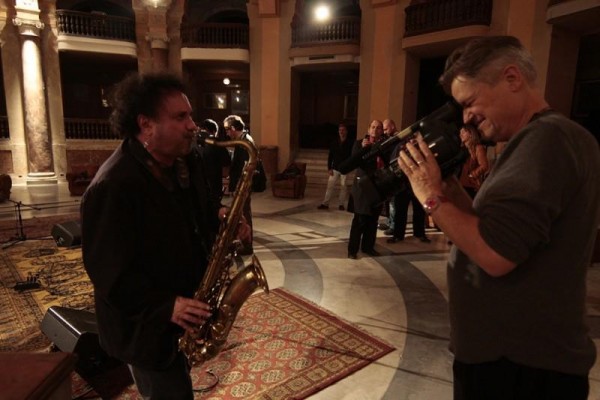
 About six years ago, Jonathan Demme was driving in his car toward the George Washington Bridge when he heard a song on the radio that changed his life. It was by a Neapolitan musician he had never heard of before, Enzo Avitable. A few years later, producer Davide Azzolini invited Demme to be a special guest at the Naples Film Festival, and Demme agreed to attend, as long as he got to meet Avitable. Not only did Azzolini arrange the meeting, but they all decided to work together as well. The result is the charming documentary Enzo Avitable Music Life, in which Demme captures the always smiling and positive Avitable playing in a beautiful Baroque church with a stellar group of musicians from around the world, showing off his cluttered apartment (along with photos of him with James Brown, Tina Turner, and other superstars he has performed with), and visiting his childhood town of Marianella. As with such previous Demme documentaries as Stop Making Sense, Storefront Hitchcock, and