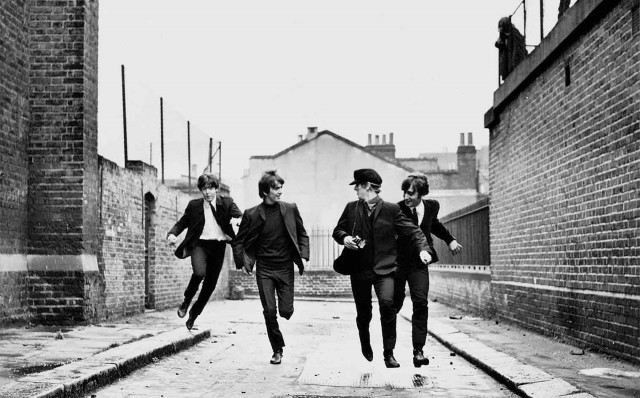
Fiftieth anniversary restoration of A HARD DAY’S NIGHT is playing July 4-17 at Film Forum
A HARD DAY’S NIGHT (Richard Lester, 1964)
Film Forum
209 West Houston St.
Opens July 4, 12:45, 3:00, 5:10, 7:30, 9:45
212-727-8110
www.filmforum.org
www.thebeatles.com
 The Beatles are invading America again with the fiftieth anniversary restoration of their debut film, the deliriously funny anarchic comedy A Hard Day’s Night. Initially released on July 6, 1964, in the UK, AHDN turned out to be much more than just a promotional piece advertising the Fab Four and their music. Instead, it quickly became a huge critical and popular success, a highly influential work that presaged Monty Python and MTV while also honoring the Marx Brothers, Buster Keaton, Jacques Tati, and the French New Wave. Directed by Richard Lester, who had previously made the eleven-minute The Running Jumping & Standing Still Film with Peter Sellers and would go on to make A Funny Thing Happened on the Way to the Forum, Petulia, and The Three Musketeers, the madcap romp opens with the first chord of the title track as John Lennon, Paul McCartney, George Harrison, and Ringo Starr are running down a narrow street, being chased by rabid fans, but they’re coming toward the camera, welcoming viewers into their crazy world. (George’s fall was unscripted but left in the scene.) As the song blasts over the soundtrack, Lester introduces the major characters: the four moptops, who are clearly having a ball, led by John’s infectious smile, in addition to Paul’s “very clean” grandfather (Wilfrid Brambell, who played a dirty old man in the British series Steptoe and Son, the inspiration for Sanford and Son) and the band’s much-put-upon manager, Norm (Norman Rossington). Lester and cinematographer Gilbert Taylor (Dr. Strangelove or: How I Learned to Stop Worrying and Love the Bomb, Repulsion, Star Wars) also establish the pace and look of the film, a frantic black-and-white frolic shot in a cinema-vérité style that is like a mockumentary taking off from where François Truffaut’s 400 Blows ends.
The boys eventually make it onto a train, which is taking them back to their hometown of Liverpool, where they are scheduled to appear on a television show helmed by a hapless director (Victor Spinetti, who would star in Help as well) who essentially represents all those people who are dubious about the Beatles and the sea change going on in the music industry. Norm and road manager Shake (John Junkin) have the virtually impossible task of ensuring that John, Paul, George, and Ringo make it to the show on time, but there is no containing the energetic enthusiasm and contagious curiosity the quartet has for experiencing everything their success has to offer — while also sticking their tongues out at class structure, societal trends, and the culture of celebrity itself. Lester and Oscar-nominated screenwriter Alun Owen develop each individual Beatle’s unique character through press interviews, solo sojourns (the underappreciated Ringo goes off on a kind of vision quest; George is mistaken by a fashion fop for a model), and an endless stream of spoken and visual one-liners. (John sniffs a Coke bottle; a reporter asks George, “What do you call your hairstyle?” to which the Quiet One replies, “Arthur.”) Oh, the music is rather good too, featuring such songs as “I Should Have Known Better,” “All My Loving,” “If I Fell,” “Can’t Buy Me Love,” “I’m Happy Just to Dance with You,” “This Boy,” and “She Loves You.” The working name for the film was Beatlemania, but it was eventually changed to A Hard Day’s Night, based on a Ringo malapropism, forcing John and Paul to quickly write the title track. No mere exploitation flick, A Hard Day’s Night is one of the funniest, most influential films ever made, capturing a critical moment in pop-culture history and unleashing four extraordinary gentlemen on an unsuspecting world. The fiftieth-anniversary restoration, courtesy of Janus Films, is screening July 4-17 at Film Forum; don’t you dare miss this glorious eighty-five-minute explosion of sheer, unadulterated joy.
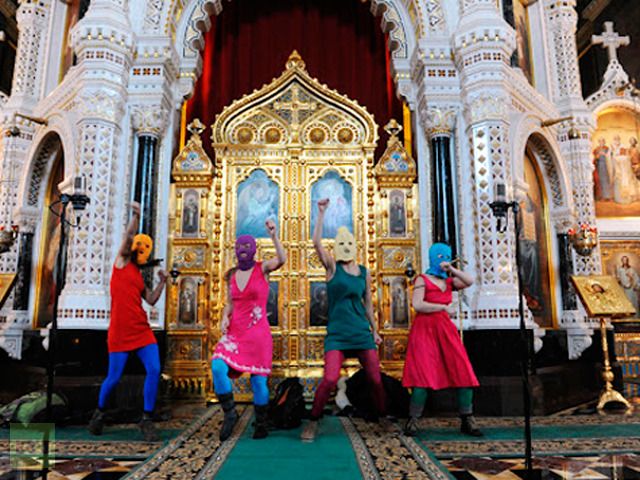
 The slogan “Free Pussy Riot!” is being shouted around the world — and was even seen on Madonna’s back — ever since the Russian government arrested three members of punk collective Pussy Riot after they staged an anarchic performance of less than one minute of “Mother Mary, Banish Putin!” at Christ the Savior Cathedral in Moscow on February 21, 2012. British documentary producer Mike Lerner and Russian filmmaker Maxim Pozdorovkin follow the sensationalistic trial of Pussy Riot leaders Maria “Masha” Alyokhina, Nadezhda “Nadia” Tolokonnikova, and Yekaterina “Katia” Samutsevich as they each face years in prison for social misconduct and antireligious behavior for what some consider a sacrilegious crime and others view as freedom of speech. The three women do a lot of eye rolling and smiling in court as they are enclosed in a glass booth, proud and unashamed of what they did, continuing to make their points about the separation between church and state, feminism, freedom, and the seemingly unlimited power of Vladimir Putin. Lerner and Pozdorovkin speak with Masha’s mother and Nadia’s and Katia’s fathers, all of whom fully support their daughters’ beliefs and discuss what their children were like growing up. Meanwhile, other members of Pussy Riot and men and women across the globe take to the streets and airwaves to try to help free the incarcerated trio, who are responsible for such songs as “Kill the Sexist,” “Death to Prison, Freedom to Protests,” and “Putin Lights Up the Fires.” Pussy Riot — A Punk Prayer is screening August 27 in Long Island City as part of Socrates Sculpture Park’s free summer Outdoor Cinema series and will be preceded by live music from Tessa Makes Love; Russian food from Pomegranate will be available for purchase as well. The sixteenth annual series continues through August 27 with such other international fare as Moussa Touré’s La Pirogue, Takashi Miike’s 13 Assassins, and Vittorio De Sica’s Umberto D. (The program was originally scheduled for July 2 but was postponed because of the weather.)