THE PLEASURES OF BEING / OUT OF STEP: NOTES ON THE LIFE OF NAT HENTOFF (David L. Lewis, 2014)
IFC Center
323 Sixth Ave. at West Third St.
Opens Wednesday, June 25
212-924-7771
www.ifccenter.com
www.pleasuresthemovie.com
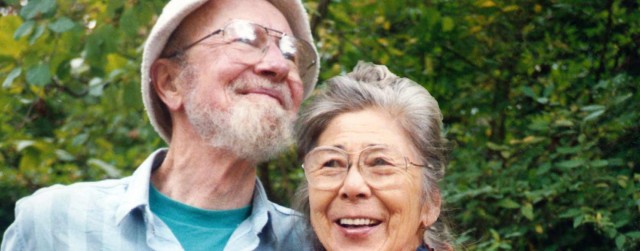
The seven-decade legacy of one of America’s most important and influential journalists is celebrated in David L. Lewis’s illuminating documentary, The Pleasures of Being / Out of Step: Notes on the Life of Nat Hentoff. The too-short, sometimes scattershot eighty-five-minute film reveals Hentoff to be much more than just a columnist and a critic; Lewis, in his debut feature film, shows Hentoff, who turned eighty-nine earlier this month, to be a fascinating character who speaks his mind, a fierce defender of the First Amendment, a crucial participant in the spread of jazz in the mid-twentieth century (including as a record producer), and an outspoken libertarian who is adamantly antiabortion. “When he came to a room, nobody said, ‘Oh, here’s the critic,’” saxophonist and composer Phil Woods explains. “They said, ‘Here’s a friend of the music.’ It’s a whole different thing. He was part of the family.” Lewis speaks extensively with the Boston-born Hentoff, a bent-over man with thick, silvery-gray hair, beard, and mustache who types with two fingers in his extremely messy and crowded home office, as well as Hentoff’s wife, Margot; cultural critic Stanley Crouch; former Village Voice editor Karen Durbin; First Amendment attorney Floyd Abrams; recently deceased poet and activist Amiri Baraka; jazz historians Dan Morgenstern and John Gennari; and even Voice editor Tony Ortega, who fired Hentoff in 2009. Hentoff discusses his childhood, his start in journalism, his personal and professional relationships with such figures as Bob Dylan, Charles Mingus, and Malcolm X, and his steadfast defense of civil liberties.
The film is narrated by Andre Braugher, who reads passages from some of Hentoff’s seminal liner notes, and also includes stunning, rarely seen archival footage of Lenny Bruce, Hentoff on William F. Buckley’s Firing Line and with Andrew Young on Look Up and Live, an all-star rendition led by Billie Holiday of “Fine and Mellow” from the television program The Sound of Jazz, and other great clips. “You never know what impact you have, if any,” Hentoff says late in the film. “So I write to write, and hope that some of it has some effect.” Hentoff needn’t worry; he’s had plenty of effect, and continues to do so now, in his weekly column for the independent news site WorldNetDaily. The Pleasures of Being / Out of Step opens June 25 at the IFC Center, with Lewis participating in Q&As following the 8:00 screening on June 25 and the 8:15 show on June 27.


Inspired by Rene Daumal’s Mount Analogue: A Novel of Symbolically Authentic Non-Euclidean Adventures in Mountain Climbing, Alejandro Jodorowsky’s The Holy Mountain also involves symbolically non-Euclidean adventures in mountain climbing, funneled through Carlos Castaneda, Stanley Kubrick’s 2001: A Space Odyssey, and magic mushrooms and LSD galore. What passes for narrative follows a Jesus look-alike thief (Horacio Salinas) and an alchemist with a thing for female nudity (Jodorowsky) on the path to enlightenment; along the way they encounter the mysterious Tarot, stigmata, stoning, eyeballs, frogs, flies, cold-blooded murder, naked young boys, chakra points, life-size plaster casts, Nazi dancers, sex, violence, blood, gambling, turning human waste into gold, death and rebirth, and the search for the secret of immortality via representatives of the planets, each with their own extremely bizarre story to tell. Jodorowsky, who is credited with having invented the midnight movie with the 1970 acid Western El Topo, literally shatters religious iconography in a kaleidoscopic whirlwind of jaw-droppingly gorgeous and often inexplicable imagery composed from a surreal color palette, set to a score by free jazz trumpeter Don Cherry and Archies keyboardist Ron Frangipane. (Frangipane also worked with John Lennon and Yoko Ono, who produced this film with their business manager, Allen Klein.)