this week in music

A LOVE SUPREME

(photo © Anne Van Aerschot)

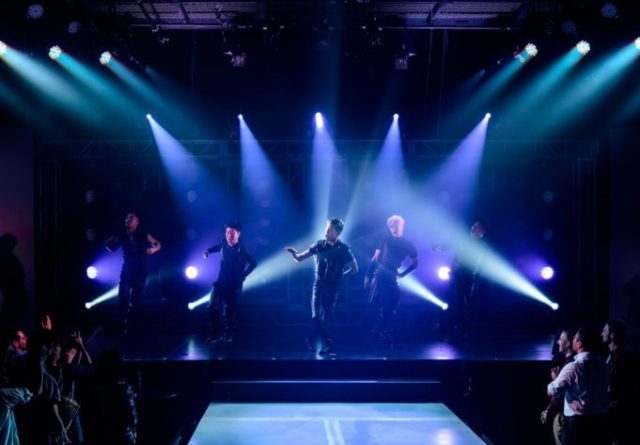
Four dancers play the roles of four musicians in Anne Teresa De Keersmaeker and Salva Sanchis’s revisiting of John Coltrane’s A Love Supreme (photo © Anne Van Aerschot)

New York Live Arts
219 West 19th St. between Seventh & Eighth Aves.
September 27-30, 7:30
212-924-0077
newyorklivearts.org
www.rosas.be/en

Bill T. Jones’s New York Live Arts strives to encompass more than just dance, a goal achieved with their stunning production of A Love Supreme, Belgian choreographer Anne Teresa De Keersmaeker and Spanish dancer and choreographer Salva Sanchis’s newly rewritten version of their 2005 evening-length piece, which continues at NYLA through September 30. Thirty minutes before the piece begins onstage in the theater, saxophonist Tony Jarvis and bassist Nathan Peck move about the waiting audience in the lobby space and head out into the street of passersby and onlookers as they perform excerpts from John Coltrane’s masterful, boundary-breaking 1965 album, the original recording of which serves as the soundtrack of De Keersmaeker and Sanchis’s collaboration. You don’t need a ticket to just hang out, get a drink, and watch Jarvis and Peck interact with each other in a way that only jazz allows, creating a spiritual conversation of dissonance and beauty. This prelude serves as an ingenious introduction to what follows inside the theater, as four male dancers embody the roles of the four main musicians on the record. The show begins in silence, with Thomas Vantuycom as saxophonist Coltrane, Jason Respilieux as bassist Jimmy Garrison, Bilal El Had (or Robin Haghi) as pianist McCoy Tyner, and José Paulo dos Santos as drummer Elvin Jones. They are all barefoot, dressed in black, with black tape dividing the black floor into a flurry of geometric patterns.

Tony Jarvis and Nathan Peck (photo by twi-ny/mdr)

Tony Jarvis and Nathan Peck perform a Coltrane overture to get the audience in just the right mood for A Love Supreme (photo by twi-ny/mdr)

After several minutes, the music starts, the glorious four-part suite consisting of “Acknowledgement,” “Resolution,” “Pursuance,” and “Psalm,” which Coltrane performed only once live in its entirety. “You see, one thing about that music is that it showed you that we had reached a level where you could move the music around,” Tyner told NPR in 2012. “John had a very wonderful way of being flexible with the music, flexing it, stretching it. You know, we reflected that kind of thing. He gave us the freedom to do that.” That idea translates beautifully into De Keersmaeker and Sanchis’s choreography, in which the dancers follow the general progression of the “sheets of sound,” as Coltrane described it, ranging from solos to duets to trios to quartets but never just mimicking what is being played. When a musician takes a solo, that respective dancer improvises. Meanwhile, the other dancers stand aside and watch, just as jazz musicians do. All four performers are outstanding, with Vantuycom brilliant in the lead, swirling with his elongated arms, making angular gestures, and gliding across the floor as Coltrane soothes the soul.

BROOKLYN MUSEUM FIRST SATURDAY: BEYOND BORDERS

Proof

Robert Longo, “Untitled (Dividing Time),” nylon and polyester poplin, hand appliqué, 2017 (courtesy of Creative Time’s “Pledges of Allegiance”)

Brooklyn Museum
200 Eastern Parkway at Washington St.
Saturday, October 7, free, 5:00 – 11:00
212-864-5400
www.brooklynmuseum.org

The Brooklyn Museum’s monthly free First Saturday program returns after its annual September Labor Day weekend break with “Beyond Borders,” an exploration of the immigrant crisis. There will be live performances by Locos por Juana, Batalá New York, and DJ Geko Jones with La Chiquita Brujita and DJ Big Nito; poetry with Cave Canem’s Darrel Alejandro Holnes and Jessica Lanay Moore; an immersive screening of Alejandro Jodorowsky’s mind-bending The Holy Mountain with live performances; a salsa party with lessons by Balmir Latin Dance Company; a hands-on workshop in which participants can make clay vessels; pop-up gallery talks with teen apprentices focusing on works that honor Latinx history; a curator tour of “Proof: Francisco Goya, Sergei Eisenstein, Robert Longo” led by Sara Softness; and a community talk with Movimiento Cosecha about immigrant rights. In addition, the galleries will be open late so you can check out “Arts of Korea,” “The Legacy of Lynching: Confronting Racial Terror in America,” “Infinite Blue,” “A Woman’s Afterlife: Gender Transformation in Ancient Egypt,” “The Dinner Party by Judy Chicago,” and more.

ANNE TERESA DE KEERSMAEKER & SALVA SANCHIS : A LOVE SUPREME

(photo © Anne Van Aerschot)

Anne Teresa De Keersmaeker and Salva Sanchis revisit John Coltrane’s A Love Supreme with four male dancers (photo © Anne Van Aerschot)

New York Live Arts
219 West 19th St. between Seventh & Eighth Aves.
September 27-30, 7:30
212-924-0077
newyorklivearts.org
www.rosas.be/en

In December 1964, saxophonist John Coltrane made one of the greatest jazz records of all time, A Love Supreme, a four-part suite consisting of “Acknowledgement,” “Resolution,” “Pursuance,” and “Psalm,” featuring Coltrane on tenor and soprano sax, Jimmy Garrison on double bass, Elvin Jones on drums and percussion, and McCoy Tyner on piano. In 2005, Belgian choreographer Anne Teresa De Keersmaeker and Spanish dancer and choreographer Salva Sanchis created the four-part dance suite A Love Supreme, set to Coltrane’s legendary music; they have now revisited the piece, rewriting it for four male dancers from De Keersmaeker’s Rosas company. The fifty-five-minute dance work, which will be performed by José Paulo dos Santos, Bilal El Had / Robin Haghi, Jason Respilieux, and Thomas Vantuycom, investigates the desire for happiness through mysticism and spirituality, incorporating jazzlike improvisation into the movement, with each dancer interpreting one of the musicians on the record: Vantuycom is Coltrane, Respilieux is Garrison, El Had / Haghi is Tyner, and dos Santos is Jones. When the musicians improvise, so will the dancers.

“Taking on A Love Supreme fits with the idea of revisiting and rewriting Rosas’s repertoire for a new generation of dancers,” De Keersmaeker said in a statement. “What is interesting about the piece, in addition to its intrinsic connection with this milestone of twentieth-century music, is the way it combines improvised and written choreography.” Sanchis, who was part of the original cast in 2005, added, “On the whole, A Love Supreme is more suitable for a dance performance than a simple collection of songs. The music poses a structure with a beginning and an end, offering a kind of dramaturgical accessibility.” The New York City premiere of A Love Supreme runs at New York Live Arts September 27-30 at 7:30, with saxophonist Tony Jarvis performing a tribute to the seminal album at seven o’clock each night. The September 28 show will be followed by a Stay Late Conversation moderated by NYU associate professor and associate chair André Lepecki; there will be a Shared Practice workshop September 30 at 2:00 ($20) with Rosas rehearsal director Bryana Fritz and Respillieux; and on September 30 at 5:00 ($10), NYLA artistic director Bill T. Jones will be joined by music historian Ashley Kahn and bassist and composer Reggie Workman for the special Coltrane program “Bill Chats — The Man and His Music.” Tickets are sold out for all four shows, but there will be a standby line each evening to see what De Keersmaeker calls “essentially a piece about defying gravity. It is a piece about the relationship between mankind and the planet, between the vertical and the horizontal.”

PROJECTS 107: LONE WOLF RECITAL CORPS LIVE PERFORMANCES

(photo by Scott Shaw)

Special live performance celebrated opening of Terry Adkins exhibition at MoMA (photo by Scott Shaw)

Museum of Modern Art
11 West 53rd St. between Fifth & Sixth Aves.
Through October 9
212-708-9400
www.moma.org

Washington-born multimedia artist Terry Adkins died in 2014 in Brooklyn at the age of sixty. MoMA is paying tribute to his legacy with the small but intimate exhibition “Projects 107: Lone Wolf Recital Corps,” consisting of film, sculpture, instrumentation, paraphernalia, and live performances. Adkins founded the Lone Wolf Recital Corps collective in Zurich in 1986, collaborating with a wide range of artists in numerous disciplines while honoring such figures as Matthew Henson, Bessie Smith, John Coltrane, George Washington Carver, Zora Neale Hurston, and John Brown. The exhibit, which continues through October 9, features such works as “Methane Sea,” constructed of rope, steel, wood, and tape and evoking something that could be found aboard a slave ship; “Omohundro,” an unusual brass and copper instrument; “Upperville,” concrete in which African porcupine quills emerge; a banner that reads “A Man Was Lynched Yesterday,” a replica of the flag the NAACP used to hang out their window on Fifth Ave. after such tragedies; “Amulet,” an almost noose/whip-like black wall hanging made of rubber, rope, electrical wire, tape, and steel; four eighteen-feet-long akrhaphones (the “rha” in the middle of the name is an homage to Adkins’s father); “Sus Scrofa (Linnaeus),” a contrabass covered by a boar hide and skull; and a trio of performance videos, The Last Trumpet from Performa 13 in November 2013; Facets: A Recital Compilation from Skidmore College the previous year; and, also from 2012, Atum (Honey from a Flower Named Blue), in which Clifford Owens puts on the wolf skin that is on view under the abovementioned banner. There is also background on Adkins alter ego and Lone Wolf mystery member Blanche Bruce, named after the first elected African American politician and only former slave to serve a full term in the Senate. “My quest has been to find a way to make music as physical as sculpture might be, and sculpture as ethereal as music is,” Adkins said in a 2006 interview with Dana Roc. In conjunction with the exhibition, there will be a series of live performances, held in the gallery space, the downstairs theater, and the education center next door; advance tickets are recommended.

Terry Adkins exhibition makes its points through sound and image (photo by twi-ny/mdr)

Terry Adkins exhibition makes its points through sound and image at MoMA (photo by twi-ny/mdr)

Monday, September 18
An Evening with Kamau Amu Patton, featuring restaging of Patton’s Amun (The Unseen Legends) with live electroacoustic improvisation to Patton’s Theory of Colors, screening of Patton’s 2008 performance Proliferation of Concept / Accident Tolerant, and discussion with Patton and Akili Tommasino, Roy and Niuta Titus Theater, $12, 7:00

Wednesday, September 20
A Living Space, with Sanford Biggers, Juini Booth, Demetrius Oliver, Clifford Owens, Kamau Amu Patton, and Dread Scott restaging passages from 2013 recital Postlude (Corpus Specere), exhibition space, $12, 7:00

Sunday, September 24
Envy of the World (A Blues for Terry Adkins), with Blanche Bruce on chordophone, Cavassa Nickens and Jamaaladeen Tacuma on bass, Kamau Amu Patton on banjo, and recitation by Arthur Flowers, Tyehimba Jess, and Rashid Johnson, exhibition space, $12, 7:00

Tuesday, September 26
A Visionary Recital (after Terry Adkins), with Charles Gaines on percussion, Jason Moran on piano, and Jamaaladeen Tacuma on bass, improvising new composition by Gaines based on scrolling projection of Lone Wolf text translated into music, Roy and Niuta Titus Theater, $12, 7:00

Wednesday, September 27
The Legacy of Terry Adkins and the Lone Wolf Recital Corps, panel discussion with Charles Gaines, Clifford Owens, and Kamau Amu Patton, moderated by Valerie Cassel Oliver and Akili Tomassino, Education and Research Building, Celeste Bartos Theater, $15, 6:00

Saturday, September 30
PopRally Presents: Twilight Brothers, with Sacred Order members Clifford Owens and Kamau Amu Patton and Da’Niro Elle Brown, Zachary Fabri, LaMont Hamilton, and Kambui Olujimi, followed by lobby reception and DJ set by Patton and Brown, exhibition viewing, and open bar, Roy and Niuta Titus Theater, $25, 9:00

TWI-NY TALK: AMANDA SZEGLOWSKI / STAIRWAY TO STARDOM

(photo by Maria Baranova)

Writer, director, choreographer, and performer Amanda Szeglowski dreams of fame and fortune in Stairway to Stardom (photo by Maria Baranova)

STAIRWAY TO STARDOM
HERE
145 Sixth Ave. at Dominick St.
September 12-23, $18-$45, 8:30
212-647-0202
www.here.org

Before there was Star Search, American Idol, The Voice, and America’s Got Talent there was Stairway to Stardom, a no-budget New York City public access television show in which men, women, and children performed with big dreams in their heads, hoping to make it big. Writer, director, choreographer, performer, and “global paradigm architect” Amanda Szeglowski explores the American dream of reaching for fame and fortune in the vastly entertaining and ridiculously clever multimedia production Stairway to Stardom, which opened at HERE on September 12. The sixty-minute show features Szeglowski and her cakeface company, Ali Castro, Jade Daugherty, Ayesha Jordan, and Nola Sporn Smith, in glittery silver-sequined gowns and high heels singing, dancing, and sharing their successes and failures, their hopes and desires with a dry, wry mechanical delivery deliciously at odds with the spectacular longing for stardom that lies beneath.

The narrative follows the arc of a contemporary U.S. life in the arts, from what creative kids want to be when they grow up and what their parents expect of them to discovering their unique talent and then working odd jobs as they strive for artistic (and maybe even financial) success while also experiencing regrets. The performers are joined by Prism House — Brian Wenner and Matt O’Hare — who provide live video and music mixing, featuring excerpts from the original public access program. Szeglowski, who is also HERE’s marketing director, formed the all-female cakeface in 2008; their previous “linguistic performance art” projects include Don’t Call Me McNeill., Alpha Pups, and Harold, I Hate You. The new show continues through September 23; there will be a talkback following the September 20 performance, and September 15 and 19 are ’80s nights, in which the audience is encouraged to dress with their best retro flair. The show begins at 8:30, but HERE will be projecting clips from the original Stairway to Stardom in the lounge beginning at 7:00 every evening. Shortly after opening night, which kicked off HERE’s twenty-fifth anniversary season, Szeglowski found time to answer some questions about her own career trajectory.

twi-ny: As you were preparing for the opening of Stairway to Stardom, your native Florida — you went to high school in Tampa and college at USF — was being battered by Hurricane Irma. What was that experience like, balancing the two? Are your friends and family safe?

amanda szeglowski: Yes, thank you for asking. My family lives in West Tampa, so we were all watching the storm very closely. It was an incredibly stressful time to be in tech rehearsals all day and night approaching the culmination of a show I’ve been building for three years while this monster of a storm was creeping towards my family. I was checking in on them every chance I got and FaceTiming to see all the prep they were doing to their houses, going over the evacuation plans. . . . Being a part of that process helped me feel like I was with them. But growing up in Florida and having been through many hurricanes actually gave me some comfort as well. We know how to prepare and we take it seriously. That’s not to say that wine isn’t the first thing in the hurricane supply shopping cart — it is. But I felt better knowing this wasn’t my family’s first rodeo; they knew exactly what to do.

(photo by Maria Baranova)

Nola Sporn Smith, Jade Daugherty, Ayesha Jordan, Amanda Szeglowski, and Ali Castro reach for the stars in glittering show at HERE (photo by Maria Baranova)

twi-ny: Were you ever a fan of such programs as Star Search, American Idol, The Voice, or America’s Got Talent?

as: I loved watching Star Search as a kid. As I got older and the shows got more scripted I lost interest. I think Idol changed the game by making the auditions part of the show, and then it became a gimmick of who could be the most outrageous. But I will occasionally watch clips from these shows when my parents call me and insist that they just saw the greatest thing.

twi-ny: What is it about the public access show that spurred your creative juices? You treat it with respect without getting overly kitschy or mean-spirited.

as: The TV show was so raw — so vulnerable. These weren’t people trying to become a character on a reality show; these were people really trying to make it. I respect that. There wasn’t any competitive aspect to the TV show; they were just performing and hoping to be seen. Sure, when you see clips from the TV show there are moments that you want to laugh, but I spent hours and hours interviewing people about their lives for my script, and a lot of it was pretty damn sad. At least these people were out there trying. I wanted to honor that drive and explore what happens to all of us along the way, because I think that fire is there for almost everyone in the beginning.

twi-ny: What kind of talent does someone have to display to become a member of cakeface? When someone is auditioning for you, are you more like Simon Cowell, Paula Abdul, Jennifer Lopez, Usher, or Miley Cyrus?

as: HAHAHA. I think I’m a Simon and Paula hybrid. I’m Simon because I have a crystal-clear vision of what I want, and if you don’t fit, I am not going to beat around the bush. I never want to waste anyone’s time. But Paula has a way of finding a spark in people and being respectful of their contributions, and I try to always do that. I’ve received many post-audition emails over the years from people that I didn’t hire saying the experience was really special. I’m proud of that.

twi-ny: Is anyone associated with the public access show still around? Did you have to go through any kind of permissions process to use some of the original footage?

as: The show was public access. But I did get the tapes directly from someone who was given them by the host of the show, Frank Masi, before he died. [Ed. note: Masi passed away in 2013 at the age of eighty-seven; you can watch a YouTube tribute to him and the show here.]

(photo courtesy of Amanda Szeglowski)

Amanda Szeglowski takes a well-deserved break from climbing the stairs to stardom (photo courtesy of Amanda Szeglowski)

twi-ny: How amazing was it to perform in such great costumes, as well as high heels?

as: The costumes, which are by Oana Botez, are absolutely fantastic. It’s such a blast being able to sparkle head to toe on a downtown stage — very atypical for the scene. The heels are challenging, but anything else with those costumes would be absurd, right? And the performers are all pros, so they make it work. I wanted an over-the-top glamorous look that I could juxtapose with the stark reality of our words. Oana definitely achieved that.

twi-ny: What did you want to be when you were growing up?

as: The opening text, which I call a monologue (even though it’s delivered by five voices), is basically a run-on sentence ticking off all of my childhood dreams. It includes a mermaid, grocery store checkout clerk, princess, trapeze artist, restaurateur, and movie star. Of course, I always wanted to be a dancer, but that’s obvious, and our unfulfilled dreams are so much more interesting.

twi-ny: What’s the worst job you’ve ever had?

as: I’ve had a slew of them. The story in the show about working in the housewares department at Burdines was my life at age fifteen. I had no idea how to sell kitchen appliances and would literally walk away from customers and kick back in the stock room. That was pretty awful. There’s another story about a boss with revolting coffee breath; that was my first job in NYC. But another horrific experience was telemarketing. In high school I worked at a call center selling satellite broadcasting to elderly people in rural areas. I had to convince them they needed HBO. It was super sleazy, plus I got sexually harassed by my boss. I’d say fifteen was not a banner year for my career trajectory.

twi-ny: What would you like audiences to take away from the show?

as: I’d like them to be reminded of our often-naive notions of success and talent, reflect on the choices they’ve made, and leave with a glimmer of hope.

EXTRAORDINARY ORDINARY PEOPLE

Sheila Kay Adams

Sheila Kay Adams is featured in new documentary and will perform live at two screenings opening weekend at Cinema Village

EXTRAORDINARY ORDINARY PEOPLE (Alan Govenar, 2017)
Cinema Village
22 East 12th St. between University Pl. & Fifth Ave.
Opens Friday, September 15
212-529-6799
www.firstrunfeatures.com
www.cinemavillage.com

With the future of such government agencies as the National Endowment for the Arts in jeopardy, documentarian and folklorist Alan Govenar celebrates the NEA’s National Heritage Fellowships in Extraordinary Ordinary People. Since 1982, the fellowships have honored “our nation’s master folk and traditional artists . . . recognizing the ways these individuals demonstrate and reflect our nation’s living cultural heritage and the efforts of these artists to share their knowledge with the next generation.” Govenar speaks with the program’s founder and first director, Bess Lomax Hawes, and former director Dan Sheehy, who explain the importance of nurturing a diverse group of artists who often live and work on the margins. New and archival footage feature more than two dozen figures, from such musicians and singers as Koko Taylor, Clifton Chenier, Wanda Jackson, Narciso Martinez, Sheila Kay Adams, “Flaco” Jiménez, John Lee Hooker, Chum Ngek, “Queen” Ida Guillory, Earl Scruggs, and B. B. King to such artisans as quilter Laverne Brackens, lace maker Sonia Domsch, and ceremonial regalia maker Clarissa Rizal. Govenar (The Beat Hotel, Stoney Knows How) previously documented the story of another of the film’s subjects, dancer and drummer Sidiki Conde, in You Don’t Need Feet to Dance. The film opens September 15 at Cinema Village; the 8:00 shows on Friday and Saturday night will be followed by a Q&A and mini-concert with Govenar, Adams, and Conde.

BILL MURRAY, JAN VOGLER & FRIENDS: NEW WORLDS

 Photo by Jim Rakete (Jan Vogler) and Marco Grob (Bill Murray),

Jan Vogler (Photo by Jim Rakete) and Bill Murray (photo by Marco Grob) seek out new worlds in unique collaboration

Who: Bill Murray, Jan Vogler, Mira Wang, Vanessa Perez
What: Carnegie Hall concert
Where: Carnegie Hall, Stern Auditorium / Perelman Stage, 881 Seventh Ave. at Fifty-Seventh St., 212-247-7800
When: Monday, October 16, $40-$250, 8:00
Why: Bill Murray has been singing his whole career, from goofing around as Nick the lounge singer on Saturday Night Live, where he would make up words to the Star Wars theme and annoy Linda Ronstadt, to delivering a rousing rendition of “Let’s Get Physical” on Late Night with David Letterman and a tender karaoke version of Roxy Music’s “More than This” in Lost in Translation. But just as he went from being a comedian to a more serious actor, he will be taking his vocal career to unseen heights on October 16 at Carnegie Hall for “Bill Murray, Jan Vogler & Friends: New Worlds,” an evening of classical music and American literature. Suburban Chicago native Murray and German cellist Jan Vogler, who met on an airplane in 2013, attended a poetry walk across the Brooklyn Bridge together in 2015, and then decided to team up on this project, will be joined by Chinese-born violinist Mira Wang (Vogler’s wife) and Venezuelan-born pianist Vanessa Perez on compositions by Johann Sebastian Bach, Astor Piazzola, Stephen Foster, George Gershwin, Henry Mancini, Van Morrison, Leonard Bernstein, and others; Murray will recite text by Ernest Hemingway, Stephen Sondheim, Mark Twain, Walt Whitman, and more alongside Vogler’s Stradivari cello. With its international quartet, the show will also focus on various connections between America and Europe. “I am bathing in this experience, really. I can’t get enough of it,” Murray said in a statement. The New Worlds studio album will be released by Decca Gold on September 9. For a sneak peek at what to expect, check out this promotional video.