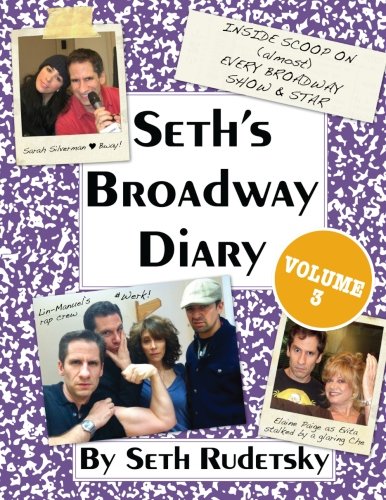
Who:Seth Rudetsky, Charles Busch, Mario Cantone, Ann Harada, Judy Kuhn What:Book release party with readings and songs Where: Barnes & Noble, 150 East 86th St. between Lexington & Third Aves., 212-369-2180 When: Monday, November 20, free, 7:00 Why: In his latest campy tome, Seth’s Broadway Diary, Volume 3: Inside Scoop on (Almost) Every Broadway Show & Star (Dress Circle, November 14, $19.99), novelist, pianist, deejay, vocal coach, actor, singer, and all-around good guy Seth Rudetsky shares more of his behind-the-scenes “Onstage and Backstage” pieces from his Playbill column, which focuses on theater and cabaret. Rudetsky (The Rise and Fall of a Theater Geek, Disaster!) will be celebrating the release of the book with a fab gathering at the Eighty-Sixth St. B&N, where he will be joined by Charles Busch (The Tale of the Allergist’s Wife, Vampire Lesbians of Sodom), Mario Cantone (Sex and the City, Laugh Whore), Ann Harada (Avenue Q, Smash), and Judy Kuhn (Les Misérables, Fun Home) for an evening of readings and music. Wristbands must be picked up in advance and priority seating is given to anyone who buys the book that day.
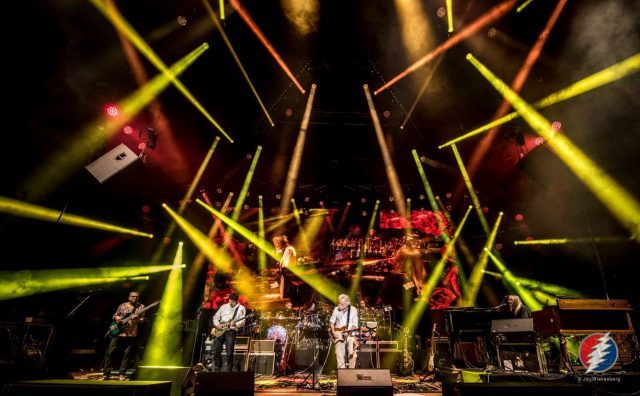
The Dead & Company fall tour comes to Madison Square Garden on November 12 and 14
Madison Square Garden
Seventh to Eighth Ave. between 31st & 33rd Sts.
Sunday, November 12, and Tuesday, November 14, $75-$500, 7:00 www.msg.com www.deadandcompany.com
When the Grateful Dead performed their five fiftieth anniversary “Fare Thee Well” concerts in 2015, the hype machine went into overdrive celebrating the legendary band’s history. Most mainstream media outlets treated “Fare Thee Well” as a one-time mega-event, roundly ignoring that the surviving members of the reuniting band had spent the twenty years following Jerry Garcia’s passing and the Grateful Dead’s demise performing together in some form or another more or less continuously in a number of guises and permutations. As recently as 2009, the four longest-tenured members of the historic psychedelic/Americana act (guitarist Bob Weir, bassist Phil Lesh, and drummers Bill Kreutzmann and Mickey Hart) had all toured together as the Dead, followed by Weir and Lesh combining forces in the group Furthur. Following the culmination of the historic “Fare Thee Well” shows, Lesh returned to fronting his long-running, rotating Phil & Friends combo in a reduced touring mode, but Weir, Kreutzmann, and Hart wasted little time in regenerating the long-running musical conversation that is the Grateful Dead’s legacy and raison d’etre.
Forming yet another new continuation of the theme — Dead & Company, which comes to the Garden on November 12 and 14 — the three took to the road in fall of 2015 with the somewhat initially curious choice of John Mayer in the lead guitarist role — a chair that has been ably filled in previous mix-and-match combinations by capable pros including Steve Kimock, Mark Karan, Jimmy Herring, Warren Haynes, John Kadlecik, and Trey Anastasio . . . though always with some controversy and always with the ubiquitous and attendant moaning or applauding of various segments of the vocal Deadhead fan base. Mayer may have seemed a peculiar choice initially, his ability as a stellar blues-influenced guitarist being somewhat overshadowed by his celebrity reputation and pop-influenced solo musical output. He had developed an interest in the Grateful Dead’s music only in recent years, but after playing with Weir on a couple of occasions, Mayer threw himself into studying the group’s material as well as its ethos. Though debate continued to rage among Deadheads over the choice, each successive tour undertaken by the nascent Dead & Co. enterprise (from 2015 to the present) has seen Mayer acclimating more and more and gradually crafting his own unique spin on the band’s repertoire — a technique sounding individualistic but still reverent to both the memory of his beatified progenitor, Garcia, and to the overall gestalt of a group that has now been creating music for more than half a century.
With a celebrated multipart documentary (Long Strange Trip) appearing on Amazon in 2017, the Grateful Dead is nothing short of an American phenomenon in the minds of casual music fans and dedicated heads alike. The Dead & Company aggregation has taken to the road again this fall to continue exploring the band’s music, pushing sonic boundaries (including the improvisational Drums-and-Space segments that were a staple of GD shows), and as always performing a completely different setlist at every unique performance. The group’s summer tour proved highly lucrative, with the shows well attended and parking lots approximating the nostalgic circus atmosphere of the Dead’s heyday. And in keeping with tradition, the repertoire over this jaunt was indeed varied, with more than one hundred different songs being played over twenty shows. Even this, though, raised some murmuring among the devoted fan base, who noted the band’s current incarnation sticking to a less-catholic assortment of material, eschewing post-Garcia compositions written by the later iterations of the band and its members. Missing in action, for instance, were any of Weir’s latter-day songs with RatDog, music explored and developed by post-Jerry outfits the Other Ones and Furthur, or material off Weir’s lauded 2016 Blue Mountain album.
Beside long-standing historical figures Weir, Kreutzmann, and Hart and alongside now-devoted disciple Mayer, the Dead & Company lineup also includes the talented keyboardist Jeff Chimenti, a veteran of all the post-Garcia lineups, and Oteil Burbridge, longtime bassist for the Allman Brothers, who has become a crowd favorite with both his dextrous playing and emerging vocal responsibilities. On the most recent tour, Burbridge began lending his vox to the mix more prominently, spelling Weir and Mayer with the occasional heartfelt lead on such songs as “Stella Blue” and “Comes a Time.” Chimenti also sings but thus far has been relegated to harmony and ensemble duties. As with Mayer via Garcia, Burbridge does not try to approximate the exact style of his long-term predecessor, Lesh, but is able to mesh his substantial talents with the music being created onstage to a degree that the group’s distinctive overall vibe is present, even as it continues to develop in new directions.
Indeed, part of what keeps the old warhorse chugging along is the sense, from night to night, that the band could do anything, that surprises could always lay in store. A new arrangement for a classic such as “Jack Straw,” a long-neglected Dylan cover pulled out of mothballs, such chestnuts as “High Time” or “Viola Lee Blues” broken out or returned to the song rotation? And all along, the debate continues to rage among concertgoers: Is Dead & Company a Dead cover band? Or are they something familiar, yet new? Is a musical conversation that began before much of the audience was even born continuing in unexpected and interesting ways? Are Dead & Company little more than a cynical cash grab? Or are they a way of keeping classic Grateful Dead material circulating, treasured songs still being performed in a way both reverential yet fresh, to the delight of thousands of fans who love both the music and the concert experience? Are the performances dynamic and ever evolving? Do they evoke nostalgia while still being vital?
The discourse shall persist. ’Twas ever thus, actually, when it comes to the music, as well as the legacy of a band that was once described as being both sociologically and sonically similar to the old parable about four blind men encountering an elephant. The long, strange trip continues apace in its latest transformative mutation, and perhaps the only way to arrive at an opinion might be to clear the mind, open one’s ears, and decide for oneself at the Garden. Or, to take a page from the Dead’s own well-trodden lyrical playbook (courtesy of Robert Hunter): “If you get confused, listen to the music play.” What you hear may surprise you.
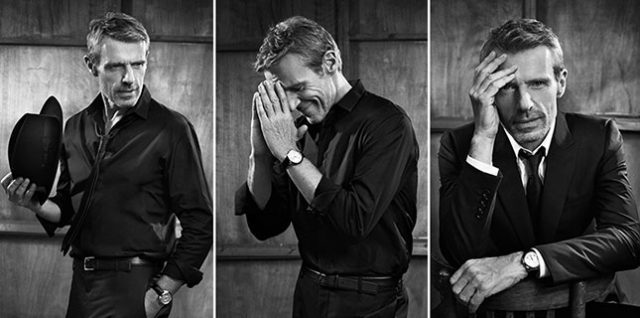
French star Lambert Wilson will make two appearances at FIAF this week
Who:Lambert Wilson What: Film intro and screening, staged concert Where: French Institute Alliance Française, Florence Gould Hall, 55 East 59th St. between Madison & Park Aves., 212-355-6160 When: Monday, November 6, $14, 7:30, and Tuesday, November 7, $50, 7:30 Why: Six-time César nominee Lambert Wilson will be at FIAF this week for a pair of special events. On November 6 at 7:30, the French star of such films as Rendez-vous, Of Gods and Men, and Private Fears in Public Places will introduce the New York premiere of his latest movie, Nicolas Silhol’s Corporate, about human resources, redundancy, and resignation. On November 7 at 7:30, Wilson will pay tribute to his idol with the staged concert “Lambert Wilson Sings Yves Montand,” using songs performed from Montand’s repertoire to tell the life story of the elegant French-Italian actor and crooner. In addition, Wilson has curated the CinéSalon series “Actor’s Choice: Lambert Wilson & Yves Montand,” which runs Tuesdays from November 14 to December 19 and includes such films as Henri-Georges Clouzot’s The Wages of Fear, Philippe Le Guay’s Bicycling with Molière, Costa Gavras’s Z, and Jérôme Salle’s The Odyssey.
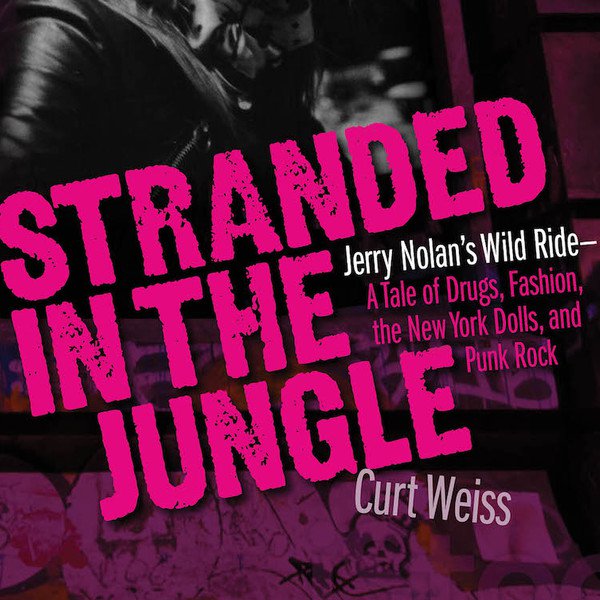
In his new book Stranded in the Jungle: Jerry Nolan’s Wild Ride (Backbeat, October, $24.99), Curt Weiss, a former member of the Rockats and Beat Rodeo (under the pseudonym Lewis King) and author of the blog “I am the coolest man on earth,” goes deep inside the rock-and-roll tale of Jerry Nolan, an underrated drummer with such bands as the New York Dolls, the Heartbreakers, and the Idols. Nolan, who died in 1992 at the age of forty-five, played with such punk icons as Sid Vicious, Richard Hell, Johnny Thunders, Arthur Kane, Glen Matlock, and many more. On November 7, Weiss will be celebrating the release of the book — which boasts the subtitle A Tale of Drugs, Fashion, the New York Dolls, and Punk Rock — at Rough Trade in Nolan’s native Williamsburg with a reading and Q&A. On November 9, Weiss heads to the Delancey on the Lower East Side for a meet-and-greet cocktail party, live performances by the Pipptones, Greg Allen’s Fringe Religion, and special guests, a book reading and signing, and Q&A sessions with Weiss, reporter Roger Clark, and photographer Roberta Bayley. Both events are free.
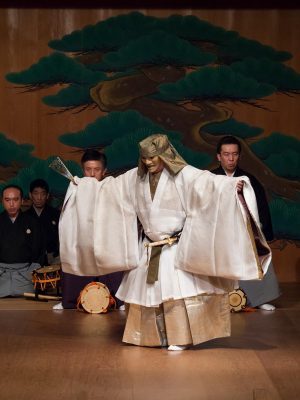
In 2011 and 2014, Japan Society awarded grants to Japanese multidisciplinary artist Hiroshi Sugimoto for his ambitious Odawara Art Foundation, which is now open to the public and features indoor and outdoor stages for noh and bunraku productions, a large gallery, a tearoom, astronomical observation spaces, and more. Sugimoto, who is based in Tokyo and New York City, will now be presenting the first fruits of that collaboration with several special programs at Japan Society, beginning with the exhibition “Gates of Paradise” (through January 7), the noh play Rikyu-Enoura (November 3-5), and the lecture and book signing “Architecture of Time: Enoura Observatory, Where Consciousness & Memory Originate” (December 15). For more than forty years, photographer, sculptor, architect, and historian Sugimoto has explored history and science, the past and the future, time and memory while blurring the lines between fiction and reality. He has photographed dioramas at natural history museums (“Still Life”), captured electrical discharges on photographic dry plates (“Lightning Fields”), focused on the horizon line across the ocean (“Seascapes”), shot wax figures to look like paintings (“Portraits”), used long exposures to reveal the blinding soul of movie palaces (“Theaters”), and turned one thousand gilded wooden Buddha statues at Sanjῡsangen-dō (Hall of Thirty-Three Bays) in Kyoto into a dizzying film (Sea of Buddha). He also curated the expansive and wide-ranging “History of History” in 2005-6 at Japan Society and designed the set and costumes for Sanbaso, divine dance, an ancient celebratory ritual dance with noh performers in the Guggenheim Rotunda in 2013. So Sugimoto was a logical go-to choice when Japan Society was putting together its “NOH NOW” series as part of its 110th anniversary. Sugimoto will be staging the world premiere of Rikyu-Enoura, about sixteenth-century tea master Sen-no-Rikyu, featuring a libretto by traditional-style poet Akiko Baba; a tea ceremony by Sen So’oku (a direct descendant of Sen-no-Rikyu); noh actors Kanze Tetsunojo and Katayama Kurouemon; noh musician Kamei Hirotada; and more. Each show will be preceded by a lecture by Wesleyan University assistant professor Dr. Takeshi Watanabe one hour before curtain.
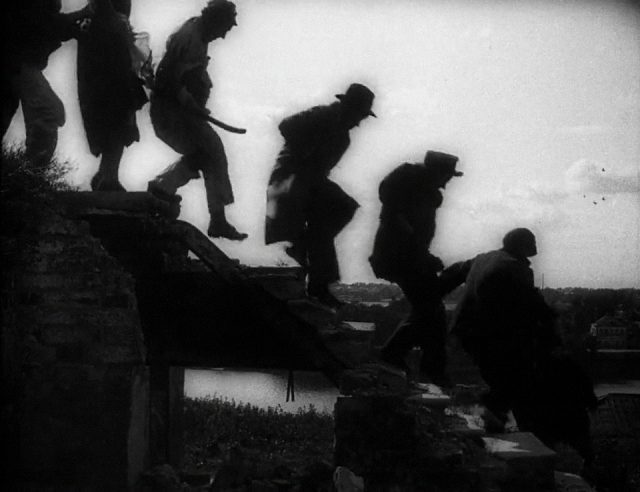
Sergei Eisenstein’s classic Strike will be screened at the Brooklyn Museum with a live score conducted by Hisham Akira Bharoocha
Brooklyn Museum
200 Eastern Parkway at Washington St.
Saturday, November 4, free, 5:00 – 11:00
212-864-5400 www.brooklynmuseum.org
The Brooklyn Museum celebrates the world’s preeminent borough in its monthly free First Saturday program in November with “Best of the Borough.” There will be live music by Alsarah & the Nubatones, Phony Ppl, and DJ Ian Friday; a curator tour of “Arts of Korea” with Joan Cummins; a hands-on art workshop inspired by Mickalene Thomas’s extraordinary “A Little Taste Outside of Love”; a scholar talk and book signing with Chip Colwell, author of Plundered Skulls and Stolen Spirits: Inside the Fight to Reclaim Native America’s Culture; a Brooklyn Dance Festival showcase with by the D.R.E.A.M. Ring, FLEXN, Kristin Sudeikis Dance, SynthesisDANCE, Concepts in Choreography, and the Francesca Harper Project; a pop-up gallery talk on Ancient Egyptian art; a book club reading with poet Tommy Pico from his latest book, Nature Poem; and a special screening of Sergei Eisenstein’s 1925 classic, Strike! with a live score conducted by Hisham Akira Bharoocha and featuring Angel Deradoorian, Jeremy Hyman, Nicos Kennedy, and Joe Williams. In addition, the galleries will be open late so you can check out “Roots of ‘The Dinner Party’: History in the Making,” “Soulful Creatures: Animal Mummies in Ancient Egypt,” “Robert Longo: Untitled (Raft at Sea),” “Proof: Francisco Goya, Sergei Eisenstein, Robert Longo,” “Arts of Asia and the Middle East, “Infinite Blue,” “A Woman’s Afterlife: Gender Transformation in Ancient Egypt,” and more.
DJ Spooky offers up a new spin on D. W. Griffith’s Birth of a Nation in Rebirth of a Nation
NYU Skirball Center for the Performing Arts
566 La Guardia Pl. between Third & Fourth Sts.
Saturday, November 4, $35, 7:30
212-945-2600 nyuskirball.org www.rebirthofanation.com
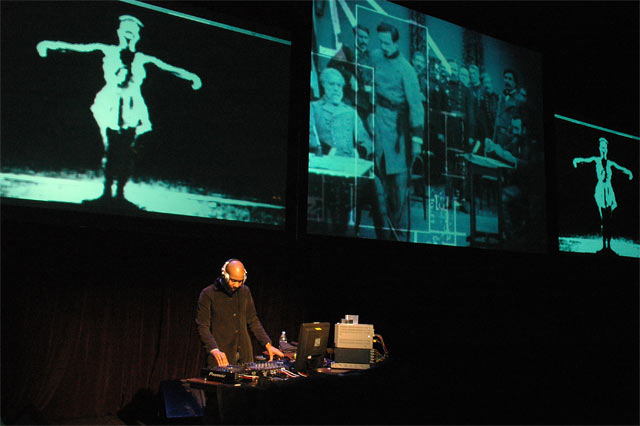
DJ Spooky That Subliminal Kid’s Rebirth of a Nation is a unique multimedia deconstruction and live remix of D. W. Griffith’s controversial 1915 silent film, Birth of a Nation, interweaving music, film, and art to create a wholly new work that the multidisciplinary artist keeps on tweaking. First performed in New York at the 2004 Lincoln Center Festival,
the show has toured around the world; we caught it back in 2007 at the Tribeca Film Festival, during the Bush administration, so it should be fascinating to see the state of the piece now when Spooky brings it to the Skirball Center on November 4, with America in the midst of a crisis over immigration, racism, white supremacy, historical statues, and other sociopolitical issues and the presidency has shifted from Barack Obama to Donald J. Trump. Spooky mixes both the Kronos Quartet’s trip-hop score and the visuals live, beginning with an overview of racism and an interview in which film pioneer Griffith discusses the importance of his so-called masterpiece. He then intercuts different scenes of the film, following the narrative, with Griffith’s original interstitial titles along with new ones credited to Paul D. Miller, DJ Spooky’s real name. He avoids being overly didactic and does not hit the audience over the head with Griffith’s unrelenting racism and support of the KKK, instead letting the film speak for itself. And it has a whole lot to say, as, of course, does DJ Spooky.