this week in (live)streaming

LIFT UP

Who: Blake Shelton, Dave Matthews, Jimmie Allen, Jason Mraz, Michael Ray, Shy Carter, the War and Treaty, John Rzeznik, Dispatch, Keala Settle, Mt. Joy, Augustana, Indigo Girls, Lucie Silvas, Annie Bosko, Bre Kennedy, CJ Hammond & Sloane, Veridia, Public, Michael Cerveris, the McCrary Sisters, Sam Wade, Roger Daltrey, Steve Connell, Michael McDonald, Kenny G, Jeff Tweedy, Nick Wheeler, Greta Van Fleet, Adam Gardner, Ray Parker Jr., Jerry Dipizzo, Taye Diggs, Ben Wysoki, the Harleys, Dublin Gospel Choir, Jim Sheridan, Storme Warren, Nicole Ryan
What: “A Festival of Music & Stories of Life On & Off the Road”
Where: Ryman Auditorium
When: Wednesday, December 16, free (donations encouraged), 8:30
Why: “It is so important that music fans and governments realize the impact this virus is having on millions of self-employed people who make the music industry function to bring much needed joy to our lives,” Roger Daltrey says about the effect the pandemic lockdown is having on the people who make a living supporting the work of superstar musicians. Daltrey will be appearing along with dozen of other rock, country, pop, R&B, and gospel musicians at “Lift Up,” a festival streaming live on Twitch from the Ryman Auditorium in Nashville that benefits the entertainment and events industry. The concert will feature the brand-new song “12 Million,” written by Sam Wade and LEVL UP music supervisor Keith Levenson in tribute to the crews that make music happen from behind the scenes. “Almost my whole adult life I have been touring in one shape or form and the road crews on my team and the venue crews that welcomed us and helped us put on a great show are all part of my extended touring family,” Cisco Adler said in a statement. “They really make it possible for artists like me to do what we do, and they are truly unsung heroes. They are also the first to be hit hard by a situation like this, so part of our mission at NoCap is to get shows happening again and get these good people back to work.”

THE FLYING LOVERS OF VITEBSK

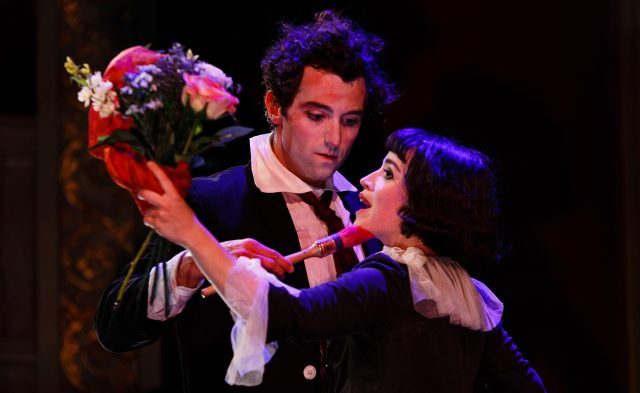
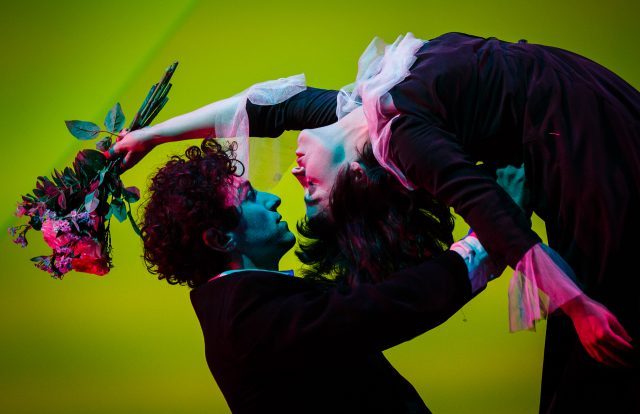
Marc Antolin and Audrey Brisson shine as Marc and Bella Chagall in The Flying Lovers of Vitebsk (photo © Steve Tanner)

THE FLYING LOVERS OF VITEBSK
December 11-18, $20 three-day rental
nyuskirball.org/chagall

Standing in front of a Marc Chagall painting can transport you to another world, a fantastical realm of lavish colors where humans and animals float through the air and fiddlers perform on rooftops. The Bristol Old Vic, Kneehigh, and Wise Children have captured the essence of the lush canvases as well as the artist himself in the gorgeously rendered revival of Daniel Jamieson’s The Flying Lovers of Vitebsk, streaming via NYU Skirball through December 18.

Filmed with three cameras and no audience at the UK’s Bristol Old Vic Theatre, the ninety-minute show is one of the best productions of the pandemic lockdown, an enchanting, bittersweet love story that will make your heart soar. Essentially a memory play, The Flying Lovers of Vitebsk recounts the tender romance between Chagall (Marc Antolin), born Moishe Zakharovich Shagal in 1887 in what is now Belarus, and Bella Samoylovna Rosenfeld (Audrey Brisson), born eight years later in the shtetl of Vitebsk to a well-off family that owned three jewelry stores. They fall madly, passionately in love when they meet in 1909; “I want to waste the rest of my life with you,” she tells him. Over the course of their life together, they experience more highs than lows as they deal with his success as a painter in Western Europe but struggles at home amid WWI, the Russian Revolution, and the rise of fascism and anti-Semitism.

The Flying Lovers of Vitebsk brings to vivid life the memorable relationship between Marc and Bella Chagall (photo © Steve Tanner)

Director Emma Rice’s staging is magnificent, as are the performances. Antolin (The Trial, Taken at Midnight) and Brisson (Secret Cinema, The Wild Bride) are engaging as the sweethearts, both wearing white greasepaint as if primed canvases ready for action; when he paints her, he gently touches her face with a brush. They occasionally break into song, in English, French, and Yiddish, accompanied by composer and pianist Ian Ross and cellist James Gow, who also appear as minor characters throughout. There are also several scenes of lovely contemporary dance, choreographed by Rice and Etta Murfitt, that reference such Chagall works as 1914’s Blue Lovers, 1915’s Green Lovers and Birthday (when it premiered in 1992, the play was titled Birthday), 1916’s Lovers in Pink, 1917’s Study for Double Portrait with Wine Glass, and the much later Bouquet with Flying Lovers (ca 1934-47).

The small, intimate set by Sophia Clist, who also designed the costumes, places the actors in between empty wooden picture planes in the front and a wall of twisted canvas in the back, with drawings of flowers on the floor; it as if the Chagalls are a painting come to life. The playful nature of Marc’s painting is echoed in Rice’s use of props, including a red balloon as Bella’s mother, a portrait of their rabbi that Brisson sits behind and puts her arms through, and animal objects from the paintings that become Salvador Dalí-like chapeaux. Cinematographer Steve Tanner occasionally cuts to a long shot of the mostly empty theater, reminding us where we are and what we’re experiencing together, but he quickly puts us right back onstage with Marc and Bella and their impassioned love. Malcolm Rippeth’s lighting and Simon Baker’s sound are excellently coordinated for online viewing.

Early on, Marc tells his biographer and son-in-law, Franz Meyer, “When some things are gone, you thirst for their details in such a heartbreaking way. You feel an agony of need to remember.” The Bristol Old Vic’s The Flying Lovers of Vitebsk is an exhilarating reminder of the power of live theater, the power of art, and the power of true love. Don’t miss it.

THE DYBBUK

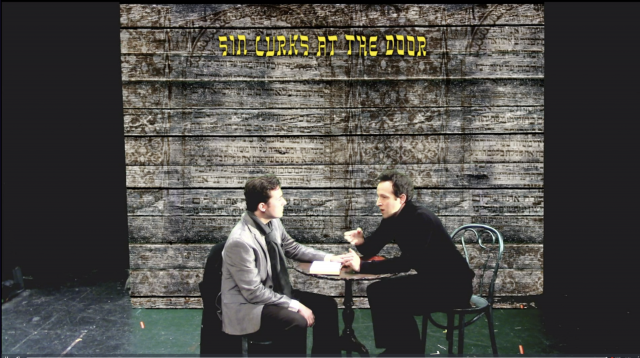
Theater for the New City is presenting a livestreamed adaptation of The Dybbuk through Sunday (screenshot by twi-ny/mdr)

Theater for the New City
December 9-13, $5-$36 (pay-what-you-can)
www.stellartickets.com
theaterforthenewcity.net

Good things come to those who wait. If there’s one thing we’ve learned during this pandemic, it’s that we need to have patience. Help is on the way, but if we as a nation follow protocols and have strong leadership, we can each make a difference, even with an administration that has turned its back on its people. We also have to be patient with the return of live theater as companies around the world experiment with Zoom, livestreaming, recording onstage without an audience, and other attempts to bring storytelling to a starving public.

So there I was on December 9, watching the hundredth-anniversary premiere of Theater for the New City’s livestreamed revival of the popular Yiddish play The Dybbuk, performed live onstage and broadcast over the Stellar platform. The chat function was on, so virtual attendees started getting ornery quickly when the show didn’t start exactly on time. And once it did, there were significant technical problems involving superimposed text, the green screening, and, most important, the sound, with a screeching electronic score drowning out the dialogue. Several people in the chat began complaining, even demanding a refund. But a solitary voice of reason explained that this is an opening night different from in-person opening nights and everyone should calm down. And she was right, because the tech crew was on the case, and after a near-disastrous beginning, the rest of the play was wonderful.

Written in 1914 by Jewish playwright S. An-ski, aka Shloyme Zaynvl Rapoport, who hailed from what is now Belarus, The Dybbuk premiered at the Elyseum Theatre in Warsaw on December 9, 1920, one month after An-ski’s death at the age of fifty-seven. Presented in association with New Yiddish Rep, this new English-language adaptation (with a fair sprinkling of Yiddish) is by NYR artistic director David Mandelbaum. The Dybbuk takes place in an old Jewish shtetl, where a long-arranged match between Menashe and Leah, the daughter of the wealthy Sender, dooms the love young student Khanan has for her. But on her wedding day, she is possessed by a spirit who will not let her marry Menashe, and the case soon comes before the judgment of the learned rabbi.
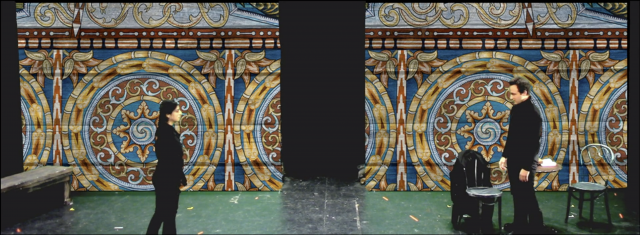
Cool backgrounds propel Theater for a New City virtual revival of classic Yiddish play (screenshot by twi-ny/mdr)

Director Jesse Freedman eventually works out the kinks in real time and gets everything in sync — with lighting by Alexander Bartieneff, sound by Eamon Goodman, and video by Tatiana Stolpovskaya — resulting in a moving and delightful production that features fun backgrounds and solid performances by Darrel Blackburn, Amy Coleman, Hannah Gee, Lev Harvey, Lucie Lalouche, Thomas Morris, and Mandelbaum as the rabbi. “A play about possession seems particularly suited to the times. The country has been possessed by the evil spirits of strife and division and could use a good exorcism to bring it back to its senses,” Mandelbaum said in a statement. “An intrepid group of artists is soldiering on through this pandemic minefield to honor the one-hundredth anniversary of this iconic play with the battle cry of their calling: ‘The show must go on.’ This will be a spiritual fusion of live performance and digital artistry. The ‘possession’ of live theater by the spirits of techno-wizardry.”

So be patient; the show will go on. It might not get off to a big start, but it packs quite a wallop by the finish.

For more on The Dybbuk, which was also made into a classic 1937 Yiddish film directed by Michał Waszyński, you can check out the Congress for Jewish Culture’s recent panel discussion “The Dybbuk at 100” on Facebook with playwright, translator, and theater historian Nahma Sandrow, Baruch College assistant professor and author Debra Caplan, and author and UT Austin senior lecturer in Yiddish Itzik Gottesman, moderated by writer, translator, actress, and theater historian Caraid O’Brien. The organization will also be presenting its own production of The Dybbuk on December 14 at 7:00 in Yiddish with Mike Burstyn, Shane Baker, Mendy Cahan, Refoyel Goldwasser, Amitai Kedar, Yelena Shmulenson, Suzanne Toren, and Michael Wex, directed by Allen Lewis Rickman; it can be seen here.

MOLIÈRE IN THE PARK: PEN/MAN/SHIP

Who: Molière in the Park theater company
What: Livestreamed performances and Q&As
Where: FIAF Facebook and Molière in the Park YouTube
When: Saturday, December 12, free with RSVP, 2:00 & 7:00 (show will be available for viewing through January 3)
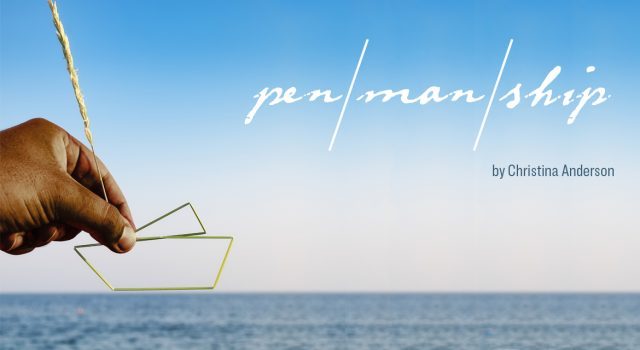
Why: After staging Zoom adaptations of three classic seventeenth-century plays by Jean-Baptiste Poquelin — better known as Molière — Brooklyn-based Molière in the Park is getting significantly more contemporary with its latest live, online production, playwright, TV writer, and educator Christina Anderson’s new work, Pen/Man/Ship. Following The Misanthrope, Tartuffe, and The School for Wives, Molière in the Park moves into the late nineteenth century with Pen/Man/Ship, which takes place in 1896 aboard a ship heading for Liberia shortly after the US Supreme Court decided in Plessy v. Ferguson to uphold the constitutionality of racial segregation under the concept of “separate but equal.” The cast features Crystal Lucas-Perry, Kevin Mambo, Jared McNeill, and Postell Pringle; the parable is directed by Molière in the Park founding artistic director Lucie Tiberghien using Liminal Entertainment Technologies’ StreamWeaver software, which takes actors out of Zoom boxes and puts them in front of backgrounds that more resemble indoor and outdoor sets while also allowing the tech crew to work together regardless of where they are. Copresented with the French Institute Alliance Française (FIAF) in partnership with the Prospect Park Alliance and the LeFrak Center at Lakeside, the play will be performed live twice on December 12, at 2:00 and 7:00, followed by Q&As with the creatives; a recording will be available for on-demand viewing through January 3.

TO THE ENDS OF THE EARTH

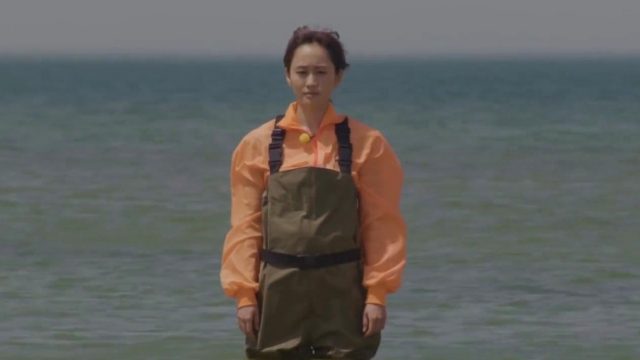
Atsuko Maeda is mesmerizing as a young woman trying to find her place in the world in To the Ends of the Earth

TO THE ENDS OF THE EARTH (Kiyoshi Kurosawa, 2019)
Metrograph Digital
December 11-17, $12
metrograph.com
www.kimstim.com

Kiyoshi Kurosawa’s To the Ends of the Earth is a gorgeously photographed, hauntingly meditative treatise on finding one’s place in the world. In her third film with Kurosawa following Seventh Code and Before We Vanish, former J-pop idol Atsuko Maeda of AKB48 fame is transcendent as Yoko, the host of a global travel show. She is making her way through Uzbekistan with her small crew — director Yoshioka (Shota Sometani), cameraman Iwao (Ryo Kase), production assistant Sasaki (Tokio Emoto), and translator Temur (Adiz Rajabov) — but the peppiness and determination she displays when being filmed is not repeated in real life, where she is quiet, lonely, and somber.

They head from Samarkand to Tashkent to Zaamin, from old cities to modern urban centers to the mountains and the sea, seeking out unusual and compelling stories, but not much is going well. At Lake Aydar on the hunt for the elusive bramul fish, a local fisherman refuses going out on the water with a woman. At an amusement park, a ride operator does not think she is strong enough to handle a fierce topsy-turvy spin. And a woman at a chaykhana won’t make her a proper plate of plov. But she soldiers on, doing whatever is necessary for the sake of the show, but it’s clear that her heart is no longer in it, if it ever was.

When she comes upon a goat tethered in a small pen in a back alley, she stops and says, “If I set that goat free in some grassy place, it’d be so happy.” Then, speaking directly to the goat, she asks, “What do you want?” It’s really a question she’s asking herself. Later she tells Iwao, “I feel like I’m moving away from what I really want to do.”

She rarely hangs out with the crew when they’re not filming. She eats by herself, is constantly late, does her own makeup and chooses her own clothing, and spends evenings alone in her hotel room, texting her firefighter boyfriend, who is in Tokyo, the only time she appears to experience any sort of genuine pleasure, but even that becomes problematic later on. When she is given a handheld video camera to take on her private adventures, she soon finds herself on the run from the law. Yoko is a kind of cross between Iris (Kati Outinen) in Aki Kaurismäki’s The Match Factory Girl, though not nearly as dark and pathetic, and Giulietta Masina in any of a number of Fellini films, sweet and innocent but hiding pain. The camera adores her face, as if it’s a character unto itself.

The film is filled with memorable images: Yoko standing waist-deep in the lake, lying flat on the floor of her hotel room, hiding from the police, trekking through sandy mountains, skittering through a sketchy underpass, and wandering into the empty Navoi Theater. It was made in conjunction with the twenty-fifth anniversary of the establishment of diplomatic relations between Japan and Uzbekistan and takes place along the Silk Road. Akiko Ashizawa’s cinematography of these little-seen landscapes is captivating, each shot composed like a unique work of art. Editor Koichi Takahashi’s pacing is mesmerizing, with immersive sound by Shinji Watanabe and understated music by Yusuke Hayashi.

Kurosawa is known for such gripping thrillers as Cure and Pulse as well as the elegiac Tokyo Sonata and the romantic drama Journey to the Shore; To the Ends of the Earth, which opens December 11 at Metrograph Digital, takes him to another level, highlighted by an unforgettable performance by Maeda in a film that is about filmmaking, about telling stories and acting them out in a fictitious world where, as in reality, life doesn’t always follow the script.

TAYLOR MAC’S HOLIDAY SAUCE . . . PANDEMIC!

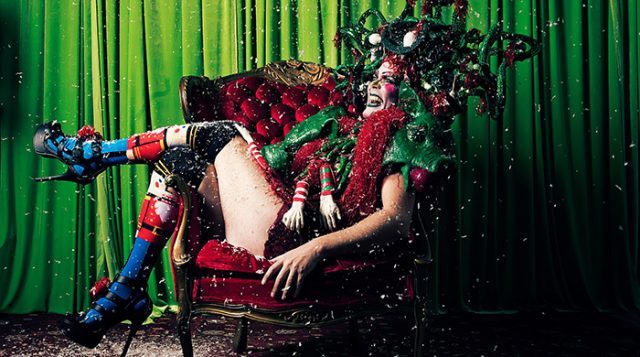
Taylor Mac’s annual “Holiday Sauce” celebration goes virtual this year (photo courtesy of Pomegranate Arts)

Who: Taylor Mac, Colin Brooks, Viva DeConcini, Antoine Drye, Greg Glassman, J. Walter Hawkes, Marika Hughes, Dana Lyn, Gary Wang, Thornetta Davis, Stephanie Christi’an, Tigger! Ferguson, Dusty Childers, Sister Rosemary Chicken, sidhe degreene, Romeo-Jay Jacinto, Glenn Marla, Travis Santell Rowland (Qween), Timothy White Eagle
What: Virtual edition of annual seasonal celebration
Where: Multiple venues through Holiday Sauce website
When: Saturday, December 12, pay-what-you-can, 2:00, 7:00, 10:00 (also available on demand through January 3)
Why: Taylor Mac isn’t about to let something like a lockdown keep him from celebrating the Christmas season as only judy, Mac’s preferred gender pronoun, can. On December 12, Mac will be hosting three “Holiday Sauce . . . Pandemic!” livestreamed parties, at 2:00, 7:00, and 10:00, featuring a fabulous cast of performers where just about anything can happen. This virtual vaudeville, an online edition of the event Mac has been holding around the country since 2017, features special guests Thornetta Davis, Stephanie Christi’an, and Tigger! Ferguson and cameos by Dusty Childers, Sister Rosemary Chicken, sidhe degreene, Romeo-Jay Jacinto, Glenn Marla, Travis Santell Rowland (Qween), and Timothy White Eagle. The festivities are directed by Jeremy Lydic, designed by Machine Dazzle and Anastasia Durasova, and photographed by Rob Kolodny.

Mac, who has written and/or performed in such works as Gary: A Sequel to Titus Andronicus, Hir, The Lily’s Revenge, and A 24-Decade History of Popular Music, will be highlighting songs from judy’s new album, Holiday Sauce, which includes covers of Graham Nash’s “Cathedral,” the Velvet Underground’s “The Black Angel’s Death Song” (paired with “Carol of the Bells”) and “All Tomorrow’s Parties” (with “Little Drummer Boy”), and Frank Ocean’s “Super Rich Kids,” such seasonal favorites as “God Rest Ye Merry Gentlemen” and “Silent Night,” and the new tune “Christmas with Grandma,” which doesn’t go well for the old lady. Ticket prices vary from pay-what-you-can to $25 for the livestreams and $10 to watch it on demand through January 3. Each institution presenting the fifty-minute show is dedicating it to a local elder of the queer community; Mac has dedicated Holiday Sauce to judy’s drag mother, Mother Flawless Sabrina. As Mac explains in the album’s liner notes, “I declare this holiday season, and all future ones, a celebration of drag mothers. That’s the world I want to live in. And if you don’t have a drag mama . . . the spirit of Mother Flawless Sabrina is out there for the loving.” In addition, Mac will be receiving the International Ibsen Award, the first American to have that honor.