this week in film and television

NYFF57: 2019 NEW YORK FILM FESTIVAL

Actor/Writer/Director/Producer EDWARD NORTON on the set of Warner Bros. Pictures’ drama “MOTHERLESS BROOKLYN,” a Warner Bros. Pictures release. (photo by Glen Wilson)

Edward Norton’s Motherless Brooklyn is the closing-night selection of the fifth-seventh New York Film Festival (photo by Glen Wilson)

Film Society of Lincoln Center
September 27 – October 13
www.filmlinc.org/nyff2019

The fifty-seventh New York Film Festival gets under way today with the opening selection, Martin Scorsese’s The Irishman, a crime drama starring Al Pacino, Joe Pesci, and Robert De Niro. The festival continues through October 13 with other Main Slate films by Olivier Assayas, the Dardenne brothers, Arnaud Desplechin, Pedro Almodóvar, Kyoshi Kurosawa, and Agnès Varda, among others, with Noah Baumbach’s Marriage Story the centerpiece and Edward Norton’s Motherless Brooklyn closing things out; the screenings are held at Alice Tully Hall, the Walter Reade Theater, and the Elinor Bunin Munroe Film Center. Documentaries include looks at rare-book sellers, Merce Cunningham, surgical transitioning at Mount Sinai Hospital, Roy Cohn, incarcerated students, and Oliver Sacks.

A stellar lineup of revivals is highlighted by Luis Buñuel’s L’age d’or, William Wyler’s Dodsworth, Jack Arnold’s The Incredible Shrinking Man, and Bert Stern’s Jazz on a Summer’s Day, while Retrospectives boasts such films as Michel Gondry’s Dave Chapelle’s Block Party, Terence Malick’s Days of Heaven, John Ford’s The Grapes of Wrath, and Jim Jarmusch’s Dead Man, focusing on cinematographers. NYFF57 also will host talks, Directors Dialogues, short films, the virtual reality and immersive Emergence section, and Projections, consisting of works that challenge what cinema can be. Below are more than a dozen programs to watch out for.

Saturday, September 28
On Cinema: Martin Scorsese (The Irishman), Alice Tully Hall, 4:15

Saturday, September 28, 8:45
and
Thursday, October 3, 6:00

Man Slate: First Cow (Kelly Reichardt, 2019), followed by Q&As with Kelly Reichardt, John Magaro, and Orion Lee, Alice Tully Hall

Sunday, September 29
On Cinema: Pedro Almodóvar (Pain and Glory), Walter Reade Theater, 3:15

Monday, September 30
Producers on Producing: Hosted by Producers Guild of America, with Emma Tillinger Koskoff and David Hinojosa, Elinor Bunin Munroe Film Center Amphitheater, free, 7:00

Tuesday, October 1
In Conversation with Nadav Lapid, , Elinor Bunin Munroe Film Center Amphitheater, free, 7:00

Wednesday, October 2
Lynne Ramsay’s Brigitte, screening followed by a Q&A with Lynne Ramsay and Brigitte Lacombe, Francesca Beale Theater, free, 1:00

In Conversation with the Dardenne Brothers, Elinor Bunin Munroe Film Center Amphitheater, free, 7:00

Thursday, October 3
In Conversation with Michael Apted, Elinor Bunin Munroe Film Center Amphitheater, free, 7:00

Thursday, October 3, 12:00 – 6:00, 9:00 – 11:00
and
Saturday, October 5

Culture Capture: Terminal Adddition (the New Red Order — Adam Khalil, Zack Khalil, Jackson Polys, 2019), Elinor Bunin Munroe Film Center Amphitheater, free

Thursday, October 3, 6:15
and
Sunday, October 5, 12:15

Spotlight on Documentary: 45 Seconds of Laughter (Tim Robbins, 2019), North American premiere followed by Q&As with Tim Robbins, Walter Reade Theater / Howard Gilman Theater

Friday, October 4
In Conversation with Kelly Reichardt, Elinor Bunin Munroe Film Center Amphitheater, free, 7:00

Friday, October 4, 12:00 – 6:00, 9:00 – 11:00
and
Sunday, October 6, 12:00 – 6:00, 9:00 – 11:00

Free Amphitheater Loops: A Topography of Memory (Burak Çevik, 2019), Elinor Bunin Munroe Film Center Amphitheater, free

Saturday, October 5
Special Events: The Cotton Club Encore (Francis Ford Coppola, 1984), followed by a Q&A with Francis Ford Coppola, Alice Tully Hall, 2:30

Film Comment: Filmmakers Chat, with Luise Donschen, Akosua Adoma Owusu, Pietro Marcello, Corneliu Porumboiu, and Justine Triet, moderated by Nicolas Rapold, Elinor Bunin Munroe Film Center Amphitheater, free, 7:00

Saturday, October 5, 2:15
and
Sunday, October 6, 1:30

Projections: The Tree House (Minh Quý Trương, 2019), North American premiere followed by Q&Ad with Minh Quý Trương, Elinor Bunin Munroe Film Center

Saturday, October 5, 5:30
and
Monday, October 7, 8:30

Spotlight on Documentary: 63 Up (Michael Apted, 2019), followed by Q&As with Michael Apted, Walter Reade Theater / Francesca Beale Theater

Sunday, October 6
Screenwriting Master Class with Olivier Assayas, Howard Gilman Theater, 12:00

Making Uncut Gems, with Josh and Benny Safdie, Ronald Bronstein, Sebastian Bear McClard, Daniel Lopatin, and Jen Venditti, Elinor Bunin Munroe Film Center Amphitheater, free, 7:00

Sunday, October 6, 5:30
and
Monday, October 7, 9:00

Main Slate: The Traitor (Marco Bellocchio, 2019), followed by Q&As with Marco Bellocchio and Pierfrancesco Favino, Alice Tully Hall

Monday, October 7
Denis Lenoir in Conversation with Kent Jones, Elinor Bunin Munroe Film Center Amphitheater, free, 4:00

Writing New York: Hosted by Writers Guild of America, East, with JC Chandor, Geoffrey Fletcher, Elisabeth Holm, Gillian Robespierre, and Steven Zaillian, Elinor Bunin Munroe Film Center Amphitheater, free, 7:00

Tuesday, October 8
Directors Dialogues: Bong Joon Ho (Parasite), Francesca Beale Theater, 6:00

We [heart] Agnès, with Rosalie Varda, Elinor Bunin Munroe Film Center Amphitheater, free, 7:00

Wednesday, October 9
Film Comment: Festival Wrap, with Nicolas Rapold, K. Austin Collins, Nellie Killian, Michael Koresky, and Amy Taubin, Elinor Bunin Munroe Film Center Amphitheater, free, 7:00

Thursday, October 10
Directors Dialogues: Mati Diop (Atlantics), Francesca Beale Theater, 8:30

Revivals: Dodsworth (William Wyler, 1936), introduced by Kenneth Lonergan and followed by a Q&A with Catherine Wyler and Melanie Wyler, Alice Tully Hall, 8:45

Thursday, October 10, 3:15 – 9:00
Friday, October 11, 5:30 – 9:00
Saturday, October 12, 1:00 – 9:00
and
Sunday, October 13, 1:00 – 9:00

Convergence: Holy Night (Casey Stein & Bernard Zeiger, 2019), Elinor Bunin Munroe Film Center lobby, free

Friday, October 11
Holy Night: Meet the Makers, with Casey Stein and Bernard Zeiger, Elinor Bunin Munroe Film Center Amphitheater, free, 7:30

Saturday, October 12
The Raven: Meet the Makers, with Lance Weiler, Ava Lee Scott, Nick Fortungo, and Nick Childs, Elinor Bunin Munroe Film Center Amphitheater, free, 3:00

AUGGIE

Auggie

Richard Kind faces unexpected loneliness as a retired architect in Auggie

AUGGIE (Matt Kane, 2019)
Cinema Village
22 East 12th St. between University Pl. & Fifth Ave.
Opens Friday, September 20
212-529-6799
auggiemovie.com
www.cinemavillage.com

Character actor supreme Richard Kind has excelled at playing more than a few schlemiels during his four decades in showbiz, which has included more than 230 film and television roles in addition to plenty of live theater, from LA and Chicago to Broadway (The Producers, The Big Knife). The sixty-two-year-old Trenton native, who has had recurring parts in Mad about You, Gotham, Spin City, and Red Oaks and played key roles in such films as A Serious Man in addition to voices in the Cars and Toy Story franchises, takes center stage in the bittersweet indie film Auggie, which opened this weekend at Cinema Village.

Kind stars as Felix Greystone, a mensch who is forced into retirement by his architecture firm, which gives him a pair of augmented reality glasses as a going-away present. Felix immediately feels lonely and useless without a job; his daughter, Grace (Simone Policano), is moving in with her boyfriend, Ben (Steven Robertson); and his wife, Anne (Susan Blackwell), has been offered a promotion that will mean longer hours and more close contact with her boss, Jack (James C. Victor). Not knowing what to expect, Felix puts the glasses on and is shocked to find a virtual beautiful young woman who calls herself Auggie (Christen Harper) suddenly next to him. Since she came from his mind, she is seemingly everything he desires in a woman, everything he thinks he is missing in a companion now that he is by himself so much. But the more time he spends with his new imaginary friend, the more potential trouble awaits.

Debut feature director Matt Kane, a Ken Loach protégé who wrote the script with actor Marc Underhill, has made a poignant and insightful film about loneliness and losing one’s value in life, particularly as one ages. Felix is a good guy with an exemplary family, but when too much changes all at once, he doesn’t know where to turn, and the alluring fantasy projected by the glasses becomes addicting — on purpose. One of the most subtle and enjoyable aspects of the film is the way viewers glimpse just how addicting those glasses are built to be; how, like the games on our phones, they are programmed to take us just one step further, to just one purchase more. Kane walks a fine line between male wish fulfillment and outright misogyny; it is doubtful Auggie, a sort of suburban, subdued version of Spike Jonze’s her, could have been written and directed by a woman. But it’s Kind’s riveting, gentle performance that saves the film from devolving into Skinemax territory. He’s an everyman here, embodying the fears of so many people in their later years, when choices are scarcer and the wrong one can result in losing everything one’s constructed so carefully.

DON’T BE NICE

Bowery Poetry Slam prepare for national championships in

Bowery Poetry Slam prepare for national championships in Don’t Be Nice

DON’T BE NICE (Max Powers, 2018)
IFC Center
323 Sixth Ave. at West Third St.
Opens Friday, September 20
212-924-7771
www.dontbenicemovie.com
www.ifccenter.com

“I’m writing as a form of activism,” Joel Francois says in Max Powers’s Don’t Be Nice, an intense and inspiring fly-on-the-wall documentary that follows the Bowery Slam poetry team over nine weeks as it prepares for the national finals in Atlanta. Representing Bowery Poetry Club, Francois, Ashley August, Noel Quiñones, Timothy DuWhite, and Sean MEGA DesVignes, are in it to win it, led by coaches Lauren Whitehead and Jon Sands, who work hard to get the most out of each of them. Sands is more of a cheerleader as Whitehead pressures the multiracial poets to reach deep within themselves to get to the root of who they are as they write about their often tenuous place in a dangerous and difficult world, sharing thoughts and feelings from their core. Filmed in the summer of 2016, Don’t Be Nice explores issues of race, class, sexual orientation, physical and emotional abuse, violence, and gender without apology as the members of the team bare their souls, particularly relating to racial injustice and the whitewashing of black culture as a stunning number of black men are killed by white police officers that year.

It’s not always easy to watch as they confront their demons in the name of their art — and in so doing challenge viewers to face their own biases with such works as “This Body,” “Octoniggas,” “Black Love,” “Black Ghosts,” and “Who Am I.” Powers also includes performances by rival teams from Brooklyn, Jersey City, San Diego, and Dallas, revealing the universality of these feelings and the desire to change things. “Don’t be nice; be necessary,” one of the poets says, while another asks, “What can I do with three minutes, a couple of mics, and a bare stage?” Don’t Be Nice opens September 20 at IFC and will feature a series of nightly postscreening Q&As through September 26 with Powers, producer Nikhil Melnechuk, editor David Lieberman, director of photography Peter Buntaine, casting director Caroline Sinclair, and others, moderated by Sarah Doneghy, John Buffalo Mailer, Randall Dottin, Otoja Abit, Michel Negroponte, and Randy Jones of the Village People. None of the Bowery Slam poets are scheduled to appear, perhaps because, according to a May 2018 New York Times article, they were upset at some of the creative decisions made by Powers involving offensive and misleading material regarding racial divide.

ARTHOUSE THEATER DAY: PUTNEY SWOPE

Putney Swope

Putney Swope is back in a fiftieth anniversary 4K restoration screening at Alamo Drafthouse

PUTNEY SWOPE (Robert Downey, 1969)
Alamo Drafthouse Downtown Brooklyn
445 Albee Square West
Wednesday, September 18, 7:00
718-513-2547
drafthouse.com

The past, present, and immediate future of indie cinema are represented in the fourth annual Art House Theater Day, taking place September 18 at several venues in New York as well as around the country. Peter Strickland’s 2018 In Fabric and Brett Story’s 2019 The Hottest August will be screening at IFC; In Fabric will also be shown at Nitehawk’s Prospect Park cinema. But the film to see is the fiftieth anniversary 4K restoration of Robert Downey Sr.’s counterculture cult classic, the low-budget 1969 satire Putney Swope, playing at the Alamo Drafthouse in Downtown Brooklyn and Yonkers. Downey Sr. is still alive, and this presentation includes a prerecorded introduction from the eighty-three-year-old writer-director of such other movies as Chafed Elbows, Sweet Smell of Sex, Greaser’s Palace, and Rittenhouse Square.

Downey skewers race, religion, politics, the corporate world, and Madison Ave. in the absurdist comedy, featuring a crazy cast of characters portrayed by professional actors as well as first-timers Downey found in city bars and cafés and on the street. When ad agency owner Mario Elias Sr. (David Kirk) drops dead during a meeting, the rest of the board, consisting primarily of a bunch of conniving, corrupt white men, accidentally vote the one black man, musical director Putney Swope (Arnold Johnson), to be the next chairman. Instead of stepping aside, Swope decides to take over and make radical changes, renaming the company Truth and Soul, Inc., firing white employees for any reason whatsoever, and hiring a team of Black Power men and women with no advertising experience to produce commercials that go far beyond industry standards, featuring foul language, nudity, and interracial relationships while promoting such products as Dinkleberry Frozen Chicken Pot Pie and Lucky Airlines, where one lucky passenger will win a trip to a back room with nearly naked stewardesses. However, he refuses to make ads for alcohol, toy guns, and tobacco. Putney courts favor with US president Mimeo and the first lady, portrayed by real-life husband-and-wife little people Pepi and Ruth Hermine, whose right-hand man, Mr. Borman Six (Larry Wolf), is a neo-Nazi. But power corrupts, and Swope soon becomes more militant and dictatorial, getting away with his bizarre business plan as the film turns into a fable of rebellion gone astray.

putney swope 2

Putney Swope almost didn’t get distributed. In 1969, at a special advance screening, Native New Yorker Downey, the father of Robert Downey Jr., reluctantly allowed Don Rugoff of Cinema Five in, even though Rugoff was late; afterward, Rugoff told him, “I don’t understand this movie, but I like it,” and shortly released the film to sold-out audiences. Downey and cinematographer Gerald Cotts switch between black-and-white for the main narrative and color for the television commercials, giving extra oomph to the latter, which get stranger and stranger, while Charley Cuva provides the groovy music and New Breed Inc. the chic costumes. The cast and crew had such trouble understanding Johnson’s mangled line readings that Downey dubbed in his dialogue in postproduction himself, using a raspy black voice that is way over the top; Putney Swope might be an equal opportunity offender, but it could never be made today, given the current politically correct environment.

Much of the acting is terrible, but a few familiar faces show up to offer a bit of a respite: Antonio Fargas, best known as Huggy Bear on Starsky and Hutch, plays the ever-angry Arab; Allan Arbus, who was Dr. Sidney Freedman on M*A*S*H (note that the poster to the left is a takeoff of the marketing campaign for Robert Altman’s film version of M*A*S*H) and was married to photographer Diane Arbus, is Mr. Bad News, filling in Swope on the continuing adventures of serial sex offender Sonny Williams (Perry Gewirtz); Shelley Plimpton (the mother of Martha Plimpton) and singer Ronnie Dyson, who were in Hair together, appear as the interracial couple pushing face cream; and Allen Garfield, a successful character actor in such films as The Conversation and Nashville, is Mario Elias Jr. The tall, awkward Stanley Gottlieb is a hoot as Nathan, who speaks primarily in bad jokes, while poet Donald Lev is a lone anarchist. Added to the US National Film Registry by the Library of Congress in 2016, Putney Swope — a major influence on such films as Paul Thomas Anderson’s Boogie Nights, in which Don Cheadle plays a character named Buck Swope, Cosmo the firecracker boy is inspired by Chinese businessman Wing Soney, and Downey Sr. makes a cameo (in addition, Louis CK hosted a Q&A with Downey in LA five years ago) — holds up better than expected, despite its cutting-edge story and small details that leave no one unblemished. It’s certainly no Mad Men, but it’s still a far-out document of a critical time in American history.

EYESLICER FEST CLOSING NIGHT FILM: KNIVES AND SKIN

Carolyn Harper (Raven Whitley) goes missing in teen noir Knives and Skin

Carolyn Harper (Raven Whitley) goes missing in teen noir Knives and Skin

KNIVES AND SKIN (Jennifer Reeder, 2019)
Nitehawk Cinema Williamsburg
136 Metropolitan Ave. between Berry St. & Wythe Ave.
Tuesday, September 17, 7:00
Festival runs September 14-17
718-384-3980
nitehawkcinema.com
www.chicagofilmproject.com

Knives and Skin, Jennifer Reeder’s feature-length debut as a writer-director, is the closing-night selection of Eyeslicer Fest, four days of special events celebrating the second season of The Eyeslicer, the self-described “secret TV show blending the boldest new American filmmaking into mind-expanding, mixtape-style episodes.” Screening September 17 at 7:00 at Nitehawk Cinema in Williamsburg, Knives and Skin is a creepy coming-of-age tale of girlhood, loss, and consent set in small-town America where the disappearance of a teenage girl tilts an already off-balance community even more on edge. Marching band member Carolyn Harper (Raven Whitley) has decided to lose her virginity to jock Andy Kitzmiller (Ty Olwin), but when she suddenly changes her mind, he becomes angry, pushes her to the ground, and leaves her in the woods. When she doesn’t come home, her mother, Lisa (Marika Engelhardt), quickly goes off the deep end, obsessed with her daughter’s clothes and smell. Fellow marching band members Charlotte Kurtich (Ireon Roach), April Martinez (Aurora Real de Asua), and Afra Siddiqui (Haley Bolithon), each of whose identities lie firmly outside old-fashioned mainstream America’s idea of girlhood, are preparing for homecoming, but Carolyn’s situation has cast a damper over everything.

Knives and Skin

Charlotte Kurtich (Ireon Roach) faces a harsh reality in Jennifer Reeder’s Knives and Skin

Reeder focuses on two families over the course of the film, which was inspired by the work of such feminist auteurs as Chantal Akerman and Catherine Breillat in addition to such indie faves as Todd Solondz and Todd Haynes, with the heaviest debt to David Lynch’s Twin Peaks as she uses our generic societal anxiety about female teen sexuality to reveal the hidden underbelly of a typical midwestern town, complete with surreal moments. (There’s also bits of Fast Times at Ridgemont High, Mean Girls, and The Breakfast Club embedded in its DNA.) Andy’s mother, Lynn (Audrey Francis), can’t face reality; his father, Dan (Tim Hopper), is an out-of-work clown fooling around with pregnant waitress Renee Darlington (Kate Arrington); his sister, Joanna (Grace Smith), sells underwear to the principal (Tony Fitzpatrick); and he is closest to his unusual grandmother (Marilyn Dodds Frank). Renee is married to Doug (James Vincent Meredith), the local sheriff in charge of the Carolyn Harper case; their son, Jesse Darlington (Robert T. Cunningham), is the school mascot and friends with Joanna; and their daughter, Laurel Darlington (Kayla Carter), is exploring her sexuality with Colleen (Emma Ladji). Racism, misogyny, sexual harassment, bullying, and more lie at the center of a community unable to come to grips with what’s really going on every day.

knives-and-skin-poster

Cinematographer Christopher Rejano bathes the film in richly saturated blues, reds, greens, and pinks, accompanied by a lurking score by Nick Zinner of the Yeah Yeah Yeahs. There are several scenes that feature hauntingly beautiful a cappella versions of such 1980s hits as Modern English’s “I Melt with You,” New Order’s “Blue Monday,” the Go-Go’s “Our Lips Are Sealed,” Naked Eyes’ “Promises, Promises,” and Icicle Works’ “Birds Fly (Whisper to a Scream),” lending the film a stark poignancy that overrides some of the inconsistent acting and over-the-top absurdities and singlehandedly makes it worth watching. The screening will be followed by a casual party in the Lo-Res Bar; Eyeslicer Fest begins September 14 and also includes the Radical Film Fair at Kickstarter HQ on September 15, the world premiere of season two of The Eyeslicer in Green-Wood Cemetery on September 16, and the theatrical release of Aaron Schimberg’s Chained for Life at IFC through September 19.

CROSSING THE LINE FESTIVAL: OPENING NIGHT

Crossing the Line Festival opens with Isabelle Adjani in Opening Night

FIAF’s Crossing the Line Festival opens with Isabelle Adjani in Opening Night (photo © Simon Gosselin)

French Institute Alliance Française, Florence Gould Hall
55 East 59th St. between Madison & Park Aves.
September 12-14
Festival continues through October 12
212-355-6160
crossingthelinefestival.org/2019

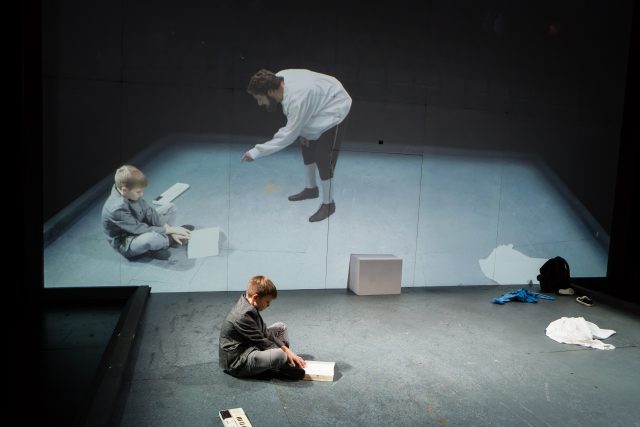
After the audience has settled in at FIAF’s Florence Gould Hall for Cyril Teste’s multimedia adaptation of John Cassavetes’s 1977 film Opening Night, there appears to be confusion on the stage, as a man in headphones converses in French with an unseen tech crew, their words not translated on the supertitles screen. It’s a disorienting moment, especially if you don’t understand French, and a terrific introduction to one of the themes of the play, the pull between fact and fiction, fantasy and reality inherent in theater and cinema. The man in the headphones is the play-within-a-play’s director, Manny (Morgan Lloyd Sicard), who is helming a melodrama featuring famous actress Myrtle Gordon (five-time César winner Isabelle Adjani) and her stoic costar, Maurice (Frédéric Pierrot); in the original film, itself based on a play by John Cromwell, Gena Rowlands was Myrtle, her real-life husband, Cassavetes, was Maurice, and one of their closest friends, Ben Gazzara, was Manny, their personal relationships further blurring the lines of reality.

With opening night a day away, Myrtle is having trouble with her lines and her physical presence, particularly in a scene that involves Maurice slapping her. She’s becoming emotionally unhinged, having a nervous breakdown, spurred by the earlier accidental death of a seventeen-year-old fan seeking an autograph and Myrtle’s inability — or overt unwillingness — to relate to her character, who is all too much like her, as if she is unable to face her own fate. Throughout the play’s eighty-five minutes, there is an additional figure onstage, cameraman Nicolas Doremus, who follows the characters as they move about Ramy Fischler’s elegant living-room set, which features a couch, a table, knickknacks on shelves, a visible backstage area with Agnès b.’s costumes, and, at the very center, a large screen where Doremus’s footage streams live, offering viewers a different angle on what’s happening. At one point, Doremus zooms in close on Manny and Myrtle, who might be about to kiss, the cameraman completing a kind of love triangle between life and artifice; at another, Doremus films other characters behind stage sharing their concerns as Myrtle is alone on the couch, drinking away her pain. Everyone is dressed in dark colors, mostly black, signaling potential doom.

star in

Morgan Lloyd Sicard, Isabelle Adjani, and Frédéric Pierrot star in Cyril Teste’s multimedia adaptation of John Cassavetes’s Opening Night at FIAF

Teste (Patio, Nobody) based his script on Cassavetes’s screenplay more than the final film itself, although he did use the director’s longtime friend and cinematographer, Al Ruban, who shot Opening Night, as a consultant. Teste encourages improvisation and changes stage directions every night, ensuring that each performance is unique in a way a film can never be yet still capturing the essence of the movie. “While Cassavetes’s other great films are models of immediacy — gut-level attempts to devise a cinematic syntax that accounts for and responds to the quantum flux of moment-to-moment experience — the doubly framed and multiply mirrored Opening Night operates at a remove,” Dennis Lim notes in his Criterion essay, which is appropriately titled “The Play’s the Thing.” He continues, “The filmmaker’s habitual insistence on the inseparability of actor and character (and of art and life) reverberates here within the haunted corridors of a backstage melodrama.” Adjani (The Story of Adele H, Queen Margot) is ravishing in her New York theatrical debut, her regal stage demeanor working hand-in-hand with her total command of the screen; we get to see both facets of her immense talent at the same time, which is both a treat and disconcerting; non-French speakers will lose a little as they avert their eyes to the supertitles while also deciding whether to look at the activity onstage, backstage, or onscreen. Sicard is superb as the director, and Pierrot is hardy as the skeptical Maurice, but Doremus stands out by not standing out even as he is right in the middle of the action. Opening Night opens FIAF’s monthlong Crossing the Line Festival and is supplemented by “Magnetic Gaze: Isabelle Adjani on Screen,” consisting of ten of her films shown on Tuesdays through October 29.

TATTOO UPRISING

Tattoo Uprising

Ink legends Stoney St. Clair and Ed Hardy show how it’s done in Columbus, Ohio, in 1980 in Alan Govenar’s Tattoo Uprising (photograph by Alan Govenar / courtesy of Documentary Arts)

TATTOO UPRISING (Alan Govenar, 2019)
Cinema Village
22 East 12th St. between University Pl. & Fifth Ave.
Opens Friday, September 13
212-529-6799
www.tattoouprising.com
www.cinemavillage.com

“Just the way they say you are what you eat, you are what you wear, too,” Calamity Jane Nemhauser says in Tattoo Uprising, Alan Govenar’s forty-years-in-the-making documentary celebrating the art of inking human bodies. Writer-director Govenar has been working on the film since 1980, when he was finishing his 1981 half hour Stoney Knows How, about tattoo legend Stoney St. Clair. Govenar and editor Jason Johnson-Spinos interweave four decades of interviews and archival footage into the film, in which Govenar speaks extensively with St. Clair and fashionista Ed Hardy, who redefined what tattooing could be; documentarian Les Blank and director Werner Herzog, who show off their tats while the former is making Burden of Dreams and the latter Fitzcarraldo; woman tattoo artists Cynthia Witkin, Calamity Jane, Jamie Summers, and Anne de Hey!; sideshow performer and tattoo artist Captain Don, who sings a song about his chosen profession; and prisoners who reveal their tattoos and discuss the impact they have on their feelings of freedom.

Author Govenar also delves into the history of tattooing, from biblical times through the Renaissance, from Captain James Cook’s discoveries to Gus Wagner’s influential flash tattoos, and such art exhibitions as “Flash from the Past: Classic American Tattoo Designs 1890 – 1965” at the Hertzberg Circus Collection and Museum in San Antonio and “Pierced Hearts and True Love: A Century of Drawings for Tattoos” at the Drawing Center in New York. “It’s a hot language. It’s a cellular semiotics of communication that we’re only now beginning to realize exists across the world and throughout history in a way that no other medium functions,” Hardy explains. And there’s plenty of tattooing, the camera getting up close and personal as needles buzz into flesh, creating complicated, daring, and exquisite designs, using the human body as a living canvas.