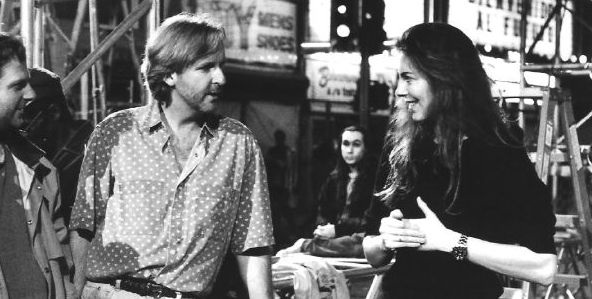
Former husband and wife James Cameron and Kathryn Bigelow claim to still be good friends, but they’ll be battling it out for directorial supremacy in Hollywood and the IFC Center
IFC Center
323 Sixth Ave. at Third St.
Weekends at midnight, February 26 – April 17
212-924-7771
www.ifccenter.com
The IFC Center isn’t waiting until March 7 to watch Kathryn Bigelow battle it out for Oscar supremacy against former husband James Cameron. Starting this Friday night and continuing into April, IFC will match up the writer-directors of THE HURT LOCKER and AVATAR by screening their earlier works on alternating weekends at midnight, a cool collection of underrated flicks and big-budget epics that all contain elements of genius, nearly every one action-packed, filled with chills and spills — and Patrick Swayze and Keanu Reeves. Yes, movie lovers, the fight kicks off February 26 with Bigelow’s kitschy classic, POINT BREAK (1991), in which FBI Agents Johnny Utah (Reeves!) and Pappas (Gary Busey!) chase surfing bad boy Bodhi (Swayze!) along the beautiful beaches of California. POINT BREAK will be tough to beat, but Cameron’s THE ABYSS (1989) will go where its challenger did not — deep underwater with Ed Harris (March 5-6). Cammie and Biggie, who were husband and wife from 1989 to 1991, will both enter round two with Jamie Lee Curtis by their side, either basking in the glow of Oscar or wallowing in sheer misery, pitting Kathryn’s 1989 cop drama BLUE STEEL (March 12-13) against Jim’s explosive 1994 remake of a French film, TRUE LIES (March 19-20), followed by KB’s misunderstood STRANGE DAYS (1995) against JC’s awesome ALIENS (1986). If there’s still any doubt as to whom the victor is, the IFC Center has loaded the deck for the last round, as Big’s 1987 vampire drama NEAR DARK (April 9-10) stands little chance against Cam’s 1984 favorite, THE TERMINATOR (April 16-17), in which Ahnold will make sure who the winner is, even if he has to travel through time to make it so.

 South Korean auteur Hong Sangsoo’s latest film about a South Korean auteur, LIKE YOU KNOW IT ALL, is another intriguing examination of art and sex in contemporary society, following NIGHT AND DAY (2008), WOMAN ON THE BEACH (2006), TALE OF CINEMA (2005), and WOMAN IS THE FUTURE OF MAN (2004). Hong, who has served as a juror at several film festivals and whose work has screened at fests all over the world, sets his latest self-reflexive story at the Jecheon International Music and Film Festival, where director Ku will be part of the jury. But it turns out that Ku is a self-absorbed, insensitive, and subtly obnoxious filmmaker who cares only about himself, walking away from fans and colleagues in the middle of a conversation or in the midst of signing an autograph, interested only in listening to people praise his own talent, which has been relegated to art-house films that few people see and even fewer understand. After leaving the festival to teach a class at a school on Jeju Island, he visits with a famous painter and former mentor who has unknowingly married Ku’s first love, setting the stage for the creepy Ku to perform yet more selfish acts. Kim Tae-woo is outstanding in the lead role, playing the self-obsessed director with an unerring casualness that makes him more absurdly ridiculous than conniving and mean-spirited. With a little bit of Federico Fellini’s 8 1/2 here, Woody Allen’s STARDUST MEMORIES there, Hong once again reveals the soft underbelly of ego within the film industry, but he also needs to edit himself more, as the bittersweet, slyly ironic LIKE YOU KNOW IT ALL, made for a mere $100,000, is his latest film to clock in at more than two hours.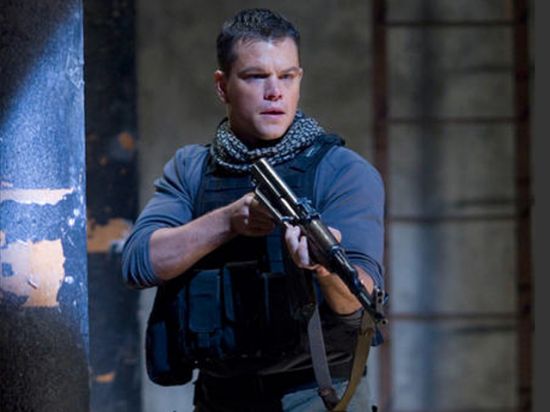
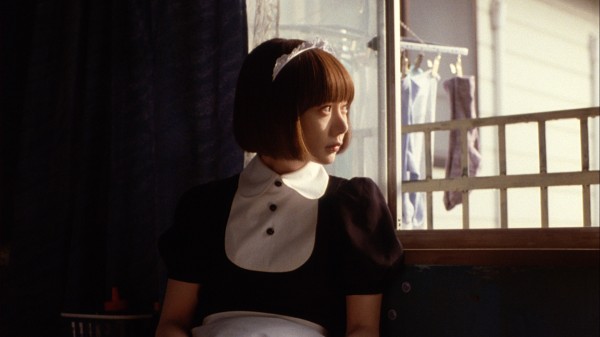
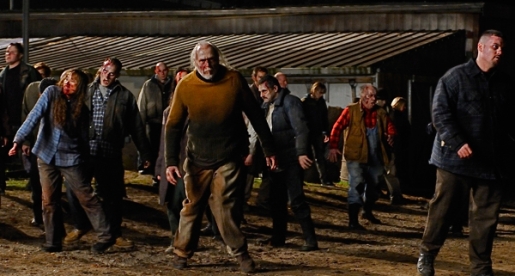

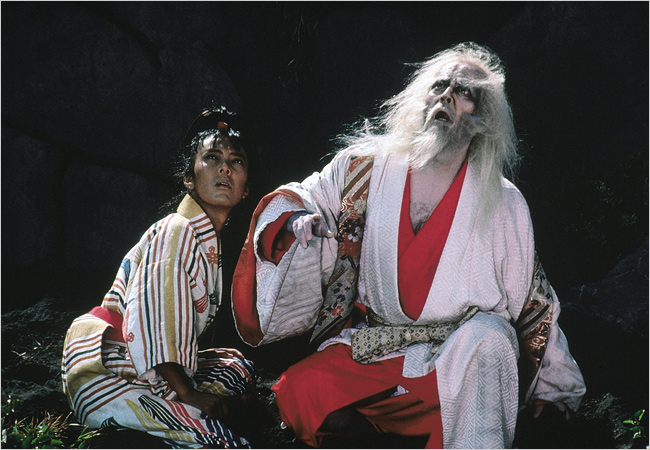
 Inspired by the story of feudal lord Mori Motonari and Shakespeare’s KING LEAR, Akira Kurosawa’s RAN is an epic masterpiece about the decline and fall of the Ichimonji clan. Aging Lord Hidetora (Tatsuya Nakadai) is ready to hand over his land and leadership to his three sons, Taro (Akira Terao), Jiro (Jinpachi Nezu), and Saburo (Daisuke Ryû). But jealousy, misunderstandings, and outright deceit and treachery result in Saburo’s banishment and a violent power struggle between the weak eldest, Taro, and the warrior Jiro. Hidetaro soon finds himself rejected by his children and wandering the vast, empty landscape with his wise, sarcastic fool, Kyoami (Peter), as the once-proud king descends into madness. Dressed in white robes and with wild white hair, Nakadai (THE HUMAN CONDITION), in his early fifties at the time, portrays Hidetaro, one of the great characters of cinema history, with an unforgettable, Noh-like precision. Kurosawa, cinematographers Asakazu Nakai, Takao Saitô, and Masaharu Ueda, and Oscar-winning costume designer Emi Wada bathe the film in lush greens, brash blues, and bold reds and yellows that marvelously offset the white Hidetaro. Kurosawa shoots the first dazzling battle scene in an elongated period of near silence, with only Tôru Takemitsu’s classically based score playing on the soundtrack, turning the film into a thrilling, blood-drenched opera. RAN is a spectacular achievement, the last great major work by one of the twentieth century’s most important and influential filmmakers. Film Forum is screening RAN in a brand-new twenty-fifth-anniversary 35mm print, concluding its terrific six-week-long Kurosawa festival celebrating the auteur’s centennial.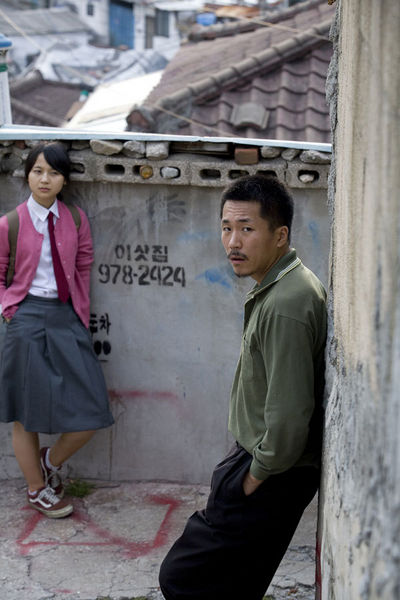
 Named Best Debut Feature at the 2009 New York Asian Film Festival and winner of a Tiger Award at Rotterdam, Yang Ik-june’s BREATHLESS is an involving portrait of family hidden beneath a veil of blood and violence. Yang, who wrote, directed, and produced the film, also stars as Sang-hoon, a local gangster who goes out every day and does whatever is necessary to collect for his loan-shark boss, Man-sik (Jeong Man-sik). Dour, angry, and full of rage, Yang curses at and strikes his coworkers, cops, and strangers as well as the people who owe Man-sik money. Not one to make friends, he is soon hanging around with a high school girl, Yeon-hee (Kim Kkot-bi), who has taken a liking to him and his young nephew, Hyeong-in (Kim Hee-soo). Although they don’t know it, Yeon-hee and Sang-hoon are drawn to each other because of their difficult relationships with their fathers, both of whom are struggling to deal with different kinds of tragedy. Although Yang does try to pull at the heartstrings with some over-the-top melodrama near the end, BREATHLESS is well-paced study of family and friendship, following a bloody path to show the importance of blood. The free screening at Tribeca Cinemas will be followed by a Q&A with Yang, who mortgaged his house to make this low-budget picture.
 The third jewel in Universal’s horror crown (following 1931’s DRACULA and FRANKENSTEIN), THE WOLF MAN stars Lon Chaney, Jr., in his signature role, the goofily charming Larry Talbot, who just happens to have a problem on certain evenings when there is a particularly bright moon. Talbot has returned home to the family mansion after the sudden death of his brother, who appeared to have been mauled by some kind of wild animal. Reunited with his erudite father, Sir John (THE INVISIBLE MAN’s Claude Rains), Larry quickly gets the hots for local antiques dealer Gwen Conliffe, but when their first date involves the tragic death of Gwen’s friend Jenny (Fay Helm) and Bela the Gypsy (Bela Lugosi), Larry becomes a suspect in the murders. And when he keeps waking up with ripped clothing and blood on him, he begins to think that maybe he has indeed done some very terrible things. THE WOLF MAN is the only one of Universal’s three primary horror classics that is not based on a popular novel; instead, Curt Siodmak wrote a fascinating original script that delves deep into the psyche of its protagonist, whose physical and mental transformation echoes the rage inside us all. The all-star cast also features Ralph Bellamy as Colonel Montford, the town constable; Patric Knowles as Frank Andrews, Gwen’s fiancé; and the great Maria Ouspenskaya as the mysterious Gypsy woman Maleva. THE WOLF MAN might not have the chills and thrills of DRACULA and FRANKENSTEIN, but it still more than holds its own after all these years. (Oh, and if you’re expecting the famous scene when Chaney’s face goes all hairy, that actually occurs in the sequel, FRANKENSTEIN MEETS THE WOLF MAN.)