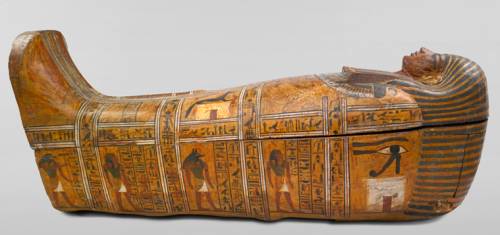
“Anthropoid Coffin of the Servant of the Great Place, Teti,” Egypt, from Thebes, wood, painted box with lid in place, circa 1339-1307 BCE
Brooklyn Museum
200 Eastern Parkway
Saturday, April 3, free, 5:00 – 11:00 (some events require free tickets distributed at the Visitor Center)
212-864-5400
www.brooklynmuseum.org
In conjunction with the exhibition “To Live Forever: Art and the Afterlife in Ancient Egypt,” the Brooklyn Museum’s free monthly First Saturdays program on April 6 will feature such special events as a discussion with curators Edward Bleiberg and Lisa Bruno, live music by Arab group Zikrayat, a Hands-On Art workshop in which you can create an Egyptian-style amulet, a book talk with Joshua Cohen about his novel A HEAVEN OF OTHERS, a dance party hosted by DJ Nickodemus and the Spy from Cairo, and a screening of the Oscar-winning Japanese film DEPARTURES. In addition, all of the museum’s exhibitions will be open late, including “Kiki Smith: Sojourn,” “Healing the Wounds of War: The Brooklyn Sanitary Fair of 1864,” “Body Parts: Ancient Egyptian Fragments and Amulets,” and the aforementioned “To Live Forever.”
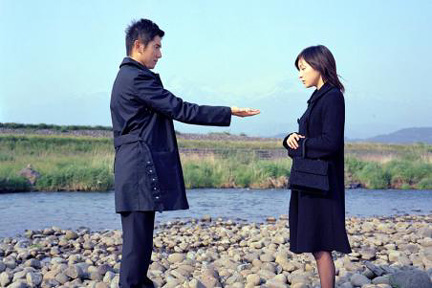
Japanese Oscar winner takes unusual look at death
DEPARTURES (Yojiro Takita, 2008)
Brooklyn Museum
200 Eastern Parkway
Saturday, April 3, free, 6:30 (free tickets distributed at the Visitor Center at 5:00)
212-864-5400
www.departures-themovie.com
 After the orchestra in which he plays cello is dissolved, Daigo Kobayashi (Masahiro Motoki) and his wife, Mika (Ryoko Hirosue) leave Tokyo and head back to his hometown in Yamagata. Seeing a classified ad in the local paper listing a job in “departures,” Daigo schedules an interview, thinking it is a travel agent position. But as it turns out, the boss, Sasaki (Tsutomu Yamazaki), claims it was a typo — it should have read “the departed” — and immediately hires Daigo as his assistant encoffinor. Daigo quickly learns that he and Sasaki attend to the newly dead, picking them up for funeral directors and then preparing the bodies, in front of grieving friends and family, for the coffins and cremation through an elaborate, detailed ceremony. Daigo takes the job out of financial desperation — Sasaki throws money at him to come on board — but doesn’t tell anyone, including Mika, what he is doing, since people who work in businesses involving corpses are shunned in Japan, considered dirty. But as Daigo grows to appreciate the importance of what Sasaki does, everything he has built threatens to fall apart when his secret starts getting out. Winner of the 2008 Oscar for Best Foreign Language Film (As well as ten Japan Academy Prizes), DEPARTURES is a moving portrait of life and death, told beautifully by director Yojiro Takita (WHENT THE LAST SWORD IS DRAWN, ONMYOJI) and screenwriter Kundo Koyama. Motoki, who had the original idea for the film, gives a wonderfully subtle performance as a Daigo, while Yamazaki is a riot as the stern boss with a sly sense of humor. Despite an embarrassingly unnecessary montage scene and sappy music by Joe Hisaishi (who’s never met an emotion he couldn’t overexploit), DEPARTURES is a moving portrait of a man searching for his place in the world — and meeting personal and professional obstacles when he thinks he might have found it.

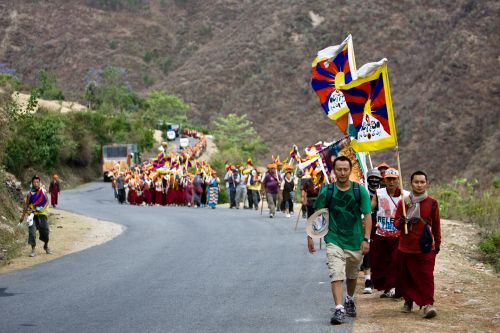
 At the Palm Springs International Film Festival earlier this year, China withdrew Lu Chuan’s CITY OF LIFE AND DEATH and Ye Kai’s QUICK, QUICK, SLOW in protest of the festival’s inclusion of the pro-Tibet documentary THE SUN BEHIND THE CLOUDS. CITY OF LIFE AND DEATH, which examines the 1937 Rape of Nanking, was scheduled to open at Film Forum on March 31, but the distributor could not guarantee that China would allow it to be shown, so Film Forum filled the open slot with THE SUN BEHIND THE CLOUDS. Subtitled TIBET’S STRUGGLE FOR FREEDOM, the seventy-nine-minute film, made by husband-and-wife team Ritu Sarin and Tenzing Sonam, delves into the battle between those Tibetans who follow the Dalai Lama’s Middle Way Approach, in which Tibet would seek autonomy from China but not full independence, and those that want their country back completely. Sarin and Sonam, who have been documenting the situation in Tibet for nearly twenty years in such films as THE TRIALS OF TELO RINPOCHE (1994), THE SHADOW CIRCUS: THE CIA IN TIBET (1998), the narrative feature DREAMING LHASA (2005), and THE THREAD OF KARMA (2007), focus on the March 2008 uprising, the biggest since the Chinese invasion of 1959.



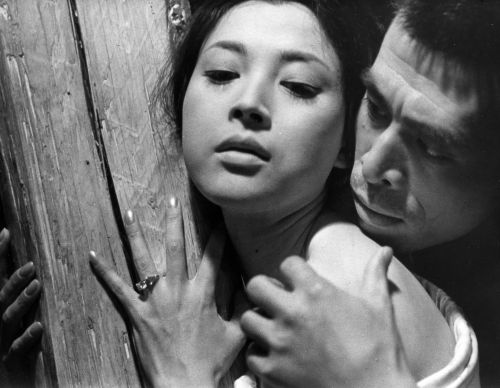
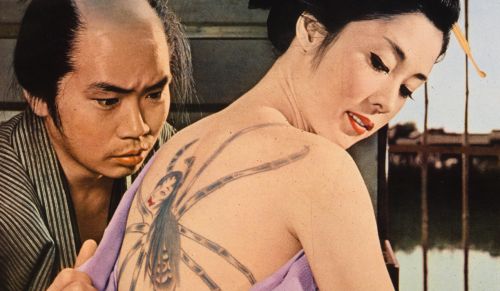
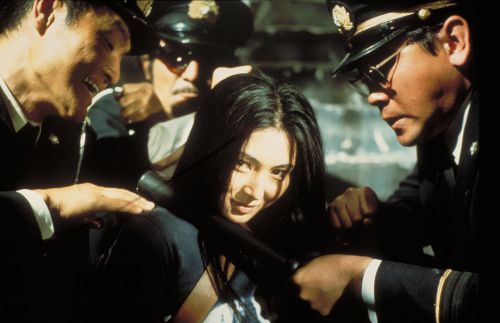
 A cult classic that spawned three sequels, Shunya Ito’s highly stylized SCORPION has everything a women-in-prison flick needs: sex, torture, rape, lesbianism, riots, sadistic male guards, shower scenes, gory violence, and lots and lots of unnecessary nudity. Set up by corrupt cop Sugimi (Isao Natsuyagi), to whom she gave her virginity, young and innocent Nami Matsushima (Meiko Kaji) is sent up the river, where she refuses to say anything about her case, leading to constant brutalization, including a harrowing hole-digging scene and some hog-tying. Afraid that she might eventually talk, Sugimi enlists another inmate, Katagiri (Rie Yokoyama), to kill her, but Matsu is not about to let anyone get in the way of her plan for revenge. Solid sexploitation all the way, SCORPION lays out much of the groundwork for Quentin Tartantino’s KILL BILL flicks; in fact, he even used the film’s theme song, “Urami-Bushi” (“Her Song of Vengeance”), which is sung by Kaji. Kaji went on to make several more FEMALE PRISONER SCORPION films with Ito and played Lady Snowblood in two movies directed by Toshiya Fujita, both of which are also part of the “Meiko Kaji: A Mad, Bad Unholy Easter Weekend” section of the Japan Society’s “Mad, Bad . . . & Dangerous to Know” film series.


