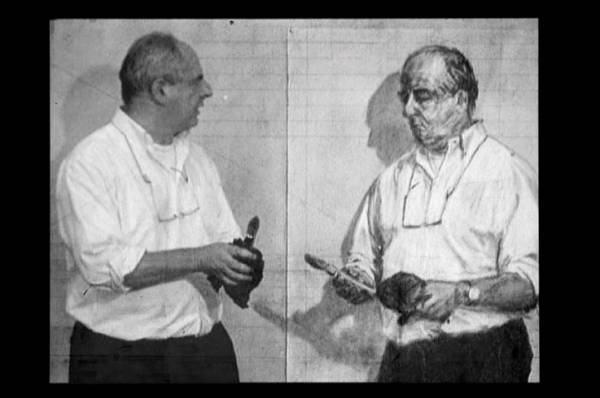
William Kentridge, from “7 Fragments for Georges Méliès,” 35mm and 16 mm animated film transferred to video, 2003 (courtesy of the artist and Marian Goodman Gallery)
Museum of Modern Art
West 54th St. between Fifth & Sixth Aves.
Through May 17 (closed Tuesdays; Fridays free from 4:00 to 8:00)
Admission: $20 (includes same-day film screening)
212-708-9400
www.moma.org
In 2001, William Kentridge burst onto the New York art scene with an awe-inspiring show at the New Museum of Contemporary Art in SoHo, introducing to many the unique style employed by this South African artist who creates remarkable films made from charcoal drawings. Nearly ten years later, Kentridge is back with a bang, as multiple exhibits and special events have displayed the breadth of his work and his ingenuity, from his production of Shostakovich’s THE NOSE at the Met and his book of watermarks at Dieu Donné to screenings of his films with live music at the World Financial Center to a quartet of his “Drawings for Projection” series opening at the Jewish Museum on May 2. The centerpiece is the sensational display at MoMA, which continues through May 17. Arranged in a beautifully “generous layout,” as curator Klaus Biesenbach noted at the opening, “William Kentridge: Five Themes” features a bevy of rooms dedicated to the many worlds the artist has created via drawing, film, and a pair of model theaters. Kentridge himself is evident in much of his work, either as a character in his films or through the smudges, erasures, and new markings visible in his animation as he moves from page to page, revealing his unique and fascinating methods, laying himself—Jewish, white, a descendant of a well-known legal family in Johannesburg—bare. “The studio is an enclosed space, not just physically but also psychically, like an enlarged head; the pacing in the studio is the equivalent of ideas spinning around in one’s head, as if the brain is a muscle and can be exercised into fitness, into clarity,” he writes in the exhibition catalog, to which he has contributed several essays alongside a major examination by Mark Rosenthal, who organized the show at its first stop, SFMoMA.
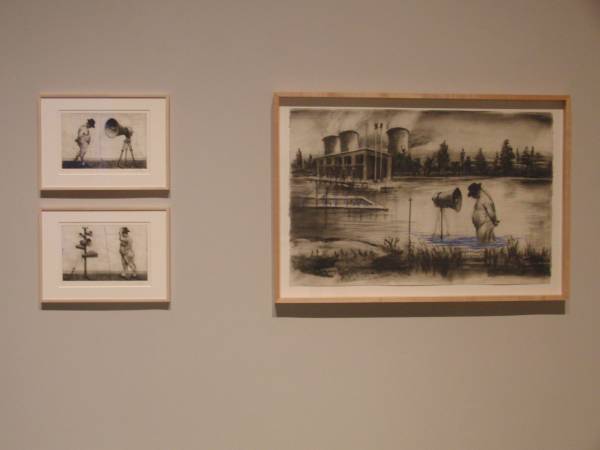
William Kentridge, “Untitled (Man with Megaphone),” “Man with Megaphone Cluster,” etching, aquatint, drypoint, and engraving with roulette and crayon additions, 1998, and “Drawing for the film ‘Stereoscope,’” charcoal and pastel on paper, 1998-99 (photo by twi-ny/mdr)
At the heart of Kentridge’s oeuvre is his series of films depicting wealthy industrialist Soho Eckstein, naked dreamer Felix Teitlebaum, and the woman caught in between, Mrs. Eckstein. In such short films as “Stereoscope,” “Monument,” “History of the Main Complaint,” and “Mine,” all made without a script or a storyboard, Kentridge relates their continuing tale in an abstract narrative bursting with emotion, incorporating greed and loneliness, love and loss, and the division of the self. (It is not a coincidence that both Soho and Felix resemble the artist himself.) But “Thick Time: Soho and Felix” is only one of the themes that runs through the exhibit. “Ubu and the Procession” includes two films that harken back to Alfred Jarry’s Ubu character, reimagining him in South Africa; “The Magic Flute” and “The Nose” take visitors behind the scenes of Kentridge’s recent productions of the two operas, the first held at BAM in 2007, the latter at the Met in March. “Artist in the Studio” consists of “7 Fragments for Georges Méliès,” seven films on view together in one room, all of which reveal the artist at work. The excellent catalog contains a must-have DVD that goes even further into Kentridge’s process, presenting discarded snippets, fascinating revelations about his method, and complete versions of his first experimental short as well as the full-length “Tide Table.” “I believe that in the indeterminacy of drawing—the contingent way that images arrive in the work—lies some kind of model of how we live our lives,” Kentridge has said. “The activity of drawing is a way of trying to understand who we are and how we operate in the world.” This exciting survey at MoMA is all that and more.

 Iranian writer-director Bahman Ghobadi (A TIME FOR DRUNKEN HORSES) goes underground in NO ONE KNOWS ABOUT PERSIAN CATS, following the plight of Negar (Negar Shaghaghi) and Ashkan (Ashkan Koshanejad) as they attempt to put together an indie band for a gig in London. Inspired by their dedication—and always out to make a buck himself—fast-talking wheeler-dealer Nadar (Hamed Behdad) takes them to get illegal passports, then introduces them to a series of bands who play in secretive underground spaces where the government and the police don’t bother them, even though it is against the law to play Western-style music. Their quest for musicians leads them to such real groups as Take It Easy Hospital and the Yellow Dogs, who regularly risk their freedom and safety by playing to excited young fans desperate to hear live, modern music. Ghobadi throws in just about every genre imaginable, from heavy metal and punk to classic rock and jazz in a stirring musical journey, turning each song into a video depicting everyday life in Tehran. The film does lapse into overheated and unnecessary heavy-handed melodrama in its final scenes, but it’s still a compelling story of the intrinsic power of music and the desperate need to make connections.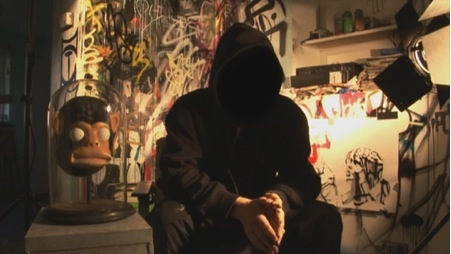
 In 1999, L.A.-based French shopkeeper and amateur videographer Thierry Guetta discovered that he was related to street artist Invader and began filming his cousin putting up his tile works. Guetta, who did not know much about art, soon found himself immersed in the underground graffiti scene. On adventures with such famed street artists as Shepard Fairey, Swoon, Ron English, and Borf, Guetta took thousands of hours of much-sought-after video. The amateur videographer was determined to meet Banksy, the anarchic satirist who has been confounding authorities around the world with his striking, politically sensitive works perpetrated right under their noses, from England to New Orleans to the West Bank. Guetta finally gets his wish and begins filming the seemingly unfilmable as Banksy, whose identity has been a source of controversy for more than a decade, allows Guetta to follow him on the streets and invites him into his studio. But as he states at the beginning of his brilliant documentary, EXIT THROUGH THE GIFT SHOP, Banksy—who hides his face from the camera in new interviews and blurs it in older footage—turns the tables on Guetta, making him the subject of this wildly entertaining film.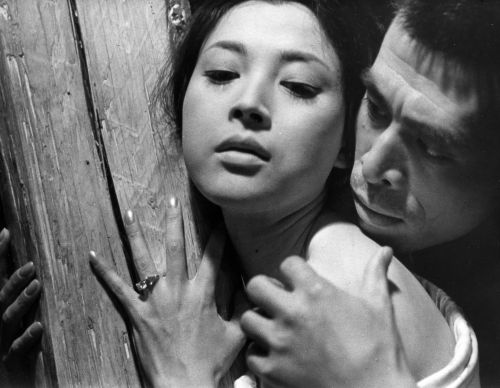
 “Mariko Okada: The Discreet Charm of the Adulteress,” the final section of the Japan Society’s three-part “Mad, Bad . . . & Dangerous to Know: Three Untamed Beauties” film series, begins on April 13 with a screening of Yoshishige Yoshida’s fifth collaboration with Okada and continues on April 14 with the fascinating erotic tale THE AFFAIR. In the latter, also known as FLAMES OF LOVE, Okada stars as Oriko, an unhappily married woman who wants a divorce from her cheating husband, Furuhata (Tadahiko Sugano). In a flashback, she shows her displeasure with her widowed mother (Yoshie Minami), who is carrying on a heated affair with young sculptor Mitsuhuru (Isao Kimura); in the current day, she seeks out the Noguchi-like artist to find out about his relationship with her now-dead mother but learns a lot more than she expected. Meanwhile, Furuhata’s sister, Yokio (Shigako Shimegi), tries to get the traditional, old-fashioned Oriko out of the house and partying with her three male friends, who smoke cigarettes, drink beer, and break out in sudden groovy dances at the spur of the moment. But when Oriko—who still wears kimonos and worries about what is considered proper in a society that is changing drastically all around her—spies on Yokio having hot, casual sex with a common worker (KILL!’s Etsushi Takahashi in his film debut), her own hidden sexuality is awakened. Yoshida, who trained at Shochiku under Nagisa Oshima (CREUL STORY OF YOUTH, IN THE REALM OF THE SENSES), incorporates Bergmanesque touches with a Nouvelle Vague sensibility and more than a hint of Teshigahara (WOMAN IN THE DUNES) in this strikingly visual, highly stylized tale, including sweeping, dreamlike flashbacks, gorgeous long shots, and a haunting theme of duality evident in his use of mirrors and windows, light and dark. “Mad, Bad . . . & Dangerous to Know” concludes on April 18 with Yoshida’s WOMAN OF THE LAKE (ONNA NO MIZUUMI) and Yasuzo Masumura’s highly charged TWO WIVES (TSUMA FUTARI), which has never before been screened outside of Japan.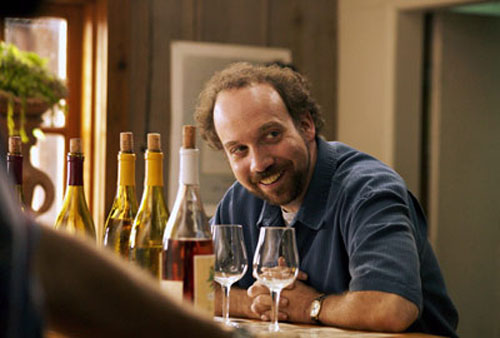
 Alexander Payne’s fourth film, following the underseen CITIZEN RUTH, the excellent ELECTION, and the overrated ABOUT SCHMIDT, is fabulously entertaining from start to finish, a smart, inventive, very funny dark comedy about friendship and love set in California wine country. Paul Giamatti stars as Miles, a schlumpy wine connoisseur who is having trouble getting over his divorce and the failure of his massive novel to get published. His best friend, Jack (Thomas Haden Church), is getting married, so the two head off on a road trip, with Miles looking forward to sampling fine wine, and Jack anticipating sampling fine women. While Jack finds what he is looking for in Stephanie (Sandra Oh, who was married to Payne at the time), Miles seems hell-bent on not allowing himself to enjoy life, even as a beautiful woman with a deep appreciation of the grape (the excellent Virginia Madsen in what should have been a career-redefining performance) shows an interest in him. You definitely do not have to be a wine drinker to fall in love with this marvelous movie, one of the best of 2004; it was nominated for Best Director, Best Picture, Best Supporting Actress (Madsen), and Best Supporting Actor (Haden Church), and screenwriters Jim Taylor and Payne won for Best Adapted Screenplay. The screening is part of the “Collaborations: Alexander Payne and Jim Taylor” series at 92YTribeca, which continues with ABOUT SCHMIDT at 8:30 (separate admission required).