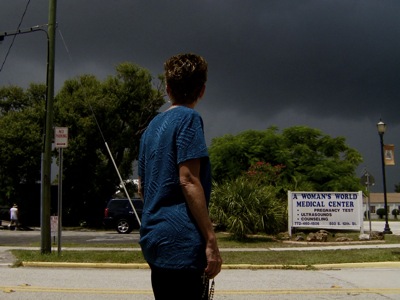
Heidi Ewing and Rachel Grady’s 12th & DELAWARE opens the 2010 Human Rights Watch Film Festival
Film Society of Lincoln Center
Walter Reade Theater, 165 West 65th St. at Amsterdam Ave.
June 10-24
Tickets: $12, five-film pass $50
212-875-5601
www.hrw.org
www.filmlinc.com
When it comes right down to it, most film festivals are really unnecessary. Sure, it’s fun for a bunch of cineastes, us included, to catch the latest indie flick or foreign epic, but it’s also often an excuse for the glitterati to look fabulous and attend ultrahip after-parties. But there’s at least one film festival that is not only necessary but also essential: the Human Rights Watch Film Festival, which begins June 10 at Lincoln Center with a benefit screening of Robert Connolly’s THE BALIBO CONSPIRACY, set in 1975 East Timor, and continues through June 24, showing seventeen features and several shorts. Heidi Ewing and Rachel Grady’s 12th & DELAWARE, about the battle between an abortion clinic and a pro-life center across the street from each other, opens the festival on June 10, while Roberto Hernández and Geoffrey Smith’s PRESUMED GUILTY, a harrowing tale of wrongful imprisonment in Mexico, closes things out on June 24. Raoul Peck’s MOLOCH TROPICAL, a political drama about his native Haiti, is the centerpiece selection. Other works examine the Angola 3, the murder of women in Ciudad Juárez, same-sex marriage, disappearances during the Khmer Rouge siege of Cambodia, immigration reform, the farmer suicide epidemic in India, and other conflicts in Afghanistan, Iraq, the Democratic Republic of Congo, Iran, and the halls of Congress. For more than two decades, the HRWFF has been presenting fiction and nonfiction films that, together, form a kind of shocking world news report, sharing unbelievable stories that we should be reading about in newspapers and on the Internet and watching on the news instead of waiting for these films each year. Many of the screenings are followed by panel discussions or Q&As with the filmmakers and participants. (Keep watching twi-ny for upcoming reviews of several festival films.)
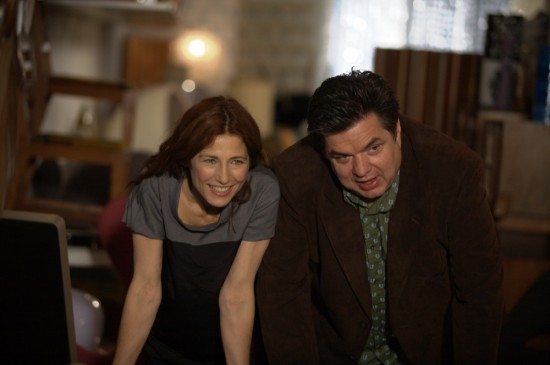
 Writer-director Nicole Holofcener’s PLEASE GIVE is a nearly flawless portrait of a couple of quirky New York City families who come together in strange, awkward ways. Kate (Catherine Keener) and Alex (Oliver Platt) resell furniture they buy from the relatives of the recently deceased; they are particularly eager for the old lady next door, Andra (Ann Guilbert, Millie Helper from THE DICK VAN DYKE SHOW), to pass on so they can knock down the walls and expand their own apartment. Sweet and innocent Rebecca (Rebecca Hall), a mammogram technician, has sacrificed any personal life she might have by taking care of her grandmother despite Andra’s nasty, mean-spirited nature. Rebecca’s sister, Mary (Amanda Peet), who gives facials at a beauty salon, doesn’t seem to care that Andra’s about to kick the bucket and isn’t afraid to say that to her face. And Abby (Sarah Steele), Kate and Alex’s teen daughter, is furious that her mother won’t buy her expensive jeans yet constantly hands out plenty of money to neighborhood bums and a local transvestite. Holofcener (WALKING AND TALKING, LOVELY & AMAZING) has a great ear for dialogue and an innate sense of creating realistic, believable situations, nailing each character’s dilemmas as their stories all converge. The central focus is on Kate, who desperately wants to make the world a better place but is having difficulty figuring just how she might be able to do that, continually seeking volunteer opportunities that end up being just too painful for her. PLEASE GIVE is a wonderful, engaging film that will be especially endearing for New York City audiences.
 In case you’re worried about the next generation of Americans, WHIZ KIDS shows that there are plenty of intelligent, ambitious teenagers around the country looking to better themselves and, more importantly, the planet. Working with Tina DiFeliciantonio (LIVING WITH AIDS) and Jane C. Wagner, Tom Shepard (SCOUT’S HONOR) spent a year following three high school students as they prepared for the annual Intel Science Talent Search: Long Island botanist Ana Cisneros, West Virginia environmental scientist Kelydra Welcker, and Staten Island paleontologist Harmain Khan. Through school and regional competitions up through the grand finale in Washington, DC, Shepard, himself a 1987 finalist, gets the protagonists to share their hopes and dreams, their fears and failures. As much as each teenager wants to win the prestigious talent search, which was famously previously sponsored by Westinghouse, they also need to win, as the $100,000 prize would help them afford to go to an Ivy League institution. Welcker’s story is particularly fascinating and frustrating, as an important regional science fair, partly sponsored by DuPont, is curiously canceled immediately after news of her project, which involves a new way of cleaning water possibly contaminated by a DuPont Teflon factory, becomes public. One of the most exciting parts of the documentary, which has nothing to do with Kelydra, Ana, and Harmain, depicts the wild and woolly final minutes leading up to the Intel application deadline, when procrastinating students must get their papers in no later than 11:59, no exceptions of any kind allowed. Treading carefully to avoid becoming yet another reality-show movie, WHIZ KIDS winds up being a rather smart, enlightening film that opens, appropriately enough, while the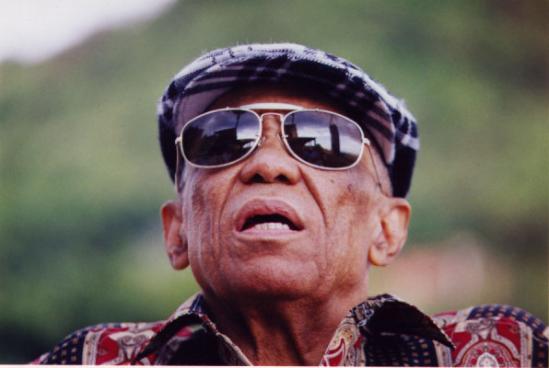

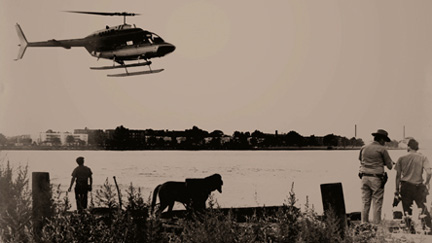
 When we were kids, one of our friends delighted in telling us over and over the story of Cropsey, a supposedly invented child-murdering creep who threatened all children everywhere. (We still think of the monster every time we pass by the Cropsey Ave. exit on the Belt Parkway.) Directors Joshua Zeman and Barbara Brancaccio go in search of the real Cropsey in a fascinating documentary that brings to frightening life the scary urban legend. In 1987, Jennifer Schweiger, a thirteen-year-old girl with Down syndrome, disappeared in Staten Island not far from the abandoned Willowbrook Mental Institution, a horrific place where unheard-of abuses had been detailed by a young reporter named Geraldo Rivera fifteen years earlier. The community, led by such activists as Donna Cutugno, came together to try to find Jennifer’s body while the police focused on Andre Rand as the possible perpetrator. Rand refused to say anything as the cops also sought to link him to other area disappearances, including that of Holly Ann Hughes in 1981. Through archival news footage, recent interviews with many of the primary figures involved in the case, and attempts at a face-to-face meeting with Rand, codirectors Zeman and Brancaccio reveal a dark side of humanity that still has devastating effects on a tight-knit Staten Island neighborhood in desperate need of closure.