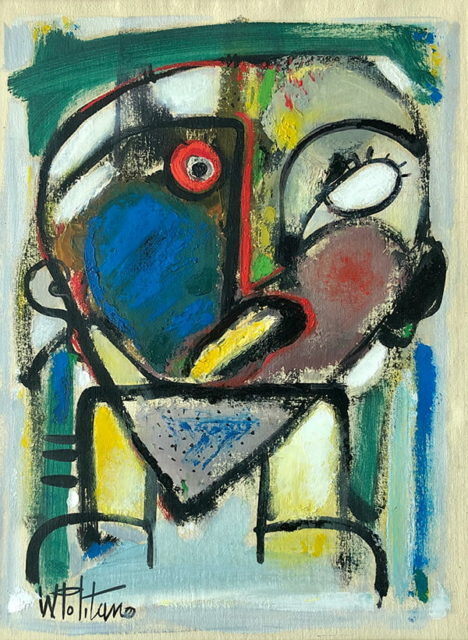
Wladimiro Politano, The Expression of the Soul XLIX, 2010
Who: Mariana Valencia, Jimena Paz, Shamel Pitts, Francesca Harper, Francisco Cordova, Ernesto Breton/Rudy Perez, Edivaldo Ernesto, Horacio Macuacua, Emilio Rojas, Claudia Rankine, Margo Jefferson, Antonio Sánchez Band, Jonathan Mendoza, Gina Belafonte, Xaviera Simmons, Enrique Morones, Roger H. Brown, Raoul Roach, Adelita-Husni-Bey, Reverend Micah Bucey What: Dance, poetry, music, film, and activism at historic location Where: Judson Memorial Church, 55 Washington Square South between Thompson & Sullivan Sts. When: Saturday, October 2, free with RSVP (suggested donation $20), 11:00 am – 6:30 pm; ninety-minute recorded version the next day at the Jersey City Theater Center Why: An all-star lineup of artists and activists are coming together October 2 at Judson Memorial Church for “Movement without Borders: A Day of Performance to Celebrate New York Immigration Coalition, UnLocal, and Gente Unida,” honoring three organizations fighting for immigration rights. From 11:00 am to 6:30 pm, dancers and choreographers, musicians, poets, authors, visual artists, and more will honor the work being done by New York Immigration Coalition,UnLocal, and Gente Unida. Among the presenters are dancer/choreographers Mariana Valencia, Ernesto Breton/Rudy Perez, Jimena Paz, Francisco Cordova, Horacio Macuacua, Francesca Harper, Edivaldo Ernesto, and Shamel Pitts/TRIBE, multidisciplinary artist Emilio Rojas, the Antonio Sánchez Band (with Sánchez, Thana Alexa, Jordan Peters, Carmen Staaf, Noam Wiesenberg), Adelita Husni-Bey (who will screen her film Chiron), visual artist Xaviera Simmons, poets Jonathan Mendoza and Claudia Rankine, Gente Unida founder and director Enrique Morones, Sankofa executive director Gina Belafonte, music producer and activist Raoul Roach, and others. Conceived, directed, and produced by Richard Colton, “Movement without Borders” will also be available in a ninety-minute recorded version on October 3 at the Jersey City Theater Center as part of the third annual Voices International Theater Festival.
John Cale and Lou Reed reunite to honor Andy Warhol in Songs for ’Drella
SONGS FOR ’DRELLA (Ed Lachman, 1990)
New York Film Festival, Lincoln Center
Francesca Beale Theater, Elinor Bunin Munroe Film Center
144 West 65th St. between Broadway & Amsterdam Ave.
Tuesday, October 5, 4:30 www.filmlinc.org
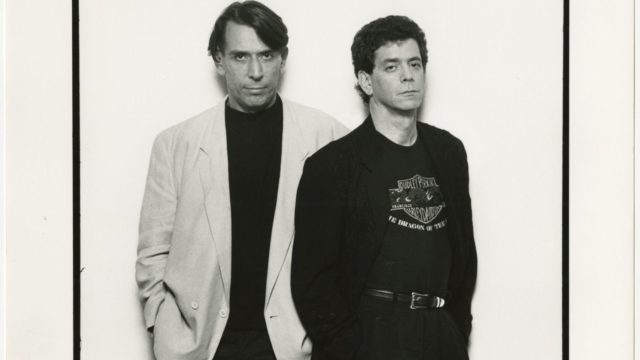
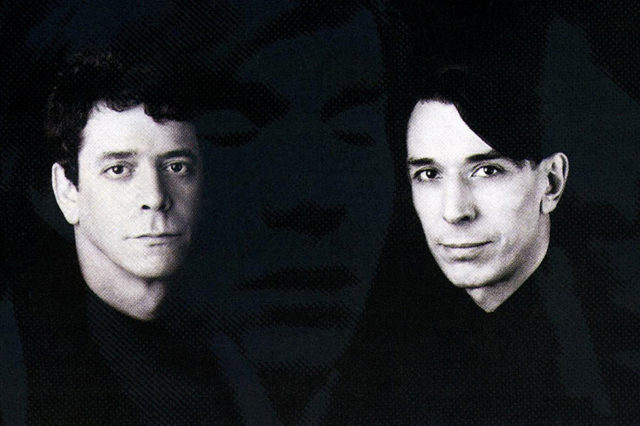
In December 1989, Velvet Underground cofounders John Cale and Lou Reed took the stage at BAM’s Howard Gilman Opera House and performed a song cycle in honor of Andy Warhol, who had played a pivotal role in the group’s success. The Pittsburgh-born Pop artist had died in February 1987 at the age of fifty-eight; although Cale and Reed had had a long falling-out, they reunited at Warhol’s funeral at the suggestion of artist Julian Schnabel. Commissioned by BAM and St. Ann’s, Songs for ’Drella — named after one of Warhol’s nicknames, a combination of Dracula and Cinderella — was released as a concert film and recorded for an album. The work is filled with factual details and anecdotes of Warhol’s life and career, from his relationship with his mother to his years at the Factory, from his 1967 shooting at the hands of Valerie Solanis to his dedication to his craft.
Directed, photographed, and produced by Ed Lachman, the two-time Oscar-nominated cinematographer of such films as Desperately Seeking Susan,Mississippi Masala,Far from Heaven, and Carol — Lachman also supervised the 4K restoration being shown at the New York Film Festival this week — Songs for ’Drella is an intimate portrait not only of Warhol but of Cale and Reed, who sit across from each other onstage, Cale on the left, playing keyboards and violin, Reed on the right on guitars. There is no between-song patter or introductions; they just play the music as Robert Wierzel’s lighting shifts from black-and-white to splashes of blue and red. Photos of Warhol and some of his works (Electric Chair,Mona Lisa,Gun) are occasionally projected onto a screen on the back wall.
“When you’re growing up in a small town / Bad skin, bad eyes — gay and fatty / People look at you funny / When you’re in a small town / My father worked in construction / It’s not something for which I’m suited / Oh — what is something for which you are suited? / Getting out of here,” Reed sings on the opener, “Smalltown.” Cale and Reed share an infectious smile before “Style It Takes,” in which Cale sings, “I’ve got a Brillo box and I say it’s art / It’s the same one you can buy at any supermarket / ’Cause I’ve got the style it takes / And you’ve got the people it takes / This is a rock group called the Velvet Underground / I show movies of them / Do you like their sound / ’Cause they have a style that grates and I have art to make.”
Songs for ’Drella is screening at NYFF59 in new 4K restoration
Cale and Reed reflect more on their association with Warhol in “A Dream.” Cale sings as Warhol, “And seeing John made me think of the Velvets / And I had been thinking about them / when I was on St. Marks Place / going to that new gallery those sweet new kids have opened / But they thought I was old / And then I saw the old DOM / the old club where we did our first shows / It was so great / And I don’t understand about that Velvets first album / I mean, I did the cover / and I was the producer / and I always see it repackaged / and I’ve never gotten a penny from it / How could that be / I should call Henry / But it was good seeing John / I did a cover for him / but I did it in black and white and he changed it to color / It would have been worth more if he’d left it my way / But you can never tell anybody anything / I’ve learned that.”
The song later turns the focus on Reed, recalling, “And then I saw Lou / I’m so mad at him / Lou Reed got married and didn’t invite me / I mean, is it because he thought I’d bring too many people? / I don’t get it / He could have at least called / I mean, he’s doing so great / Why doesn’t he call me? / I saw him at the MTV show / and he was one row away and he didn’t even say hello / I don’t get it / You know I hate Lou / I really do / He won’t even hire us for his videos / And I was so proud of him.”
Reed does say hello — and goodbye — on the closer, “Hello It’s Me.” With Cale on violin, Reed stands up with his guitar and fondly sings, “Oh well, now, Andy — I guess we’ve got to go / I wish some way somehow you like this little show / I know it’s late in coming / But it’s the only way I know / Hello, it’s me / Goodnight, Andy / Goodbye, Andy.”
It’s a tender way to end a beautiful performance, but Lachman has added a special treat after the credits, with one final anecdote and the original trailer he made for Reed’s 1974 song cycle, Berlin.Songs for ’Drella is screening October 5 at 4:30 at the Francesca Beale Theater; it is also being shown October 2 prior to the free outdoor presentation of Todd Haynes’s new documentary, The Velvet Underground, in Damrosch Park, which will be followed by a Q&A with Lachman and Haynes. Lachman and Haynes will also be part of a Q&A with producers Christine Vachon and Julie Goldman and editors Affonso Gonçalves and Adam Kurnitz at the September 30 screening of The Velvet Underground at Alice Tully Hall; Cale was supposed to attend but has had to cancel.
Todd Haynes documents the history of the Velvet Underground in new film
THE VELVET UNDERGROUND (Todd Haynes, 2021)
Thursday, September 30, Alice Tully Hall, 6:00
Saturday, October 2, Damrosch Park, 7:00
Film Comment Live: The Velvet Underground & the New York Avant-Garde, Sunday, October 3, Damrosch Park, free, 4:00 www.filmlinc.org
Much of Haynes’s documentary, which will have its theatrical premiere October 14–21 at the Walter Reade (and streaming on Apple+ beginning October 15), focuses on Warhol’s position in helping develop and promote the Velvets. “Andy was extraordinary, and I honestly don’t think these things could have occurred without Andy,” Reed, who died in 2013, says. “I don’t know if we would have gotten the contract if he hadn’t said he’d do the cover or if Nico wasn’t so beautiful.”
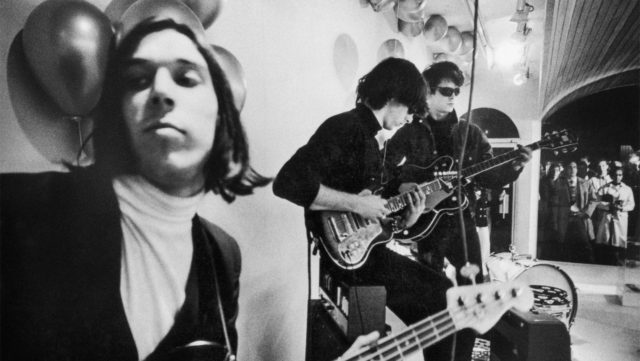
Haynes details the history of the group by delving into Cale and Reed’s initial meeting, the formation of the Primitives with conceptual artists Tony Conrad and Walter DeMaria, and the transformation into the seminal VU lineup at the Factory under Warhol’s guidance — singer-songwriter-guitarist Reed, Welsh experimental composer and multi-instrumentalist Cale, guitarist Sterling Morrison, drummer Maureen Tucker, and German vocalist Nico.
Haynes and editors Gonçalves and Kurnitz pace the film like VU’s songs and overall career, as they cut between new and old interviews and dazzling archival photographs and video, frantic and chaotic at first, then slowing down as things change drastically for the band They employ split screens, usually two but up to twelve boxes at a time, to deluge the viewer with a barrage of sound and image. Among the talking heads in the film are composer and Dream Syndicate founder La Monte Young, actress and film critic Amy Taubin, actress and author Mary Woronov, Reed’s sister Merrill Reed-Weiner, early Reed bandmates and school friends Allan Hyman and Richard Mishkin, filmmaker and author John Waters, manager and publicist Danny Fields, composer and philosopher Henry Flynt, and avant-garde filmmaker and poet Jonas Mekas. “We are not part really of the subculture or counterculture. We are the culture!” Mekas, who passed away in 2019 at the age of ninety-six, declares.
Haynes, who has made such previous music-related films as Velvet Goldmine, set in the 1970s glam-rock era, and I’m Not There, a fictionalized musical inspired by the life and career of Bob Dylan, also speaks extensively with Cale and Tucker, who hold nothing back, in addition to Sterling Morrison’s widow, Martha Morrison; singer-songwriter Jackson Browne, who opened up for the Velvets; and big-time fan Jonathan Richman (of Modern Lovers fame). While everyone shares their thoughts about Warhol, the Factory, the Exploding Plastic Inevitable shows, and the eventual dissolution of the band, Haynes bombards us with clips from Warhol’s Sleep,Kiss,Empire, and Screen Tests (many opposite the people who appear in the film) as well as works by such artists as Maya Deren, Jack Smith, Kenneth Anger, Barbara Rubin, Tony Oursler, Stan Brakhage, and Mekas and paintings by Warhol, Jasper Johns, Robert Rauschenberg, and Mark Rothko. It’s a dizzying array that aligns with such VU classics as “I’ll Be Your Mirror,” “I’m Waiting for the Man,” “Heroin,” “White Light / White Heat,” “Sister Ray,” “Pale Blue Eyes,” and “Sweet Jane.”
Several speakers disparage the Flower Power era, Bill Graham, and Frank Zappa and the Mothers of Invention, with Tucker admitting, “This love-peace crap, we hated that. Get real.” They’re also honest about the group’s own success, or lack thereof. Tucker remembers at their first shows, “We used to joke around and say, ‘Well, how many people left?’ ‘About half.’ ‘Oh, we must have been good tonight.’” And there is no love lost for Reed, who was not the warmest and most considerate of colleagues.
The Velvets continue to have a remarkable influence on music and art today despite having recorded only two albums with Cale (The Velvet Underground and Nico and White Light / White Heat) and two with Doug Yule replacing Cale (The Velvet Underground and Loaded) in a span of only three years. Haynes (Far from Heaven,Safe) sucks us right into their extraordinary world and keeps us swirling in it for two glorious hours of music, gossip, art, celebrity, and backstabbing. If you end up watching the film at home, turn it up loud. No, louder than that. Even louder. . . .
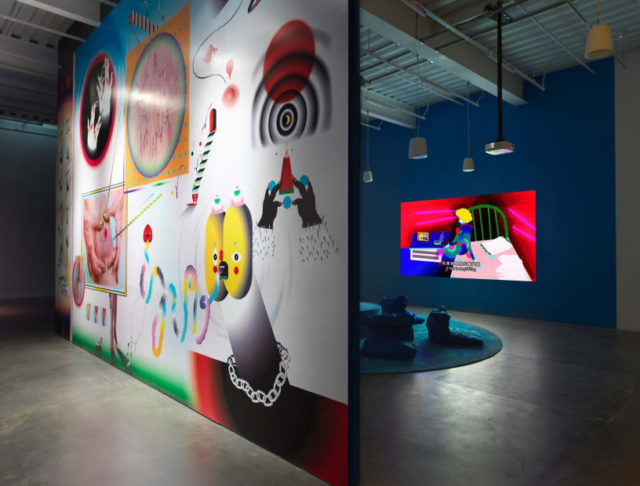
“Wong Ping: Your Silent Neighbor” continues at the New Museum through October 3 (photo by Dario Lasagni)
WONG PING: YOUR SILENT NEIGHBOR
New Museum of Contemporary Art
235 Bowery at Prince St.
Tuesday – Sunday through October 3, $12-$18 www.newmuseum.org
WONG PING: THE GREAT TANTALIZER
Tanya Bonakdar Gallery
521 West 21st St. between Tenth & Eleventh Aves.
Tuesday – Saturday through October 23, free, 10:00 am – 6:00 pm www.tanyabonakdargallery.com
Multimedia artist Wong Ping’s current shows at the New Museum in SoHo and Tanya Bonakdar in Chelsea are filled with lovable animated pandas, colorful cartoons, a retelling of Pinocchio, and playful sculpture and installation. But you might want to think twice before bringing the kids, as Wong’s work tackles income inequality, sexual repression and expression, police corruption, dating and desire, climate change, and sociopolitical aspects of contemporary life, particularly in his native Hong Kong as its battles with Mainland China since the 1997 handover from the British grow ever-more dangerous, all told in a DIY style inspired by video games and narrated by Wong himself.
At the New Museum, An Emo Nose (2015) reimagines Pinocchio’s proboscis, resembling both a heart and a penis, as its own sentient being, reacting to the protagonist’s negative thoughts by stretching out and going off on its own, depicting humanity’s vulnerability of both mind and body. In the two-channel The Other Side (2015), projected onto a screen and a small television monitor in front of it, the narrator journeys across treacherous terrain, has soup with Granny Meng (forgetfulness goddess Meng Po), and ponders his future, a parable of emigration from Hong Kong filtered through the Beatles’ Yellow Submarine. A 3-D printed text panel relates self-affirmations in tiny letters, including “I am the last drop of period blood before menopause” and “I am the last rebellious punk.”
The retrospective is centered by four videos projected onto four screens on all sides of one large room; visitors sit on comfy beanbag chairs or a round couch as they rotate to watch the short films, which total forty-three minutes. In Jungle of Desire (2015), an impotent man is powerless when his wife becomes a prostitute to satisfy her sexual desire and is exploited by a cop. In Who’s the Daddy? (2017), a man considers himself an outcast because his penis is straight, not bending to the left or right, and confuses politics and sex as things go wrong with a woman he hooked up with on a dating app. “People even deny its existence,” he opines about his member.
Wong Ping’s Fables 2 (2019) follows the trials and tribulations of a special cow and three conjoined rabbit siblings attempting to make their own way in life. And in Sorry for the Late Reply (2021), commissioned for this show, a fisherman becomes obsessed with an elderly saleswoman’s varicose veins. “If you’ve ever stepped into the supernatural world during a hike, or have gotten lost in the parking lot and couldn’t find the exit, or have stared into the eyes of a black chicken standing outside your door through the peephole late at night, then you would know how I feel,” he says.
Wong Ping is a curator researching the Great Tantalizer in show at Tanya Bonakdar
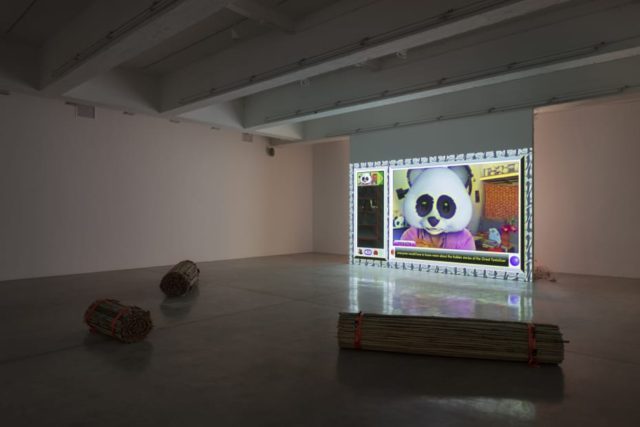
Over at Tanya Bonakdar, Wong’s “The Great Tantalizer” is a multimedia installation structured around a mockumentary about a scientist who had been determined to increase sexual desire in pandas and bring that information on their mating techniques to humans, particularly in China, given its former one-child policy and overall preference for boys. The relentless drive to tantalize may be commenting as well on the current tangping movement, or “lying flat,” in which many younger Chinese have opted out of the pressures of modern life by declining to engage in the endless competition for personal and professional success, a high-quality education, a good job, a happy marriage, a beautiful home, and lovely children.
The gallery has been reimagined as the Great Tantalizer’s abandoned laboratory, with a stack of white plastic chairs and a labcoat, an exhibition poster and bamboo pole that declare, “EAT.SLEEP.POOOOOP.DIE,” and The Tender Rider, a cute old kiddie vehicle with a panda head that now serves as a projector, beaming highly sexualized images onto the walls in a back room. It’s all organized around a screen showing a Zoom-like panel discussion featuring Wong in a panda outfit, hosting the virtual talk with the GT’s former laboratory staff, one-night stand, and main competitor, whose identities are disguised. Visitors can sit on rolls of bound bamboo sticks as Wong explores who the GT was and what his legacy is.
The thirty-seven-year-old Wong is quickly building up an impressive legacy of his own with these presentations at the New Museum and Tanya Bonakdar, expanding his breadth with his distinctive approach to exposing society’s ills.
Bill Morrison explores Russian and Soviet cinematic history from a unique angle in The Village Detective
THE VILLAGE DETECTIVE: a song cycle (Bill Morrison, 2021)
IFC Center
323 Sixth Ave. at West Third St.
September 22-30
212-924-777 www.ifccenter.com
In the 1970 documentary Zharov Tells, longtime Russian film favorite Mikhail Zharov says, “Remembering my life, I am trying to follow, to find for myself, and for others too, especially the young, the answer to the question of how life gets woven into art and how art reflects life.” When it comes to cinema, Chicago-born, New York City–based filmmaker Bill Morrison has been excavating this connection for more than thirty years, in such masterworks as Dawson City: Frozen Time and Decasia.
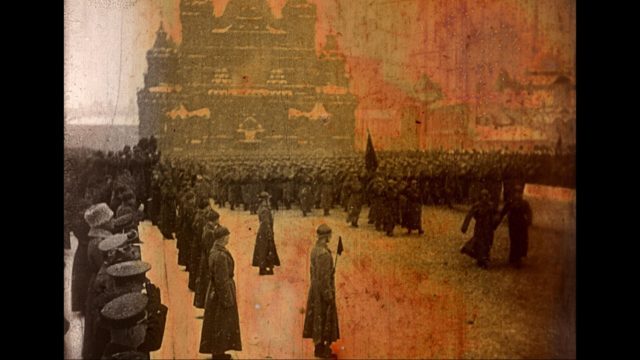
Morrison uses found footage, often in terrible shape, the celluloid practically disintegrating in his hands and before our eyes onscreen, to examine sociocultural issues and film history itself. So when his friend Jóhann Jóhannsson, the Icelandic musician and composer who passed away in 2018 at the age of forty-eight, emailed him in July 2016 about a lobster trawl that had scraped up a film canister, Morrison jumped at the opportunity to explore its contents. Fishing in Faxaflói, about twenty nautical miles southwest of the Snæfellsjökull glacier, near the Mid-Atlantic Ridge where the North American and Eurasian plates meet — what Morrison calls in the film “the deep divide between East and West” — the lobster boat Fróði had scooped up four reels containing an incomplete copy of Ivan Lukinsky’s 1969 Soviet crime comedy Derevenskiy Detektiv (Village Detective), starring Zharov as local rural policeman Fyodor Ivanovich Aniskin, who is investigating the theft of an accordion.
While there is nothing special about the movie, which is not some long-lost treasure but just a mediocre-at-best tale that led to two sequels, Morrison decided to become a kind of detective himself, doing a deep dive into Zharov’s oeuvre, producing a unique look at twentieth-century Soviet and Russian history as seen through its cinema. And he centers his film on the found reels of Derevenskiy Detektiv, with all their glips, blotches, dirt, and grime instead of using a cleaner print (which is available), adding an extra layer of commentary on the changes occurring from multiple revolutions, two world wars, and the transition from tsars to Vladimir Lenin and Joseph Stalin.
Serving as producer, director, and editor, Morrison includes numerous clips of Zharov, who was born in 1899 and died in 1981, having appeared in more than five dozen films and a hundred theatrical productions, beginning with his debut as a soldier in 1915’s Tsar Ivan the Terrible and including 1931’s Road to Life, in which Zharov, as a thief named Zhigan, became the first actor to sing in Russian on camera. Morrison concentrates on the clips themselves; there are only a few moments of commentary, from Erlendur Sveinsson, the former director of the National Film Archive of Iceland who supervised the preservation of the discovered reels, and George Eastman Museum curator Peter Bagrov, who compares Zharov’s popularity to that of Humphrey Bogart or Clark Gable in Hollywood.
“Once you were a prince. Now you are a nobody,” Zharov says as Menshikov to the title character in 1937’s Peter the First. “I am not Soviet,” he declares as Dymba in 1939’s New Horizons. He displays his loyalty to Comrade Stalin as Perchikhin in 1942’s Fortress on the Volga. He plays a former soldier for the tsar who is now a Bolshevik in 1942’s He Will Come Back. The next year, in In the Name of the Fatherland, he proclaims as Globa, “I hate these Bolsheviks. I hate them more than I hate you!” And in Sergei Eisenstein’s 1958 Ivan the Terrible Pt. 2., Zharov states as guard Malyuta Skuratov, “I would give my soul for the tsar.”
The soundtrack, composed by Pulitzer and Grammy winner and Oscar nominee David Lang, also takes us back to old Russia with a sly nod to the plot of Derevenskiy Detektiv; the compelling score was written for one accordion and is played by Norwegian musician Frode Andersen, with vocals by Shara Nova. Not only is the accordion a traditional Eastern European folk instrument but it was used by Tchaikovsky, Sterligov, and others in their orchestrations. The final seconds of the film bring it all together beautifully.
“You know, when I heard about the reels being found, I was expecting a lost silent masterpiece and not a film which we have in our collection on camera negative from which it’s been shown on television from month to month,” Bagrov recounts. Lukinsky’s Derevenskiy Detektiv might not be a masterpiece of any kind, but Morrison’s (The Miners’ Hymns,The Great Flood) The Village Detective is another masterful triumph from one of America’s most ingenious filmmakers.
Apichatpong Weerasethakul will discuss his new film, Memoria,) at NYFF59 free talk
NYFF59 FREE TALKS
Film at Lincoln Center
Elinor Bunin Munroe Film Center Amphitheater
144 West Sixty-Fifth Street between Broadway & Amsterdam Ave.
September 25 – October 9, free (first come, first serve one hour before program) www.filmlinc.org
The New York Film Festival, which opens today, has just announced its slate of free talks, taking place September 25 to October 9 at the Elinor Bunin Munroe Film Center Amphitheater (with one exception). Admission is first come, first served starting an hour before each event; the talks will also be recorded for later on-demand viewing on YouTube. The highlight is the inaugural Amos Vogel Lecture, honoring the centennial of the birth of the cofounder of the festival, who is also the subject of a centenary retrospective. The lecture will be given by Albert Serra, the director of previous NYFF selections The Death of Louis XIV and Liberté and who wrote the foreword for the French edition of Vogel’s seminal book, Film as a Subversive Art.
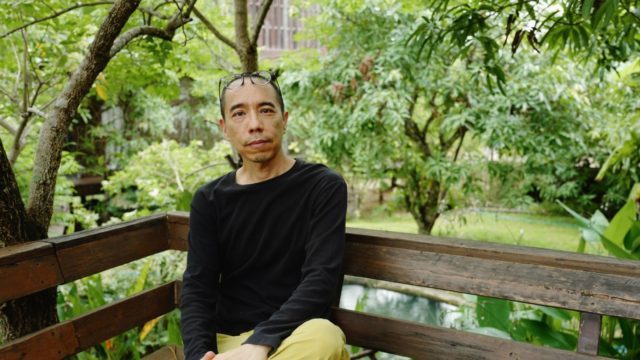
The rest of the panel discussions, in-depth conversations, and filmmaker dialogues are divided into “Deep Focus,” “Crosscuts,” and “Film Comment Live,” with such participants as Jane Campion (The Power of the Dog), Sofia Coppola, Mia Hansen-Løve (Bergman Island), Joachim Trier (The Worst Person in the World), Todd Haynes (The Velvet Underground), Apichatpong Weerasethakul (Memoria,Night Colonies), Ryûsuke Hamaguchi (Drive My Car,Wheel of Fortune and Fantasy), and Amy Taubin. The discussion about the thirtieth anniversary of Mississippi Masala with director Mira Nair, star Sarita Choudhury, and cinematographer Ed Lachman, moderated by Jhumpa Lahiri, follows the free screening of the film in Damrosch Park, for ticket holders only. Below is the full schedule.
Jane Campion will delve into her NYFF59 centerpiece selection, The Power of the Dog, with Sofia Coppola
Saturday, September 25
Deep Focus: The Making of Mississippi Masala, with Mira Nair, Sarita Choudhury, and Ed Lachman, moderated by Jhumpa Lahiri, Damrosch Park, 9:30
Sunday, September 26
Roundtable: Cinema’s Workers, with Abby Sun, Ted Fendt, Kazembe Balagun, and Dana Kopel, moderated by Gina Telaroli, Amphitheater, 7:00
Monday, September 27
Crosscuts: Mia Hansen-Løve & Joachim Trier, Amphitheater, 7:00
Saturday, October 2
Deep Focus: Jane Campion, moderated by Sofia Coppola, Amphitheater, 4:00
Sunday, October 3
Film Comment Live: The Velvet Underground & the New York Avant-Garde, with Todd Haynes, Ed Lachman, and Amy Taubin, Amphitheater, 4:00
Deep Focus: Ryûsuke Hamaguchi, Amphitheater, 7:00
Tuesday, October 5
Deep Focus: Maggie Gyllenhaal & Kira Kovalenko, Amphitheater, 7:00
Thursday, October 7
Deep Focus: Apichatpong Weerasethakul, Amphitheater, 6:30
Saturday, October 9
Film Comment Live: Festival Report, with Devika Girish, Clinton Krute, Molly Haskell, Bilge Ebiri, and Phoebe Chen, Amphitheater, 7:00
Agathe Rousselle makes a sizzling debut in Julia Ducournau’s Titane
TITANE (TITANIUM) (Julia Ducournau, 2021)
New York Film Festival
Sunday, September 26, Alice Tully Hall, 9:00
Monday, September 27, Alice Tully Hall, 8:45
Wednesday, September 29, Walter Reade Theater, 3:45 www.filmlinc.org
Julia Ducournau’s Titane is a dark, disturbing body horror thriller about family, fetishization, and obsession, a pulse-pounding, high-octane mash-up of David Cronenberg’s Crash, Donald Cammell’s The Demon Seed, and Mervyn LeRoy’s The Bad Seed.
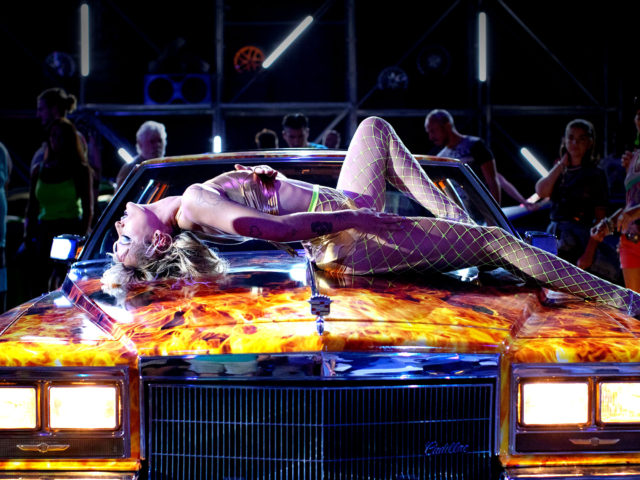
Winner of the Palme d’Or at the 2021 Cannes Film Festival, Titane features newcomer Agathe Rousselle in a revved-up performance as Alexia, a young woman whose life changed dramatically after getting seriously hurt in a car accident when she was a little girl (Adèle Guigue), having a titanium plate put in her head, an odd scar left over her right ear. The teenage Alexia is drawn to raging fires and the cool, metallic smoothness of cars. She has become somewhat of a star at auto shows, where she dances alluringly, touching and mounting cars like they are lovers, attracting a fan base of men who would do just about anything for an autograph, a selfie, or a kiss, and is befriended by fellow dancer Justine (Garance Marillier). But she’s also prone to taking out her long, sharp hairpin and stabbing people to death.
With the cops closing in, she radically changes her appearance — just try not to look away when she purposely breaks her nose — and pretends to be Adrien, a boy who has been missing for more than ten years. Adrien’s fire-captain father, Vincent (a stoic Vincent Lindon), takes her in, overjoyed that he has his son back. Alexia stops speaking and hides her breasts and stomach from Vincent — a belly that is growing by the day, leaking oil instead of blood, as something unusual seems to be developing in her womb. Despite her PTSD and addiction, Alexia tries to have a normal life, but danger lurks around every corner.
Writer-director Ducournau burst onto the scene with her 2016 debut, the FIPRESCI Prize–winning Raw, which involved vegetarianism, blood galore, and, like Titane, main characters named Adrien, Alexia, and Justine. (In fact, Marillier has played women named Justine in these two films as well as Ducournau’s 2011 short, Junior.). Body metamorphosis is a continuing theme in Ducournau’s oeuvre, and it is at the center of Titane. At first, Alexia is a tall blond with a body to die for and rad tattoos — one on her chest proclaims, “Love is a dog from hell” — but as time goes on, she is barely recognizable, her breasts sagging, her skin breaking open, motor oil leaking out. Alexia is often seen naked as Ducournau documents her change.
Vincent London shows off his bod and his acting chops in body horror thriller Titane
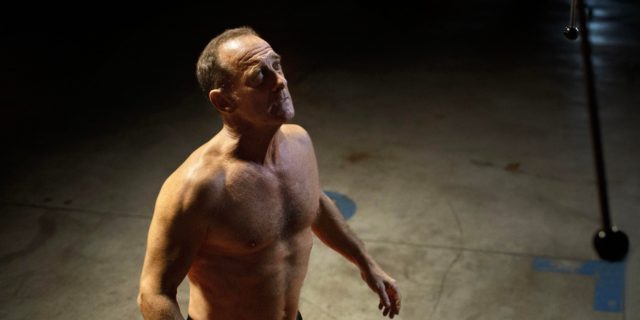
Award-winning French star Lindon (Welcome,The Measure of a Man), in a role specifically created for him, gets to show off his (dad) bod as well; he worked out for a year to get into great shape to play a haunted man obsessed with his abs, shooting hormones into his bruised butt every night to help him keep up with the younger generation. Where Alexia hides her body, Vincent enjoys being bare-chested any chance he gets.
Titane won the People’s Choice Award for Midnight Madness at the 2021 Toronto International Film Festival, and it’s easy to see why. But there’s a method to its madness; Ducournau, whose parents were both doctors, is not just shocking the audience but making it look at things it usually would turn away from or think differently about, pulling back the curtain on gender and body issues and the relationship between parents and children. The fierce soundtrack by Jim Williams is bookended by two versions of the folk gospel standard “The Wayfaring Stranger,” about a lost soul on the road home to Jordan, to meet their mother and father.
Despite the nastiness that Alexia does, and she does a whole lot of nastiness, we continue to root for her, and not merely out of sympathy for her past. (We also forgive Ducournau her plot holes and extended dance scenes.) In a man’s world, she’s been forced to give up who she is. She refuses to be yet another classic car to be gazed upon, an inanimate metal object to be worshipped. In the end, all she’s really looking for is to be loved and understood.
Titane is screening September 26, 27, and 29 at the New York Film Festival, with Ducournau, only the second female director to win the Palme D’Or — Jane Campion, whose new western, The Power of the Dog, is the centerpiece selection for NYFF59, won the award in 1993 for The Piano — participating in Q&As after the first two show, before opening theatrically October 1.
Emi (Katia Pascariu) goes on a strange journey in Rade Jude’s Bad Luck Banging or Loony Porn
BAD LUCK BANGING OR LOONY PORN: A SKETCH FOR A POSSIBLE FILM (BABARDEALA CU BUCLUC SAU PORNO BALAMUC) (Radu Jude, 2021)
New York Film Festival, Lincoln Center
Saturday, September 25, Alice Tully Hall, with virtual Q&A, 9:00
Sunday, September 26, Francesca Beale Theater, 8:00 www.filmlinc.org
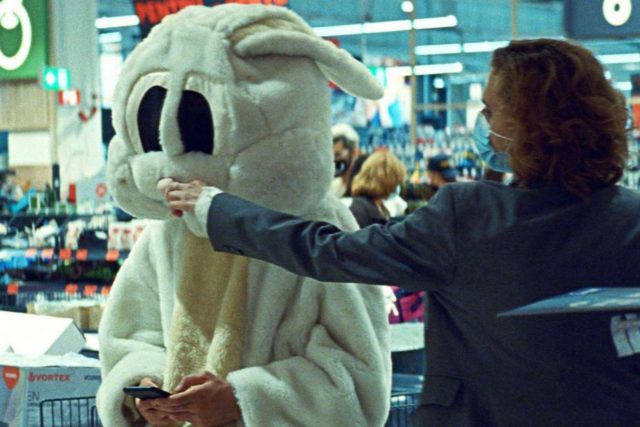
Radu Jude’s brilliantly absurdist Bad Luck Banging or Loony Porn lives up to its title, a wildly satiric takedown of social mores that redefines what is obscene. Winner of the Golden Bear for Best Film at the 2021 Berlinale, the multipart tale begins with an extremely graphic prologue, a XXX-rated homemade porn video with a woman and an unseen man holding nothing back. In the first main section, the woman, a successful teacher named Emi (Katia Pascariu), is distressed to learn that the video is threatening to go viral. She determinedly walks through the streets of Bucharest, buying flowers (which she holds upside down), discussing her dilemma with her boss, the headmistress (Claudia Ieremia), and calling her husband, Eugen, trying to get the video deleted before her meeting with angry parents at the prestigious private school where she teaches young children.
Jude and cinematographer Marius Panduru follow the masked Emi — the film was shot during the pandemic, so masks are everywhere — on her journey, the camera often lingering on the scene well after Emi has left the frame, focusing on advertising billboards, couples in the middle of conversations, people waiting for a bus, and other random actions, before finding Emi again. She sometimes fades into the background, barely seen through the windows of a passing vehicle or amid a crowd crossing at a light. She gets into an argument with a man who has parked on the sidewalk, blocking her way; she insists that he move the car, but he unleashes a stream of misogynistic curses. Swear words are prevalent throughout the film, mostly adding poignant humor.
The second segment consists of a montage of archival and new footage that details some of Romania’s recent history, involving the military, the government, religion, fascism, Nazi collaboration, patriotism, the two world wars, the 1989 revolution, Nicolae Ceaușescu, domestic violence, jokes about blondes, and the value of cinema itself. The bevy of images also points out which NSFW word is most commonly looked up in the dictionary, as well as which is second. (The film is splendidly edited by Cătălin Cristuțiu, with a fab soundtrack by Jura Ferina and Pavao Miholjević.)
It all comes together in the third section, in the school garden, where Emi faces a few dozen masked, socially distanced, very angry parents and grandparents who want her fired immediately, while the headmistress demands a calm discussion. The masked Emi is a stand-in for all of us, facing the wrath of the unruly mob forcing its sanctimonious platitudes on others when it really needs to look at itself. It’s a riotously funny sitcomlike debate in which Jude roasts many common, hypocritical beliefs held by Romanians (and people all over the world) that have not necessarily changed much from the news clips shown in the previous part.
The cartoonish cast, which includes Olimpia Mălai as Mrs. Lucia, Nicodim Ungureanu as Lt. Gheorghescu, Alexandru Potocean as Marius Buzdrugovici, and Andi Vasluianu as Mr. Otopeanu, really gets to strut its stuff while making sure their masks are properly covering their mouths and noses. They argue about beloved national poet Mihai Eminescu and Russian writer Isaac Babel, delve into various sexual positions, repeat Woody the Woodpecker’s trademark call, and quote long, intellectual passages from the internet as Jude (I Do Not Care If We Go Down in History as Barbarians,Aferim!) reveals where society’s true obscenities lie. It’s an irreverent tour de force that offers three distinct endings to put a capper on the strangely alluring affair, turning a scary mirror on the sorry state of twenty-first-century existence.
Playfully subtitled A Sketch for a Possible Film in a reference to André Malraux’s description of Eugène Delacroix’s belief that his sketches could be of the same quality as his paintings, Bad Luck Banging or Loony Porn is making its US premiere September 25 and 26 at the New York Film Festival; the first screening will be followed by a virtual Q&A. The film opens in theaters November 19.