
There will be no cheek-pinching of Ken Jacobs at special day celebrating his avant-garde classic STAR SPANGLED TO DEATH
Union Docs
322 Union Ave.
Saturday, September 18, 1:30
Suggested donation: $12
www.uniondocs.org
www.starspangledtodeath.com
Union Docs, in conjunction with Electronic Arts Intermix, will honor legendary filmmaker and artist Ken Jacobs with a full day of festive events on Saturday, September 18, built around the Brooklyn native’s magnum opus, the no-budget STAR SPANGLED TO DEATH, which was begun in the 1950s and completed in 2004. Jacobs describes the four-hundred-minute work as “an epic film shot for hundreds of dollars! [C]ombining found-films with my own more-or-less staged filming, it pictures a stolen and dangerously sold-out America, allowing examples of popular culture to self-indict. Racial and religious insanity, monopolization of wealth and the purposeful dumbing down of citizens and addiction to war oppose a Beat playfulness.” The cast includes Jacobs, Jack Smith as the Spirit Not of Life But of Living, and Jerry Sims as Suffering. The day will feature a screening of the film, a Star Spangled Supper, a Jacobs-led tour of East Village locations used in the film, and a discussion with J. Hoberman and Jacobs at around 10:00. This is a spectacular program that lovers of independent, avant-garde film and the city itself should not miss.

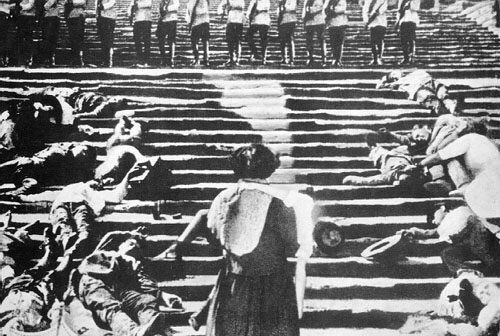
 Sergei M. Eisenstein’s BATTLESHIP POTEMKIN might be a seminal silent classic that changed the nature of filmmaking, but it is also still a vastly entertaining movie regardless of its cinematic influence and worldwide importance. Divided into five episodes — Men and Maggots, Drama at the Harbour, A Dead Man Calls for Justice, The Odessa Staircase, and The Rendez-vous with a Squadron — the film tells the based-on-fact story of a mutiny on board a sailing vessel, the result of unfair treatment of the workers, a microcosm of the Russian Revolution of 1905 that later led to the bigger revolution of 1917. The film is like an editing primer, its approach to montage causing its own revolution at the time, particularly during the unforgettable Odessa Steps sequence, in which Eisenstein’s cuts manipulate the action in powerful, emotional ways that were new to cinema. The film also features the best mustaches in the history of movies. BATTLESHIP POTEMKIN is available in numerous versions with slightly different intertitles and soundtracks; although we’re not sure which one will be shown at the Rubin Museum on September 17 (introduced by Russian writer Alex Galper) as part of its latest K2 Friday night CabaretCinema series, Icons, you can rest assured that it will be a thrilling experience, especially if you’ve never seen the film before.

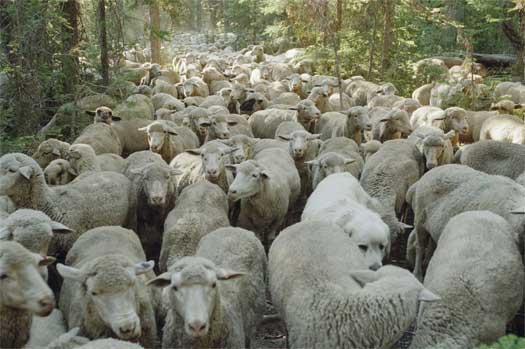
 Husband-and-wife filmmakers Lucien Castaing-Taylor and Ilisa Barbash follow a flock of sheep herded by a family of Norwegian-American cowboys on their last sojourns through the public lands of Montana’s Absaroka-Beartooth Wilderness in the gorgeously photographed, surprisingly intimate, and sometimes very funny documentary SWEETGRASS. In 2001, Castaing-Taylor, director of the Sensory Ethnography Lab at Harvard, and Barbash, a curator of Visual Anthropology at Harvard’s Peabody Museum, found out about the Allestad ranch, an old-fashioned, Old West group of sheepherders who still did everything by hand, including leading hundreds of sheep on a 150-mile journey into the mountains for summer pasture with only a few dogs and horses. Director Castaing-Taylor uses no voice-over narration or intertitles, instead inviting the viewer to join in the story as if in the middle of the action, offering no judgments or additional information. The film begins with shearing and feeding, then birthing and mothering, before heading out on the long, sometimes treacherous trail, especially at night, when bears and wolves sneak around, looking for food. Slowly the focus switches to the men themselves, primarily an old-time singing grizzled ranch hand and a cursing, complaining cowboy. Castaing-Taylor and Barbash spent three years with the sheepherders and in the surrounding areas, amassing more than two hundred hours of footage and making to date nine films out of their experiences, mostly shorter work to be displayed in gallery installations or for anthropological reasons; SWEETGRASS is the only one to be released theatrically. It’s a fascinating look at a something that is destined to soon be gone forever. The film is closing out 92YTribeca’s monthly Eat This Film! series with a special screening September 15, introduced by Castaing-Taylor, Barbash, and local sheep farmer Eugene Wyatt.