
Comic Con will team up with the New York Anime Festival this weekend at the Javits Center (photo by twi-ny/mdr)
Jacob K. Javits Convention Center
11th Ave. between 34th & 39th Sts.
October 8-10
Weekend Pass: $50 (Friday Pass $30, Saturday Pass $40, Sunday Pass $30)
www.newyorkcomiccon.com
www.newyorkcomiccon.com/en/NYAF
This year New York Comic Con teams up with the New York Anime Festival for a three-day party of the best in comic books, graphic novels, superheroes and villains, animated shorts and features, artists, writers, filmmakers, video games, collectibles, live music, and so much more. A lot of the fun comes from just watching your fellow attendees, many of whom show up in elaborate costumes. Among the many guest on hand to sign autographs (some free, some ticketed, some paid) and/or participate in panel discussions, concerts, and sneak-peek screenings are Adrien Brody, Michelle Forbes, Bruce Campbell, Joyce DeWitt, Cary Elwes, Lou Ferrigno, Maggie Q, Morgan Spurlock, Boom Boom Satellites, J. Michael Straczynski, Sherrilyn Kenyon, Seth Green, VAMPS, Stan Lee, Todd McFarlane, Frank Miller, Puffy AmiYumi, M. Knight Shymalan, Tricia Helfer, Eric Bana, Priscilla Barnes, William Katt, Tara McPherson, Noah Wyle, Echostream, and James Marsters. (Sorry, folks, but Gil Gerard canceled.) Below are just a handful of recommended events by day.
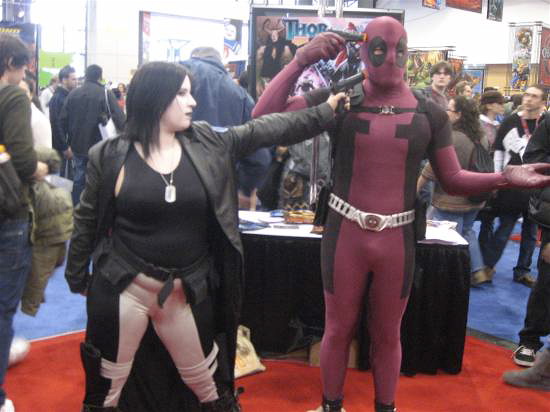
You never know what or who you’ll enounter at the annual New York Comic Con and Anime Festival (photo by twi-ny/mdr)
Friday, October 8: Oyama X Nitta Shamisen Concert, Room 1E09, 2:00
Friday, October 8: Remembering Harvey Pekar, with Jeff Newelt, Dean Haspiel, Peter Kuper, Rick Parker, Joseph Remnant, and Danny Fingeroth, Room 1A22, 4:30
Friday, October 8: Robot Chicken, screening and panel with Seth Green and Matt Senreich, IGN Theater, 6:45
Friday, October 8: MUTANT GIRLS SQUAD, Room 1E02, 7:45
Friday, October 8: Dash Shaw and Chip Kidd in Conversation, Room 1A14, 8:15
Saturday, October 9: MTV Geek with Stan Lee and Bill Plympton, Room 1A08, 11:00 am
Saturday, October 9: Mort Walker and Beetle Bailey, with Mort Walker and Tom Spurgeon, Room 1A15, 1:00
Saturday, October 9: Spotlight on Dean Haspiel, with Dean Haspiel, Walter Simonson, Nick Bertozzi, Joan Hilty, and Jonathan Ames, moderated by Christopher Irving, Room 1A23, 2:45
Saturday, October 9: Minori Chihara Concert, IGN Theater, 7:30
Saturday, October 9: Roddenberry Is Back! with Eugene “Rod” Roddenberry Jr. and Trevor Roth, Room 1A23, 9:00
Sunday, October 10: Castles, Forests, and Bath Houses: The Worlds of Hayao Miyazaki, Room 1E13, 11:00 am
Sunday, October 10: Welcome to the Space Show, Room 1E03, 1:00
Sunday, October 10: The Walking Dead on AMC, with Andrew Lincoln, Jon Bernthal, Sarah Wayne Callies, Laurie Holden, Steven Yeun, Frank Darabont, Robert Kirkman, and Gale Anne Hurd, IGN Theater, 2:15
Sunday, October 10: Voice and Art — Veronica Taylor and Misako Rocks!, Room 1E12, 3:00
Sunday, October 10: Bruce Campbell Spotlight, with Bruce Campbell, Room 1A08, 4:00
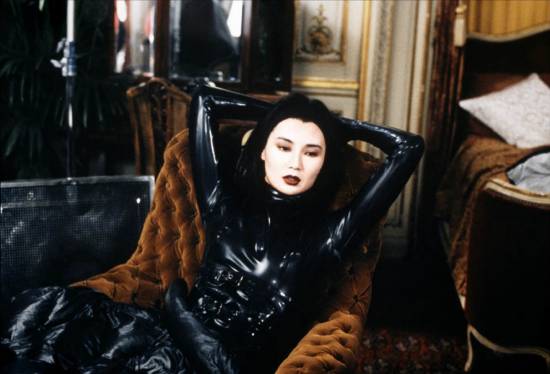
 Olivier Assayas pays homage to François Truffaut’s DAY FOR NIGHT in this piece of pseudoartistic fluff about a film crew’s attempts at remaking Louis Feuillade’s 1915 classic LES VAMPIRES. The great Maggie Cheung, who later married and divorced Assayas, is wasted as the star of the remake, and Truffaut regular Jean-Pierre Léaud, playing the director, is frustratingly unintelligible when he speaks in English, which unfortunately is a lot in this high-falutin’ mess. The film is being shown as part of “Post–Punk Auteur: Olivier Assayas,” consisting of seventeen films by the French writer-director, continuing through October 28.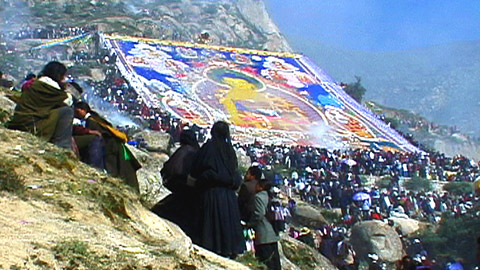
 John Bush’s Yatra Trilogy concludes with VAJRA SKY OVER TIBET: JOURNEY INTO AN ENDANGERED WORLD, a reverential documentary that examines the history of the Tibetan people, focusing on the long-standing battle with China. In 1959, the fourteenth Dalai Lama was forced into exile, finding safe haven in India. Although many Tibetans escaped with him, many stayed behind, where they practice their faith under the sharp watch of the Chinese government, which would like to name their own Dalai Lama in time. VAJRA SKY OVER TIBET is the third part of the Yatra Trilogy by producer/director John Bush, following DHARMA RIVER and PRAJNA EARTH, as Bush completes his Buddhist pilgrimage that previously took him to Southeast Asia. Bush, a Western Buddhist himself, gained remarkable access to some of Vajrayana Buddhism’s holiest palaces and sites of worship, including Jokhang Temple in Llasa, the Potala, and the Norbulinka. Bush winds his way through the Drepung Festival, traveling with a Tibetan guide whose name he can’t share because of possible reprisals. Bush narrates much of the film, along with Tenzin L Choegyal, the nephew of the current Dalai Lama, and Dadon, a popular Tibetan singer. The meditative score is by David Hykes and the Harmonic Choir, supplemented with devotional music by Dadon and other Himalayan musicians. Although it often plays too much like a travel show on PBS or the Travel Channel, VAJRA SKY, which has been personally endorsed by the Dalai Lama, is an illuminating look into a fascinating culture that is in serious danger of disappearing. “Tibetan civilization,” writes the Dalai Lama as the film begins, “forms a distinct part of the world’s precious common heritage. Humanity would be the poorer if it were to be lost.” For nearly ninety minutes, with beautiful cinematography, captivating music, and gorgeous settings, Bush takes viewers deep inside a mysterious, peaceful, and threatened world that you will not soon forget. Bush will be on hand for this special screening at the Interdependence Project to participate in a postscreening Q&A — in addition, there will also be a prescreening optional meditation.
 Named Best Documentary at numerous film festivals across the country, MARWENCOL offers a surprising look inside the creative process and the fine line that exists between art and reality. On April 8, 2000, Mark Hogancamp was nearly beaten to death outside a bar in his hometown of Kingston, New York. He spent nine days in a coma and more than a month in the hospital before being released, suffering severe brain damage that has left his memory a blur. To help put his life back together, he began using toys and dolls — Barbies, celebrity replicas, army men — to re-create his personal journey. He makes dolls of his friends and relatives, the people he works with, and others, constructing an alternate WWII-era universe he calls Marwencol, complete with numerous buildings and plenty of Nazis. He captures the detailed story in photographs that are not only fascinating to look at but that also help him figure out who he was and who he can be. This miniature three-dimensional world is reminiscent of the two-dimensional one carefully fashioned by outsider artist Henry Darger in his fifteen-thousand-page manuscript, The Story of the Vivian Girls, in What is known as the Realms of the Unreal, of the Glandeco-Angelinnian War Storm, Caused by the Child Slave Rebellion, which also features an alternate reality involving military battles set amid stunning artwork. Director, producer, and editor Jeff Malmberg makes no judgments about Hogancamp, and asks the same of the audience. In his first full-length film, Malmberg shares the compelling story of a deeply troubled, flawed man suddenly forced to begin again, using art and creativity to bring himself back to life. He speaks with Hogancamp’s mother, his old roommate, the prosecutor who handled his case, and others who are first seen proudly holding the doll Hogancamp made of them. And Malmberg doesn’t turn away from the more frightening aspects of Hogancamp’s daily existence. MARWENCOL is an unforgettable portrait of lost identity and the long road to redemption.
 In conjunction with his recent appearance at the New York Film Festival discussing his life and career and presenting his latest film, the five-and-a-half-hour CARLOS, about the notorious assassin Carlos the Jackal, BAMcinématek will be screening seventeen of French writer-director Olivier Assayas’s works, which range from ultracool flicks to boring dramas, but they’re almost always visually stunning, filled with cinematic references and hip music. The series begins October 9 with SUMMER HOURS, which falls somewhere in the middle of his oeuvre.
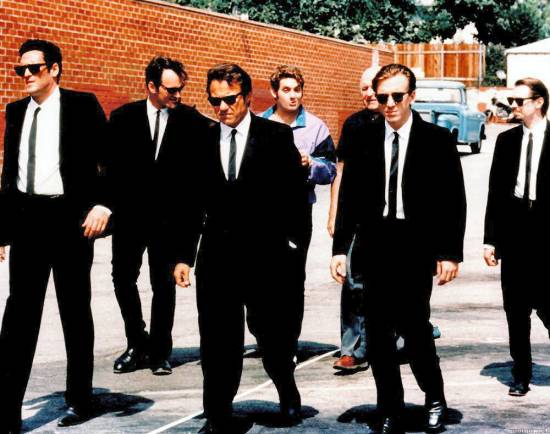
 Why does Steve Buscemi have to be Mr. Pink? Because Quentin Tarantino said so. Tarantino burst onto the indie film scene with the ultraviolent genre picture RESERVOIR DOGS, about a robbery gone horribly wrong. You know there’s a problem if Mr. White (Harvey Keitel) has to be called in to clean up the mess made by Mr. Blonde (Michael Madsen), Mr. Blue (Eddie Bunker), Mr. Brown (Tarantino), Mr. Orange (Tim Roth), and, of course, Mr. Pink. Double crosses, Madonna discussions, and an ear slicing set to the Stealers Wheel song “Stuck in the Middle With You” make things go from funny to frightening in hysterical blasts of bloody irony. RESERVOIR DOGS sent Tarantino on his way, to be followed by his great script for TRUE ROMANCE (1993) and his blockbuster PULP FICTION (1994). RESERVOIR DOGS is being screened October 8 in a double feature with KANSAS CITY CONFIDENTIAL (Phil Karlson, 1952) as part of the outstanding series