Sexually charged THE DREAMERS is part of complete Bertolucci retrospective at MoMA
THE DREAMERS (Bernardo Bertolucci, 2003)
MoMA Film, Museum of Modern Art
11 West 53rd St. between Fifth & Sixth Aves.
Wednesday, December 29, 6:30
Wednesday, January 12, 4:00
Series continues through January 12
Tickets: $10, in person only, may be applied to museum admission within thirty days, same-day screenings free with museum admission, available at Film and Media Desk
212-708-9400
www.moma.org
www.the-dreamers.com
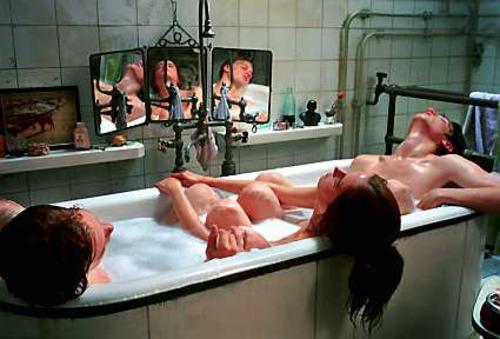
 Bernardo Bertolucci’s sexiopolitical look at Paris in the tumultuous year of 1968 focuses on three individuals: Matthew (DAWSON CREEK’s Michael Pitt), a shy American studying in France; Theo (Louis Garrel), a cigarette-smoking oh-so-French moody lad; and Isabelle (Eva Green), Theo’s “twin” who likes to walk around naked and flirt with both Matthew and Theo. The trio acts out scenes from films, plays dangerously erotic games, and drinks a lot of wine as the outside world comes crashing down around them. This is Bertolucci’s third film set in Paris, following THE CONFORMIST (1970) and LAST TANGO IN PARIS (1972), and it’s another winner. Green is mesmerizing in her film debut, Pitt reveals that he has few shortcomings, and the NC-17 rating is sure to attract an interesting crowd. Look for a cameo appearance by Jean-Pierre Leaud playing himself. THE DREAMERS is part of MoMA’s complete retrospective of the career of Bernardo Bertolucci, four weeks of classic films that include such upcoming screenings as LAST TANGO IN PARIS, LITTLE BUDDHA, THE SPIDER’S STRATAGEM, THE LAST EMPEROR, THE GRIM REAPER, 1900, BEFORE THE REVOLUTION, STEALING BEAUTY, OIL, and TRAGEDY OF A RIDICULOUS MAN.

 One of the grandest Westerns ever made, this Sergio Leone masterpiece features an all-star cast that includes Henry Fonda, Charles Bronson, Jason Robards, Woody Strode, Keenan Wynn, Lionel Stander, and Jack Elam, all enhanced by Ennio Morricone’s epic score and Tonino delli Colli’s never-ending extreme close-ups. (The opening shot of a fly crawling over Elam’s grimy face is unforgettable.) Fonda was never more evil, and Bronson was perhaps never more likable. The film is a huge step above most of Leone’s spaghetti Westerns, partially because of the cast, but also because of the script help he got from Italian horrormeister Dario Argento and iconic filmmaker Bernardo Bertolucci. ONCE UPON A TIME IN THE WEST is screening as part of “20 Years of Martin Scorsese’s Film Foundation,” an eighteen-film salute to Scorsese’s ongoing work preserving and restoring more than five hundred films so far. The series continues through January 2 with such highlights as William Wellman’s BEGGARS OF LIFE starring Louise Brooks, Otto Preminger’s BONJOUR TRISTESSE featuring Jean Seberg, Howard Hawks’s THE BIG SKY with Kirk Douglas, Joseph Losey’s THE BOY WITH GREEN HAIR, John Cassavetes’s FACES, Max Ophüls’s LETTERS FROM AN UNKNOWN WOMAN, Jean Renoir’s THE RIVER, and Satyajit Ray’s THE MUSIC ROOM (JALSAGHAR).
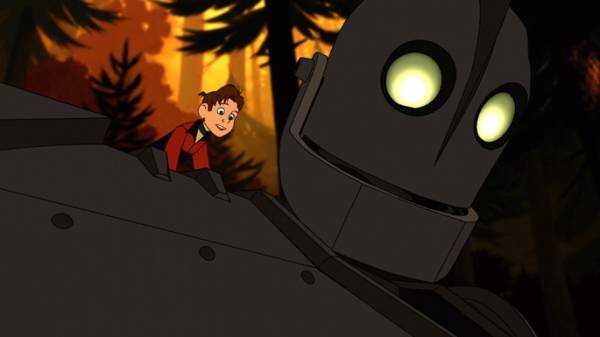
 Writer-director Brad Bird won Oscars for his animated features THE INCREDIBLES (2004) and RATATOUILLE (2007), but the Simpsons veteran first made his mark with the charming 1999 sci-fi cartoon THE IRON GIANT, being revived at Film Forum during this holiday week. Based on the 1968 book THE IRON MAN by Ted Hughes, the animated film is set during the Cold War, with the general populace and the military fearful of a nuclear attack by the Soviet Union. So when rumors that a fifty-foot-tall iron giant (voiced by Vin Diesel) has fallen from the sky, the government wants to destroy it, but it is being hidden by young Hogarth Hughes (Eli Marienthal), who has saved its life. Hogarth keeps his new best friend a secret from his mother (Jennifer Aniston) and federal agent Kent Mansley (Christopher McDonald) with the help of the town beatnik, Dean McCoppin (Harry Connick Jr.), who takes a liking to Hogarth’s mom. The screenplay, written by Tim McCanlies (SECONDHAND LIONS), plays with various genre clichés just enough to avoid being clichéd itself, instead making THE IRON GIANT a delightful, nearly flawless twist on the E.T. mythos, mixed in with a little Androcles & the Lion, THE DAY THE EARTH STOOD STILL, and even FRANKENSTEIN and KING KONG. The film, which also features the voices of Cloris Leachman (Mrs. Tensedge), John Mahoney (General Rogard), and M. Emmet Walsh (Earl Stutz), is a treat for children and adults. Bird, meanwhile, has graduated to live action; his next movie will be MISSION: IMPOSSIBLE — GHOST PROTOCOL, starring Tom Cruise, Jeremy Renner, and Simon Pegg.

 Born in São Paulo, Brazil, but based in New York City for many years, Vik Muniz has been making portraits and re-creating artistic masterpieces using such materials as sand, sugar, jewels, junk, paper, and pigments and showing them in galleries and museums around the globe. In 2007, he returned to Brazil and met with the catadores, men and women who work at Jardim Gramacho, the largest landfill in the world, picking out recyclable materials they can then sell to survive. He comes to know Tiaõ and Zumbi, who help run the Association of Recycling Pickers of Jardim Gramacho, as well as such other catadores as Suelem, Isis, Irma, Magna, and Valter, each a character in his or her own right, with unique stories to tell. Filmmaker Lucy Walker (BLINDSIGHT, COUNTDOWN TO ZERO) documents Muniz’s interaction with these dirt-poor people, who live in Rio’s dangerous favelas, as he sets out to capture their images by using the garbage they sift through to eke out some kind of living. Despite their surroundings, they are proud and happy, welcoming in Muniz, who is not shy about calling himself the most successful Brazilian artist in the world and sharing his determination to give something back. WASTE LAND is about art and ecology, about class consciousness and the vast separation between the rich and the poor. The film proceeds in a fairly standard, straightforward manner, putting Muniz and the project on too high a pedestal, which is not surprising given that the initial idea was Walker’s; the heartwarming subject matter, more than the filmmaking itself, is the reason it has been a hit at international festivals, including winning Audience Awards at Sundance and Berlin earlier this year. WASTE LAND is being screened at the Museum of Modern Art on December 29 as part of the series “The Contenders 2010,” a collection of influential and innovative international movies the institution believes will stand the test of time. MoMA has already shown such works as Luca Guadagnino’s I AM LOVE, Christopher Nolan’s INCEPTION, Roman Polanski’s THE GHOST WRITER, and Mads Brügger’s THE RED CHAPEL, and upcoming films include Tom Hooper’s THE KING’S SPEECH, Mark Romanek’s NEVER LET ME GO, and Banksy’s EXIT THROUGH THE GIFT SHOP. WASTE LAND is also being shown December 23 and 29 at IndieScreen in Williamsburg.