
The Museum of the Moving Image will celebrate its grand reopening this weekend with a full slate of multidisciplinary events (vuwstudio.com / Museum of the Moving Image)
Museum of the Moving Image
35th Ave. at 36th St., Astoria
Admission: $10 (free Fridays 4:00 – 8:00), film screenings $15
Free Family Day: Monday, January 17, 10:30 am – 5:00 pm
718-777-6888
www.movingimage.us
Following a $67 million expansion overseen by architect Thomas Leeser that has doubled its size to nearly 100,000 square feet, the Museum of the Moving Image will celebrate its grand reopening this weekend with three days of film screenings, interactive exhibitions, a multimedia dance party, and much more. The Astoria institution, which is dedicated to the past, present, and future of international cinema, will get things under way with a family matinee of DUCK SOUP (Leo McCarey, 1933) on Saturday at 12:30, the inaugural Signal to Noise party Saturday night at 8:00 (with performances by Nick Yulman, Martha Colburn, Bit Shifter, Nullsleep, Project Jenny, Scott Draves and the Electric Sheep, and others), the Indian Cinema Showcase feature MUMBAI DIARIES (DHOBI GHAT) (Kiran Rao, 2010) Sunday at 7:00, and a full slate of activities on Monday: a digital 3-D screening of CORALINE (Henry Selick, 2009) at 1:00, a screening of the 1970 documentary KING: A FILM RECORD… MONTGOMERY TO MEMPHIS introduced by associate producer Richard Kaplan at 3:00, and a special presentation of THE KING’S SPEECH (Tom Hooper, 2010) at 7:00, followed by a discussion with stars Colin Firth, Geoffrey Rush, Claire Bloom, and Helena Bonham Carter.

“Chiho Aoshima: City Glow” will help light up revamped museum (courtesy of the artist and Blum & Poe, Los Angeles. © 2005 Chiho Aoshima/Kaikai Kiki Co., Ltd.)
The museum has a history of putting on splendid exhibitions, and the initial ones in the newly revamped space include Colburn’s film installation “Dolls vs. Dictators” through April 10; “Real Virtuality” through June 12, with works by Thomas Soetens, Paul Kaiser, Pablo Valbuena, Bill Viola, Cao Fei, and Marco Brambilla; the large-scale video “Chiho Aoshima: City Glow” through July 17; and the reinstalled “Behind the Screen” from the permanent collection, which is always a thrill. There will also be several film series kicking off in the next week, starting with “Rediscovered Treasures: Great Films from World Archives,” which runs January 15 through February 20 and begins this weekend with a a restored 70mm print of PLAY TIME (Jacques Tati, 1967), the world premiere of a restored print of THE HUSTLER (Robert Rossen, 1961), 2001: A SPACE ODYSSEY (Stanley Kubrick, 1968), and the live event screening “Magic, Music and Early Movies: Georges Méliès and Sxip Shirey.” “Avant-Garde Masters” runs January 15 through February 19, beginning Saturday and Sunday with “8MM Films by George and Mike Kuchar.” And from January 19 through February 6 the museum will honor David O. Russell with screenings of THE FIGHTER (2010), SPANKING THE MONKEY (1994), FLIRTING WITH DISASTER (1996), THREE KINGS (1999), and the underrated I HEART HUCKABEE (2004). The Museum of the Moving Image is one of those New York City treasures that you should be going back to over and over again. We know we will be. (And as added encouragement, admission is free all day Monday, January 17.)

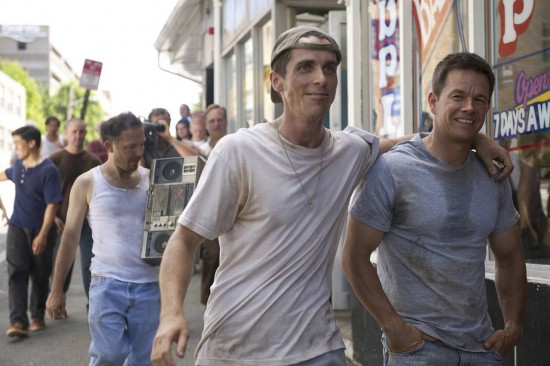
 A lot of professional fighters face adversity in and out of the ring, but “Irish” Micky Ward took it to a whole new level on his quest to be welterweight champion of the world, as documented in the winning motion picture THE FIGHTER. Ward (Mark Wahlberg) surrounded himself with his family, with his mother, Allice Eklund (Melissa Leo), as his manager, his half-brother, the Pride of Lowell (for once knocking down Sugar Ray Leonard), Dicky Eklund (Christian Bale), as his trainer, and his many big-haired sisters, including Tar (Erica McDermott), Little Alice (Melissa McMeekin), Pork (Bianca Hunter), Red Dog (Dendrie Taylor), and Beaver (Kate O’Brien), part of the team as well. Despite getting pummeled over and over again and continually finding his brother at a condemned crack house, Micky stands by the family until Dicky is back in prison and Micky finally decides to go with a new promoter. As his stock begins to rise again, he is deeply affected by his separation from his family, who are blaming the parting on his new girlfriend, local bartender Charlene (Amy Adams). Based on the true story of the Ward/Eklund clan of Lowell, Massachusetts, THE FIGHTER is a poignant tale of fighting and family, of love and responsibility. Bale is a whirlwind as the effusive, drug-addicted Dicky, who dreams of helping his brother get a title shot even as he misses training sessions because of his dependence on crack. Leo, who nearly steals the show, is virtually unrecognizable as Alice, who can’t understand why Micky would go with a new crew and has quite a few battles of her own with Charlene. And Walhlberg, who trained for several years to get himself in shape for the film, is strong and solid as the conflicted yet determined potential boxing champion. Director David O. Russell (THREE KINGS) gives THE FIGHTER a realistic feel, at times echoing the documentary that HBO is making about Dicky in the movie, and even hiring Ward’s trainer, Mickey O’Keefe, to play himself. In fact, much of the cast got to meet their real-life counterparts, all of whom loved how they were portrayed onscreen, which is actually quite funny once you see how some of them come off. You don’t have to love boxing to love THE FIGHTER, although fans of the sweet science will be impressed by the carefully choreographed fight scenes, complete with the original HBO commentary (and shot by some of the same cameramen).
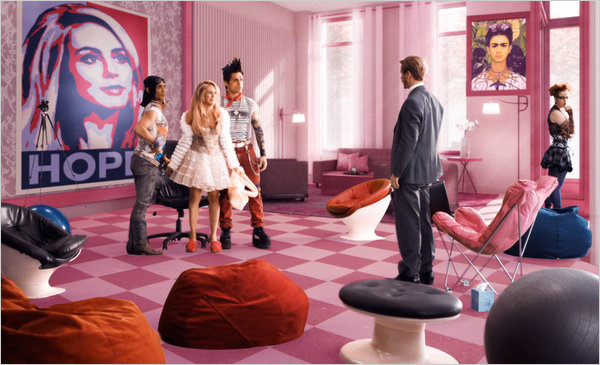
 Cult director Alex Cox, the mastermind behind REPO MAN and SID & NANCY, must have threatened the people running the 2009 Venice Film Festival with a barrage of Growler missiles to get this unwatchable, thoroughly embarrassing piece of pernicious nonsense to be included in the prestigious festival’s competition. This very strange, low-rent satire, made primarily on green screen, is an unbelievably lame supposedly comic thriller about Pixxi De La Chasse (Jaclyn Jonet), a disinherited debutante who gets a job working for a pair of repo men (Miguel Sandoval and Robert Beltran) after her father (Xander Berkeley) and aunt (Karen Black) cut her off because of her penchant for getting arrested. Upon learning of a million-dollar reward for repossessing a long-missing train, Pixxi is determined to prove to her family, her Euro-trash wannabe sidekicks (Danny Arroyo as 666, Jennifer Balgobin as Nevavda, and Zahn McClarnon as Savage Dave), and fellow repo woman and urban legend expert Lola (a nearly unrecognizable Rosanna Arquette) that she can take care of herself, even as terrorists threaten to blow up Los Angeles with Cold War-era Growler missiles if the game of golf isn’t banned. Or something like that. While it’s possible that Cox might have been striving to make one of those so-bad-it’s-good kind of movies, he’s failed at that as well, even dragging Chloe Webb into this disaster. REPO CHICK is in no way a sequel to REPO MAN, but it does bring down its legend ever so slightly, especially when it includes the word “pernicious” in the dialogue, a direct link to the great “pernicious nonsense” line delivered in its awesome predecessor. The lone saving grace is activist singer-songwriter Danbert Nobacon’s “Jamestown 2007” song that plays over the end credits, but you’re better off just checking that out on his record THE LIBRARY BOOK OF THE WORLD. (Nobacon makes a cameo in the film, while Cox illustrated the former Chumbawumba leader’s 2010 book THREE DEAD PRINCES.) REPO CHICK will screen at the IFC Center for one week before being released on Blu-ray and DVD February 8.

 Declaring this to be “the Plastic Age,” Viennese filmmaker Werner Boote travels the globe in PLASTIC PLANET, seeking answers that are not very easy to come by about the mysterious material. Boote grew up around the plastics boom, his grandfather an early manufacturer of the non-biodegradable synthetic. Boote meets with former president of PlasticsEurope John Taylor, Italian judge and politician Felice Casson, environmental scientist Susan Jobling-Eastwood, Japanese artist Hiroshi Sagae, American biophysicist Scott Belcher, Austrian environmental analyst Kurt Scheidl, European Commission vice president Margot Wallstrom, German plasticization specialist Gunther von Hagens, and others, each of whom has a different relationship with plastic, some citing its many virtues, others emphasizing its myriad dangers. Perhaps the most important thing Boote discovers is the power of the plastics industry in maintaining secrecy over the exact chemicals that go into their products, claiming that the release of such information could ruin their businesses. Thus, people might know the specific ingredients in their food, but they are not privy to what goes into the packaging, and there’s nothing they can do about it. One Chinese press representative almost spills the beans, but the interview is cut short before she can give away any of her company’s secrets. Unfortunately, Boote is not quite as interesting a character as he thinks, and he tries too hard to remain relatively neutral about plastics in general, straddling a line that leaves viewers somewhat disengaged from his personal journey. Although the film does reveal some frightening facts and scary predictions, it lacks a continuous narrative flow, meandering much as Boote does around the world, with some segments filled with confusing or difficult-to-follow scientific data. Ultimately, PLASTIC PLANET wants to be more important than it is, which is a shame, because it had the potential to be so much more.