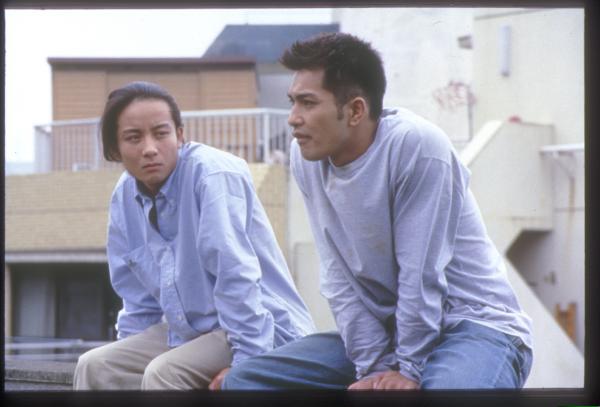
Brothers Shun (Michisuke Kashiwaya) and Ryuchi (Kazuki Kitamura) discuss finding a better life in Takashi Miike’s LEY LINES
13 FROM TAKASHI MIIKE: LEY LINES (NIHON KURO SHAKAI) (Takashi Miike, 1999)
Film Society of Lincoln Center
Walter Reade Theater
165 West 65th St.
Friday, March 18, 1:00, and Sunday, March 20, 6:45
Series runs March 16-20
212-875-5610
www.filmlinc.com
www.subwaycinema.com
 Takashi Miike complete his thematic Black Society Trilogy with one of his best crime dramas, 1999’s Ley Lines. Following 1995’s Shinjuku Triad Society: Chinese Mafia War and 1997’s Rainy Dog, the third film focuses on Godardian-like ennui of disenchanted youth as Ryuchi (Kazuki Kitamura), his younger brother, Shun (Michisuke Kashiwaya), and their friend Tan (Tomorowo Taguchi), Japanese children of Chinese immigrants, leave their rural home to find a more exciting life in Shinjuku, and they get their wish pretty quickly, immediately getting hustled by tough-talking prostitute Anita (Dan Li). To make money, they start selling toluene on the street and end up on mob boss Wong’s (Naoto Takanaka) bad side, which is never a good idea. Ley Lines is beautifully shot by Naosuke Imaizumi, with intense colors and dramatic shots of the city. Although the film contains plenty of sex and violence, it is also one of Miike’s deepest, most emotional works, especially when the main characters gather on a rooftop and talk about life. Ley Lines, which also features Miike regulars Ren Osugi and Shô Aikawa, is screening twice at the Film Society of Lincoln Center series “Shinjuku Outlaw: 13 from Takashi Miike,” being held March 16-20 in conjunction with Subway Cinema and also including such Miike films as Fudoh: The New Generation (1996), Agitator (2001), Crows Zero II (2009), and the awesome new 13 Assassins (2010). [Ed. note: Miike was originally scheduled to appear at the Walter Reade Theater to introduce several screenings but has had to cancel because of the catastrophic events occurring in Japan.]
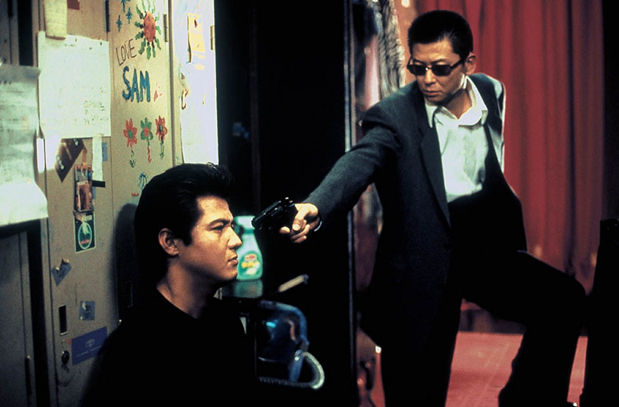
 In Takashi Miike’s Dead or Alive, the ultracool beginning and unforgettably bizarre ending are awesome; unfortunately, the long middle section lacks the excitement and originality of many of his other crime films, from Ley Lines (1999) and City of Lost Souls (2000) to Ichi the Killer (2001) and Izo (2004). The DVD comes with the following warning: “This motion picture contains explicit portrayals of violence; sex; violent sex; sexual violence; clowns and violent scenes of violent excess, which are definitely not suitable for all audiences…. Enjoy at your own risk.” Dead or Alive lives up to its billing with plenty of drugs, sex, violence, blood, gluttony, stabbings, shootings, chopsticks, strippers, sunglasses, sin, sloth, Russian roulette, betrayal, Yakuza battles, explosions, revenge, feces, vomit, communism, cops and robbers, and, yes, clowns. Miike also explores complex relationships among fathers and sons, fathers and daughters, and siblings while delving into one of his most common cross-cultural themes, as Chinese triad boss Ryūichi (Riki Takeuchi) and Japanese detective Jojima (Show Aikawa) prepare for the ultimate showdown. The first of a conceptual trilogy that continues with Dead or Alive 2: Birds (2000) and Dead or Alive: Final (2002), Dead or Alive is screening March 15 at Japan Society as part of the Globus Film Series “Hardest Men in Town: Yakuza Chronicles of Sin, Sex & Violence” and will be introduced by Miike, who is in town for the Film Society of Lincoln Center’s awesome retrospective “Shinjuku Outlaw: 13 from Takashi Miike.” [Ed. note: Takashi Miike has had to cancel all upcoming New York City appearances because of the catastrophic events occurring in Japan.]
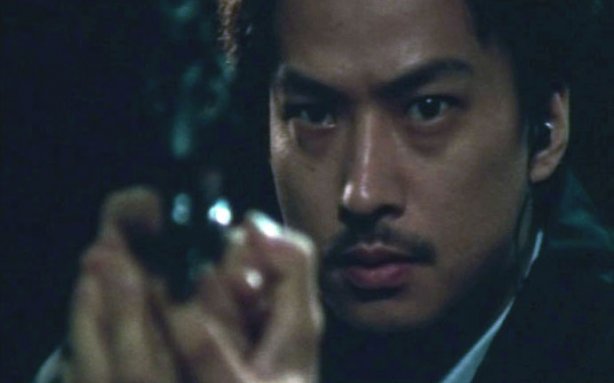
 “Shinjuku is not the best post,” detective Tatsuhito Kiriya says in Shinjuku Triad Society: Chinese Mafia War. Boy, is he not kidding. Takashi Miike’s first major theatrical release after a series of television and straight-to-video projects, 1995’s Shinjuku Triad Society serves as an excellent introduction to the controversial auteur, who is prone to a bit of the old ultra-violence in his films. The fifty-year-old Miike grew up in various parts of Japan but with direct ties to Korean and China, influencing the race battles that drive the Black Society Trilogy, which begins with Shinjuku Triad Society and continues with 1997’s Rainy Dog and 1999’s Ley Lines. In Shinjuku Triad Society, Kippei Shiina stars as Tatsuhito, a cop-on-the-edge desperate to bring down Taiwanese gang leader Wang’s (Tomorowo Taguchi) Dragon’s Claw crime syndicate, turning personal when Tatsuhito’s brother, Yoshihito (Kyosuke Izutsu), starts working for the brutal warlord. The dark, lurid film showcases Miike’s penchant for the extreme, including a ripped-out eyeball, organ selling, slashed bodies, rape, and beheadings. Miike also flips the genre on its head by featuring a lot of gay sex, as Wang has a decided preference for pretty boys. Shinjuku Triad Society, which also features Ren Osugi as Yakuza boss Uchida and Airie Yanagi as sly, dangerous prostitute Ritsuko, is screening March 27 at 4:30 as part of the Film Society of Lincoln Center series “Shinjuku Outlaw: 13 from Takashi Miike,” being held in conjunction with the fine folk over at Subway Cinema. [Ed. note: Miike was originally going to be at the Walter Reade Theater to introduce several screenings but has had to cancel because of the catastrophic events occurring in Japan.]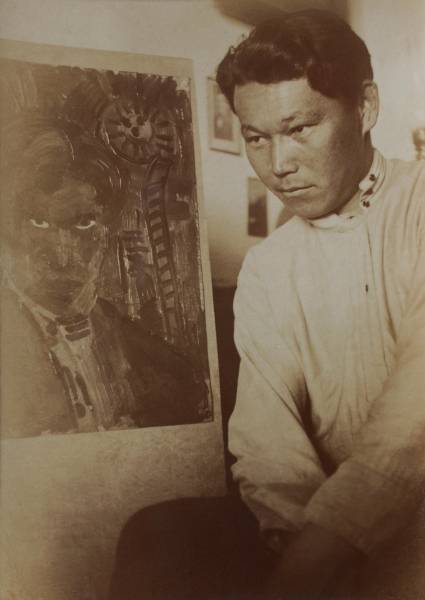
 While making a documentary about grass-roots political activism in the former Soviet Union, Amanda Pope and Tchavdar Georgiev learned of a remarkable museum in the middle of nowhere. Tucked away in the desert border town of Nukus in Uzbekistan is a monument built by one man’s fierce vision and refusal to give up, risking his freedom and security in the name of art. Winner of awards in Beijing, Palm Beach, and Russia and selected for festivals all around the world, The Desert of Forbidden Art tells the compelling story of archaeologist and wannabe painter Igor Savitsky, who devoted his life to amassing a stunning collection of forbidden Soviet avant-garde art, primarily by little-known artists who were challenging the Fascist leadership on beautiful canvases loaded with social and historical relevance. Through interviews with surviving members of some of the artists’ families and friends of Savitsky’s, former New York Times Central Asia bureau chief Stephen Kinzer (the first Western journalist to write about the institution), art historians, longtime Savitsky Museum director Marinika Babanazarova, and others, supplemented by readings from Savitsky’s letters, Pope and Georgiev explore the power art can have in a repressed society as Savitsky, often getting funds from the very government that was banning the art he was collecting, put on public display works by such painters as Alexander Volkov, Kliment Redko, Victor Ufimtsev, Lyubov Popova, and Ivan Koudriachov from among the forty thousand pieces in the museum’s holdings (which now have passed the eighty-thousand mark). One of the most fascinating characters is Ural Tansykbaev, who was believed to have been collaborating with the Fascist government but is revealed to have had a subversive side as well. “I like to think of our museum as a keeper of the artists’ souls,” Savitsky is quoted as saying in the film. “Their works are the physical expression of a collective vision that could not be destroyed.” Sir Ben Kingsley supplies the voice of Savitsky, with Sally Field, Ed Asner, and Igor Paramonov providing voice-overs for various artists. As Pope and Georgiev note, the future of the Savitsky Collection is in jeopardy as it becomes more well known, more people look to profit from it, and Islamic fundamentalists seek to destroy it.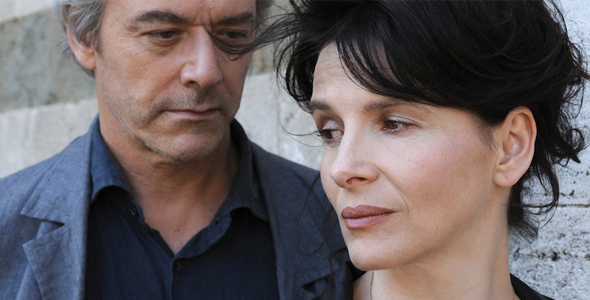
 Writer, director, poet, photographer, editor, graphic designer, and painter Abbas Kiarostami has been one of Iran’s leading filmmakers for nearly forty years, compiling a resume that includes such important international films as Under the Olive Trees (1994), Taste of Cherry (1997), and The Wind Will Carry Us (1999). His latest film, Certified Copy, is his first feature made outside of his home country, a dreadfully boring and annoying art-infused romantic comedy set in Italy. Juliette Binoche was named Best Actress at Cannes this year for her starring role as an unnamed single mother and antiques dealer who is obsessed with English author James Miller’s (British opera star William Shimell) book on the history and meaning of art replicas, Certified Copy. Inexplicably, the two strangers are soon on a bizarre sort-of date, driving through Tuscany and becoming involved in a series of vignettes about love and marriage, literature and art, and other topics. Both characters are seriously flawed and emotionally unstable in ways that make them unattractive to watch, especially in obvious set-ups that either go nowhere or exactly where you think they’re going. While Julie Delpy and Ethan Hawke made the somewhat similar Before Sunrise (1995) and Before Sunset (2004), in which two strangers from different countries spend a day together (but mostly by themselves), the sexual tension and excitement always building, Certified Copy is more reminiscent of Hans Canova’s ridiculous Conversations with Other Women (2005), in which Aaron Eckhart and Helena Bonham Carter star as wedding guests with a past whom viewers can’t wait to just shut up and get off the screen. Don’t let the supposed adult dialogue of Certified Copy fool you into thinking it’s an intelligent, mature look at believable relationships; instead, it feels like a staid copy of other, better films you think you’ve seen but can’t remember — and won’t care.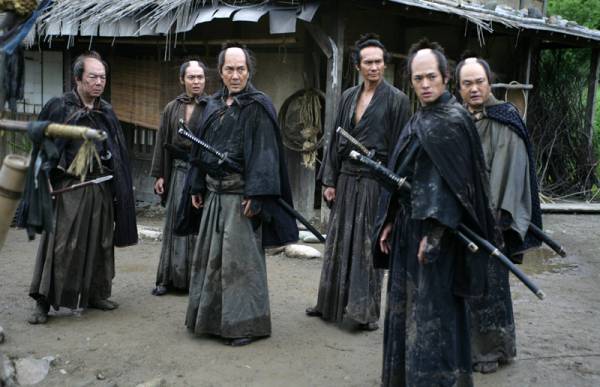
 Japanese director Takashi Miike’s first foray into the samurai epic is a nearly flawless film, perhaps his most accomplished work. Evoking such classics as Kurosawa’s Seven Samurai, Mizoguchi’s 47 Ronin, Aldrich’s The Dirty Dozen, and Eastwood’s High Plains Drifter, 13 Assassins is a thrilling tale of honor and revenge, inspired by a true story. In mid-nineteenth-century feudal Japan, during a time of peace just prior to the Meiji Restoration, Lord Naritsugu (Gorô Inagaki), the son of the former shogun and half-brother to the current one, is abusing his power, raping and killing at will, even using his servants and their families as target practice with a bow and arrow. Because of his connections, he is officially untouchable, but Sir Doi (Mikijiro Hira) secretly hires Shinzaemon Shimada (Kôji Yakusho) to gather a small team and put an end to Naritsugu’s brutal tyranny. But the lord’s protector, Hanbei (Masachika Ichimura), a former nemesis of Shinzaemon’s, has vowed to defend his master to the death, even though he despises Naritsugu’s actions. As the thirteen samurai make a plan to get to Naritsugu, they are eager to finally break out their long-unused swords and do what they were born to do. “He who values his life dies a dog’s death,” Shinzaemon proclaims, knowing that the task is virtually impossible but willing to die for a just cause. Although there are occasional flashes of extreme gore in the first part of the film, Miike keeps the audience waiting until he unleashes the gripping battle, an extended scene of blood and violence that highlights death before dishonor. Selected for the 2009 Cannes Film Festival and nominated for the Silver Lion at the 2010 Venice Film Festival, 13 Assassins is one of Miike’s best-crafted tales; nominated for ten Japanese Academy Prizes, including Best Picture, Best Director, Best Screenplay (Daisuke Tengan), Best Editing (Kenji Yamashita), Best Original Score (Koji Endo), and Best Actor (Yakusho), it won awards for cinematography (Nobuyasu Kita), lighting direction (Yoshiya Watanabe), art direction (Yuji Hayashida), and sound recording (Jun Nakamura). 13 Assassins is the centerpiece of the Film Society of Lincoln Center’s “Shinjuku Outlaw: 13 from Takashi Miike” series, running March 16–20 at the Walter Reade Theater and held in conjunction with Subway Cinema; Miike will be at the March 17 screening, which will be followed by a reception. [Ed. note: Miike was originally scheduled to appear at the Walter Reade Theater to introduce this and several other screenings but has had to cancel because of the catastrophic events occurring in Japan.]