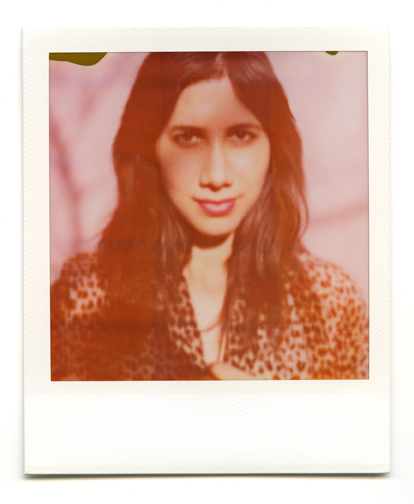
Molly Surno is keeping the spirit of experimental and avant-garde film alive by bringing back Cinema 16
Metropolitan Museum of Art
1000 Fifth Ave. at 82nd St.
Friday, June 3, 7:00
Free with recommended admission of $20
212-570-3828
www.mollysurno.wordpress.com
www.metmuseum.org/collegegroup
In 1947, Amos Vogel founded Cinema 16 as an art community where film devotees could see and discuss experimental celluloid works. Vogel, who turned ninety this past April, later cofounded the New York Film Festival with Richard Roud, serving as its first director in 1963; the NYFF still features the “Views from the Avant-Garde” showcase every year. Since April 2008, photographer and curator Molly Surno has taken up the reins of Vogel’s initial call to arms, answering his question “Shall this audience continue unaware of these hundreds of thought-provoking, artistically satisfying, and socially purposeful films?” by bringing back Cinema 16. The L.A.-born, Brooklyn-based Surno puts together monthly programs that combine classic and contemporary avant-garde films with cutting-edge bands providing live scores. On June 3 at 7:00, she is presenting her latest gathering, being held at the Metropolitan Museum of Art in conjunction with the exhibition “Guitar Heroes: Legendary Craftsmen from Italy to New York.” Introduced by Met associate curator Jayson Kerr Dobney, the evening, part of the Met’s College Group initiative, will feature films by Andy Warhol, Rudy Burckhardt, Edgar Varèse and Le Corbusier, Gina Carducci, Herbert Kosower, and Francis Thompson and live music by Nick Zinner and Brian Chase of the Yeah Yeah Yeahs, Shahin Motia of Oneida, and MV Carbon. As she prepared for the event, Surno was able to sneak in a few minutes to discuss experimental cinema and more with twi-ny.
twi-ny: You’ve held previous editions of Cinema 16 at such venues as the Kitchen, Smack Mellon, Galapagos, the Bell House, and MoMA/PS1, but your next edition is taking place June 3 at the Met, in conjunction with the “Guitar Heroes” exhibition. How did that come about? Did the location impact how you curated the program?
Molly Surno: To my amazement the Metropolitan Museum contacted me to do a performance as part of the programming for the “Guitar Heroes” exhibit. Humbled and inspired, I tailored this program entirely to the current show. The band is composed of some of Brooklyn’s most incredible string players, echoing the three centuries of string instruments on display. The films I selected are all based on the idea of a cityscape being a muse for artistic expression. “Guitar Heroes” shows the journey of string instruments from Southern Italy to New York and the way the luthiers drew from their environments. I took that same premise and selected films that used one’s surroundings as the platform for creative influence. Francis Thompson’s film N.Y., N.Y. quite literally examines the day in a life of a New Yorker but through a kaleidoscope-type lens; Andy Warhol’s Screen Test of Salvador Dalí expresses the culture of an artistic community congregating in New York; Gina Carducci’s Stone Welcome Mat journeys from the Sicily of her grandfather’s home super-8 films to her own return to Southern Italy decades later from the eye of a New York–based artist, among other tales of our surroundings informing and motivating creative works.
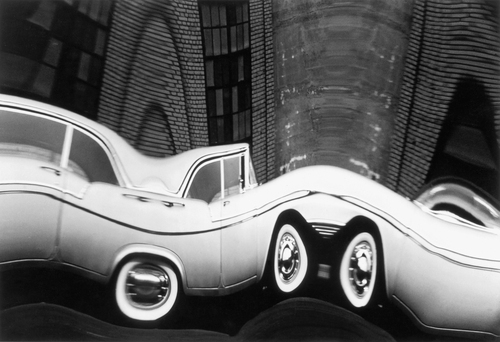
Francis Thompson’s “N.Y., N.Y.” is among the avant-garde films Molly Surno will be presenting at the Met on June 3
twi-ny: What do you choose first when putting together a program, the films or the musicians?
MS: The selection process entirely depends on the commission. For the Met the “Guitar Heroes” exhibition completely dictated both the musical and film curation.
twi-ny: Where did your love of experimental films come from? Was there a “Eureka!” moment? For us, the Eureka! moment, for example, was taking a class with Amos Vogel back in college. Is he familiar with what you’re doing?
MS: I am actively trying to find my way uptown so that I can meet Amos and potentially do a program together. It’s on the wish list.
twi-ny: Are there certain films out there that you’ve been searching for but have been unable to find or gain access to? Who are the new artists making experimental films today who have a similar spirit to those made by such innovators as Maya Deren, Bruce Conner, Shirley Clarke, and Stan Brakhage?
MS: Certainly films are hard to access because they weren’t preserved properly. For example, I wanted to show some Italian experimental film for this program, but there is so little that was properly archived (or archived at all). There is a community that is vibrant and active around the preservation of experimental films, and through them I have met some incredible contemporary avant-garde artists, including Joel Schlemowitz, Gina Carducci, MM Serra, and Mark Street, to name a few. A few years back I showed a piece by an artist named Ezra Johnson, who also works with animation. His work blows my mind.
twi-ny: You’re constantly surrounded by avant-garde film and music. Do you ever just push it all to the back of your mind and spend a Saturday night checking out The Hangover Part II, Thor, or the latest Twilight or Pirates of the Caribbean flick?
MS: This might be my favorite question any journalist has ever asked me. Oddly enough, the more experimental films I watch, the harder it is for me to sit through big-budget films. I mean, let’s put it this way: For me, a Saturday night spent among purely escapist entertainment would include The Godfather or The French Connection. . . . That is about as mainstream as I like to get.
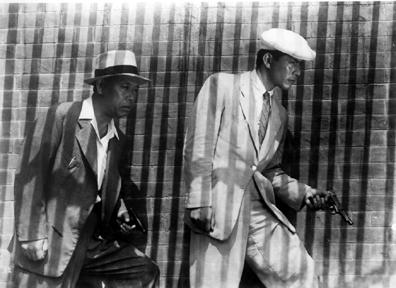
 Akira Kurosawa’s thrilling police procedural, Stray Dog, is one of the all-time-great film noirs. When newbie detective Murakami (Toshirō Mifune) gets his Colt lifted on a bus, he thinks he will be fired if he does not get it back. But as he searches for it, he discovers that it is being used in a series of robberies and murders that he feels responsible for. Teamed with seasoned veteran Sato (Takashi Shimura), Murakami risks his career — and his life — as he tries desperately to track down his gun before it is used again. Kurosawa makes audiences sweat as postwar Japan is in the midst of a heat wave, with Murakami, Sato, prostitute Harumi Namiki (Keiko Awaji), and others constantly mopping their brows, dripping wet. Inspired by the novels of Georges Simenon, Stray Dog is a dark, intense drama shot in creepy black and white by Asakazu Nakai and featuring a jazzy soundtrack by Fumio Hayasaka that unfortunately grows melodramatic in a few key moments — and oh, if only that final scene had been left on the cutting-room floor. Stray Dog will be screening at 11:00 am on June 3-5 as part of the IFC Center’s Weekend Classics — Kurosawa series, with half of the proceeds from all festival screenings benefiting
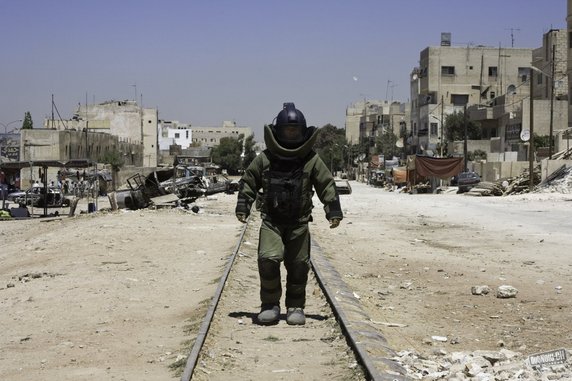
 Based on embedded journalist Mark Boal’s experiences in Iraq, The Hurt Locker follows a three-member Explosive Ordnance Disposal unit as they are called in to defuse a series of dangerous situations involving various kinds of bombs, including IEDs and other life-threatening explosive devices. Team leader Will James (Jeremy Renner) is an expert bomb defuser and maverick who doesn’t follow protocol and likes to live on the edge. Spc. Owen Eldridge (Brian Geraghty) is a greenhorn who just wants to survive the last forty days of their rotation. And Sgt. J. T. Sanborn (Anthony Mackie) likes to go by the book and take no unnecessary chances, which puts him in constant conflict with the unpredictable James. Recalling the second half of Stanley Kubrick’s Vietnam drama Full Metal Jacket (1987), The Hurt Locker unfolds in a series of harrowing set pieces in which the EOD unit is called in to either safely detonate or defuse explosive devices while under the eyes of local Iraqis, any of whom could potentially be the bomber or a sniper. Director Kathryn Bigelow (Blue Steel, Point Break) masterfully builds suspense scene after scene, beginning with the edge-of-your-seat opener through to the gripping conclusion. The experiences of the EOD unit serve as a microcosm for modern warfare in general and the U.S. involvement in the Middle East specifically, placing viewers in the midst of a tense, bitter, psychologically and emotionally draining battle that can never be won. The outstanding cast also features Guy Pearce, Ralph Fiennes, David Morse, and Evangeline Lilly in small roles; many of the Iraqis were played by actual war refugees. Shot in Jordan not far from the Iraq border, The Hurt Locker is a remarkable story, one of the best war films of the decade.