GOLD DIGGERS OF 1933 is screening as part of pre-Hays Code series at Film Forum
GOLD DIGGERS OF 1933 (Mervyn LeRoy, 1933)
Film Forum
209 West Houston St.
Friday, July 22, 1:00, 4:35, and 8:10
Series continues through August 11
212-727-8110
www.filmforum.org
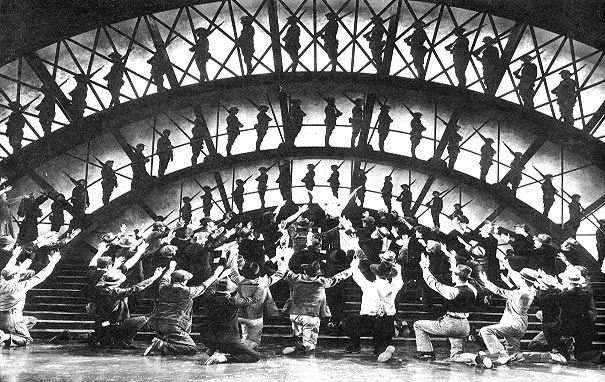
 Hitting a little too close to home these days, Gold Diggers of 1933 is a depression-era musical directed by Mervyn LeRoy (Little Caesar, Mister Roberts) and featuring dance numbers choreographed by Busby Berkeley. Polly Parker (Ruby Keeler), Trixie Lorraine (Aline MacMahon), Carol King (Joan Blondell), and Fay Fortune (Ginger Rogers) are four out-of-work actresses desperate to find a job on Broadway. When cigar-chomping producer Barney Hopkins (Ned Sparks) teams up with newcomer Brad Roberts (Dick Powell) to create a show about the Great Depression itself, the women get excited about the possibility of getting back on the Great White Way, but mistaken identity, financing problems, and class warfare — in the form of wealthy old-money barons Lawrence Bradford (Warren William) and Faneul H. Peabody (Guy Kibbee) — threaten the show and their love lives. Gold Diggers of 1933 is screening at Film Forum on July 22 in a double feature with Frank Tuttle’s Roman Scandals as part of the series “Essential Pre-Code,” which continues through August 11 with films made immediately prior to the enactment of the values-based Hays Code in 1930s Hollywood, including Rouben Moumalian’s Dr. Jekyll and Mr. Hyde, Cecil B. DeMille’s The Sign of the Cross, Josef von Sternberg’s Blonde Venus, Howard Hawks’s Scarface, Ernst Lubitsch’s Trouble in Paradise, and Merian C. Cooper and Ernest B. Schoedsack’s King Kong (bestiality!), nearly all of which are part of double or triple features. Oh, and if you’re wondering why Gold Diggers made the cut here, the “Pettin’ in the Park” number should tell you all you need to know.
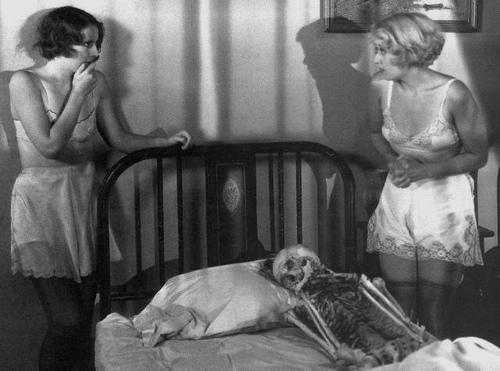
 It’s hard to believe that the Hays Code, a set of standards initiated by two religious figures and named after chief censor Will H. Hays, was enacted and enforced, to varying degrees, in Hollywood from 1934 all the way up to 1968. Film Forum is looking back at some of the racier movies made right before the code took effect in the series “Essential Pre-Code,” consisting of fifty films made between 1931 and 1934, all being shown in 35mm prints. One of the best examples of pre-code films is William A. Wellman’s rarely screened 1931 doozy, Night Nurse. The first of five collaborations between Wellman and Barbara Stanwyck, Night Nurse, based on Dora Macy’s 1930 novel, stars Stanwyck as Lora Hart, a young woman determined to become a nurse. She gets a probationary job at a city hospital, where she is taken under the wing of Maloney (Joan Blondell), who likes to break the rules and torture the head nurse, the stodgy Miss Dillon (Vera Lewis). Shortly after treating a bootlegger (Ben Lyon) for a gunshot wound and agreeing not to report it to the police, Lora starts working for a shady doctor (Ralf Harolde) taking care of two sick children (Marcia Mae Jones and Betty Jane Graham) whose proudly dipsomaniac mother (Charlotte Merriam) is being manipulated by her suspicious chauffeur (Clark Gable). Wellman pulls out all the stops, hinting at or simply depicting murder, child endangerment, rape, alcoholism, lesbianism, physical brutality, and Blondell and Stanwyck regularly frolicking around in their undergarments. It’s as if Wellman is thumbing his nose directly at the Hays Code in scene after scene. Although far from his best film — Wellman directed such classics as Wings (1927), The Public Enemy (1931), A Star Is Born (1937), Nothing Sacred (1937), Beau Geste (1939), and The Ox-Bow Incident (1943) — Night Nurse is an overly melodramatic, dated, but entertaining little tale with quite a surprise ending. Night Nurse is screening at Film Forum on July 19 as part of a triple feature with Howard Bretherton and William Keighley’s Ladies They Talk About, starring Stanwyck in one of the earliest women-in-prison movies, and William Dieterle’s Lawyer Man, which pairs Blondell with the always charming William Powell. The series continues through August 11 with such films as Rouben Moumalian’s Love Me Tonight, Frank Tuttle’s Roman Scandals, Cecil B. DeMille’s The Sign of the Cross, Josef von Sternberg’s Blonde Venus, Howard Hawks’s Scarface, Ernst Lubitsch’s Trouble in Paradise, and Merian C. Cooper and Ernest B. Schoedsack’s King Kong (bestiality!), nearly all of which are part of double or triple features.


 In the stunning Dersu Uzala, director-cowriter Akira Kurosawa has fashioned one of cinema’s greatest characters, a worldly-wise, deceptively simple charming man who understands life, nature, responsibility, and helping others. Tuvan actor Maksim Munzuk gives a marvelously understated performance as the title character, a hunter who is suddenly taken out of his quiet life of solitude when Russian army troops come to Siberia. Based on the 1923 memoir of Russian explorer Vladimir Klavdiyevich Arsenyev, the dazzling achievement focuses on the friendship between Uzala and Arsenyev (Yuri Solomin) as they battle the elements from Siberia to the city of Khabarovsk. Winner of the 1975 Academy Award for Best Foreign Language Film, Dersu Uzala will be screening at 11:00 am on July 14, 15, and 16 as part of the IFC Center’s Weekend Classics — Kurosawa series, which continues with Ran (July 22-24), Dreams (July 29-31), and Rhapsody in August (August 5-7); ticket sales benefit