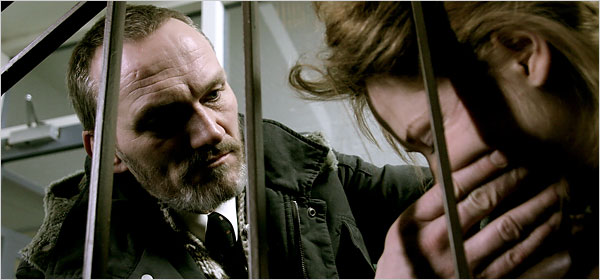
Tense Icelandic thriller based on award-winning book will have a special screening at BAMcinématek
JAR CITY (MYRIN) (Baltasar Kormákur, 2006)
BAMcinématek
BAM Rose Cinemas
30 Lafayette Ave. between Ashland Pl. & St. Felix St.
Thursday, September 22, 7:20 & 9:30
718-636-4100
www.bam.org
 Writer-director Baltasar Kormákur’s adaptation of Arnaldur Indriðason’s award-winning novel Jar City (Myrin) is a bleak but compelling police procedural that focuses on a fact-based controversial government initiative that is cataloging genetic research on all Icelandic families. When an aging man named Holberg (Thorsteinn Gunnarsson) is murdered in his home, brooding inspector Erlendur (Ingvar E. Sigurdsson) heads the investigation into the death, leading him to a thirty-year-old rape, a dirty cop, a trio of criminals (one of whom has been missing for a quarter century), a woman who killed herself shortly after her four-year-old daughter died, and a doctor who collects body parts. The divorced Erlendur also has to deal with his troubled daughter (Augusta Eva Erlendsdottir), a pregnant drug addict who hangs out with some very sketchy company. Meanwhile, a mysterious man (Atli Rafn Sigurdarson) is up to something following the traumatic death of his young daughter. Kormakur weaves together the story line of the two fathers side by side — in the book, the unidentified man appears only near the conclusion, although who he is still remains a mystery for most of the film — centering on the complex relationship between parents and children and what gets passed down from generation to generation, both on the outside and the inside. Sigurdsson plays Erlendur with a cautious seriousness, the only humor coming from the way he treats his goofy partner, Sigurdur Oli (Bjorn Hlynur Haraldsson). Iceland’s entry for the 2007 Foreign-Language Oscar and winner of the Crystal Globe at the Karlovy Vary International Film Festival, Jar City is a dark, tense intellectual thriller. Indriðason has turned Erlendur into a continuing character in such follow-ups as Silence of the Grave and Voices; here’s hoping Kormákur and Sigurdsson do the same. Jar City will be screening on September 22 at 7:20 and 9:30 at BAMcinématek as part of the ongoing “Cinemachat with Elliott Stein” series, with the early showing including a discussion with Stein.
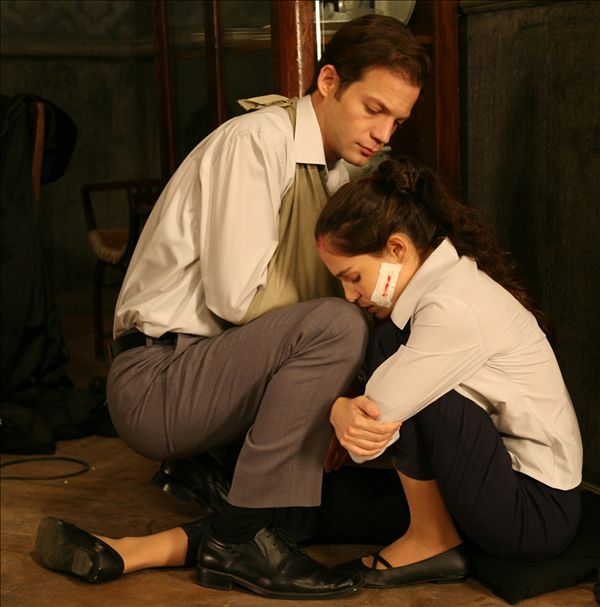
 Following a launch party for her book about how she and two fellow Mossad agents in 1964 captured and killed Max Reiner (Edgar Selge), the notorious “Surgeon of Birkenau,” Rachel Brener (Gila Almagor) immediately learns that there is an old man in a Ukrainian nursing home claiming that he is in fact the doctor who performed horrific experiments on Jewish men, women, and children in the German concentration camp during World War II. Rachel is reunited with Zvi (Alex Peleg) and Ehud (Oded Teomi), who come up with a plan to eliminate the doctor once again to protect a secret that has been haunting them for forty years. But they’re no longer the brash, finely chiseled spies they were when they were young, leading to crises of conscience and other physical and psychological dilemmas. Nominated for four Israeli Academy Awards, The Debt is a tense thriller from director Assaf Bernstein, who cowrote the screenplay with Ido Rosenblum. The story weaves back and forth between the present day, as Rachel meets Ehud in Ukraine and they hash out their plan, neither one having done anything like this in decades, and 1964, when Rachel (Neta Garty), Zvi (Itay Tiran), and Ehud (Yehezkel Lazarov) were younger and more idealistic. The scenes in which the young Rachel visits the doctor, who has become a gynecologist, and pretends she is trying to conceive a child are particularly gripping, setting up a powerful conclusion. With the release of John Madden’s American remake starring Helen Mirren, Ciarán Hinds, Sam Worthington, Jessica Chastain, and Tom Wilkinson, the Israeli original, which evokes such films as The Wild Geese, The Boys from Brazil, and QB VII, is screening Tuesday night at the JCC in Manhattan.

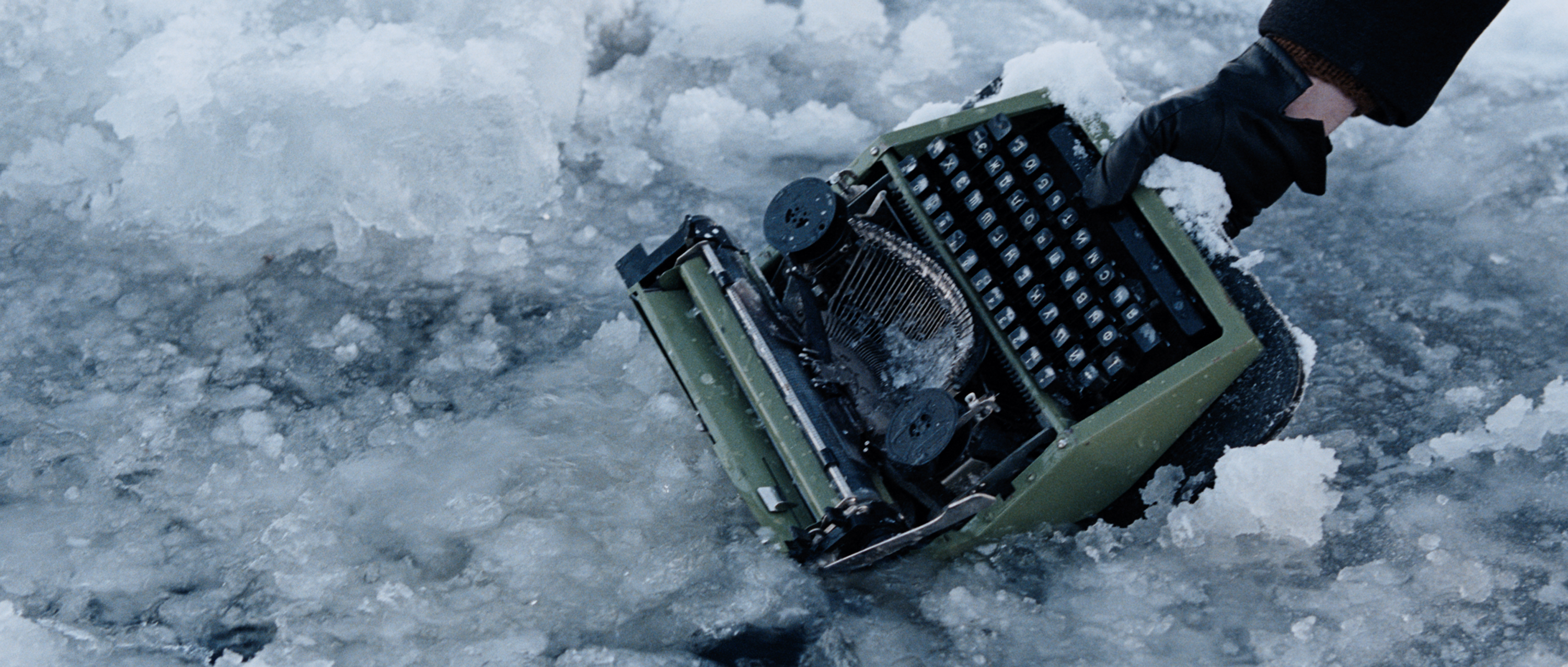
 After his wife, Tanya (Yuliya Aug), suddenly dies, paper factory boss Miron Alekseevich (Yuri Tsurilo) recruits his best friend and employee, Aist Sergeev (Igor Sergeyev), to join him in a Finno-Ugric ritual farewell to the young woman. The two Merjan men prepare the body in the traditional way — which includes a thorough cleansing and the tying of colored threads to her pubic region — and then begin the multiday journey to Lake Nero. Aist, who lives a relatively solitary life, brings with him his pair of beloved buntings, the two men in the car and the two caged birds off on a road trip of a very different kind, with the deceased woman wrapped in a blanket in the back. Along the way, Miron “smokes,” telling Aist intimate details of his and Tanya’s sex life, which is also part of the Finno-Ugric funeral tradition. Siberian-born director Aleksei Fedorchenko’s third feature film, Silent Souls is a touching, elegiac poem about love, friendship, and the ancient rituals of a Russian culture that has not fully assimilated into the modern Slavic ways. Beautifully shot by Mikhail Krichman and with an evocative score by Andrei Karasyov, the film includes long scenes with minimal camera movement, placing the viewer in the car as the men drive down a dirt road or in a hotel room as Miron gives Tanya an erotic vodka bath in a poignant flashback. The two men never talk about work, about the state of the world, about what comes next in their lives. Instead, they quietly go about their business, keeping their traditions alive. Previously shown at the New York, Toronto, and Venice film festivals, Silent Souls is an extraordinary seventy-five-minute adventure into the heart and the soul.
 The first half of Lorenz Knauer’s documentary about Jane Goodall, Jane’s Journey, offers fascinating insight into the life and career of the famed primatologist. Making sure she’s not mistaken for the late Dian Fossey, Goodall shares intimate details about her personal and professional lives, discussing her two marriages and her conflict with her son while also delving into her early days working with chimpanzees and archaeologist Louis Leakey in Gombe National Park in Tanzania. Wanting to study animals in Africa since she was a little girl, Goodall achieved her dreams in her early twenties, as she came upon major discoveries that changed the way the scientific world looked at both chimpanzees and humans. Goodall, now in her seventies, returns to Tanzania, sitting with the chimpanzees, showing how they welcomed her those many years ago and still do today. In 1986, Goodall made an abrupt shift in her career, giving up primatology in favor of traveling around the world in a desperate effort to save the planet; the documentary makes an abrupt shift as well, going from a charming study of this highly influential woman to a worshipful fundraising campaign for her many charitable efforts, which include Roots & Shoots and the Jane Goodall Institute. It is here that the film loses its edge; whereas before Knauer spoke with people who knew Goodall well, including her son, her sister, her biographer, and a longtime coworker, now he adds interviews with superstar celebrities (Pierce Brosnan and Angelina Jolie) and random fans lining up for autographs. It’s not that what Goodall has been doing for the last quarter-century isn’t as important as what she did previously; it’s just that it’s not very interesting as presented, playing more like an infomercial than a documentary. Goodall will be at the IFC Center for the 7:20 and 9:50 screenings on opening night, September 16; on September 27 at 8:00 ($18), the one-night-only event