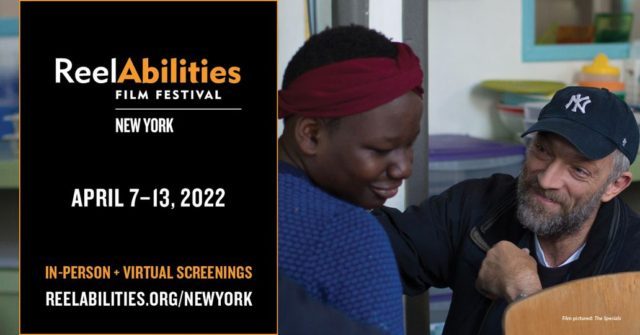
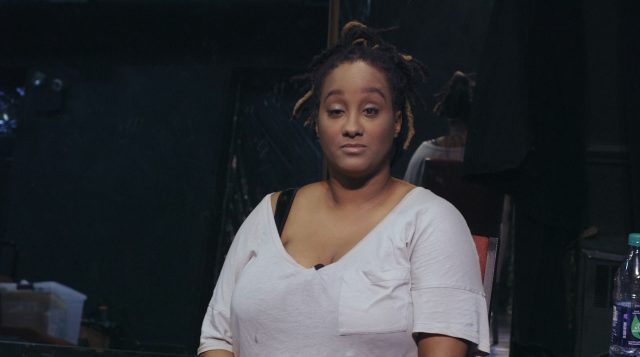
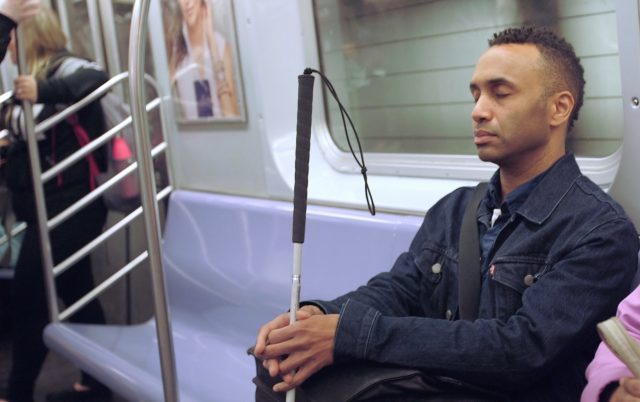
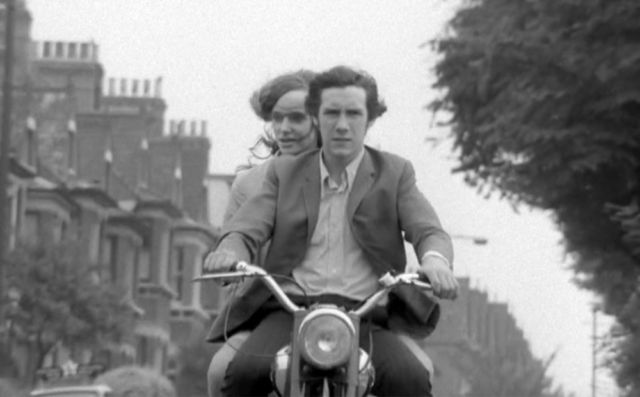
Who:ReelAbilities Film Festival: New York What: Annual festival of films celebrating stories of people with disabilities Where:Marlene Meyerson JCC Manhattan and other venues as well as online When: April 7-13, free – $15 Why: Since 2007, the ReelAbilities Film Festival has been showcasing shorts, features, and animated works from around the world to continue its mission “dedicated to promoting awareness and appreciation of the lives, stories, and artistic expressions of people with disabilities.” The fourteenth annual event takes place at the host venue, the Marlene Meyerson JCC Manhattan, as well as Lincoln Center, the IAC Building, the Museum of the Moving Image, the Maysles Documentary Center, the Intrepid Sea, Air & Space Museum, and online. The opening-night selection is Olivier Nakache and Éric Toledano’s The Specials, about caregivers of autistic youths in underprivileged areas, starring Vincent Cassel, Reda Kateb, and Hélène Vincent; Victor Calise, former commissioner of the New York City Mayor’s Office for People with Disabilities, will be the guest honoree. The closing-night film is Brian Malone and Regan Linton’s imperfect, about a theater group staging Chicago; the screening will be followed by a Q&A with the directors moderated by actor Gregg Mozgala and the presentation of the ReelAbilities Spotlight Award to deaf actress Lauren Ridloff.
Among the other full-length films are Marc Schiller’s deeply personal No Bone: Scars of Survival, Jim Bernfield’s Me to Play, Margaret Byrne’s Any Given Day, Lynn Montgomery’s Amazing Grace, Teemu Nikki’s The Blind Man Who Did Not Want to See Titanic, Linda Niccol’s Poppy, and Jack Youngelson’s Here. Is. Better.; the films deal with such issues as stroke, Parkinson’s disease, mental illness, Acute Flaccid Myelitis, multiple sclerosis, Down syndrome, deafness, ADHD, and PTSD. In addition, there will be workshops on film puppetry and storytelling, an accessibility summit, a solo musical by Anita Hollander, a conversation with Deaf Utopia author Nyle DiMarco, the panel discussion “Just Do It?: The Impact of Perfectionism & Productivity on Mental Health and Disability,” and such shorts programs as “Out of the Box,” “Relationships,” and “Autism.” Many of the screenings will be followed by a Q&A with the filmmakers, actors, documentary subjects, and health experts.
Dancer Kayla Hamilton is not about to let visual impairment get in the way of her career in Vision Portraits (photo by Kjerstin Rossi)
Who:Moving Body — Moving Image What:ScreenDance Film Festival Where: Barnard College Department of Dance Movement Lab, Glicker Milstein Theatre in the Diana Center, 3009 Broadway at 116th St., and online When: Sunday, April 3, free with advance RSVP, noon – 6:00 pm (festival continues through April 11) Why: The Moving Body — Moving Image Biennale Festival was founded in 2018 by choreographer, dancer, teacher, filmmaker, and curator Gabri Christa to “give voice to social and social justice themes,” two years before dance films began reaching new heights of creativity during the pandemic lockdown, with a concerted focus also on social justice. The third iteration, “The Moving Body with Disabilities,” is underway now at Barnard College, with an international collection of six installation films, eight shorts, one feature, and three online-only works. On Sunday, April 3, Barnard’s Glicker Milstein Theatre will host a full in-person afternoon at its Morningside Heights home, with screenings of all films in addition to a panel discussion. “We are stunned by how much demand there was for the festival films among the global audiences,” Christa, whose now-wheelchair-bound mother was a special ed teacher, said in a statement. “Also, I hope that the pandemic isolation brought greater awareness around social inequity and perhaps more understanding of racism, ageism, and ableism.” The themes of the previous festivals were “Moving Brown Body” in 2018 and “Aging & Othering” in 2020.
The festival begins at noon with welcome remarks, followed by two shorts programs, at 12:30 and 2:00. Part I consists of Robert Dekkers’s Flutter (with AXIS Dance Company and others), Stephen Featherstone’s Stopgap in Stop Motion (with Stopgap Dance Company), Katrina MacPherson’s Uath Lochans (with Marc Brew), and Karina Epperlein’s Phoenix Dance (with Homer Avila, Andrea Flores, and choreographer Alonzo King). The second program comprises Ralph Klisiewicz’s Moods in Three Movements (with Kris Lenzo), Pioneer Winter’s Gimp Gait (with Marjorie Burnett and Pioneer Winter), Alison Ferrao’s From Me (with the Dancer Development Course at Magpie Dance), and Katherine Helen Fisher’s One + One Makes Three (with Jerron Herman, Laurel Lawson, Brandon Kazen-Maddox, Catherine Nelson, and choreographer Alice Sheppard). The feature presentation at 3:00 is Rodney Evans’s 2019 documentary, Vision Portraits, about three artists with vision impairment, made by the blind Evans. Admission is free with advance registration. If you can’t make it to Barnard, all of the films and events will be available online through April 11, including Anna-Lena Ponath’s Eudaimonia, Yannis Bletas’s How to Train an Antihero, and Alexandros Chantzis’s Who Is Honorine Platzer?
Filmmaker Rodney Evans explores his increasing blindness in Vision Portraits (photo by Kjerstin Rossi)
VISION PORTRAITS (Rodney Evans, 2019)
Barnard College, Glicker Milstein Theatre in the Diana Center, 3009 Broadway at 116th St.
Sunday, April 3, free with advance RSVP, 3:00 www.thefilmcollaborative.org
“In a lot of ways, I feel like I’m just looking for guidance in how to be a blind artist,” filmmaker Rodney Evans says in Vision Portraits, his remarkable documentary. Evans follows three artists as they deal with severe visual impairment but refuse to give up on their dreams as he seeks experimental treatment for his retinitis pigmentosa. Manhattan photographer John Dugdale lost most of his eyesight from CMV retinitis when he was thirty-two but is using his supposed disability to his advantage, taking stunning photos bathed in blue, inspired by the aurora borealis he sees when he closes his eyes. “Proving to myself that I could still function in a way that was not expected of a blind person was really gonna be the thing,” he says. “It’s fun to live in this bliss.” Bronx dancer Kayla Hamilton was born with no vision in one eye and developed iritis and glaucoma in the other, but she is shown working on a new piece called Nearly Sighted that incorporates the audience into her story. “How can I use my art form as a way of sharing what it is that I’m experiencing?” she asks.
Canadian writer Ryan Knighton lost his eyesight on his eighteenth birthday due to retinitis pigmentosa, but he teaches at a college and presents short stories about his condition at literary gatherings. “I had that moment where I had a point of view now, like, I realized blindness is a point of view on the world; it’s not something I should avoid, it’s something I should look from, and I should make it my writerly point of view,” Knighton explains. Meanwhile, Evans heads to the Restore Vision Clinic in Berlin to see if Dr. Anton Fedorov can stop or reverse his visual impairment, which is getting worse.
Vision Portraits is an intimate, honest look at eyesight and art and how people adapt to what could have been devastating situations. Evans, who wrote and directed the narrative features Brother to Brother and The Happy Sad, also includes animated segments that attempt to replicate what the subjects see, from slivers of light to star-laden alternate universes. The Moving Body — Moving Image screening at Barnard will be followed by a discussion with Evans and Hamilton.
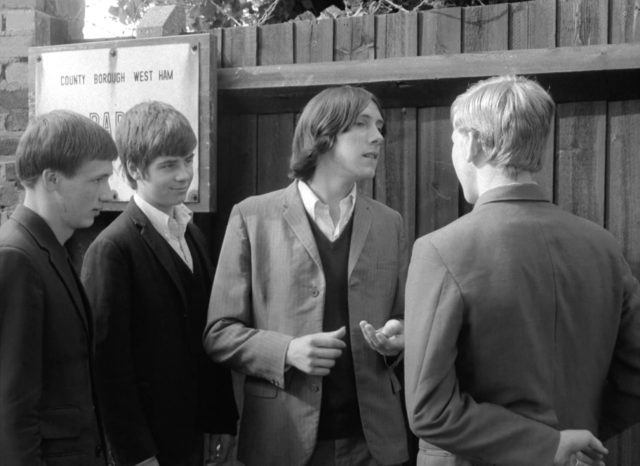
Del (Del Walker) takes Irene (Anne Gooding) on a ride to nowhere in Bronco Bullfrog
BRONCO BULLFROG (Barney Platts-Mills, 1969)
Film Forum
209 West Houston St.
March 25-31
212-727-8110 filmforum.org
It’s a shame that writer-director Barney Platts-Mills won’t be around for the US theatrical premiere of the 2K restoration of his remarkable, long-forgotten 1970 underground black-and-white cult favorite, Bronco Bullfrog. But the British auteur, who passed away in October at the age of seventy-six, did supervise the restoration, and the film’s cinematographer, Adam Barker-Mill, will be at the 7:00 show at Film Forum on opening night, March 25, to talk about the making of the kitchen sink drama, the British neorealist subgenre that included such works as Tony Richardson’s Look Back in Anger, Ken Loach’s Kes, and Jack Clayton’s Room at the Top.
The story takes place in the shabby East End of London, where a group of boys battle malaise and boredom by sneaking into the movies, pulling off petty robberies, and fighting a gang of well-dressed, better-educated guys led by Parker (J. Hughes Jr.). Del Quant (Del Walker) is a seventeen-year-old welding apprentice who hangs around with his ne’er-do-well buddies, Roy (Roy Haywood), Chris (Chris Shepherd), and Geoff (Geoffrey Wincott). When Del meets Chris’s cousin, Tina (Tina Syer), and her fifteen-year-old friend, Irene Richardson (Anne Gooding), Del and Irene start seeing each other, but with little money they don’t exactly go out on the town; sometimes they merely head to the group’s hideout, a ramshackle space with dirty words and magazine pictures of naked women on the walls.
When local legend Jo Saville (Sam Shepherd), also known as Bronco Bullfrog, gets out of reform school, he offers Del a chance to make some fast cash, but they’re not exactly a crackerjack bunch of thieves; Jo, Del, Roy, and Chris are not even the droogs from Stanley Kubrick’s A Clockwork Orange, which came out the following year. In fact, the films have several elements in common; perhaps Platts-Mills was familiar with Anthony Burgess’s 1962 novel. Like Clockwork,Bronco Bullfrog has its own language and features heavy accents, so subtitles are often used, which has also been the case with many of Loach’s films. (In Platts-Mills’s second film, the more free-wheeling Private Road, the protagonists go to see Kubrick’s Spartacus.)
Neither Del’s father (Dick Philpott) nor Irene’s mother (Freda Shepherd) is happy about the kids’ relationship, especially when Sergeant Johnson (Stuart Stones) shows an interest in Del. But Del and Irene keep doing their thing, not talking or doing much as they try to figure out if there’s anything out there in the world for them; they know what they don’t want but not what they do, their lives devoid of the promise of a happy future while they seek out instant, temporary kicks.
Bronco Bullfrog is a wonderfully drawn study of teen angst and ennui. The characters wander aimlessly through empty, decrepit streets and alleys, every turn leading nowhere. Much of the poetic and deeply romantic film is improvised and shot on location where the nonprofessional actors live; it was made for a mere eighteen thousand pounds. Platts-Mills himself ran away from his expensive public school when he was fifteen; his father, John Platts-Mills, was a prominent barrister and member of Parliament.
The idea for the film came from Walker and his friends, who had participated in theater director Joan Littlewood’s workshop at the Play Barn, which was depicted in Platts-Mills’s 1969 documentary, Everybody’s an Actor, Shakespeare Said. They needed something to do, so Walker asked the director to make a movie with them.
Four East End teens battle malaise in Barney Platts-Mills’s Bronco Bullfrog
Although there was a script, the disenfranchised youth, neither mods nor rockers, just go about a fictionalized version of their lives, making it up on the fly as Platts-Mills and Barker-Mill — who became a successful installation artist — keep the cameras rolling. The charmless Del fancies himself a ladies’ man, but the scene in which he meets Irene is hysterical. He and Chris sit opposite Irene and Tina in a small tea shop, with nothing to say; Roy, playing pinball, looks over as if he’s jealous that his pals are talking to girls, but he’s not ready for that either and goes back to his game. On another date, Del, who recently bought a used motorbike, sits with Irene outside the fence of a motocross race, watching the kind of excitement that never comes his way.
Meanwhile, Bronco Bullfrog is no tough gang leader; he’s a bit of a doofus and maybe even just a nice guy who’s lost, which is perhaps why Platts-Mills named the film after him, because he’s a relatively minor character. He’s so thoughtful and gentle with his landlady (E. E. Blundell) that it’s easy to see through his supposed tough exterior. And the battles with Parker and his friends are pathetic; after Del and his group lamely push one of them to the ground, they later brag about how they beat him up.
The 2K restoration, made from the original 35mm print that was saved out of the garbage, is stark and sharp, capturing the feel of the teens’ mundane existence in this downtrodden corner of British society. The soundtrack is by drummer Tony Connor, saxophonist Keith Gemmell, bassist Trevor Williams, and guitarist Howard Werth of the British art-rock band Audience, adding to the late-1960s vibe. The multi-award-winning Platts-Mills went on to make the 1982 sword and sorcery film Hero and the 2010 drama Zohra: A Moroccan Fairy Tale, also about teen lovers. But it all started with Bronco Bullfrog, a landmark of British cinema that is finally getting its due here in America.
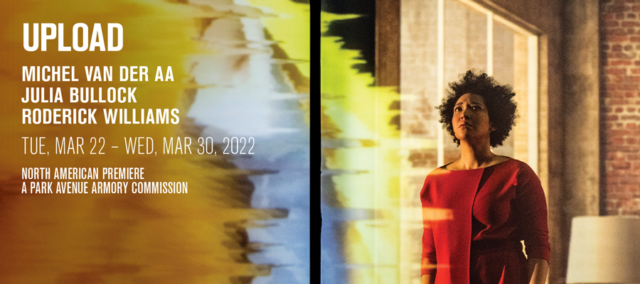
UPLOAD
Park Ave. Armory, Wade Thompson Drill Hall
643 Park Ave. at Sixty-Seventh St.
March 22-30, $45-$150, 7:30 / 8:00 www.armoryonpark.org www.vanderaa.net
Dutch composer Michel van der Aa returns to Park Ave. Armory this month with the North American premiere of Upload, a multimedia opera running March 22-30 in the Wade Thompson Drill Hall. The hybrid work uses film and motion capture technology to tell the story of a father and daughter seeking digital consciousness, an exciting follow-up to Rashaad Newsome’s recently concluded Assembly installation at the armory, which was hosted by the AI known as Being the Digital Griot.
Previously presented at the Dutch National Opera and the Bregenz Festival in Austria, the eighty-five-minute Upload features soprano Julia Bullock as the daughter and baritone Roderick Williams as the father in person, with Katja Herbers as a psychiatrist and Ashley Zukerman as a CEO in prerecorded flashbacks shot by cinematographer Joost Rietdijk. The score is performed by the Cologne-based Ensemble Musikfabrik under the direction of Otto Tausk; the set and lighting are by Theun Mosk, with motion capture and graphics by Darien Brito and special effects by Julius Horsthuis.
Composer, director, and librettist van der Aa was last at the armory with 2017’s Blank Out, in which Williams appeared onscreen in a story loosely based on the life and career of bilingual South African poet Ingrid Jonker. “Park Ave. Armory is one of my favorite performance spaces in the world,” van der Aa said in a statement. “When it presented Blank Out, I was inspired by the response from the armory’s open-minded and diverse audiences. Upload was developed with the Armory in mind.” There will be an artist talk with van der Aa, moderated by performance artist Marina Abramović, on March 22 at 6:00 ($15).
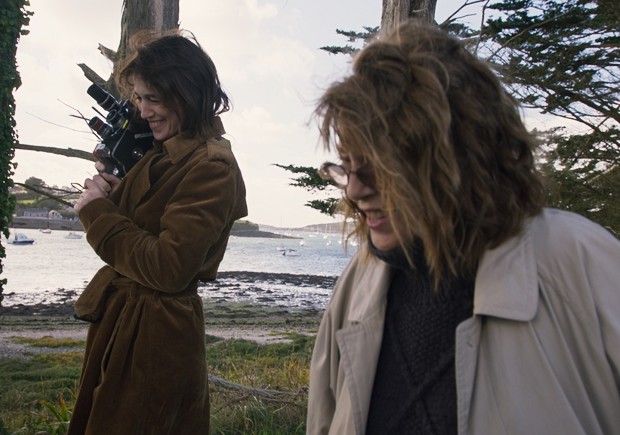
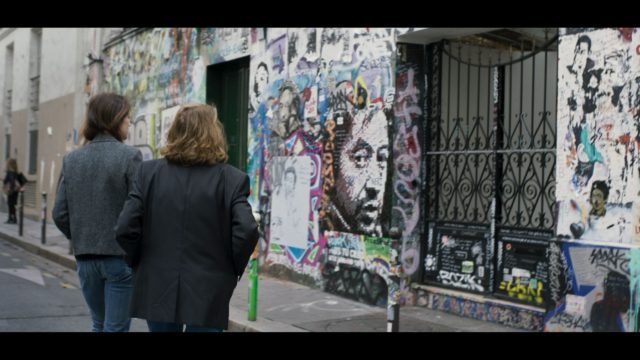
Jane Birkin is seen through the eyes of her daughter in Jane by Charlotte
JANE BY CHARLOTTE (Charlotte Gainsbourg, 2021)
Quad Cinema
34 West 13th St.
Opens Thursday, March 17
212-255-2243 quadcinema.com
Jane by Charlotte is a documentary that only a daughter could make about her mother, a movie about two women who are always being looked at looking at each other.
In 1988, French New Wave auteur Agnès Varda made Jane B. par Agnès V., in which the director herself was a character in the film, showing London-born French singer, actress, and fashion icon Jane Birkin galivanting through imaginative and playful set pieces as Varda photographed her, with Varda sometimes revealing herself in front of and behind the camera. She had just finished Kung Fu Master, a family affair starring Birkin, her daughters Charlotte Gainsbourg (who also appeared in the documentary) and Lou Doillon, and Varda’s son Mathieu Demy.
Charlotte, the actress and singer who is the daughter of Birkin and French pop star and heartthrob Serge Gainsbourgh, now picks up the camera to delve into her complicated relationship with her mother in another family affair, Jane by Charlotte, opening March 17 at the Quad. Charlotte will be at the theater for Q&As after the 7:00 and 7:30 screenings Thursday night. It’s a deeply personal film in which mother and daughter share intimate details of their lives together, the good and the bad, while also avoiding certain topics as they head toward milestones, with Jane approaching seventy-five and Charlotte fifty.
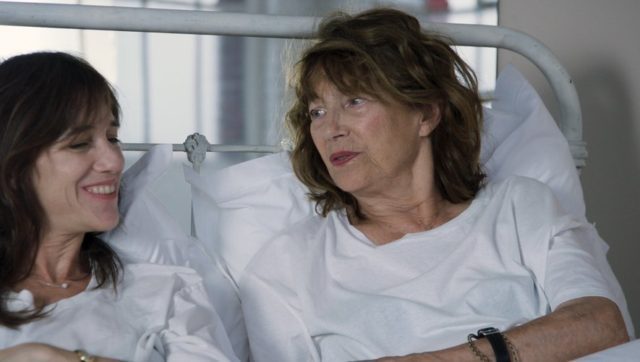
Daughter and mother take a break in bed by Jane by Charlotte
“Filming you with a camera is basically an excuse to just look at you. That’s a brief explanation of the process, OK?” Charlotte tells her mother, who has been looked at most of her life. Birkin has been a public figure since she was a teenager as an international model in the 1960s, her name immortalized in the treasured Hermés Birkin bag. She’s released some twenty albums and appeared in such films as Blowup,Je t’aime moi non plus,La Belle Noiseuse, and Death on the Nile. Charlotte is no stranger to the limelight either, starring in such films as Lars von Trier’s Antichrist,Melancholia, and Nymphomaniac, Franco Zeffirelli’s Jane Eyre, Alejandro González Iñárritu’s 21 Grams, and Michel Gondry’s The Science of Sleep and releasing five records of her own.
Cinematographer Adrien Bertolle follows Jane, Charlotte, and, occasionally, Charlotte’s young daughter, Jo, as they roam from Paris and New York City to Brittany, visiting the beach, a Manhattan rooftop, and, for the first time in many years, the home Jane and Charlotte lived in with Serge, who passed away in 1991 at the age of sixty-two. They are shown rehearsing a duet at the Beacon for the touring concert “Birkin Gainsbourg: Le Symphonique,” performing Serge’s song “Ballade de Johnny-Jane.” [ed. note: Birkin will be performing at the Town Hall on June 22 in support of her December 2020 record, Oh! Pardon tu dormais. . . .] The soundtrack also features snippets of Birkin’s “F.R.U.I.T.,” “Max,” and “Je voulais être une telle perfection pour toi!” and Charlotte’s “Lying with You” and “Kate.”
Jane often poses for her daughter, who takes still shots and movies of her mother, who speaks openly about her aging as Charlotte snaps close-ups of her mother’s wrinkled face, arms, and hands. They lie together in bed, all in a heavenly white, as Jane talks about her insomnia and her longstanding near-addiction to sleeping pills.
Jane had one child with each of her major relationships: She had Kate with her husband, conductor and film composer John Barry, in 1967; Charlotte with Serge, who she never married, in 1971; and singer, actress, and model Lou with director Jacques Doillon in 1982. But mother and daughter carefully avoid several details. They discuss Jane’s recent illness without ever naming it as leukemia. And although they often mention Kate, they never speak of her as being dead; a fashion photographer, Kate died in 2013 at the age of forty-six, perhaps by suicide. Both Jane and Charlotte divide their lives into two segments, before and after Kate, a haunting presence who hovers over them.
Charlotte Gainsbourgh and Jane Birkin stroll through Paris in intimate documentary
Jane, who suffered a minor stroke in September, has come to terms with getting older. “We don’t have much of a choice, you know,” she says. “I’m very lucky.” She also admits to making mistakes with Charlotte and in other parts of her life. “I never wanted to do wrong in regards to you,” she tells her. “You were so private, and so . . . secretive. I didn’t have any clues.” Later, sitting in front of projections of home movies, Jane confesses, “I think I’m always tormented by guilt. I often wonder if it was all my fault, if I should have done differently, in regards to everything.”
Ultimately, in her directorial debut, Charlotte makes some confessions of her own, revealing what she still needs from her mother. It’s a poignant and emotional, wholly French finale, evoking Truffaut as we watch Jane on a beach, her hair blowing in the wind. The two of them then hug as if they never want to let go, Charlotte’s Bolex camera dangling over her shoulder.
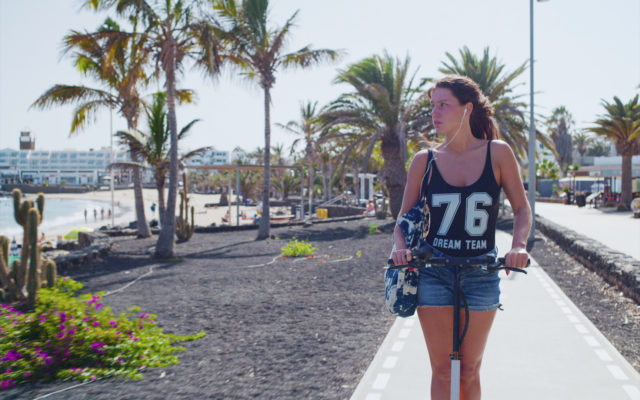
Adèle Exarchopoulos stars as a flight attendant going nowhere in Zero Fucks Given
FIRST LOOK 2022: ZERO FUCKS GIVEN (RIEN À FOUTRE) (Julie Lecoustre & Emmanuel Marre, 2021)
Museum of the Moving Image
35th Ave. at 36th St., Astoria
Friday, March 18, 7:00
Festival runs March 16-20; weekend pass $60; festival pass $120
718-777-6800 movingimage.us
Adèle Exarchopoulos is magnetic as a flight attendant with a loose grip on her life in Zero Fucks Given, the debut directorial collaboration between Paris- and Brussels-based cowriters and producers Emmanuel Marre and Julie Lecoustre. The film makes its New York premiere as part of the Museum of the Moving Image’s eleventh “First Look” festival, consisting of more than three dozen international shorts and features in addition to a gallery presentation and a live virtual reality performance.
Exarchopoulos (Blue Is the Warmest Color,Mandibles) stars as Cassandre, a twentysomething woman who’s unable to commit to anything, but it doesn’t seem to bother her. She considers herself a free spirit, but she doesn’t do much with that freedom. She is based at an airport in Lanzarote in the Canary Islands and wants to get a better airline job in Dubai; she might travel the world, but she spends most of her time in airport hotels and nightclubs, swiping right and left on her cellphone for company. “I like people for two hours and then it’s goodbye,” she tells friends.
As a flight attendant for Wing, she downs vodka before takeoff, usually does the bare minimum at work, and regularly breaks the rules, which she thinks don’t apply to her; when she is offered a promotion, she asserts that she doesn’t want any more responsibilities. After partying, she often wakes up in a blackout about the night before. She might claim to not care, but she is clearly haunted by the death of her mother, who died in a horrific car crash. She has trouble communicating with her father, Jean (Alexandre Perrier), who was devastated by the loss and is trying to sue someone, anyone. When Cassandre — whose name references the Greek mythological figure who was cursed with the ability to prophesize doom that no one listens to — eventually has to return home, suppressed emotions bubble to the surface.
Zero Fucks Given has an infectious, freewheeling atmosphere; the cast includes nonprofessional actors and actual airline personnel, and Perrier, who plays Cassandre’s distraught dad, is one of the associate producers. Marre and Lecoustre (Castle to Castle) eschew rehearsals and encourage significant improvisation while shooting on location with extended breaks in between filming scenes. Exarchopoulos even does her own hair and makeup and wears her own clothing to give the film a more realistic feeling.
Cinematographer Olivier Boonjing zooms in on Cassandre’s face and body as she pretends not to care about what she’s doing, but there’s more to her than she’s allowing herself to acknowledge. “I’m rather lucky,” she says, but she’s going nowhere. She rarely has time to experience the ritzy cities she flies to, traveling back and forth in the enclosed space of airplanes, breathing recycled air. Her mother died in a roundabout, unable to get out of a traffic circle, a stark metaphor for how Cassandre is stuck in life. You might not give a fuck about Cassandre at the beginning, but by the end you’ll be giving more than a few.
Zero Fucks Given is screening at MoMI on March 18 at 7:00. “First Look 2022” runs March 16-20, kicking off with Antoneta Alamat Kusijanović’s Croatia-set Murina, preceded by Tsai Ming-liang’s Hong Kong short The Night. The closing night selection is Pawel Lozinski’s documentary The Balcony Movie. Among the other films are Kirill Serebrennikov’s Petrov’s Flu, Sergei Loznitza Babi Yar. Context, Valentyn Vasyanovych’s Reflection, Qiu Jiongjiong’s A New Old Play, Edwin’s Vengeance Is Mine, All Others Pay Cash, Omar El Zohairy’s Feathers, and Radu Jude’s Semiotic Plastic. There will also be daily “Working on It” lab sessions with live presentations, panel discussions, and screenings, followed by receptions with festival guests
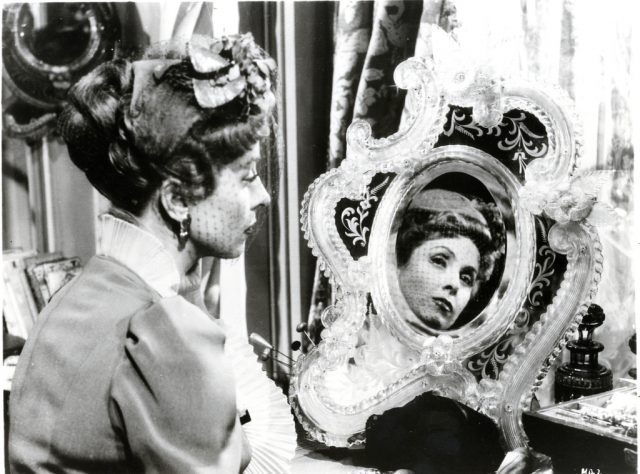
The Comtesse Louise de . . . (Danielle Darrieux) reflects on her life in The Earrings of Madame De . . .
THE EARRINGS OF MADAME DE . . . (Max Ophüls, 1953)
French Institute Alliance Française, Florence Gould Hall
55 East 59th St. between Madison & Park Aves.
Tuesday, March 15, $14, 4:00 & 7:30
Series continues Tuesday nights through March 29
212-355-6100 fiaf.org
Max Ophüls’s The Earrings of Madame de . . . (also known as just Madame de . . .) is a marvelously told tale, a majestic cinematic achievement that Andrew Sarris considered the greatest movie ever made and Dave Kehr called “one of the most beautiful things ever created by human hands.” In 1950, the German-born auteur made La Ronde, a merry-go-round of romance in which one of the two lovers from one scene moves on to someone else in the next. Three years later, Ophüls again follows a series of current, past, and potential lovers in The Earrings of Madame de . . . , but this time via a pair of diamond earrings whose meaning and importance are altered every time they change hands. The film opens with the Comtesse Louise de . . . (a radiant Danielle Darrieux) looking through her personal possessions, from jewelry to furs to a Bible. During a two-minute continuous shot with a handheld camera, Ophüls shows only her hands and the side of her face until she sits down and looks at herself in the mirror; it not only immediately establishes the woman’s character — like her fancy things, she has become merely another object, an empty reflection — but lets the audience know that they are in the grip of a master, that the very motion of the camera itself will play a central role in what we’re about to experience.
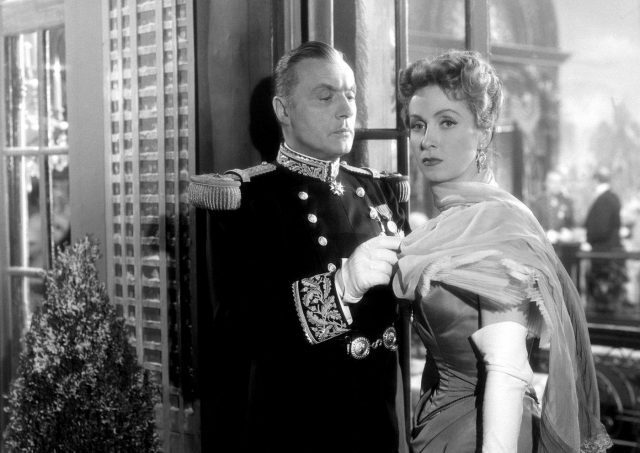
And indeed, Christian Matras’s gorgeous black-and-white cinematography, composed of wonderfully orchestrated close-ups and sweeping montages, guides us along as we follow the travels of a pair of diamond earrings that, through various circumstances, keeps coming back to the countess. Louise, whose last name we never learn through clever blocks made in sound and image, needs money, but she is afraid to let her husband, Général Andre de . . . (a stern Charles Boyer), know. She decides to sell the diamond earrings he gave her as a wedding present — she not only wants the cash but also is seeking to rid herself of what the jewelry represents, a love that is not what it once was. Meanwhile, her husband is saying goodbye to his lover, Lola (Lia Di Leo), shipping her off to Constantinople as if she were a piece of jewelry he no longer requires. But when Louise’s playful flirtation with the graceful Italian diplomat Baron Fabrizio Donati (Neorealist director Vittorio De Sica) threatens to become more serious, Andre gets more serious as well, and the heart-wrenching melodrama reaches epic dilemmas.
Général Andre (Charles Boyer) takes a newfound interest in his wife (Danielle Darrieux) in Max Ophüls classic
Loosely adapted by Ophüls with Marcel Achard and Annette Wademant from the novel by Louise Lévêque de Vilmorin, The Earrings of Madame de . . . is a ravishing film, every moment a gem. Darrieux, who also appeared in Ophüls’s House of Pleasure and La Ronde and only passed away this past fall at the age of one hundred, is bewitching as the countess, a long-unsatisfied woman attempting to break out of the shell she has been held captive in. Boyer, who had previously starred in Anatole Litvak’s Mayerling with Darrieux, is beguiling as the general, a proud man who is protective of certain possessions. And De Sica, who appeared in more than 150 films but is best known as the director of such Italian stalwarts as The Bicycle Thieves, Umberto D., and Miracle in Milan, is enchanting as the baron, who has fallen passionately in love with Louise and doesn’t care who knows it. Their courtship is breathlessly depicted in a whirling, swirling series of dances at various balls where they are the last to leave. James Mason, who starred in Ophüls’s Caught and Letters from an Unknown Woman, famously wrote, “A shot that does not call for tracks / Is agony for poor old Max, / Who, separated from his dolly, / Is wrapped in deepest melancholy. / Once, when they took away his crane, / I thought he’d never smile again.” Ophüls, who died in 1957 at the age of fifty-four during the making of Les Amants de Montparnasse, goes all out in The Earrings of Madame de . . . , an unforgettable movie with a spectacular ending.
The film is screening March 15 at 4:00 and 7:30 in the FIAF series “Our Love Affairs: Arnaud Desplechin Selects,” comprising five films that have influenced and inspired the French auteur (Kings and Queen,A Christmas Tale). Desplechin says about Madame de . . . , “Danielle Darrieux suffocates under the obligations of marriage. Infidelity will be the risky path she takes to remember herself. And, following along through the film on this journey of a gem, we encounter the twists and turns of desire.” The festival continues March 22 with Ingmar Bergman’s The Touch and concludes March 29 with Martin Scorsese’s The Age of Innocence; Desplechin will provide video introductions for each film.