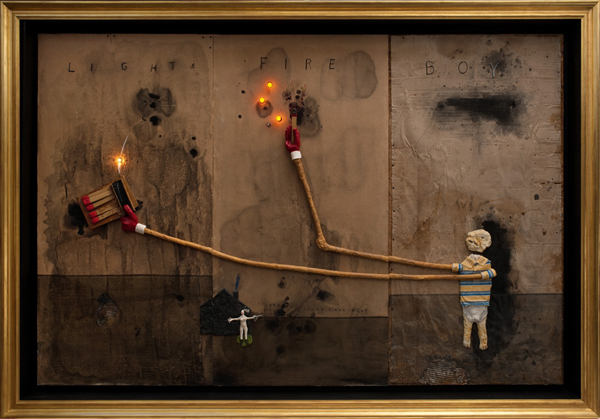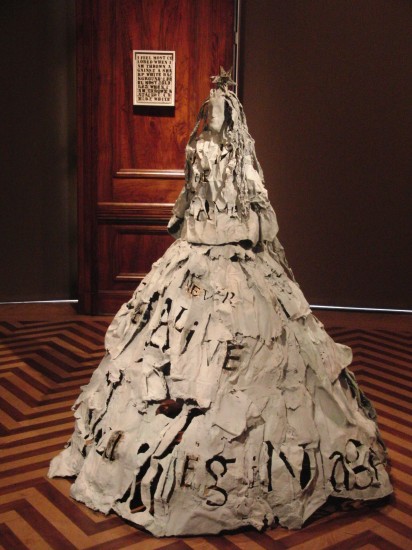
Lesley Dill’s “Woman in Dress with Star” and Glenn Ligon’s untitled oil painting are cleverly juxtaposed at 2012 Annual (photo by twi-ny/mdr)
THE ANNUAL: 2012
National Academy Museum
1083 Fifth Ave. at 89th St.
Wednesday – Sunday through April 29, $12, 11:00 am – 6:00 pm
212-369-4880
www.nationalacademy.org
In an artistic convergence that occurs only once every six years, the National Academy’s annual, the Whitney’s biennial, and the New Museum’s triennial are all on view at the same time. And in a perhaps unexpected convergence, all three reveal that less is more with shows that avoid jam-packing galleries with brand-name artists and instead concentrate on fewer works with a focus on installation. At the National Academy, a mix of cross-generational academicians and invited non-academicians makes for an effective examination of contemporary American art, albeit through a more traditional lens than at the biennial and the triennial, using juxtaposition as a means to an end. Figurative paintings by Burton Silverman, Daniel Bennett Schwartz, Gillian Pederson-Krag, and Philip Pearlstein are seen alongside abstract works by Dorothea Rockburne, Richard Mayhew, David Driskell, and Eric Aho. Sculptures by Barbara Chase-Riboud, Jeffrey Schiff, and Arlene Shechet line the center of a hallway of paintings. Lesley Dill’s “Woman in Dress with Star” stands in front of Glenn Ligon’s untitled oil painting, each incorporating text. The annual also includes a trio of video installations: Joan Jonas’s “Lines in the Sand,” Kate Gilmore’s “Break of Day,” and Carrie Mae Weems’s three-channel “Afro-Chic,” which keeps the funk pumping on the second floor. The 2012 Annual is the best the National Academy has put on in several years.
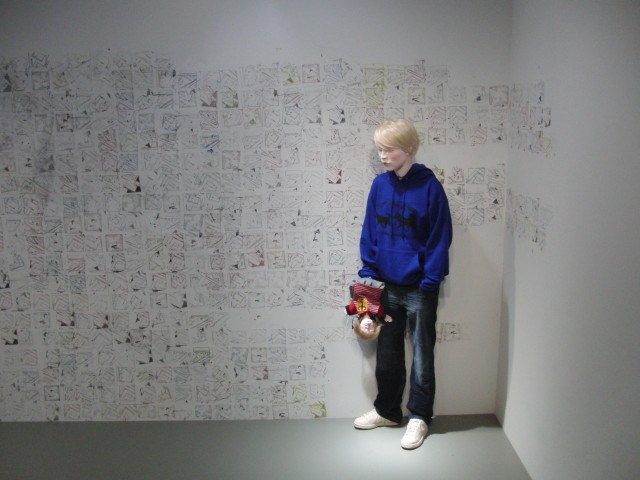
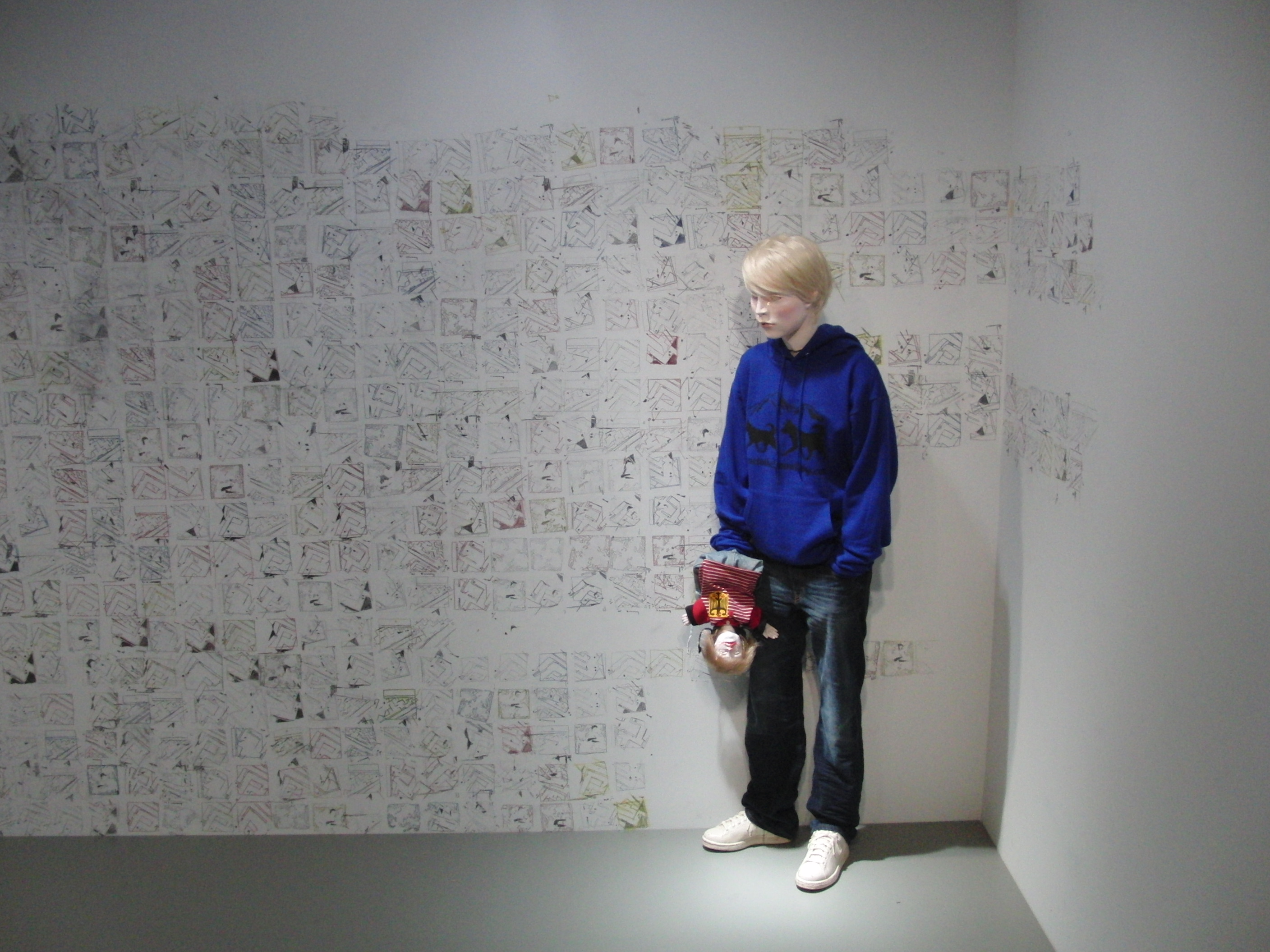
Gisèle Vienne with Dennis Cooper, Stephen O’Malley, and Peter Rehberg, “Last Spring: A Prequel,” mixed-media installation, 2011 (photo by twi-ny/mdr)
WHITNEY BIENNIAL 2012
Whitney Museum of American Art
945 Fifth Ave. at 75th St.
Wednesday – Sunday through May 27, $12, 11:00 am – 6:00 pm (pay what you wish Fridays 6:00 -9:00)
212-570-3600
www.whitney.org
“Art discourse serves to maintain links among artistic subfields and to create a continuum between practices that may be completely incommensurable in terms of their economic conditions and social as well as artistic values,” Andrea Fraser writes in “There’s no place like home,” an essay that serves as her contribution to the 2012 Whitney Biennial. “This may make art discourse one of the most consequential—and problematic—institutions in the art world today, along with mega-museums that aim to be all things to all people and survey exhibitions (like the Whitney Biennial) that offer up incomparable practices for comparison.” As it turns out, curators Elisabeth Sussman and Jay Sanders have not turned the biennial into all things for all people, instead putting together a manageable collection of contemporary American art that leans heavily toward performance and installation, showing off the space of the Marcel Breuer building instead of cluttering every nook and cranny with anything and everything. Visitors can walk through Oscar Tuazon’s “For Hire,” Georgia Sagri’s “Working the No Work,” and Wu Tsang’s “Green Room” and watch the New York City Players get ready for Richard Maxwell’s new site-specific play in an open dressing room. Gisèle Vienne’s “Last Spring: A Prequel” features a young animatronic teen standing in a corner, mumbling text by Dennis Cooper. More traditional art forms like painting and photography tend to get lost in these kinds of shows, but the disciplines are well represented by Nicole Eisenman’s uneasy figures, Andrew Masullo’s eye-catching small canvases filled with bright colors and geometric patterns, and Latoya Ruby Frazier’s photographic examination of her hometown of Braddock, Pennsylvania. If you’re thirsting for some music, there’s Lutz Bacher’s “Pipe Organ,” Lucy Raven’s “What Manchester Does Today, the Rest of the World Does Tomorrow” player piano, and Werner Herzog’s “Hearsay of the Soul,” a four-channel video installation that brings together Hercules Segers’s etchings with music by Ernst Reijseger. And then there’s Robert Gober’s exploration of the career of Forrest Bess, which has to be seen to be believed. For a closer look at the myriad live performances, talks, and workshops, visit here.
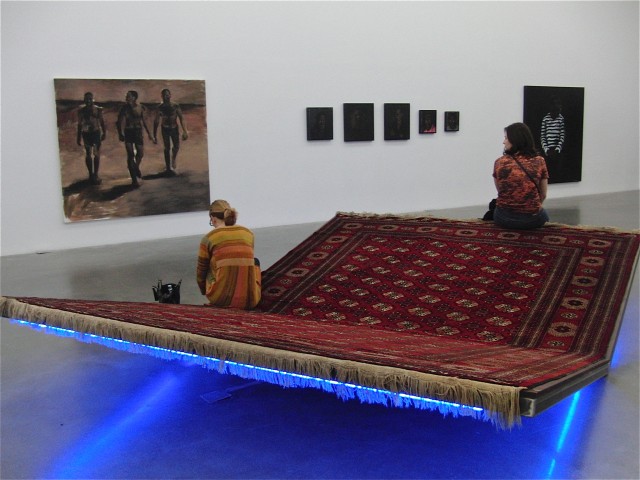
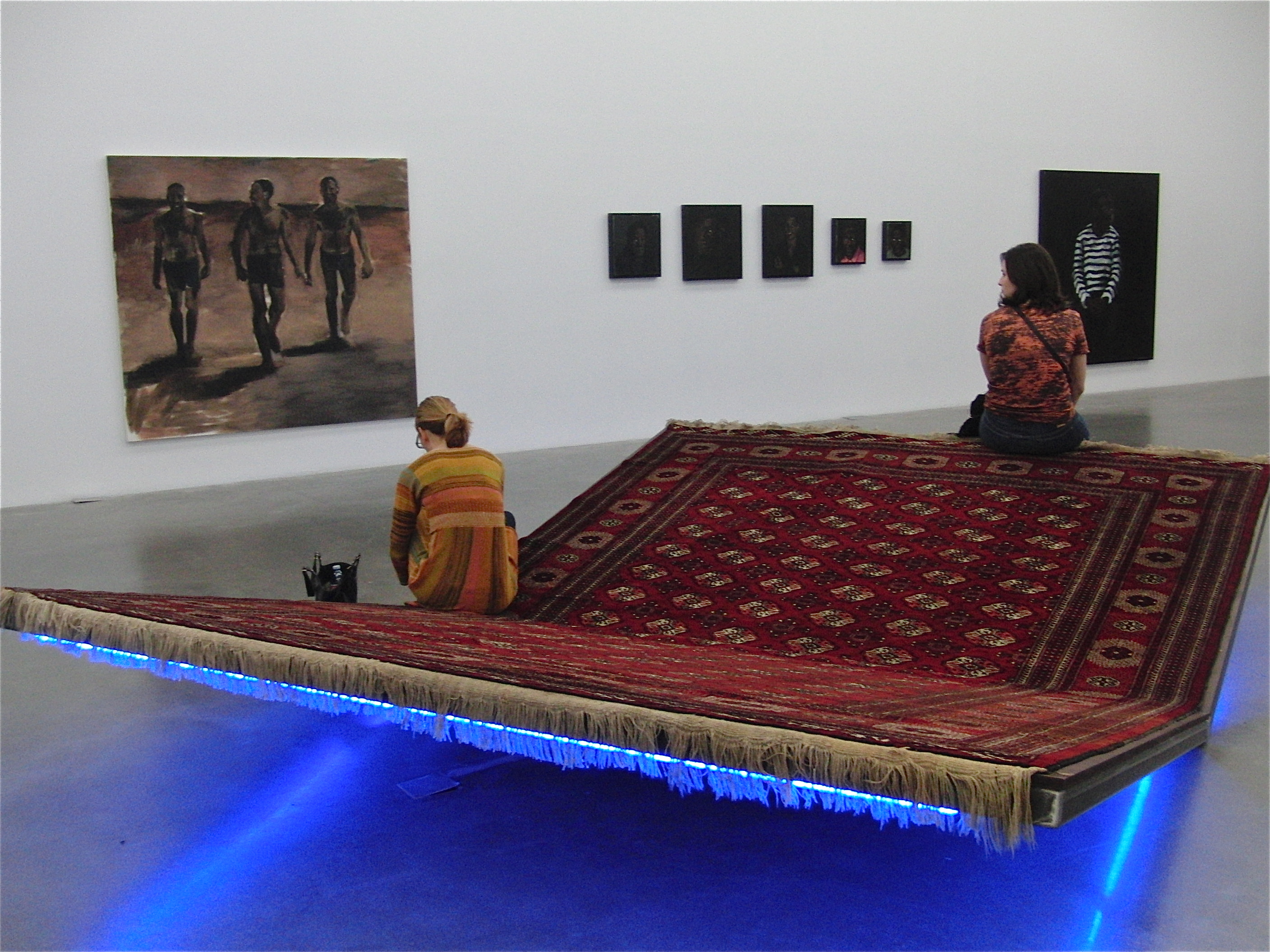
Triennial visitors can take a seat on Slavs and Tatars’ “PrayWay” while contemplating Lynette Yiadom-Boakye’s oil paintings (photo by twi-ny/mdr)
THE UNGOVERNABLES: 2012 NEW MUSEUM TRIENNIAL
New Museum
235 Bowery at Prince St.
Wednesday – Sunday through April 22, $12, 11:00 am – 6:00 pm (free Thursdays 7:00 -9:00)
212-219-1222
www.newmuseum.org
Three years ago, the New Museum’s inaugural triennial featured international artists who were all younger than Jesus was at his death at age thirty-three. The 2012 edition, “The Ungovernables,” comprises sculpture, painting, video, and installation that challenge the status quo often in subtle ways, commenting on world economics, corporatization, and politics through creative methods. In Amalia Pica’s “Eavesdropping,” a group of drinking glasses stick out from a wall, referencing both the surveillance and the digital age. Danh Vo’s “We the People” consists of sheets of pounded copper that are actually re-creations of the skin of the Statue of Liberty, a different way to look at freedom. Pratchaya Phinthong’s “What I learned I no longer know; the little I still know, I guessed” is a square collection of Zimbabwean paper money whose specific value continually decreases. Cinthia Marcelle and Tiago Mata Machado’s O Século (The Century) shows debris being thrown from a building, resulting in a visual and aural cacophony of chaos. The Propeller Group’s multichannel “TVC Communism” details the creation of a modern advertising campaign selling communism. Slavs and Tatars’ “PrayWay” is a folded prayer carpet on which visitors are invited to sit and get lost in contemplation that need not be religious. Lynette Yiadom-Boakye’s oil paintings examine race and gender. Hassan Khan’s short video, Jewel, depicts two men dancing using signifiers set to a propulsive Cairene song. José Antonio Vega Macotela’s “Time Exchange” details a four-year collaboration with Mexican prisoners in which tasks are exchanged instead of money. Pilvi Takala’s riotous “The Trainee” follows the Finnish-born artist’s intervention as she pretends to be working in a Deloitte office. And Gabriel Sierra’s interventions involve placing such objects as a ladder and a level, which he refers to as devils, directly into the walls of the museum. As with the National Academy’s Annual and the Whitney Biennial, “The Ungovernables” avoids clutter and overt political statements, steering clear of the obvious and instead offering a varied and intriguing look at the contemporary art world

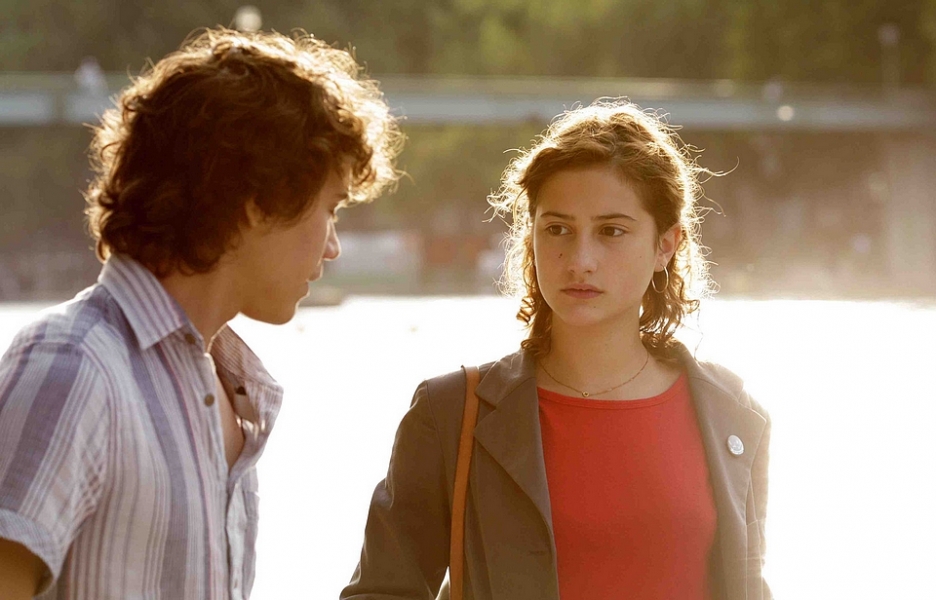
 French filmmaker Mia Hansen-Løve’s third film is an infuriating yet captivating tale that runs hot and cold. Goodbye First Love begins in Paris in 1999, as fifteen-year-old Camille (Lola Créton) frolics naked with Sullivan (Sebastian Urzendowsky), her slightly older boyfriend. While she professes her deep, undying lover for him, he refuses to declare his total dedication to her, instead preparing to leave her and France for a long sojourn through South America. When Camille goes home and starts sobbing, her mother (Valérie Bonneton), who is not a big fan of Sullivan’s, asks why. “I cry because I’m melancholic,” Camille answers, as only a fifteen-year-old character in a French film would. As the years pass, Camille grows into a fine young woman, studying architecture and dating a much older man (Magne-Håvard Brekke), but she can’t forget Sullivan, and when he eventually reenters her life, she has some hard choices to make. Créton (Bluebeard) evokes a young Isabelle Huppert as Camille, while Urzendowsky (The Way Back) is somewhat distant as the distant Sullivan. There is never any real passion between them; Hansen-Løve (All Is Forgiven,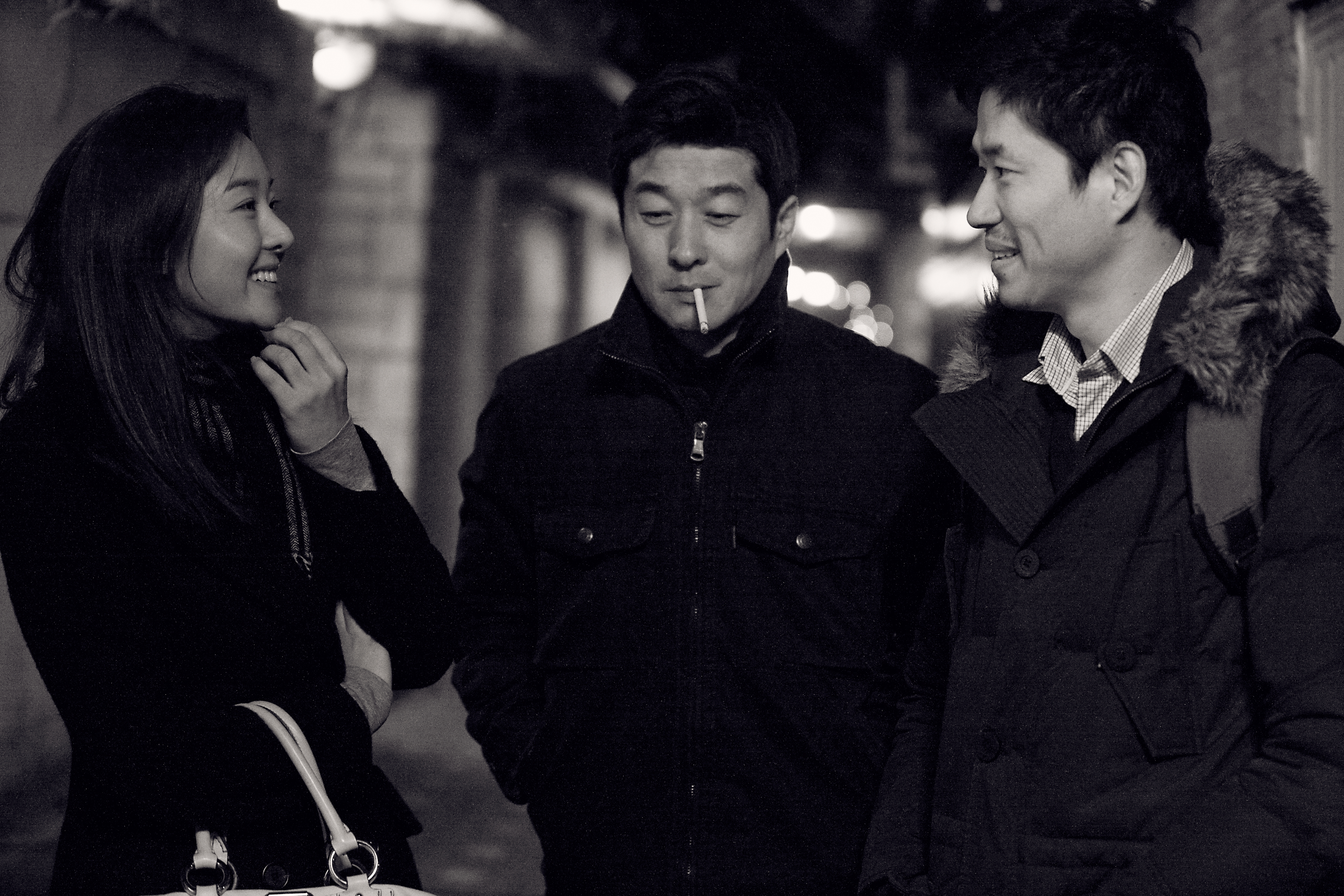
 For most of his career, South Korean auteur Hong Sang-soo has been making films about filmmakers, although not always about the filmmaking process itself. In such works as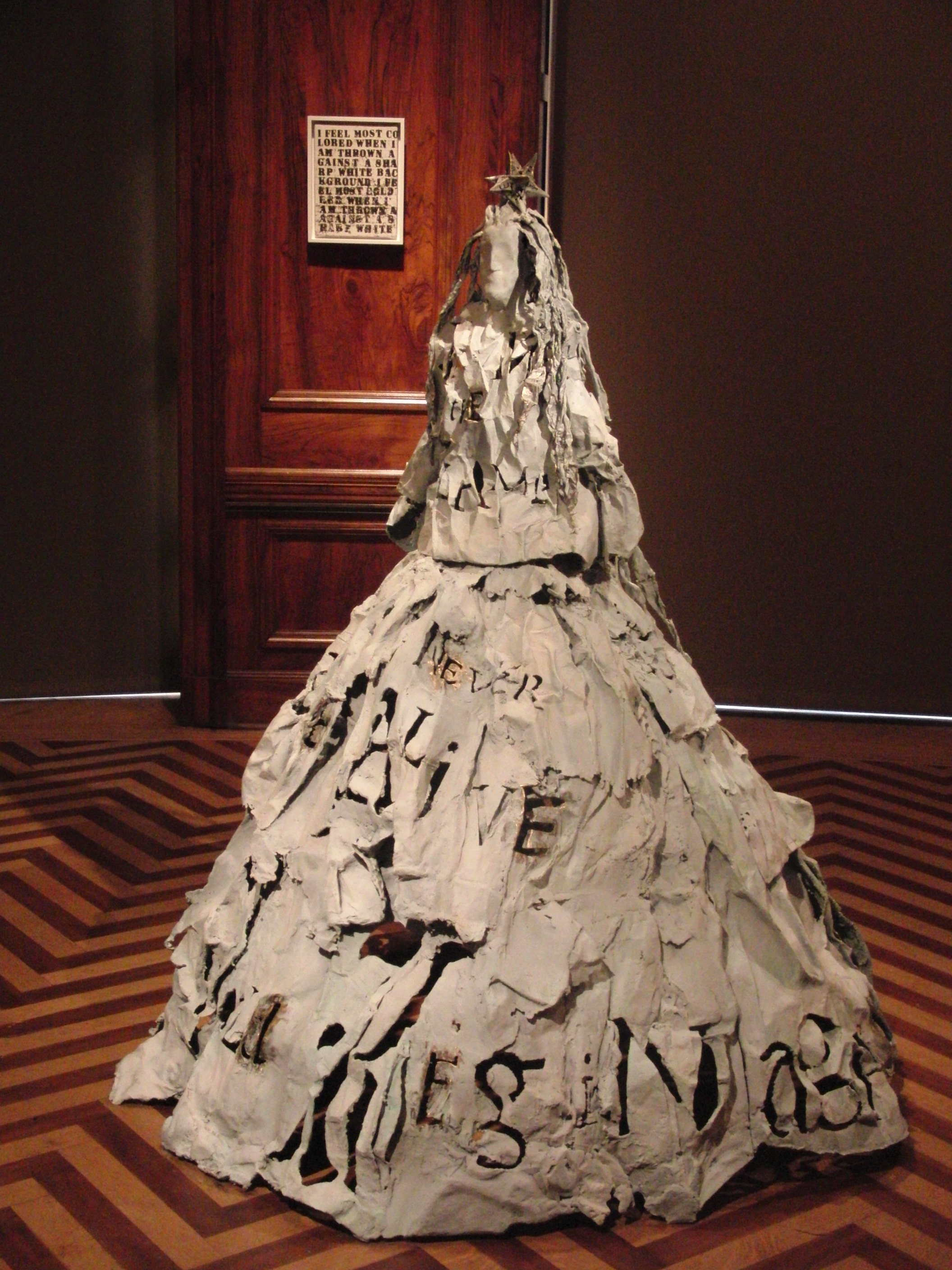
 Writer-director Baltasar Kormákur’s adaptation of Arnaldur Indriðason’s award-winning novel Jar City (Myrin) is a bleak but compelling police procedural that focuses on a fact-based controversial government initiative that is cataloging genetic research on all Icelandic families. When an aging man named Holberg (Thorsteinn Gunnarsson) is murdered in his home, brooding inspector Erlendur (Ingvar E. Sigurdsson) heads the investigation into the death, leading him to a thirty-year-old rape, a dirty cop, a trio of criminals (one of whom has been missing for a quarter century), a woman who killed herself shortly after her four-year-old daughter died, and a doctor who collects body parts. The divorced Erlendur also has to deal with his troubled daughter (Augusta Eva Erlendsdottir), a pregnant drug addict who hangs out with some very sketchy company. Meanwhile, a mysterious man (Atli Rafn Sigurdarson) is up to something following the traumatic death of his young daughter. Kormakur weaves together the story line of the two fathers side by side — in the book, the unidentified man appears only near the conclusion, although who he is still remains a mystery for most of the film — centering on the complex relationship between parents and children and what gets passed down from generation to generation, both on the outside and the inside. Sigurdsson plays Erlendur with a cautious seriousness, the only humor coming from the way he treats his goofy partner, Sigurdur Oli (Bjorn Hlynur Haraldsson). Iceland’s entry for the 2007 Foreign-Language Oscar and winner of the Crystal Globe at the Karlovy Vary International Film Festival, Jar City is a dark, tense intellectual thriller. Indriðason has turned Erlendur into a continuing character in such follow-ups as Silence of the Grave and Voices; here’s hoping Kormákur and Sigurdsson do the same. Jar City will be screening on April 20 and 24 at the Film Society of Lincoln Center’s “Images from the Edge: Classic & Contemporary Icelandic Cinema” series, comprising nineteen works from Iceland ranging from Loftur Guðmundsson’s 1949 Between Mountain and Shore and Ævar Kvaran’s 1950 The Last Farm in the Valley to Árni Ásgeirsson’s 2010 Undercurrent and Hafsteinn Gunnar Sigurðsson’s 2011 Either Way, with the directors present for many of the screenings, including Kormákur following the 6:15 showing of Jar City on April 20.