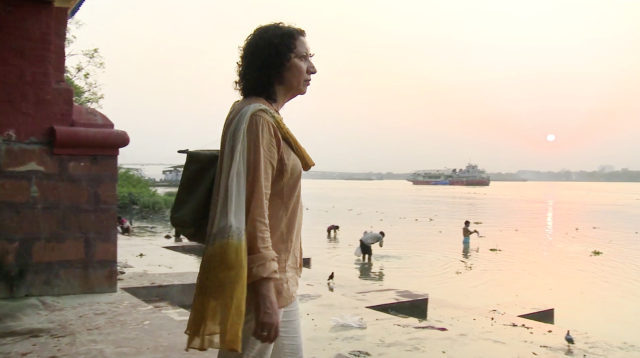
Fatima Shaik searches for a critical piece of family history in The Bengali
THE BENGALI (Kavery Kaul, 2021)
Quad Cinema
34 West 13th St. between Fifth & Sixth Aves.
Opens Friday, September 9
212-255-2243 quadcinema.com www.thebengalifilm.com
“Why would anybody come from the other side of the world to find somebody who doesn’t even exist anymore?” author Fatima Shaik says at the beginning of The Bengali. “Why not?” asks Kolkata-born American director Kavery Kaul. Armed with a partial ship’s registry and a photograph of her grandfather, Shaik Mohamed Musa, who left his small village in India in 1893 to make a new life in the United States, in New Orleans, where he married a Black woman, Fatima travels to her ancestral country, wanting to know more about where she came from and to see a patch of land that he owned. Joined by Kaul, who is Bengali, and cinematographer John Russell Foster, who is white, they have very little information and face roadblock after roadblock until success is in reach, but everywhere she goes, Fatima is met with resistance, as Indians view her with suspicion, thinking that she, a Christian in a Muslim community, might be there to reclaim her grandfather’s land.
The Bengali is an emotional, deeply personal search for identity, almost to the point of obsession, of seeking out one’s family history in a land where you don’t speak the language and are not immediately welcome. The film opens at the Quad on September 9, with Kaul (Cuban Canvas,Long Way from Home) participating in Q&As following the 7:00 screenings on September 9 and 10 and after the 5:10 show on September 11.
Tatsuya Nakadai has a ball in Kihachi Okamoto’s campy Eastern Western
KILL! (KIRU) (Kihachi Okamoto, 1968)
Japan Society
333 East 47th St. at First Ave.
Friday, September 2, $15, 7:00
212-715-1258 www.japansociety.org
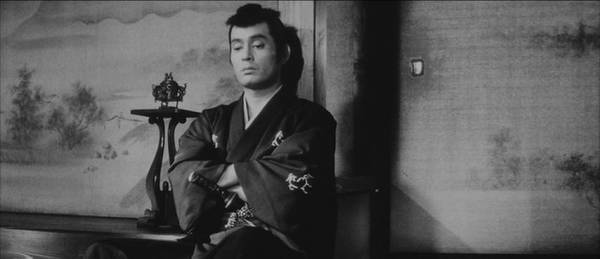
Kihachi Okamoto’s Kill! is a goofy, fun Eastern Spaghetti Western, loaded with references to other samurai flicks. If some of it feels familiar, that’s because it is based on Shūgorō Yamamoto’s novel Peaceful Days, which was also turned into Akira Kurosawa’s 1962 Asian oater Sanjuro, though with significant changes. But this time around, it’s played more for laughs. Tatsuya Nakadai, one of the main villains in both Sanjuro and Yojimbo, stars as former samurai Genta, a laid-back dude who gets caught up in the middle of an inner struggle of a split clan (one group of which contains seven rogue samurai). He meets up with former peasant farmer Hanjiro (Etsushi Takahashi), who dreams of becoming a brave samurai and involves himself in the same battle, though on an opposing side. As the plot grows more impossible to follow, with lots of betrayals, double crosses, would-be yakuza, and romantic jealousy, so does the riotous relationship between Genta and Hanjiro. Masaru Sato’s score is fab as well. Another example of Okamoto’s (The Sword of Doom,Rainbow Kids) mastery of multiple genres, Kill! is screening September 2 at 7:00 as part of Japan Society’s ongoing “Monthly Classics” series, which continues October 7 with Hideo Nakata’s unforgettable Ringu.
Reese Witherspoon and Joaquin Phoenix reveal that opposites attract in Inherent Vice
INHERENT VICE (Paul Thomas Anderson, 2014)
Metrograph
7 Ludlow St. between Canal & Hester Sts.
August 27, 28, 31
Series continues through September 1
212-660-0312 www.inherentvicemovie.com metrograph.com
It makes sense that award-winning writer-director Paul Thomas Anderson, who has made such complex, challenging films as Magnolia, There Will Be Blood,Licorice Pizza, and The Master, made the first cinematic adaptation of a novel by reclusive, iconoclastic author Thomas Pynchon, who has written such complex, challenging books as Gravity’s Rainbow, V., and Vineland. It also makes sense that the book he chose to adapt is Inherent Vice, probably the most lighthearted and breezy of Pynchon’s tomes. But it also makes sense that the film itself is complex and challenging — and downright confusing. Walking out of the theater, we were pretty sure we liked what we had just seen, even if we didn’t completely understand what had happened. (As Jena Malone said of the making of the film, “The logic becomes the chaos and the chaos becomes the logic.”)
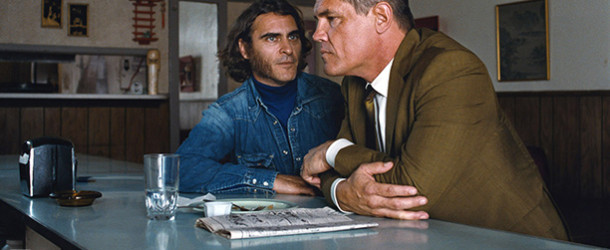
The neonoir takes place in 1970 in the fictional Valley town of Gordita Beach (based on Manhattan Beach, where Pynchon lived for a long time). Joaquin Phoenix stars as Larry “Doc” Sportello, a mutton-chopped ex-hippie who is now a private gumshoe working out of a health clinic. One day his ex, Shasta Fay Hepworth (a transplendent Katherine Waterston), shows up to ask him to get her out of a jam involving her billionaire boyfriend, Mickey Wolfmann (Eric Roberts), who has gone missing, perhaps at the hands of Wolfmann’s high-society wife, Sloane (Serena Scott Thomas). Meanwhile, Doc is also hired by Hope Harlingen (Malone) to determine whether her supposedly dead husband, surf-sax legend Coy (Owen Wilson), is actually alive. As Pynchon himself says in the book trailer, “At that point, it gets sort of peculiar,” and peculiar it does indeed get, as Doc becomes immersed in a web of lies and deceit, dealing with a dangerous cult known as the Golden Fang (where Martin Short plays a sex-crazed dentist with a wild abandon), a curious health facility called the Chryskylodon Institute run by Dr. Threeply (Jefferson Mays), and Det. Bigfoot Bjornsen (Josh Brolin), a “renaissance cop” who has no time for any of Doc’s hippie crap, as the Manson murders hover over everything. Well, at least that’s what we think the plot is about.
Doc (Joaquin Phoenix) and Bigfoot (Josh Brolin) don’t agree on much in Paul Thomas Anderson adaptation of Thomas Pynchon novel
As with all Anderson films, Inherent Vice looks and sounds great; cinematographer Robert Elswit, who has shot most of Anderson’s works, bathes the quirky drama in hazy, syrupy colors, while Jonny Greenwood’s score is accompanied by songs by Can, Sam Cooke, Minnie Riperton, the Marketts, and Neil Young. (In fact, Young’s Journey through the Past experimental film served as an influence on Anderson when making Inherent Vice, as did David Zucker, Jim Abrahams, and Jerry Zucker’s Police Squad and Naked Gun series, Robert Altman’s 1973 Philip Marlowe movie The Long Goodbye, and Howard Hawks’s 1946 version of Raymond Chandler’s The Big Sleep.) It all has the feel of the Coen brothers’ The Big Lebowski as reinterpreted by Anderson and Pynchon — who might have been on-set during at least some of the shooting and supposedly makes a cameo in the picture. The film is littered with absurdist jokes and oddities, from the way Bigfoot eats a chocolate-covered banana to a trio of FBI agents picking their noses, from the right-wing Vigilant California organization to a clip from the 1952 Cold War propaganda film Red Nightmare.
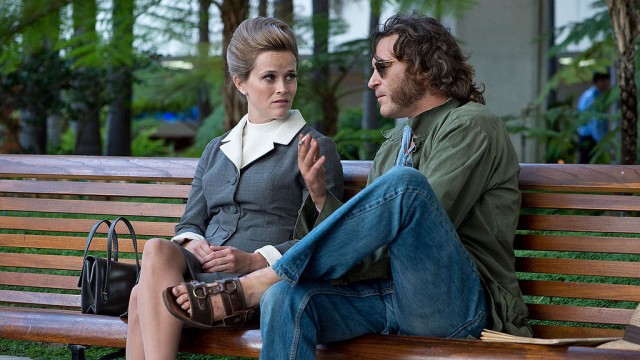
Phoenix once again fully inhabits his character, who putt-putts around in an old Dodge Dart and just wants life to be mellow and groovy. Brolin is hysterical as his foil, the straitlaced, flattop cop who has a penchant for busting down doors. The large cast also includes Benicio del Toro as Sauncho Smilax, Doc’s too-cool lawyer; Reese Witherspoon as Penny Kimball, Doc’s well-coiffed girlfriend; Maya Rudolph (Anderson’s real-life partner and the daughter of Riperton) as receptionist Petunia Leeway; Sasha Pieterse as Japonica Fenway, who hangs with Golden Fang dentist Rudy Blatnoyd (Short); and Joanna Newsom as Sortilège, the film’s narrator (who does not appear in the book). Inherent Vice is yet another unique cinematic experience from Anderson, one that is likely to take multiple viewings to understand just what is going on, but as with his previous films, it is likely to be well worth the investment.
Inherent Vice is screening August 27-31 in the Metrograph series “Road Trip: American Cinema from Coast to Coast,” which continues through September 1 with such other on-the-move flicks as Matt Cimber’s The Witch Who Came in from the Sea,Kent Mackenzie’s The Exiles, Clint Eastwood’s Play Misty for Me, Ivan Passer’s Cutter’s Way,Wayne Wang’s Chan Is Missing, and Paul Schrader’s Hardcore.
Three minutes of footage tell a remarkable story in documentary
THREE MINUTES: A LENGTHENING (Bianca Stigter, 2021)
Quad Cinema
34 West 13th St. between Fifth & Sixth Aves.
August 18-25
212-255-2243 quadcinema.com www.threeminutesfilm.com
“For the Jewish inhabitants of Nasielsk in Poland, nothing remains,” narrator Helena Bonham Carter says in Bianca Stigter’s astounding documentary, Three Minutes — A Lengthening. “The only thing left is an absence.”
In 1938, David and Liza Kurtz, Polish immigrants who had come to New York in the 1890s and found success, took a trip to Europe, where they visited Holland, Belgium, Switzerland, France, and England, on the cusp of the Holocaust. In an unusual move for Americans making a Grand Tour, they visited David’s hometown of Nasielsk in Eastern Europe that August. There, David used his brand-new movie camera to shoot footage in 16mm Kodachrome and black-and-white of the men, women, and children of the village, smiling, goofing around, and preening, of course unaware of what was to come in a very short time.
In 2009, David and Liza’s grandson Glenn Kurtz donated the three minutes of footage to the United States Holocaust Memorial Museum in Washington, DC, for preservation and research. The museum posted it online, hoping that perhaps some of the people in the film could be identified. Glenn further researched the excerpt for four years, detailing his journey in the 2014 book Three Minutes in Poland: Discovering a Lost World in a 1938 Family Film.
“Nasielsk was not an important town, unless you lived there. It was just a town,” Kurtz explains in the documentary. “But of all the Polish towns destroyed in the Holocaust, Nasielsk is among the very few that exists in moving pictures, among just a handful preserved in color.”
In 2015, Dutch historian and cultural critic Stigter made a short work-in-progress film based on the footage (Three Minutes Thirteen Minutes Thirty Minutes), and now she has expanded it into her feature-length debut, Three Minutes — A Lengthening, opening August 18 at the Quad. It’s a haunting investigation of time and memory that focuses exclusively on the 180+ seconds of David Kurtz’s Nasielsk footage; there are no other images in the seventy-minute film. Stigter and editor Katharina Wartena perform a kind of forensic analysis of each moment, zooming in on specific individuals or locations, trying to figure out the name of a grocery store, even determining what kind of trees lined the cobblestone square, understanding that anything could provide critical information.
The style of the film is reminiscent of what filmmaker Peter Greenaway did with Leonardo da Vinci’s The Last Supper, Rembrandt’s The Night Watch, and Veronese’s Wedding at Cana, fantastically close examinations of every face and detail on the canvases, but the subjects of Three Minutes are all too real.
“These three minutes of life were taken out of the flow of time,” Bonham Carter says. That becomes particularly apparent when thirteen-year-old Maurice Chandler, born Mozek Tuchendler, is recognized by a family member, and Stigter visits him in Detroit; we hear him as he watches the footage, remembering some of the other residents and telling a charming story of some trouble he and a friend got into one day.
The only misstep, and a minor one at that, is a section in which Stigter slowly fills the screen with thumbnails of every face in the footage; while the point is to give each individual their own moment of identity, proof of their existence, it takes away from the overall flow of the film and its compelling detective-procedural-style pacing. However, stick around to the end of the credits for a little bonus.
Although Stigter, who previously served as an associate producer on Widows and Twelve Years a Slave, both directed by her husband, Steve McQueen, who is a co-producer on Three Minutes, speaks with Kurtz, Chandler, survivor Andrzej Lubieniecki, historian Zdzisław Suwiński, translator Katarzyna Kacprzak, and two of Chandler’s relatives, they are never shown; this film is about the three thousand people who lived in Nasielsk in 1938, fewer than a hundred of whom survived the Nazi invasion. It’s also about all such Eastern European Jewish towns that were decimated in the Holocaust.
“By defining the loss of that world, we might succeed in keeping the memory alive,” Kurtz says. In addition, it’s about the power of the medium of film, how it can capture the past and preserve culture and history that might have otherwise disappeared forever. Stigter has noted that there were other surprising elements that she could have pursued, some of which are included in Kurtz’s book, but she wanted to concentrate solely on what could be discovered and interpreted from the celluloid itself.
Last year, Ruth Katcher, a colleague of mine, found 8mm footage of her family holding a Passover seder in Philadelphia in April 1932, led by her great-grandfather, who, with his wife and children in 1906, had fled Donetsk in what is now Eastern Ukraine. It is a remarkable three-and-a-half-minute scene, which she discusses in an article in the Forward. “The film has special resonance, showing nearly the last seder with the family intact,” Katcher writes.
After experiencing Three Minutes, don’t be surprised if you find yourself going through closets and basements, looking for recorded remnants of your family’s past.
Stigter and Kurtz will participate in a series of Q&As following screenings on August 18, 19, 20 (all at 7:00) and 21 (2:00), moderated by Dr. Ori Z. Soltes, Aviva Slesin, or Annette Insdorf. The film will also be presented September 8 and 12 at the Marlene Meyerson JCC Manhattan.
A 4K restoration of Keane, starring Damian Lewis, comes to Lincoln Center beginning August 19
KEANE (Lodge Kerrigan, 2004)
Film at Lincoln Center, Francesca Beale Theater, Elinor Bunin Munroe Film Center
144 West 65th St. between Eighth Ave. & Broadway
Opens Friday, August 19 www.filmlinc.org grasshopperfilm.com
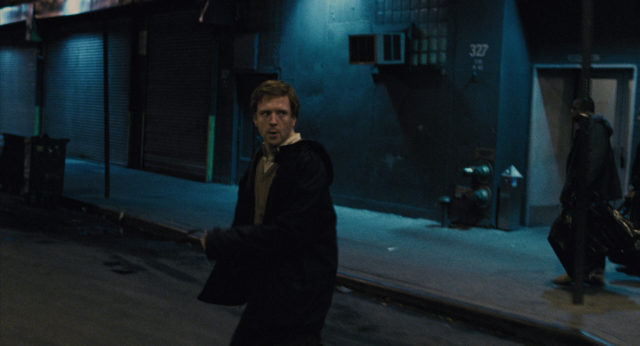
Lodge Kerrigan’s remarkable third feature, Keane, is mesmerizing, always teetering on the brink of insanity. Damian Lewis, years before Homeland and Billions, stars as William Keane, whom we first meet as he rants and raves in the Port Authority, filled with anger, paranoia, and a twitchiness that immediately sets you on edge and never lets up. He is trying to figure out what went wrong when his daughter was abducted from the area, but he now acts like just another crazy at the bus depot. As he befriends a desperate woman (Gone Baby Gone’s Amy Ryan) and her daughter (Little Miss Sunshine’s Abigail Breslin), you’ll feel a gamut of terrifying emotions rush through your body. The cast also features such familiar faces as Liza Colón-Zayas, Christopher Evan Welch, Chris Bauer, Frank Wood, Stephen McKinley Henderson, and others in tiny roles.
With Keane, Kerrigan, who made a big indie splash with his 1993 debut, Clean, Shaven, has created a brilliant psychological film centered on one man’s obsession that will leave you emotionally and physically spent. Filmed on location in 35mm with a handheld camera (with only one shot per scene) and natural sound, Keane has a taut realism that will knock you for a loop. You’ll love this film, but it will also scare the hell out of you.
A selection of the 2004 New York Film Festival, Keane is back at Lincoln Center beginning August 19 in a brand-new 4K restoration supervised by Kerrigan and TV and film editor Kristina Boden; Lewis and Kerrigan — who has made only one film since Keane, 2010’s Rebecca H. (Return to the Dogs), instead concentrating on directing episodes of such series as Homeland,The Killing, and The Girlfriend Experience — will participate in a Q&A following the 6:30 screening on August 20, moderated by Christopher Abbott.
Interactive experience immerses fans into the creepy world of Stranger Things (photo courtesy Netflix)
STRANGER THINGS: THE EXPERIENCE
Duggal Greenhouse
63 Flushing Ave., Building 268, Brooklyn
Wednesday – Sunday through September 4, children $64 – $96.80, adults $84.90 – $129 strangerthings-experience.com
If you’ve been watching or are up to date with Stranger Things on Netflix, you might have found yourself occasionally having trouble sleeping, especially after certain particularly frightening episodes of the sci-fi horror hit, set in the fictional town of Hawkins, Indiana, in the 1980s. Unsurprisingly, the citizens of Hawkins are having their own slumber issues, which is the premise behind Stranger Things: The Experience, an immersive adventure that continues at the Duggal Greenhouse at the Brooklyn Navy Yard through September 4.
The Hawkins National Laboratory (HNL), part of the US Department of Energy, is conducting a sleep study to find out just what is going on in “the Best Small Town in America” — as if they didn’t already know that it has to do with killer creatures and the Upside Down, an alternate dimension where evil, unexplainable events are happening, brought about by the lab itself.
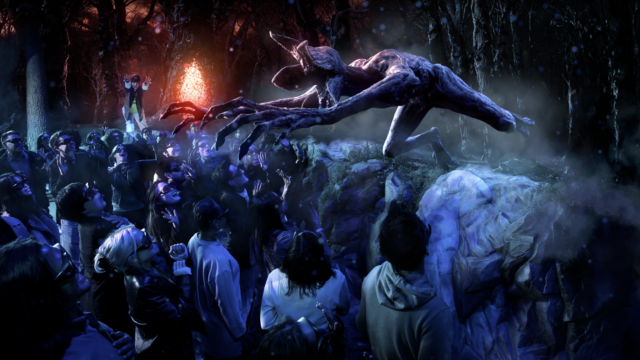
Subjects — er, ticket holders — are led through a series of rooms that begins as a scientific research study into paranormal powers, testing various skills, but quickly turns dangerous. Suddenly the soothing, instructive words of Dept. of Energy executive Sam Owens (Paul Reiser) and HNL head Dr. Martin Brenner (Matthew Modine), affectionately known to his patients as Papa, seem disingenuous as new perils await around each corner.
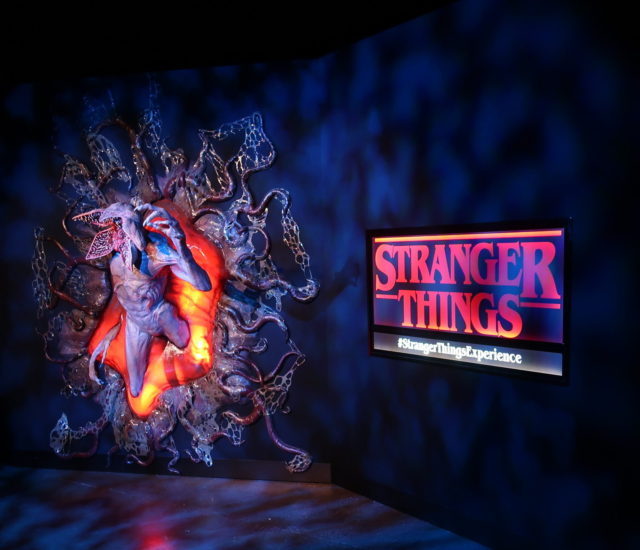
Beware the demogorgon at Stranger Things experience (photo by twi-ny/mdr)
Meanwhile, a group of kids are trying to help, consisting of the goofy but determined Dustin Henderson (Gaten Matarazzo); the always serious Lucas Sinclair (Caleb McLaughlin); the fiercely independent Max Mayfield (Sadie Sink); the deeply sensitive Will Byers (Noah Schnapp), who went missing in season one; Mike Wheeler (Finn Wolfhard), who undergoes the biggest coming-of-age changes over the course of the show; and, at the center of it all, Eleven (Millie Bobby Brown), a mysterious young girl with special powers who appears virtually out of nowhere in the first episode. Just as an fyi, you won’t encounter Joyce Byers (Winona Ryder), Sheriff Jim Hopper (David Harbour), Nancy Wheeler (Natalia Dyer), Jonathan Byers (Charlie Heaton), Steve Harrington (Joe Keery), Eddie Munson (Joseph Quinn), Erica Sinclair (Priah Ferguson), or Murray Bauman (Brett Gelman) during the journey, but to say any more would venture into spoiler territory.
Stranger Things: The Experience is like a series of escape rooms, except there is always a way out. The show, created by the Duffer Brothers, has presented thirty-four episodes over four seasons since its premiere on July 15, 2016; each of the uniquely detailed spaces in Duggal Greenhouse is like a new episode, with its own storyline as well as prompts to make sure participants make it through safely.
Although children as young as five are allowed to enter, there are four-letter words, and several of the cool special effects can be legitimately scary for some people of any age, so be prepared. Netflix clearly went all-in on this sixty-minute production, which includes a 3D room that, like the show, makes you question reality. Everything is original to the experience; it does not repurpose existing material. It also knows exactly what fans want, so arrive with an investigative spirit that can lead to a few little bonuses that others might miss. But you won’t be lost if you haven’t finished season four yet. (The fifth and final season is not scheduled to air until 2024 or 2025.)
The experience concludes with a re-creation of the Starcourt Mall, complete with the Scoops Ahoy Ice Cream Parlor, Surfer Boy Pizza, the Time-Out Arcade, a video store, a 1980s-style telephone booth (alas, there’s a dial tone but you can’t make a call), the Hellfire Club merch shop, Rink-O-Mania, the Byers living room (with fab details that need to be seen up close), and the Upside bar, where you can order such drinks as the Demogorgon, the Upside Down, Friends Don’t Lie, the Hopper, and Yuri Gonna Love This and check out a few original costumes and props. There’s also a bonus photo opp room.
Tickets are expensive — $64-$84.90 for standard admission, $96.80-$129 for VIP skip-the-line access, which includes a free drink, a tote bag, and a discount on merchandise — so it’s really meant for the true Stranger Things fan. But for those loyal devotees, some of whom come dressed as characters — everyone is encouraged to dress like it’s the ’80s — it’s wicked fun, a bitchin’, righteously gnarly good time.
To keep up the strangeness, Stranger Sings! The Parody Musical returns to New York City in an updated, immersive, in-the-round production starting September 12 at Playhouse 46 at St. Luke’s. Directed by Nick Flatto and with book, music, and lyrics by Jonathan Hogue, the hundred-minute show features such songs as “Welcome to Hawkins,” “The Dad I Never Had,” “Getting Closer,” “In These Woods,” and “Where There’s a Will.”
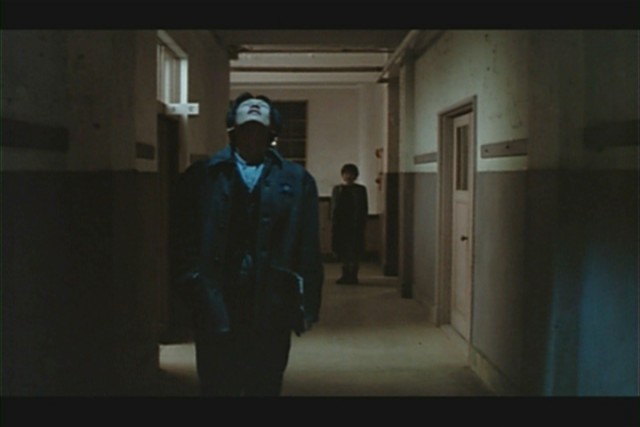
Guides interview the deceased in Hirokazu Kore-eda’s After Life
AFTER LIFE (WANDÂFURU RAIFU) (Hirokazu Kore-eda, 1998)
Japan Society
333 East 47th St. at First Ave.
Friday, August 12, $15, 7:00 www.japansociety.org
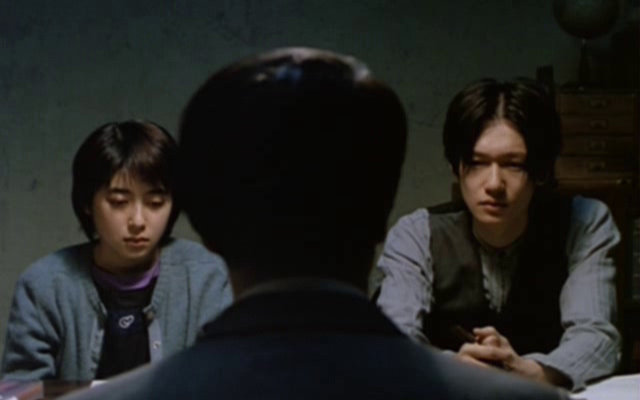
Japan Society’s Monthly Classics series continues on August 12 with Hirokazu Kore-eda’s second narrative feature, After Life, an eminently thoughtful film about two of his recurring themes: death and memory. Every Monday, the deceased arrive at a way station where they have three days to decide on a single memory they can bring with them into heaven. Once chosen, the memory is re-created on film, and the person goes on to the next step of their journey, to be replaced by a new batch of souls. The way station is staffed by guides, including Takashi Mochizuki (Arata), Shiori Satonaka (Erika Oda), and Satoru Kawashima (Susumu Terajima), whose job it is to interview the new arrivals and help them select a memory and then bring it to life on-screen. Some want to take with them an idyllic moment from childhood, others a remembrance of a lost love, but a few are either unable to or refuse to come up with one, which challenges the staff. Twenty-one-year-old Yūsuke Iseya declares, “I have no intention of choosing. None,” while seventy-year-old Ichiro Watanabe (Taketoshi Naito) is having difficulty deciding on the exact moment, reevaluating and reflecting on the life he led. As the week continues, the guides look back on their lives as well, sharing intimate details, one of which leads to an emotional finale.
After Life explores life, death, memory, heaven, and the art of filmmaking
Kore-eda, who previously examined memory loss in the documentary Without Memory and explored a family’s reaction to death in the brilliant Still Walking, interviewed some five hundred people about what memory they would take with them to heaven, and some of those nonprofessional actors are in the final cut of After Life, blurring the lines between fiction and reality. After Life is also very much about the art of filmmaking itself, as each memory is turned into a short movie created on a set and watched in a screening room. In fact, the film was inspired by Kore-eda’s memories of his grandfather’s battle with what would later be identified as Alzheimer’s disease; the director has also cited Ernst Lubitsch’s 1943 comedy, Heaven Can Wait, as an influence, and the Japanese title, Wandâfuru raifu, means “Wonderful Life,” evoking Frank Capra’s holiday classic. But Kore-eda never gets maudlin about life or death in the film, instead painting a memorable portrait of human existence and those simple moments that make it all worthwhile — and will have viewers contemplating which memory they would take with them when the time comes.