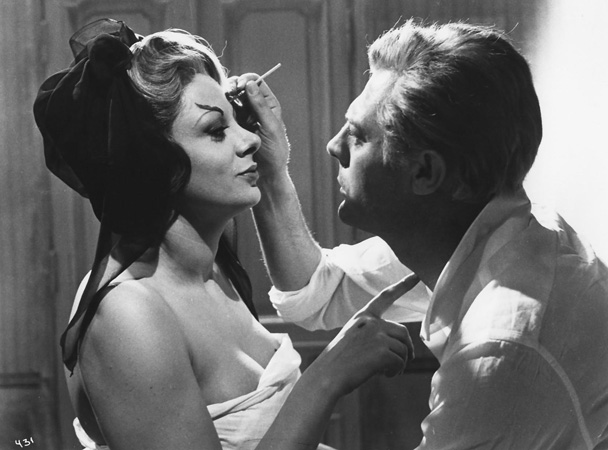
Guido Anselmi (Marcello Mastroianni) is in a bit of a personal and professional crisis in Fellini masterpiece “8½”
CABARET CINEMA: 8½ (Federico Fellini, 1963)
Rubin Museum of Art
150 West 17th St. at Seventh Ave.
Friday, October 19, free with $7 bar minimum, 9:30
212-620-5000
www.rmanyc.org
 “Your eminence, I am not happy,” Guido (Marcello Mastroianni) tells the cardinal (Tito Masini) halfway through Federico Fellini’s self-reflexive masterpiece 8½. “Why should you be happy?” the cardinal responds. “That is not your task in life. Who said we were put on this earth to be happy?” Well, film makes people happy, and it’s because of works such as 8½, which will be screening October 19 as part of the Rubin Museum Cabaret Cinema series “Happiness is . . .” and will be introduced by Mexican-born, New York-based cartoonist Felipe Galindo. Fellini’s Oscar-winning eighth-and-a-half movie is a sensational self-examination of film and fame, a hysterically funny, surreal story of a famous Italian auteur who finds his life and career in need of a major overhaul. Mastroianni is magnificent as Guido Anselmi, a man in a personal and professional crisis who has gone to a healing spa for some much-needed relaxation, but he doesn’t get any as he is continually harassed by producers, screenwriters, would-be actresses, and various other oddball hangers-on. He also has to deal both with his mistress, Carla (Sandra Milo), who is quite a handful, as well as his wife, Luisa (Anouk Aimée), who is losing patience with his lies. Trapped in a strange world of his own creation, Guido has dreams where he flies over claustrophobic traffic and makes out with his dead mother, and his next film involves a spaceship; it doesn’t take a psychiatrist to figure out the many inner demons that are haunting him. Marvelously shot by Gianni Di Venanzo in black-and-white, scored with a vast sense of humor by Nino Rota, and featuring some of the most amazing hats ever seen on film — costume designer Piero Gherardi won an Oscar for all the great dresses and chapeaux — 8½ is an endlessly fascinating and wildly entertaining exploration of the creative process and the bizarre world of filmmaking itself. And after seeing 8½, you’ll appreciate Woody Allen’s 1980 homage, Stardust Memories, a whole lot more. “Happiness is . . .” continues through December 28 with such other Allen favorites as Ingmar Bergman’s Cries and Whispers, Michael Curtiz’s Casablanca, and George Cukor’s Camille, held in conjunction with the larger Rubin Museum program “Happy Talk.”
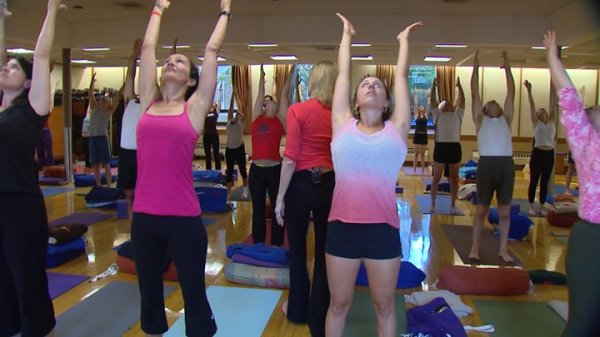
 Yoga has come a long way, baby, as shown in the award-winning documentary Yogawoman. Unfortunately, however, this eighty-four-minute look at the transition of the art and practice of yoga from a male-exclusive method of finding inner peace to a woman-dominated community is a self-congratulatory infomercial that basically preaches to the converted. Dryly narrated by yoga enthusiast Annette Bening, who sounds like she had something better to do, Yogawoman is a family affair, written and directed by Kate McIntyre Clere (A Hard Place, Gaining Ground) and her sister Saraswati Clere and produced and photographed by Kate’s husband, Michael McIntyre. The film portrays the yoga world — indeed, it’s an international affair, visiting Japan, Australia, India, Germany, Kenya, and the UK in addition to various cities in the US (primarily New York and San Francisco) — as a tight-knit collection of women who use yoga not only for physical exercise and easing the mind but to play a key role in the overall life cycle, having positive effects on menstruation, sexuality, pregnancy, eating habits, the aging process, and battling cancer. Among the parade of talking heads who speak while sitting in front of the same blue background are Seane Corn, Angela Farmer, Cyndi Lee, Tari Prinster, and Patricia Walden, superstars in the field who sing the praises of the ever-growing discipline, but it all comes off as New Agey and self-important. There’s no doubt that yoga is beneficial and empowering in so many ways, but Yogawoman sells it like it’s a magic elixir that will cure all of your — and this troubled world’s — ills. Yogawoman opens October 19 at the Angelika; the filmmakers and various women who appear in the movie will participate in Q&A sessions following the screenings at 7:00 on Friday and Saturday and 3:00 on Sunday.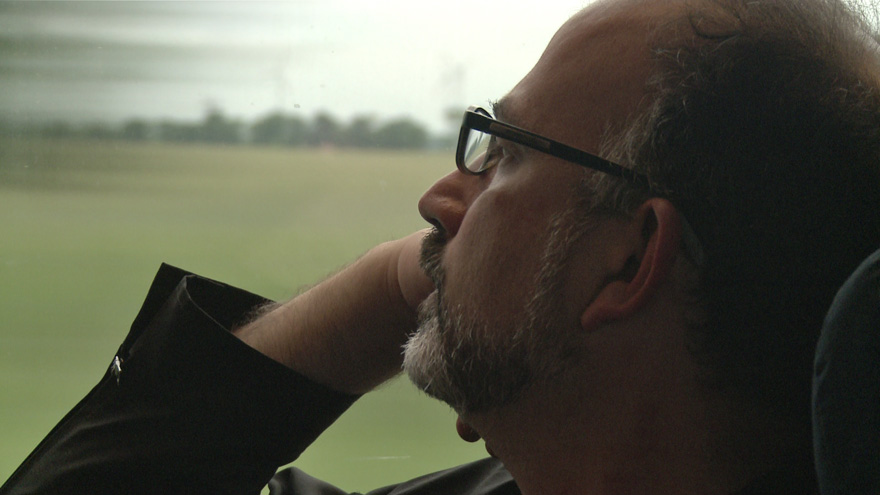
 After his grandmother’s death at the age of ninety-eight, filmmaker Arnon Goldfinger (The Komediant) brought a camera to her Tel Aviv apartment to document going through the things she left behind and delve into Gerda Tuchler’s long life, which included growing up in Germany prior to WWII and escaping to Palestine in the 1930s. While opening drawers and closets, Goldfinger discovers a stack of Nazi propaganda magazines, soon learning a secret about Gerda and her parents that shocks him and his family. And in investigating further, he finds out yet more about this fascinating yet troubling relationship that has direct links to the highest levels of the S.S., coming upon intriguing details that he must decide whether to reveal or keep buried, well aware how they could affect other people’s lives and memories. The Flat is a compelling research procedural that Goldfinger spent five years putting together, with no intention of stopping, despite the potential hurt it could bring to his friends and family, particularly his mother. But it is not cruelty or revenge so much as a thirst for knowledge and the truth that drives him, no matter the cost, as he explores his Jewish grandparents’ questionable ties to their German roots. Goldfinger was named Best Director of a Documentary at the Jerusalem Film Festival for The Flat, with the jury noting, “This is a beautifully composed film about uncomfortable truths and the challenge of confronting them. Mr. Goldfinger undertakes expert research and leads us through his findings in a way that is not only gentle and sensitive, but also compelling and creative.” The Flat, which was shown at the 2012 Tribeca Film Festival and opens theatrically on October 19, is indeed all of those things and more. Goldfinger will be at the IFC Center to discuss the film at the 7:30 and 9:45 screenings on Friday and Saturday night.
 All work and no play makes Jack a not-so-quite dull boy in Stanley Kubrick’s classic horror story, based on the Stephen King novel. One of the all-time-great frightfests, The Shining is a truly scary movie about a writer named Jack Torrance (Jack Nicholson at his overacting best) who has agreed to become the caretaker of the old Overlook Hotel in Colorado during the snowy winter when the enormous mountain resort closes down for the season. He is joined by his perpetually nervous wife, Wendy (Shelley Duvall), and their young son, Danny (Danny Lloyd), who seems to have brought along his invisible friend, Tony, who speaks through Danny’s finger. Between taking care of the Overlook and working on his novel, Jack finds a whole bunch of other folks to hang out with, people who have populated the place during the ritzy establishment’s golden age, including a strange woman in room 237. Kubrick plays with horror conventions as he seeks to scare the crap out of the audience, something he accomplishes time and time again as Jack grows more disturbed, Wendy’s shrieks become more and more ear piercing and annoying, and Danny’s visions get more and more bloody. No matter how many times you’ve seen it, it still gets you, even when you know exactly what’s lurking around that corner. Only those who went to the film during its opening weekend, as we did, got to see the two-minute finale that Kubrick cut out immediately thereafter, which involved the iconoclastic director riding his bicycle to various theaters, armed with a pair of scissors. The Shining is screening on Friday and Saturday at midnight as part of Landmark Sunshine Cinema’s Sunshine at Midnight series, which continues October 26-27 with Sam Raimi’s Evil Dead 2: Dead by Dawn and November 2-3 with the underground cult classic The Miami Connection.

 Nothing is off limits for South Park dudes Trey Parker and Matt Stone in this marionette musical actioner that mixes Top Gun, Mission: Impossible, and The Matrix with that old classic television puppet show Thunderbirds. Kim Jong Il is determined to unleash his weapons of mass destruction on an unsuspecting world, and it is up to Team America and its newest member, actor Gary Johnston, formerly of the hit musical Lease, to stop the North Korean leader’s heinous plan. But Team America is a reckless bunch that has a tendency to destroy major cities and landmarks (the Eiffel Tower, the Sphinx) as it attempts to take out terrorists. Meanwhile, love threatens to complicate the success of their mission. Parker and Stone skewer international politics, the military, celebrity, and the media in this very dirty, very funny flick; among their victims are Alec Baldwin, Susan Sarandon, Sean Penn, Peter Jennings, Hans Blix, George Clooney, and, mercilessly, Matt Damon and Ben Affleck. There’s lots of blood and gore, a very hot puppet sex scene, and the best description ever about the three kinds of people in the world. Although it often misses its target or goes way too far — it could have been a classic like South Park: Bigger Longer & Uncut — it’s still a good way to spend a late night out at the movies. Team America: World Police is screening in 35mm at 12:15 am on Friday and Saturday night as part of the IFC Center’s Waverly Midnights series, which continues October 26-27 with Paul Verhoeven’s Starship Troopers and November 2-3 with Todd Solondz’s Election.